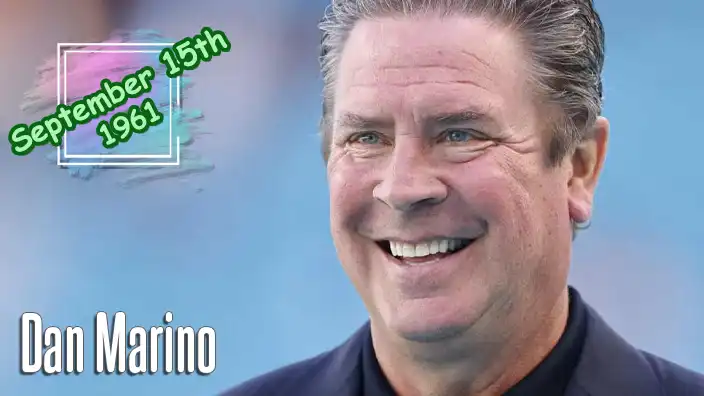
September 15, 1961, in Pittsburgh, Pennsylvania
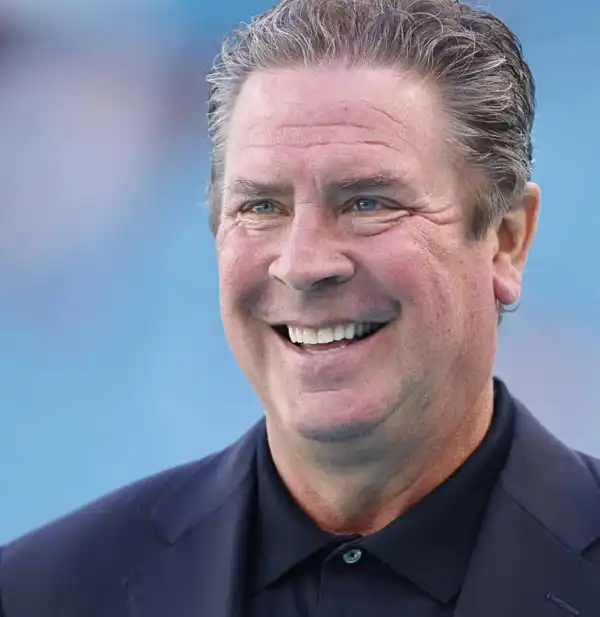
Daniel Constantine Marino Jr. was born on September 15, 1961, in Pittsburgh, Pennsylvania. Growing up in the city's South Oakland neighborhood, Marino was surrounded by the sort of hard-edged sporting culture for which Pittsburgh has long been famous. He attended Central Catholic High School, where his athletic ability became obvious enough that professional baseball was a genuine possibility. The Kansas City Royals selected him in the fourth round of the 1979 Major League Baseball draft, but Marino chose college football instead. Considering what happened next, the Miami Dolphins can probably be forgiven for being grateful that he preferred throwing footballs to chasing curveballs.
Marino stayed close to home and attended the University of Pittsburgh, becoming the Panthers' starting quarterback and one of the country's most prominent college players. One of the defining moments of his college career came in the 1982 Sugar Bowl against Georgia. With Pittsburgh trailing late in the game, Marino threw a fourth-down touchdown pass to tight end John Brown with less than a minute remaining, giving Pitt a dramatic 24–20 victory. It was precisely the sort of moment that would become familiar during his professional career: Marino had the football, time was disappearing, and the defense was about to have a very unpleasant evening.
Yet Marino's arrival in the NFL came surprisingly late in the first round of the celebrated 1983 NFL Draft. That quarterback class would become one of the most famous in league history. John Elway went first overall, while Todd Blackledge, Jim Kelly, Tony Eason and Ken O'Brien were also selected before Marino. By the time the Miami Dolphins were on the clock with the 27th overall selection, Marino was still sitting there.
Miami selected him.
Sometimes history really does hand you a bargain.
The Dolphins were coached by Don Shula, already one of professional football's great coaches, and Marino did not spend very long waiting for his opportunity. He took over the starting job during his rookie season and immediately looked remarkably comfortable playing professional football. He finished his first NFL season with 2,210 passing yards and 20 touchdown passes despite appearing in only 11 games, led the AFC with a 96.0 passer rating and helped Miami win the AFC East. He was also selected to the Pro Bowl.
Then came 1984.
Calling Marino's second NFL season "good" would be rather like calling the Atlantic Ocean "a bit damp." Professional football had simply not seen a passing season like it.
Marino threw for 5,084 yards and 48 touchdowns. Both were NFL single-season records, and the touchdown figure demolished the previous mark of 36. He became the first quarterback in NFL history to pass for 5,000 yards in a season, accomplishing it at a time when defensive backs were allowed considerably more physical freedom than they are today and quarterbacks did not enjoy quite the same degree of protection.
The numbers are even more extraordinary when viewed in the context of their era. The modern NFL is built around passing. Marino was producing modern-looking statistics when the league still featured offenses in which handing the football to a running back repeatedly was considered perfectly reasonable entertainment.
Miami went 14–2 during the regular season. Marino was named the NFL's Most Valuable Player and led the Dolphins through the playoffs to the AFC Championship Game against the Pittsburgh Steelers. Returning to his hometown, Marino threw for 421 yards and four touchdowns as Miami defeated Pittsburgh 45–28.
That victory sent Marino to Super Bowl XIX against Joe Montana and the San Francisco 49ers.
It would become one of the great peculiarities of Marino's career. He reached the Super Bowl in only his second season, seemingly establishing himself as a quarterback who would surely return several times. Instead, it proved to be his only appearance. San Francisco defeated Miami 38–16, with Montana and the 49ers producing a superb performance.
Marino never returned to the Super Bowl.
That fact inevitably became attached to discussions of his career, sometimes unfairly. Quarterbacks receive an enormous amount of credit when teams win championships and an equally enormous amount of blame when they do not, but football stubbornly insists upon putting 11 players on the field at once. Marino could throw the ball; unfortunately, league rules prevented him from simultaneously blocking, catching it, tackling the opposition and kicking field goals.
What followed his extraordinary 1984 season was not a brief burst of brilliance but a remarkably long career at the center of the Dolphins franchise. Marino spent all 17 of his NFL seasons with Miami, from 1983 through 1999. In an era when star players increasingly moved between teams, the sight of Marino wearing anything other than a Dolphins uniform became almost impossible to imagine.
His greatest weapon was not simply arm strength. Marino possessed an exceptionally quick release, outstanding anticipation and an ability to read defenses that allowed him to get rid of the football before pass rushers could reach him. He was hardly known for scrambling around the field. Nobody watching Dan Marino thought they were about to witness an Olympic sprint. Instead, he moved within the pocket, identified his target and delivered the ball with remarkable speed.
The statistics accumulated accordingly.
Marino passed for more than 4,000 yards in six seasons and exceeded 3,000 yards 13 times. He led the NFL in passing yards five times. He produced 63 games with at least 300 passing yards and 13 games with at least 400. He was selected to nine Pro Bowls and received multiple All-Pro honors.
By the time his career ended, Marino had completed 4,967 of 8,358 passes for 61,361 yards and 420 touchdowns. At retirement, he held the NFL career records for completions, attempts, passing yards and touchdown passes. Many of those records have since been surpassed as NFL rules and offensive strategies increasingly favored passing, but Marino helped demonstrate what a pass-heavy professional offense could accomplish long before it became standard practice.
There was also something wonderfully theatrical about Marino when the Dolphins were behind late in a game. He engineered numerous fourth-quarter comebacks and game-winning drives, earning a reputation for being particularly dangerous when opponents thought they had Miami safely beaten.
Perhaps the most famous example came against the New York Jets in 1994. Late in the game, Marino hurried Miami toward the goal line while appearing ready to stop the clock by spiking the football. Instead, he shouted that he was going to spike it, took the snap and threw a touchdown pass to Mark Ingram while the Jets defense reacted to the expected spike. The play became known as the "Clock Play" and remains one of the most famous pieces of deception in NFL history.
It also provided a useful lesson for defensive players everywhere: when Dan Marino announced exactly what he intended to do, perhaps further investigation was advisable.
Marino's career was not without physical setbacks. In 1993, he ruptured his Achilles tendon, an injury that could easily have ended the career of a veteran quarterback. He returned the following season and immediately demonstrated that his passing ability remained intact. In Miami's opening game of the 1994 season against New England, Marino threw for 473 yards and five touchdowns in a 39–35 victory.
His final season came in 1999. The ending was not particularly romantic. Miami's postseason run concluded with a brutal 62–7 loss to the Jacksonville Jaguars in the divisional playoffs. Marino subsequently announced his retirement, closing one of the most remarkable quarterback careers in NFL history.
The Dolphins made certain there would never be any confusion about what Marino meant to the franchise. His familiar No. 13 was retired by Miami in 2000, and he was inducted into the Dolphins Honor Roll. In 2005, his first year of eligibility, Marino was elected to the Pro Football Hall of Fame.
He was later selected as one of the quarterbacks on the NFL 100 All-Time Team, placing him among the players chosen to represent the greatest performers from the league's first century.
Marino's connection to Miami did not disappear when he stopped playing. In 2014, the Dolphins named him a special adviser to the organization, allowing one of the most recognizable figures in franchise history to remain involved with the team he represented throughout his professional career.
Football, however, is only part of the Dan Marino story.
In 1992, Dan and his wife, Claire, established the Dan Marino Foundation, inspired by their experiences after their son Michael was diagnosed with autism. The organization has worked to support people with autism and other developmental disabilities, with programs involving education, employment, independence and community participation. Over the decades, the foundation has become a major part of Marino's work away from football.
Then there is Dan Marino the actor.
Well, perhaps "Dan Marino playing Dan Marino" would be more accurate.
His most famous movie appearance came in the 1994 Jim Carrey comedy Ace Ventura: Pet Detective. Marino becomes central to the increasingly ridiculous plot when he is kidnapped, allowing a movie about a missing Miami Dolphins mascot to escalate into a full-scale investigation involving Marino, Ray Finkle, laces, dolphins and considerably more shouting than usually occurs during legitimate police work.
The film turned Marino into something unusual: an athlete whose pop-culture identity extended well beyond people who actually watched football.
He subsequently appeared as himself in several other productions, including Holy Man, Little Nicky and Bad Boys II. He voiced a character in The Magic School Bus, appeared in an episode of The Simpsons, and turned up in the Hootie & the Blowfish music video for "Only Wanna Be with You."
His appearance in Little Nicky even provided a particularly good joke at his own expense. Marino appears in Hell asking Satan for a Super Bowl championship, a wonderfully self-aware reference to the one major achievement missing from his football résumé.
That willingness to laugh at himself probably helped Marino remain such a popular figure long after his final NFL pass. There are legendary athletes whose public image becomes almost solemn after retirement, carefully protected as though every appearance requires dramatic music and a bronze statue. Marino has generally seemed quite comfortable acknowledging that football is enormously important while also recognizing that occasionally it is perfectly acceptable to let Jim Carrey make a joke about you.
For Miami Dolphins supporters, however, Dan Marino remains much more than a famous former quarterback.
Generations of quarterbacks have followed him in Miami, but No. 13 remains the standard against which Dolphins passers inevitably find themselves compared. Marino played the position with aggression, confidence and extraordinary speed of thought. He helped push professional football toward the passing game that eventually came to dominate the sport, putting up statistics in the 1980s that would have looked ambitious even decades later.
The missing Super Bowl championship will always appear somewhere in discussions of his career because championships matter. But reducing Marino's career to the absence of a ring misses what made him exceptional. He did not merely accumulate statistics. He altered expectations of what an NFL quarterback and passing offense could do.
For 17 seasons, Miami knew exactly who its quarterback was.
Number 13 walked to the line, surveyed the defense, took the snap and released the football before somebody on the other side had finished thinking, Hang on, where did it go?
Usually, the answer was somewhere considerably farther downfield.