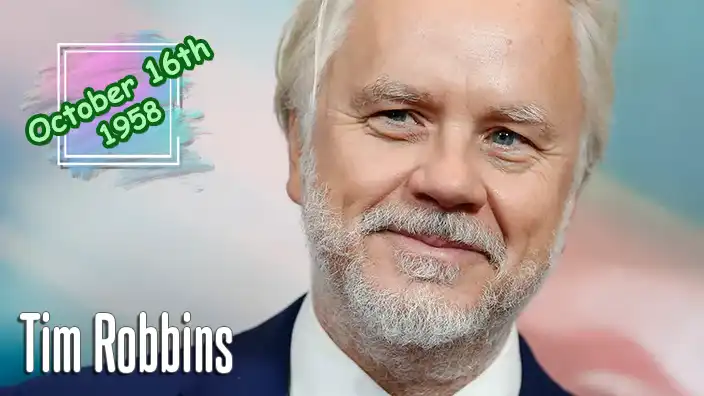
October 16, 1958, in West Covina, California
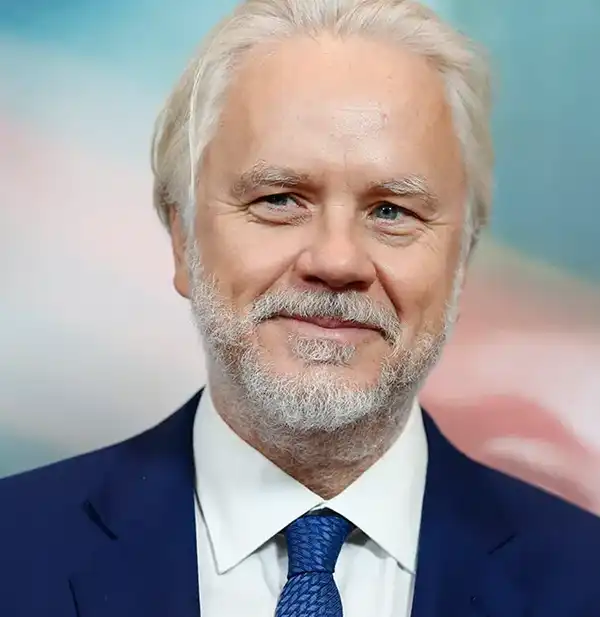
Timothy Francis Robbins was born on October 16, 1958, in West Covina, California, and grew up in New York City's Greenwich Village. His father, Gilbert Robbins, was a folk musician and member of the Highwaymen, while his mother, Mary Cecelia Bledsoe, was an actress. Growing up in a household surrounded by music, theater, and political discussion helped shape Robbins' creative interests and his later willingness to tackle controversial subjects. He began acting while attending Stuyvesant High School and subsequently studied drama at the University of California, Los Angeles, graduating in 1981. His early experiences in experimental theater encouraged him to develop a performance style that combined emotional realism with an appreciation for satire and unconventional storytelling.
After completing his education, Robbins became involved in Los Angeles theater and helped establish the Actors' Gang, an experimental theater company founded in 1981. The company developed a reputation for energetic performances, politically engaged productions, and inventive interpretations of classical and contemporary works. Robbins served as artistic director and remained closely associated with the organization throughout his career. The Actors' Gang provided an important creative outlet beyond commercial film and television, allowing Robbins to explore challenging material and support theatrical education. His dedication to the stage also demonstrated that, despite his later Hollywood success, he regarded acting as a craft rather than simply a route to celebrity.
Robbins began appearing in television and film during the early 1980s, gradually building a reputation through supporting roles. His early film credits included No Small Affair (1984), The Sure Thing (1985), and Top Gun (1986), in which he portrayed Lieutenant Sam Wells, known by the call sign Merlin. Although these appearances did not immediately establish him as a leading man, they gave him valuable experience in mainstream Hollywood productions. His breakthrough arrived with the baseball comedy Bull Durham (1988), directed by Ron Shelton. Robbins played Ebby Calvin "Nuke" LaLoosh, a talented but wildly unpredictable young pitcher whose career is guided by a veteran catcher portrayed by Kevin Costner. The film also starred Susan Sarandon and became a critical and commercial success. Robbins' comic performance captured the mixture of athletic confidence and youthful foolishness that made his character both frustrating and endearing.
Following Bull Durham, Robbins continued to develop an unusually varied film career. He appeared in Jacob's Ladder (1990), a psychological horror thriller directed by Adrian Lyne, portraying a Vietnam War veteran experiencing disturbing visions and an increasingly uncertain grasp of reality. The film required Robbins to convey fear, confusion, and emotional vulnerability, demonstrating his ability to handle demanding dramatic material. He also appeared in Robert Altman's The Player (1992), a satirical examination of the Hollywood film industry. As Griffin Mill, a studio executive whose professional anxieties lead him into dangerous territory, Robbins delivered a performance that balanced dark comedy with moral ambiguity. His work earned him the Golden Globe Award for Best Actor in a Motion Picture – Musical or Comedy and the Best Actor award at the Cannes Film Festival.
In 1994, Tim Robbins delivered what became his most widely recognized screen performance in The Shawshank Redemption, directed by Frank Darabont and adapted from a Stephen King novella. Robbins portrayed Andy Dufresne, a banker convicted of murdering his wife and her lover and sentenced to life imprisonment at Shawshank State Penitentiary. The film follows Andy's experiences behind bars, his friendship with fellow prisoner Ellis "Red" Redding, played by Morgan Freeman, and his determination to preserve hope and dignity despite years of hardship. Robbins brought a quiet intelligence and emotional restraint to the character, allowing Andy's resilience to emerge through small gestures and carefully controlled performances. Although the film achieved only modest box-office success during its original theatrical release, it later became one of the most celebrated films in cinema history through home video, television broadcasts, and enduring audience appreciation.
The success of The Shawshank Redemption established Robbins as a performer particularly suited to complex characters confronting moral dilemmas and oppressive institutions. His portrayal of Andy Dufresne remains closely associated with the film's themes of friendship, perseverance, injustice, and redemption. The movie received seven Academy Award nominations, including Best Picture, although Robbins himself was not nominated for his performance. Its subsequent popularity has made it a frequent presence on lists of the greatest films ever made. For many viewers, Andy's carefully planned escape remains one of cinema's most satisfying moments, although it probably did little to improve the reputation of prison maintenance departments.
Robbins also demonstrated considerable talent behind the camera. He made his feature-film directing debut with Bob Roberts (1992), a political mockumentary in which he starred as a wealthy conservative folk singer running for the United States Senate. The film satirized political campaigning, media manipulation, and the commercialization of public life, establishing Robbins as a filmmaker interested in examining the relationship between power and public perception. His second feature as director, Dead Man Walking (1995), explored the death penalty through the experiences of a nun, portrayed by Susan Sarandon, who becomes a spiritual adviser to a convicted murderer played by Sean Penn. The film received widespread critical acclaim, earning Robbins an Academy Award nomination for Best Director and Sarandon the Academy Award for Best Actress.
Throughout the late 1990s and early 2000s, Robbins continued appearing in films that balanced mainstream entertainment with serious dramatic subjects. His credits included Arlington Road (1999), a suspense thriller involving domestic terrorism and paranoia, and High Fidelity (2000), in which he delivered a memorable comic performance as Ian Raymond, an irritatingly self-satisfied romantic rival. He also appeared in Mission to Mars (2000), directed by Brian De Palma, and Antitrust (2001), a technology thriller exploring corporate power and ethical responsibility. These varied projects allowed Robbins to move between psychological suspense, science fiction, comedy, and social commentary without becoming confined to a single screen identity.
One of Robbins' greatest critical achievements came with Clint Eastwood's Mystic River (2003), an adaptation of Dennis Lehane's crime novel. Robbins portrayed Dave Boyle, a deeply troubled man whose childhood trauma continues to affect his adult life. The film also starred Sean Penn and Kevin Bacon and explored grief, suspicion, violence, and the long-lasting consequences of personal tragedy. Robbins delivered an emotionally devastating performance, capturing the vulnerability and psychological complexity of a man struggling with memories he cannot escape. His work earned him the Academy Award for Best Supporting Actor, a Golden Globe Award, and a Screen Actors Guild Award. The Oscar recognized a performance that demonstrated his ability to communicate profound emotional distress without relying on excessive dialogue or theatrical gestures.
Robbins later appeared in Steven Spielberg's War of the Worlds (2005), portraying Harlan Ogilvy, a deeply unsettled survivor encountered during an alien invasion. His character introduced a disturbing psychological dimension to the science-fiction thriller, illustrating how fear and desperation can transform ordinary people under extraordinary circumstances. He subsequently appeared in The Lucky Ones (2008), Green Lantern (2011), and Thanks for Sharing (2012). Robbins also continued directing, writing, and producing theatrical productions, maintaining his commitment to socially engaged storytelling and independent creative expression.
Television provided Robbins with further opportunities to explore complicated characters and ambitious narratives. He starred in the HBO political comedy The Brink (2015), portraying Walter Larson, the United States Secretary of State, in a satirical series about an international crisis. He later appeared in HBO's Here and Now (2018), created by Alan Ball, playing the patriarch of a multicultural family confronting personal and ideological tensions. Robbins also appeared in the second season of the anthology series Castle Rock (2019), inspired by the fictional universe of Stephen King. His portrayal of Reginald "Pop" Merrill connected him once again with the storytelling traditions that had helped make The Shawshank Redemption such an enduring success.
In 2023, Robbins joined the cast of the Apple TV+ science-fiction drama Silo, based on Hugh Howey's novels. He portrayed Bernard Holland, an influential authority figure within a vast underground community whose inhabitants live under strict regulations and possess limited knowledge of the outside world. The series explores secrecy, institutional control, survival, and the consequences of questioning established authority. Robbins' performance brought a mixture of intelligence, calculation, and restrained menace to the role, reinforcing his reputation for portraying characters whose outward composure conceals complicated motivations.
Outside acting and directing, Tim Robbins has remained closely involved with music and theatrical activism. In 2010, he released the album Tim Robbins & The Rogues Gallery Band, drawing on his longstanding interest in folk music and storytelling. His musical background reflected the influence of his father and the artistic environment in which he grew up. Robbins has also supported theater programs for young people and incarcerated individuals through the Actors' Gang, using performance and creative education to encourage communication, confidence, and personal development. These activities reflect his belief that theater can serve a meaningful social purpose beyond conventional entertainment.
Robbins' personal life has occasionally attracted public attention, particularly his long relationship with actress Susan Sarandon. The couple met while filming Bull Durham and became one of Hollywood's most recognizable creative partnerships. They had two sons together, Jack and Miles, before separating in 2009. Robbins has generally preferred to focus public discussion on his professional work, artistic interests, and social causes rather than the details of his private relationships. His long association with Sarandon nevertheless remains an important chapter in his personal and professional history, particularly given their collaboration on Dead Man Walking.
Tim Robbins has also been an outspoken participant in political and social debates, frequently expressing his views on civil liberties, freedom of expression, war, and the responsibilities of government. His willingness to address controversial issues has sometimes attracted criticism, but it has also been consistent with the themes explored in many of his films and theatrical productions. Whether portraying a corrupt studio executive, a wrongly convicted prisoner, a psychologically damaged survivor, or an influential political figure, Robbins has repeatedly gravitated toward stories examining power, morality, and individual conscience.
Across his career, Tim Robbins has demonstrated an uncommon ability to combine Hollywood success with independent artistic ambition. His achievements include an Academy Award, Golden Globe Awards, major international film recognition, and a substantial body of work as a director and theatrical leader. Yet his enduring popularity rests just as much on the characters he has brought to life, particularly Andy Dufresne, whose determination to find freedom continues to resonate with audiences around the world. From baseball diamonds and Hollywood boardrooms to prison cells and underground science-fiction communities, Robbins has built a career defined by versatility, intelligence, and a willingness to challenge expectations. And while many actors would be delighted to have one truly unforgettable role, Robbins has managed to collect several, without once having to crawl through a sewer in real life.