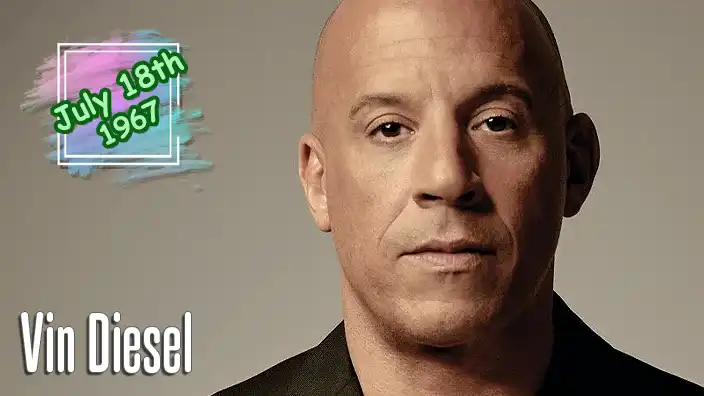
July 18, 1967, in Alameda County, California
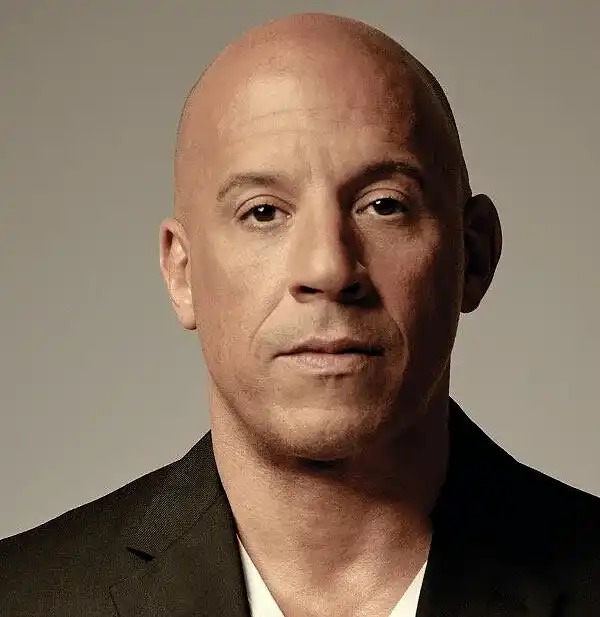
Vin Diesel is one of the most recognizable action stars in modern cinema. Best known as Dominic Toretto in the Fast & Furious films, he has built a career around muscular heroes, spectacular stunts, gravelly dialogue, and an almost religious devotion to the word “family.” He is also a writer, director, producer, entrepreneur, and voice actor whose career began far from the enormous franchises that eventually made him internationally famous.
He was born Mark Sinclair in Alameda County, California, and was raised in New York City. He and his fraternal twin brother, Paul, were brought up by their mother, Delora Sherleen Vincent, and their adoptive father, Irving H. Vincent, who worked as an acting instructor and theater manager.
Diesel has described himself as being of mixed heritage, although he did not know his biological father. Growing up in a diverse New York household and frequently being difficult for casting directors to categorize would later influence his earliest filmmaking work.
His acting career began unexpectedly when he was about seven years old. Diesel and several friends entered a New York theater intending to vandalize it. They were caught by the theater’s artistic director, who offered them parts in a production rather than calling the police. It may have been one of the few occasions when breaking into a building resulted in a legitimate acting career instead of a stern conversation at the police station.
Diesel continued appearing in theater productions throughout his childhood and teenage years. He performed at the Theater for the New City and gradually developed an interest not only in acting but also in writing and producing.
While working as a nightclub bouncer in New York, he adopted the name Vin Diesel. “Vin” was derived from his adoptive surname, Vincent, while “Diesel” reportedly came from friends who said he seemed to possess a constant supply of energy. The name was certainly better suited to an action star than Mark Sinclair, although it also sounds like someone who might personally guarantee an automobile warranty.
He attended Hunter College, where he studied English and creative writing. His studies encouraged him to write screenplays and consider making his own films rather than waiting for Hollywood to discover him.
Diesel moved to Los Angeles in hopes of establishing an acting career, but early success proved elusive. He reportedly struggled to obtain substantial roles and supported himself with other work before returning to New York.
Rather than continue waiting for the perfect opportunity, Diesel decided to create one. He wrote, directed, produced, and starred in the short film Multi-Facial, which was released in 1995. The semi-autobiographical story followed a multiracial actor encountering stereotypes and confusion during a series of auditions.
Made on a limited budget, Multi-Facial was screened at the Cannes Film Festival and attracted attention for its honest examination of identity and the entertainment industry. It demonstrated that Diesel possessed ambitions extending well beyond standing in front of a camera and looking intimidating.
He followed the short with the independent feature Strays in 1997. Once again serving as writer, director, producer, and lead actor, Diesel portrayed a young man attempting to change his direction in life after falling in love. The film was screened at the Sundance Film Festival.
Director Steven Spielberg reportedly noticed Diesel after seeing Multi-Facial and created a role for him in the 1998 war drama Saving Private Ryan. Diesel played Private Adrian Caparzo, a soldier in the unit sent to locate the missing Private Ryan.
Although his role was relatively small, appearing in a major Spielberg production placed Diesel before an enormous international audience. The film received widespread acclaim and became one of the defining motion pictures about World War II.
Diesel’s distinctive voice helped him secure another memorable role in 1999, when he voiced the title character in the animated film The Iron Giant. Although the enormous robot says relatively little, Diesel gave the character warmth, innocence, and emotional depth.
The Iron Giant performed modestly during its original theatrical release but later developed a devoted following. Diesel’s performance showed that his deep voice could convey more than physical toughness, even when attached to a towering metal visitor from outer space.
In 2000, Diesel appeared in the financial drama Boiler Room and achieved a major breakthrough as Richard B. Riddick in the science-fiction thriller Pitch Black. Riddick was a dangerous prisoner capable of seeing in darkness, making Diesel’s commanding physical presence and distinctive delivery particularly effective.
The character developed a strong following and became the center of the Chronicles of Riddick franchise. Diesel later returned for The Chronicles of Riddick in 2004 and Riddick in 2013, while also lending his voice and likeness to related animated and video-game projects.
His career changed dramatically with the release of The Fast and the Furious in 2001. Diesel played Dominic Toretto, a Los Angeles street racer, mechanic, and suspected hijacker whose life revolves around fast cars and the fiercely loyal group he considers family.
The original film paired Diesel with Paul Walker, who played undercover police officer Brian O’Conner. Their chemistry became central to the film’s success and eventually to the entire franchise.
Diesel did not appear in 2 Fast 2 Furious, released in 2003, and returned only briefly at the end of The Fast and the Furious: Tokyo Drift in 2006. His cameo helped reconnect the developing series to its original characters.
He returned fully in Fast & Furious in 2009, reuniting with Walker, Michelle Rodriguez, and Jordana Brewster. The film revived the original cast and began transforming the series from stories about illegal street racing into increasingly elaborate international action adventures.
Later installments included Fast Five, Fast & Furious 6, Furious 7, The Fate of the Furious, F9, and Fast X. Diesel also became one of the franchise’s producers, giving him a significant role in shaping its characters and direction.
The series has grown into a multibillion-dollar global property encompassing feature films, short films, television animation, attractions, merchandise, and spin-offs. Diesel’s Dominic Toretto remains its central figure, recognizable by his sleeveless shirts, Dodge Charger, measured speeches, and unwavering belief that nearly every crisis can be resolved by gathering everyone around a large table.
The 2013 death of Paul Walker had a profound effect on Diesel and the entire production. Walker died while Furious 7 was still being filmed, forcing the filmmakers to reconsider how the story could be completed while respecting both the actor and his character.
Walker’s brothers, Caleb and Cody, assisted in completing certain scenes, while visual effects and previously filmed material were also used. The ending of Furious 7, in which Dominic and Brian travel separate roads, became an emotional farewell to Walker.
Diesel has frequently spoken about the close friendship he shared with Walker and refers to him as his brother. He named his youngest daughter Pauline in Walker’s honor, maintaining a close relationship with Walker’s daughter, Meadow.
Outside the Fast & Furious series, Diesel established another action franchise through the 2002 film XXX. He played Xander Cage, an extreme-sports athlete recruited by the government for a dangerous undercover mission.
Although he did not appear in the first sequel, Diesel returned in XXX: Return of Xander Cage in 2017. The movie assembled an international cast and leaned heavily into the oversized action for which Diesel had become known.
He demonstrated a lighter side in the 2005 comedy The Pacifier, playing a Navy SEAL assigned to protect a family of children. The role placed his hardened action persona in a suburban household, where dangerous missions were replaced by diapers, school problems, and the terrifying prospect of supervising children.
Diesel also earned praise for playing real-life mobster Jackie DiNorscio in Sidney Lumet’s 2006 courtroom drama Find Me Guilty. The performance allowed him to depart from the polished action-hero image and display his dramatic and comedic range.
Other film appearances have included Babylon A.D., The Last Witch Hunter, Bloodshot, and Ang Lee’s Billy Lynn’s Long Halftime Walk. His projects frequently combine science fiction, fantasy, action, or comic-book influences.
In 2014, Diesel joined the Marvel Cinematic Universe as the voice of Groot in Guardians of the Galaxy. Groot is a tree-like extraterrestrial whose spoken vocabulary is generally limited to variations of “I am Groot.”
Despite the restricted dialogue, Diesel recorded the phrase repeatedly to express different emotions and meanings. He also recorded versions in several languages for international releases, an impressive commitment to a character who could probably fit his entire script on a refrigerator magnet.
Diesel returned as Groot in several Marvel productions, including the Guardians of the Galaxy sequels, Avengers: Infinity War, Avengers: Endgame, Thor: Love and Thunder, The Guardians of the Galaxy Holiday Special, and the animated I Am Groot shorts. Marvel’s official character materials identify Groot as a member of the Guardians whose apparent three-word vocabulary carries far more meaning than outsiders realize.
His voice performance as Groot followed his earlier success in The Iron Giant, reinforcing his unusual ability to create memorable characters with minimal dialogue. Few performers have made such an impact while repeatedly delivering approximately four words, depending on whether “We are Groot” is included in the accounting.
Diesel founded One Race Films, the production company involved with many of his projects, particularly the Fast & Furious, XXX, and Riddick franchises. He has also been involved in video-game development through Tigon Studios.
His interest in interactive entertainment produced games connected to the Riddick universe, including The Chronicles of Riddick: Escape from Butcher Bay. The game was well received and expanded the character’s story beyond the films.
In August 2013, Diesel received a star on the Hollywood Walk of Fame in recognition of his motion-picture career. The Hollywood Chamber of Commerce described him as one of the world’s most popular action stars.
Behind his imposing screen image, Diesel is known for maintaining a relatively private family life. He and his longtime partner, Mexican model Paloma Jiménez, have three children.
His public image has become closely associated with loyalty, friendship, and chosen family, themes that extend beyond his most famous films. While the Fast & Furious franchise sometimes handles the subject with the subtlety of a car crashing through a skyscraper, audiences continue responding to its emphasis on belonging and devotion.
Diesel’s success also reflects his determination to create opportunities when conventional Hollywood casting failed to provide them. His early independent films demonstrated initiative, while his later producing work allowed him to exercise greater control over the franchises that defined his career.
From New York theater stages and nightclub doors to intergalactic adventures and impossible car chases, Vin Diesel has followed an unusual route to international fame. He built his career by combining physical presence with business ambition, a recognizable voice, and an understanding of the loyal audiences who return to his films.
He may always be most closely associated with Dominic Toretto, but Diesel’s career encompasses independent filmmaking, drama, comedy, animation, science fiction, video games, and producing. That is quite a journey for someone whose first great career opportunity reportedly began when he entered a theater for entirely the wrong reason.