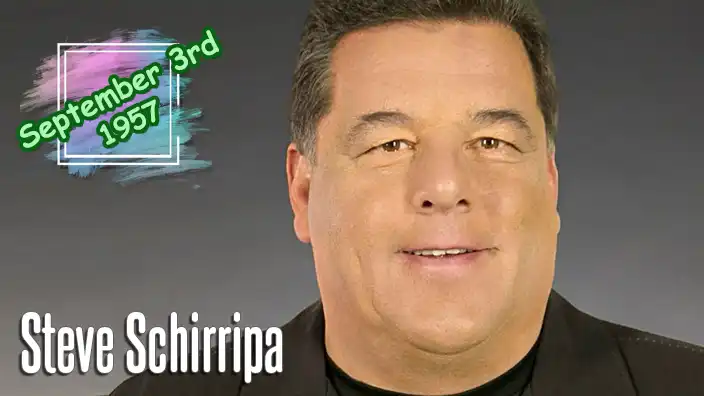
September 3, 1957, in Brooklyn, New York
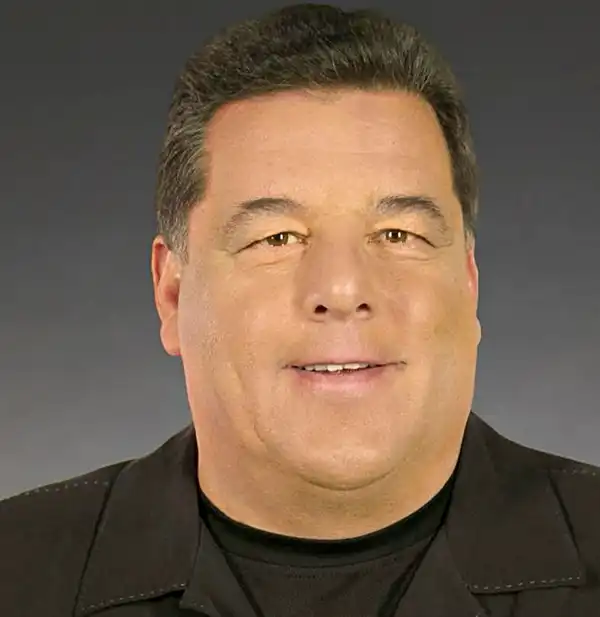
Steve Schirripa was born Steven Ralph Schirripa on September 3 in Bensonhurst, Brooklyn, New York, and grew up in a working-class family with four siblings. His father, Ralph, was Italian-American, with family roots in Calabria, while his mother, Lorraine, was of Jewish ancestry. Schirripa has spoken about both sides of that heritage, although he was raised Catholic. He attended Lafayette High School and later graduated from Brooklyn College.
There is a curious disagreement over Schirripa's birth year. IMDb lists September 3, 1958, while a number of other biographical sources, including Rotten Tomatoes and TV Insider, give September 3, 1957. September 3, however, is consistently reported as his birthday, allowing birthday celebrants to proceed without requiring a congressional inquiry into the missing year.
Schirripa did not follow the traditional path of a child actor or drama-school graduate dreaming of Hollywood from the age of six. Instead, he moved to Las Vegas in 1980, where he worked in several jobs before becoming involved in the city's entertainment business. Eventually he became entertainment director at the Riviera Hotel and Casino, booking performers and working around professional entertainers night after night.
Among the acts he encountered during his Las Vegas career were comedians, singers and established stars. It was an unusual apprenticeship for acting because Schirripa was learning show business from the business side. He saw performers work, dealt with agents and managers, watched audiences react and became thoroughly familiar with the machinery required to put entertainment on a stage.
Eventually, standing on the other side of the curtain began to look appealing.
Schirripa started picking up small acting roles during the 1990s. One of his earliest movie appearances came in Martin Scorsese's Casino, appropriately enough for a man whose working life was centered in Las Vegas. His role was tiny, but the experience helped convince him that acting was something he wanted to pursue more seriously.
Small appearances followed in television programs and movies, including Chicago Hope, The King of Queens, Fear and Loathing in Las Vegas and Play It to the Bone. Schirripa was building a résumé the old-fashioned way: one modest job at a time, usually without anyone predicting that he was about to become part of one of the most celebrated television dramas ever made.
Then he happened to be in New York for a wedding.
While visiting the city, Schirripa learned about an audition for HBO's The Sopranos. He initially read for the role of an FBI agent, but casting director Georgianne Walken apparently saw something rather different in him and had him read for another character.
That character was Bobby Baccalieri.
Bobby, commonly known as Bobby Bacala, entered The Sopranos during its second season as an associate assigned to care for aging mob boss Corrado "Junior" Soprano. In a television world populated by volatile killers, schemers, adulterers and men capable of turning a restaurant disagreement into a major criminal investigation, Bobby seemed almost suspiciously decent.
He was shy, loyal and frequently awkward. He loved his family. He adored model trains. He cared for Junior when the older man needed help. Most remarkably for somebody occupying a significant position within a Mafia organization, Bobby initially had never killed anyone.
This naturally made him something of an exotic species in Tony Soprano's social circle.
Schirripa's physical appearance became part of Bobby's early characterization, but there was a Hollywood trick involved. During his first seasons on The Sopranos, Schirripa wore a fat suit. He later recalled being confused when he read dialogue in which Tony mocked Bobby's weight because Schirripa did not consider himself dramatically larger than James Gandolfini. Then wardrobe fitted him with the additional padding, and suddenly Tony's insults made considerably more sense.
Bobby initially functioned partly as comic relief, particularly in his scenes with Junior, played by Dominic Chianese. But one of the strengths of The Sopranos was its willingness to develop apparently minor characters into complicated human beings, and Bobby gradually became much more important.
His marriage to Karen Baccalieri presented an unusually stable domestic relationship by Sopranos standards. When Karen was suddenly killed in a traffic accident, Bobby's grief revealed a depth that transformed the character. He was devastated and struggled to move forward, even preserving his wife's last baked ziti in the freezer because eating it would mean accepting another piece of her disappearance.
Eventually Bobby became involved with Janice Soprano, Tony's formidable sister, played by Aida Turturro. Anyone familiar with Janice may reasonably conclude that joining organized crime was not necessarily the most dangerous decision Bobby ever made.
Their relationship brought Bobby deeper into Tony's family as well as the criminal organization. His responsibilities increased, and the gentle man who had once seemed almost out of place among hardened mobsters gradually became an increasingly significant member of Tony's crew.
One of Bobby's defining moments came during the episode "Soprano Home Movies." During a weekend at Bobby and Janice's lake house, a drunken Monopoly game deteriorates into an argument between Bobby and Tony. The confrontation becomes physical, and Bobby does something few people in Tony Soprano's world could boast about afterward: he wins the fight.
Tony, naturally, handles this setback with the calm maturity for which he is famous.
Which is to say, not particularly well.
The following day Tony assigns Bobby a job that permanently changes him. Bobby is ordered to commit his first murder. The killing strips away part of the moral distance that had previously separated him from the other gangsters and provides one of Schirripa's strongest dramatic sequences in the series.
Bobby's story eventually reaches its tragic conclusion during the escalating conflict between the New Jersey and New York crime families. In one of the show's most memorable scenes, Bobby visits a model-train store and admires a vintage train set. Completely absorbed in his beloved hobby, he fails to notice the assassins approaching him.
For Bobby Baccalieri, model railroading finally proved more dangerous than organized crime.
Schirripa appeared in more than 50 episodes of The Sopranos between 2000 and 2007. Along with the cast, he shared Screen Actors Guild Awards for Outstanding Performance by an Ensemble in a Drama Series, recognition of one of television's most celebrated acting ensembles.
More importantly, Bobby became one of the series' most beloved supporting characters. Schirripa managed to make him funny without turning him into a joke and sympathetic without pretending he was innocent. Bobby was still a mobster, but within the profoundly warped morality of The Sopranos, he often appeared to be one of the closest things the organization had to a normal human being.
After The Sopranos, Schirripa demonstrated that Bobby Bacala was not going to be his only substantial television character.
Beginning in 2008, he joined The Secret Life of the American Teenager as Leo Boykewich, father of Ben Boykewich. The ABC Family drama introduced Schirripa to a considerably different audience and kept him as a regular presence throughout the series' run.
He also developed a substantial career as a voice actor, playing Roberto in the Open Season animated franchise. Roberto is an excitable Italian-accented dog, allowing Schirripa to prove that even when audiences could not see him, Hollywood could still find a use for that unmistakable voice.
Schirripa has appeared in numerous other television programs and films, including Law & Order, Law & Order: Special Victims Unit, Ugly Betty, My Wife and Kids, Joe Dirt, Must Love Dogs and Jersey Boys. He has also hosted television programs including Nothing Personal and Karma's a Btch!* for Investigation Discovery.
Another long-running role arrived when Schirripa joined the cast of Blue Bloods as Anthony Abetemarco, an investigator working with Assistant District Attorney Erin Reagan, played by Bridget Moynahan. Anthony became a recurring and eventually familiar presence on the CBS police and family drama.
The role was an entertaining reversal of Schirripa's most famous television identity. After years of being recognized as a member of Tony Soprano's criminal organization, he was now helping a prosecutor investigate criminals. Bobby Bacala would probably have considered this an alarming career development.
Schirripa remained with Blue Bloods through the conclusion of the series in 2024, giving him another lengthy television association. Between Bobby Baccalieri, Leo Boykewich and Anthony Abetemarco, he accumulated hundreds of appearances across three long-running television series — impressive longevity for someone who entered acting comparatively late.
He has also become an author. Working with Charles Fleming, Schirripa wrote A Goomba's Guide to Life, which humorously examined Italian-American stereotypes and culture. Additional books followed, including The Goomba's Book of Love and the young-adult novels Nicky Deuce: Welcome to the Family and Nicky Deuce: Home for the Holidays.
The Nicky Deuce books eventually inspired a television movie featuring several actors associated with The Sopranos. Apparently once you have worked with the Soprano family, getting completely away from them is considerably harder than advertised.
Schirripa later reunited professionally with Michael Imperioli, who played Christopher Moltisanti, for the Talking Sopranos podcast. Beginning in 2020, the two actors revisited the series episode by episode, discussing production stories, fellow cast members and their memories of making the show.
The podcast became enormously popular among Sopranos fans and eventually led to the book Woke Up This Morning: The Definitive Oral History of The Sopranos, written by Imperioli and Schirripa with Philip Lerman. It provided fans with another opportunity to hear about the series directly from people who had been inside its peculiar and frequently murderous universe.
Schirripa has continued acting as well. His later television appearances have included a role in Dexter: Resurrection, demonstrating that decades after Bobby Baccalieri first wandered into Junior Soprano's house, Schirripa remains a recognizable and active character actor.
Away from acting, he has been married to Laura Lemos since 1989, and the couple have two daughters, Bria and Ciara. The longevity of that marriage is particularly impressive considering the fictional families with which Schirripa has spent so much of his professional life.
Steve Schirripa's career is unusual because stardom was not the culmination of a carefully planned childhood ambition. He spent years working in Las Vegas entertainment before acting gradually changed from an occasional sideline into a profession. Even then, success was hardly immediate. There were small parts, brief appearances and plenty of auditions before Bobby Baccalieri changed everything.
And Bobby remains the role against which much of Schirripa's work is inevitably measured. Surrounded by some of television's most frightening characters, he created a mobster audiences could genuinely feel sorry for — right up until the show reminded everyone that being comparatively nice does not make membership in organized crime a sensible career choice.
Born on September 3, Steve Schirripa turned an accidental audition opportunity into one of television's most memorable supporting characters and then built a long career beyond it. From the Riviera in Las Vegas to The Sopranos, The Secret Life of the American Teenager and Blue Bloods, he has managed something even Bobby Bacala might appreciate: he found a good thing, stayed loyal to it and kept working.
And somewhere, one suspects, there ought to be a model train running around the birthday cake.