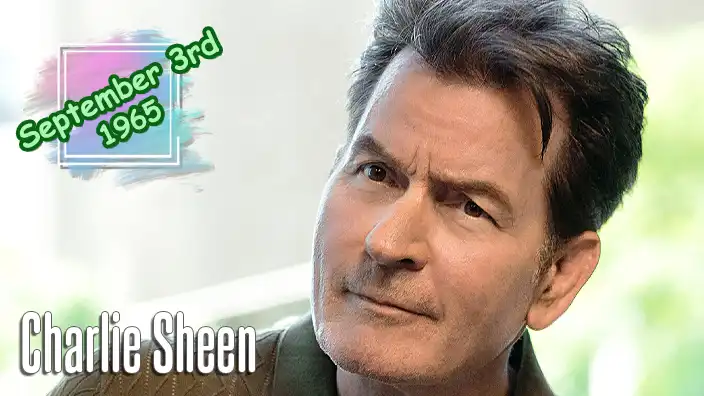
September 3, 1965, in New York City
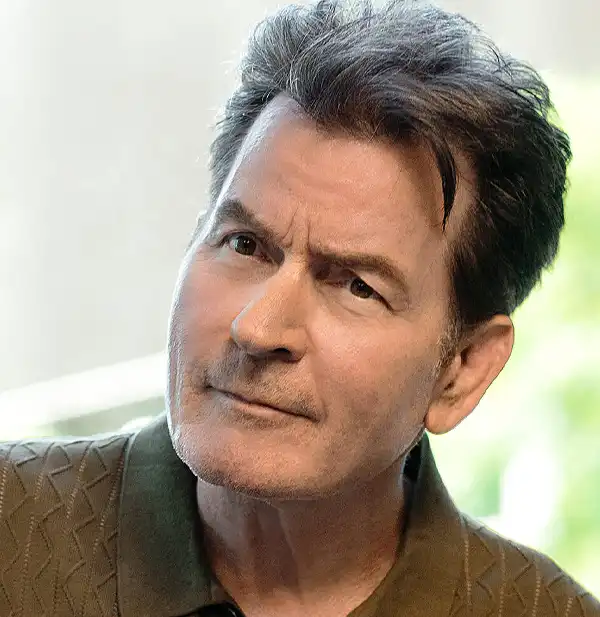
Charlie Sheen was born Carlos Irwin Estévez on September 3, 1965, in New York City, into a family where acting was practically the household business. His father is acclaimed actor Martin Sheen, born Ramón Antonio Gerardo Estévez, and his siblings Emilio Estevez, Ramon Estevez and Renée Estevez also entered the acting profession. Charlie adopted his father’s professional surname, Sheen, while Emilio notably retained Estevez. Long before Charlie became one of television’s highest-profile stars, he was therefore surrounded by people who knew exactly what a camera, script and call sheet were.
The family eventually settled in California, and Sheen attended Santa Monica High School, where his interests were considerably more cinematic than academic. As a teenager he made amateur films with friends who included future actors Rob Lowe and Sean Penn. His school career ended shortly before graduation when he was expelled, leaving acting as a considerably more promising occupation than asking the principal for another chance. Fortunately for Sheen, Hollywood proved rather more receptive.
Sheen's first substantial theatrical role arrived in Red Dawn in 1984. The Cold War action film imagined Soviet and allied forces invading the United States and followed a group of young Americans fighting back. Sheen played Matt Eckert alongside Patrick Swayze, C. Thomas Howell, Lea Thompson and Jennifer Grey. The film became a memorable piece of 1980s popular culture and gave the young actor valuable exposure.
Then came the role that demonstrated he could handle considerably heavier material. Oliver Stone cast Sheen as Private Chris Taylor in Platoon, released in 1986. The Vietnam War drama followed Taylor as an inexperienced soldier confronted not merely by combat but by a bitter moral conflict within his own platoon. Sheen's comparatively restrained performance placed him at the center of an extraordinary ensemble that included Willem Dafoe and Tom Berenger. The film won the Academy Award for Best Picture and became one of the defining Vietnam War films of its generation. For Sheen, it was the breakthrough that moved him decisively into leading-man territory.
Oliver Stone quickly employed him again, this time as Bud Fox in Wall Street in 1987. Sheen played an ambitious young stockbroker drawn into the orbit of Michael Douglas's ruthless corporate raider Gordon Gekko. Adding another layer to the film, Martin Sheen played Bud's father, Carl Fox. The younger Sheen therefore found himself acting opposite both his actual father and Michael Douglas while Oliver Stone directed the proceedings — not exactly a low-pressure day at the office. The movie became another major success and remains one of Sheen's best-known dramatic performances.
Sheen proved throughout the late 1980s and early 1990s that he was capable of moving comfortably between genres. He appeared in Eight Men Out, John Sayles' dramatization of the 1919 Black Sox scandal, and joined an impressive young cast in the Western Young Guns. Then he found one of his most enduring comic roles as pitcher Ricky "Wild Thing" Vaughn in Major League. Vaughn was a flame-throwing pitcher with terrible eyesight, questionable control and an entrance memorable enough to make opposing batters wonder whether facing him was really worth the trouble.
Comedy increasingly became an important part of Sheen's career. He starred as Topper Harley in the 1991 spoof Hot Shots! and returned for Hot Shots! Part Deux in 1993. The films gleefully demolished the conventions of action movies, with Sheen demonstrating a willingness to play absurd situations completely straight — often the secret to making ridiculous comedy work. In 1993 he also played Aramis in The Three Musketeers, adding swashbuckling adventure to a résumé that was already becoming unusually difficult to categorize.
By the end of the 1990s, however, television was about to transform Sheen's career. He joined the ABC sitcom Spin City, replacing Michael J. Fox as the show's principal male star during its later seasons. Sheen played Charlie Crawford, deputy mayor of New York City, and his move into network sitcom comedy proved remarkably successful. His performance earned him the 2002 Golden Globe Award for Best Performance by an Actor in a Television Series – Musical or Comedy.
That success prepared the ground for the role with which millions of viewers would permanently associate him. In 2003, Sheen began playing Charlie Harper in Two and a Half Men, alongside Jon Cryer as Charlie's neurotic brother Alan and Angus T. Jones as Alan's son Jake. Charlie Harper was a wealthy Malibu jingle writer whose principal interests included women, alcohol, gambling and avoiding anything that resembled responsibility. Then his recently separated brother and young nephew moved into his beachfront house, providing the basic machinery for years of sitcom chaos.
There was an obvious danger in casting Charlie Sheen as a wealthy bachelor with a spectacularly undisciplined personal life: audiences occasionally had difficulty determining precisely where Charlie Harper stopped and Charlie Sheen began. But the arrangement worked extraordinarily well on television. Sheen possessed excellent comic timing, and his relaxed delivery suited a character who regarded almost every crisis as something that might disappear if he poured another drink and waited long enough.
Two and a Half Men became an enormous television success, and Sheen remained with the series from 2003 until 2011, appearing as Charlie Harper in 178 episodes according to IMDb. His work brought him four consecutive Primetime Emmy nominations for Outstanding Lead Actor in a Comedy Series, in 2006, 2007, 2008 and 2009. He also received Golden Globe nominations for the role in 2005 and 2006.
Unfortunately, the distinction between Sheen's professional and private lives became increasingly difficult to maintain. His personal problems, including highly publicized struggles involving substance abuse and turbulent relationships, had generated headlines for years. During the 2010–2011 period those difficulties collided spectacularly with his professional life. Production of Two and a Half Men was halted, Sheen publicly attacked series co-creator Chuck Lorre, and Warner Bros. Television ultimately terminated his employment in 2011.
What followed became one of the strangest celebrity media spectacles of the early 21st century. Sheen gave a succession of interviews filled with phrases that immediately escaped into popular culture. "Winning" became inseparable from the episode, while television, newspapers and the rapidly expanding world of social media followed seemingly every new pronouncement. For a period, Charlie Sheen was not simply appearing in entertainment news; he practically was entertainment news.
Yet Sheen's acting career did not end with Charlie Harper. In 2012 he returned to television as Charlie Goodson in Anger Management, a sitcom loosely inspired by the 2003 film of the same name. Sheen played a former professional baseball player who becomes an anger-management therapist — casting that may have caused a few people in Hollywood to admire the producers' sense of humor. The series ran for 100 episodes between 2012 and 2014.
His personal life has been similarly public. Sheen has been married three times — to Donna Peele, Denise Richards and Brooke Mueller — and is the father of five children. In November 2015, he publicly announced that he was HIV-positive, saying he had been diagnosed several years earlier. The announcement brought a much more serious dimension to a public story that had too often been treated simply as celebrity spectacle.
Despite the controversies, it would be a mistake to allow Sheen's tabloid reputation to completely overshadow his work as an actor. His film career includes Platoon, Wall Street, Major League, Young Guns, Eight Men Out, Hot Shots! and The Three Musketeers, while his television career produced major successes with Spin City and Two and a Half Men. He demonstrated convincing dramatic ability early in his career before becoming particularly successful at comedy, where his dry delivery and ability to appear completely untroubled by increasingly ridiculous circumstances became valuable trademarks.
There is also something unusual about the longevity of his most famous characters. Chris Taylor in Platoon remains associated with one of the most celebrated American war films of the 1980s. Bud Fox remains part of the cultural vocabulary surrounding Wall Street. Ricky Vaughn still belongs to the great collection of fictional baseball characters. And Charlie Harper remains one of the defining sitcom characters of the 2000s.
Sheen's career is therefore difficult to summarize neatly — which seems entirely appropriate. There have been acclaimed dramas, broad comedies, blockbuster television ratings, major awards recognition, public controversies, spectacular professional breakdowns and repeated attempts at reinvention. Very few actors could put Platoon and Two and a Half Men at opposite ends of the same résumé and have both entries represent enormous successes.
Born on September 3, Charlie Sheen has spent decades demonstrating that a Hollywood career rarely travels in a straight line. His has occasionally traveled without brakes, headlights or any apparent regard for the posted speed limit, but the body of work underneath all those headlines remains substantial. From the battlefields of Vietnam to Gordon Gekko's Wall Street, the pitcher's mound in Cleveland and Charlie Harper's Malibu living room, Sheen created characters that audiences continue to remember — and he certainly never gave the entertainment press much opportunity to become bored.