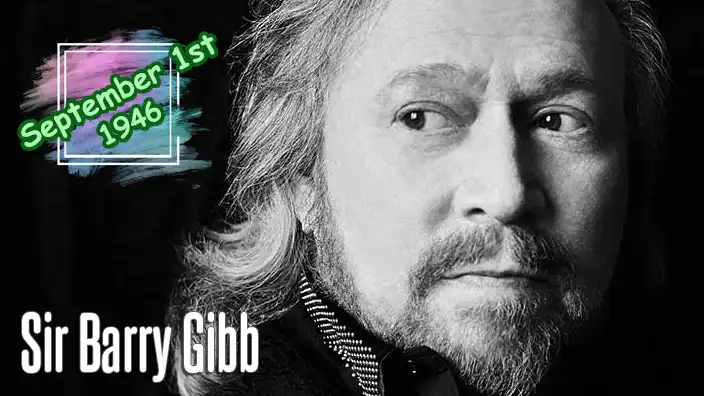
September 1, 1946, in Douglas on the Isle of Man

Barry Alan Crompton Gibb was born on September 1, 1946, in Douglas on the Isle of Man, the son of drummer Hugh Gibb and Barbara Pass. He was the second of five children, following his sister Lesley and preceding his younger brothers, fraternal twins Robin and Maurice, and later Andy. Music was woven into family life from the beginning. Hugh had worked professionally as a drummer and bandleader, so the Gibb children grew up in a household where making music was not regarded as an unusual way to spend one's time. Nobody could have known quite how far that family habit was going to travel.
When Barry was still young, the family moved to Manchester, England. Barry and the twins quickly discovered that their voices worked remarkably well together. They began performing as children during the 1950s, initially under names including the Rattlesnakes. One frequently repeated story from their early years involves the boys preparing to mime to a record at a local cinema, only for the record to break on the way there. Faced with disaster, they sang live instead. The audience liked what it heard, and an accidental necessity helped point the brothers toward their future. It was an appropriately chaotic beginning for a career that would eventually involve worldwide fame, changing musical fashions, family arguments and trousers that became alarmingly tight during the 1970s.
In 1958, the Gibb family emigrated to Australia and settled in Queensland. Barry, Robin and Maurice continued performing, eventually attracting the attention of Australian radio personality and racing driver Bill Goode and disc jockey Bill Gates. The name Bee Gees emerged during this period, with the initials "B.G." associated with several people involved in their early career. Contrary to a persistent assumption, the name did not originally mean "Brothers Gibb," although that interpretation certainly became convenient once the brothers were famous.
The young Bee Gees worked relentlessly around Australia, appearing on television and performing wherever opportunities arose. Barry was already developing as a songwriter, and his compositions became increasingly important to the group. Their first Australian album, The Bee Gees Sing and Play 14 Barry Gibb Songs, released in 1965, made the authorship rather difficult to misunderstand. The following year brought their Australian breakthrough with "Spicks and Specks," written by Barry. By then, the brothers had decided that Australia was no longer large enough for their ambitions.
The family returned to Britain in 1967, and the Bee Gees soon came under the management of Robert Stigwood. Their international breakthrough was remarkably swift. "New York Mining Disaster 1941" became one of their first major overseas successes, followed by songs including "To Love Somebody," "Massachusetts," "Words," "I've Gotta Get a Message to You" and "I Started a Joke." Barry's songwriting was central to this extraordinary run, often in collaboration with Robin and Maurice.
The Bee Gees of the late 1960s sounded very different from the group that would later become synonymous with disco. Their early international work was built around orchestral pop, ballads and close harmonies. Barry's natural voice was rich and expressive, and his songwriting demonstrated a strong instinct for melody long before falsetto became his most recognizable vocal weapon. "To Love Somebody," originally written by Barry and Robin with Otis Redding in mind, became one of the group's most enduring compositions and was subsequently recorded by artists ranging from Nina Simone to Janis Joplin and Michael Bolton.
Success did not make the brothers immune to disagreements. In fact, being brothers may have made disagreements considerably easier. By the end of the 1960s, tensions within the Bee Gees had become severe. Robin temporarily left the group, and Barry and Maurice continued briefly before the band effectively dissolved. Solo projects followed, but the separation did not last. The brothers reunited in 1970 and soon returned to the charts with songs including "Lonely Days" and "How Can You Mend a Broken Heart," the latter becoming their first No. 1 single in the United States.
Then the hits slowed.
By the early 1970s, the Bee Gees were struggling commercially, and the possibility that their best years were already behind them must have seemed entirely reasonable. They had been teenage performers, Australian pop stars and internationally successful balladeers. Popular music was changing quickly, however, and the Bee Gees needed to change with it.
Producer Arif Mardin played an important role in that transformation. Working with him on the 1975 album Main Course, the brothers embraced a stronger rhythm-and-blues and dance-oriented sound. During the recording of "Nights on Broadway," Mardin encouraged Barry to experiment with screaming in tune during an ad-lib section. Barry discovered that his falsetto could be used as a powerful lead instrument.
Popular music was about to receive considerably more Barry Gibb above normal speaking altitude.
"Jive Talkin'" became a major hit in 1975, reaching No. 1 in the United States and announcing the Bee Gees' commercial resurrection. "Nights on Broadway" followed, and the group's new sound continued developing through Children of the World in 1976, which produced "You Should Be Dancing." The Bee Gees were no longer merely back. They were becoming one of the biggest acts in the world.
Then came Saturday Night Fever.
The 1977 film starring John Travolta transformed disco from a popular musical movement into an international cultural phenomenon, and the Bee Gees supplied much of its heartbeat. Their contributions included "Stayin' Alive," "Night Fever," "How Deep Is Your Love" and "More Than a Woman." They also wrote "If I Can't Have You," which became a No. 1 hit for Yvonne Elliman.
The remarkable thing is that several of these songs were not originally written specifically for the film. Producer Robert Stigwood asked the Bee Gees for material while they were working on other projects, and their songs were incorporated into Saturday Night Fever. The resulting soundtrack became one of the best-selling albums in recording history.
Barry's falsetto became one of the defining sounds of the era. "Stayin' Alive" opened with a rhythm and vocal combination recognizable within seconds, while "How Deep Is Your Love" demonstrated that the Bee Gees remained capable of creating delicate ballads amid all those dance floors and illuminated squares.
At their commercial peak, the Bee Gees achieved a degree of chart domination approached by very few performers. During 1978, songs written by the Gibb brothers occupied the No. 1 position on the U.S. charts for an extraordinary portion of the year, whether performed by the Bee Gees themselves or by other artists. Barry became the only songwriter to write four consecutive Billboard Hot 100 No. 1 singles, a remarkable demonstration of just how thoroughly the Gibbs had taken possession of popular radio.
The Bee Gees followed the Saturday Night Fever phenomenon with Spirits Having Flown in 1979. "Too Much Heaven," "Tragedy" and "Love You Inside Out" all reached No. 1 in the United States. For a period, it appeared that Barry, Robin and Maurice could record themselves reading instructions from a washing machine and somebody would put it at the top of the charts.
Unfortunately, enormous popularity has a habit of creating an equally enormous backlash.
By the end of the 1970s, disco had become commercially saturated. The "Disco Sucks" movement gained momentum, culminating symbolically in the notorious Disco Demolition Night at Chicago's Comiskey Park in July 1979. The Bee Gees became convenient targets despite having enjoyed major success for a decade before disco. American radio stations that had played them relentlessly suddenly became reluctant to play them at all.
Barry and his brothers responded in one of the cleverest ways available to songwriters whose own records were temporarily unwelcome: they wrote hits for everybody else.
Barry's songwriting and production work during the 1980s demonstrated just how much of the Bee Gees' success had been based upon craftsmanship rather than fashionable clothing. He wrote or co-wrote major songs for an extraordinary collection of performers. Barbra Streisand's 1980 album Guilty, largely written by Barry and his brothers and co-produced by Barry, became one of the biggest albums of her career. Its title duet, "Guilty," paired Streisand with Barry himself, while "Woman in Love" became a worldwide No. 1 hit.
Dionne Warwick's 1982 album Heartbreaker was another Gibb family project, with its Barry-written title song becoming one of Warwick's signature recordings. Kenny Rogers and Dolly Parton scored an enormous international hit in 1983 with "Islands in the Stream," written by Barry, Robin and Maurice. The song reached No. 1 on the Billboard Hot 100 and became one of the most famous country-pop duets ever recorded.
Barry also worked with Diana Ross on her 1985 album Eaten Alive. By this stage, anybody claiming the Bee Gees had succeeded only because of disco had to explain why Barry Gibb kept writing enormous hits for singers who were conspicuously not the Bee Gees.
The brothers themselves gradually returned to commercial favor. The 1987 album E.S.P. produced "You Win Again," a major international hit that reached No. 1 in Britain and numerous other countries. The achievement made the Bee Gees the first group to score a UK No. 1 single in each of the 1960s, 1970s and 1980s.
Their career continued through the 1990s with albums including High Civilization, Size Isn't Everything and Still Waters. "For Whom the Bell Tolls" and "Alone" demonstrated that the brothers could still produce significant hits decades after their first success. In 1997, the Bee Gees were inducted into the Rock and Roll Hall of Fame, recognition of a career that by then had already survived enough changing musical fashions to exhaust several ordinary bands.
That same year brought One Night Only, a concert filmed in Las Vegas that became a major international success. The performance celebrated the group's enormous catalog and included a tribute to younger brother Andy Gibb, who had died in 1988 at just 30 years old after enjoying his own successful recording career.
The Gibb family's triumphs were accompanied by terrible losses.
Maurice Gibb died unexpectedly in January 2003 at the age of 53 after suffering complications from a twisted intestine. Barry and Robin initially announced that the Bee Gees name would be retired, although they later performed together again. Without Maurice's musicianship, harmonies and personality, however, the group could never truly be the same.
Robin died in May 2012 at the age of 62 following a battle with cancer and other health complications. Barry was now the sole surviving Gibb brother.
The loss profoundly affected him. Barry had spent most of his life performing alongside his brothers, beginning when they were children. The Bee Gees had survived arguments, breakups, reunions, extraordinary fame and dramatic changes in public taste, but mortality accomplished what the music industry never could.
Barry nevertheless continued performing and recording. His solo album In the Now was released in 2016, his first album containing new material in many years. In 2017, he performed a memorable solo set at the Glastonbury Festival, drawing an enormous crowd and demonstrating that songs once dismissed during the disco backlash had long since become standards enjoyed by several generations.
In 2018, Barry was knighted by Prince Charles at Buckingham Palace, becoming Sir Barry Gibb. The honor recognized his services to music and charity. For a boy who had once performed with his brothers at cinemas and clubs, becoming Sir Barry was not a bad progression—although one suspects Maurice and Robin would have found several opportunities to remind him not to become too impressed with himself.
Barry returned to familiar songs from a different direction with the 2021 album Greenfields: The Gibb Brothers' Songbook, Vol. 1. The project reimagined Gibb compositions as country collaborations with performers including Dolly Parton, Keith Urban, Alison Krauss, Sheryl Crow, Little Big Town and Jason Isbell. The album reached No. 1 in Britain, giving Barry a chart-topping UK album in yet another decade.
His songwriting achievements are staggering. Barry has written or co-written numerous Billboard Hot 100 No. 1 songs and belongs to the small company of songwriters whose compositions have become hits across generations, genres and continents. His songs have been recorded by hundreds of performers, and the Bee Gees are among the best-selling musical acts in history.
The falsetto may be the easiest Barry Gibb characteristic to imitate—and usually the most dangerous one to attempt after several drinks—but songwriting is the foundation of his legacy. "To Love Somebody," "Words," "How Can You Mend a Broken Heart," "How Deep Is Your Love," "Stayin' Alive," "Night Fever," "Tragedy," "Woman in Love," "Heartbreaker" and "Islands in the Stream" represent only part of an enormous catalog.
His personal life has displayed considerably more stability than many long rock-and-roll careers. Barry married Linda Gray, a former Miss Edinburgh, in 1970 after the two met during the filming of the BBC's Top of the Pops. They have five children: Stephen, Ashley, Travis, Michael and Alexandra. Their marriage has lasted for more than half a century, surviving an era of popular music in which marriages sometimes struggled to outlive the promotional tour.
On September 1, 2026, Sir Barry Gibb celebrates his 80th birthday.
It is a milestone worthy of considerably more than simply remembering the white suits and disco years. Barry Gibb was already an internationally successful songwriter a decade before Saturday Night Fever, continued writing enormous hits after disco collapsed, and has remained a significant musical figure long after the cultural arguments of the 1970s became history.
Few songwriters have influenced popular music as broadly. Fewer still have experienced the extraordinary cycle Barry Gibb has lived through: obscurity, success, superstardom, ridicule, rediscovery and eventually recognition as one of popular music's great songwriters.
The Bee Gees spent decades asking us "How Deep Is Your Love?"
After all these years, the answer appears to be: deep enough to keep playing the songs.