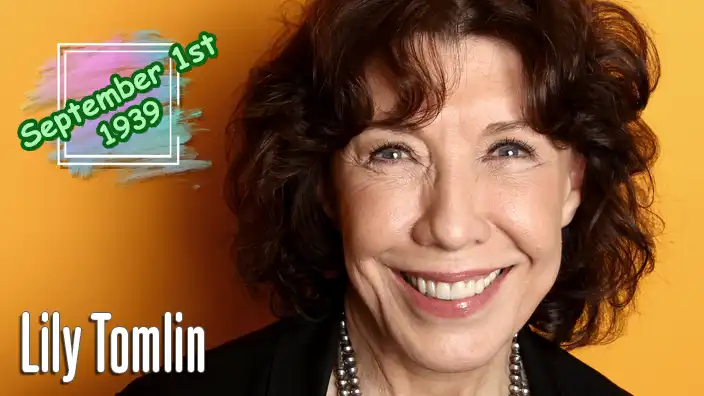
September 1, 1939, in Detroit, Michigan
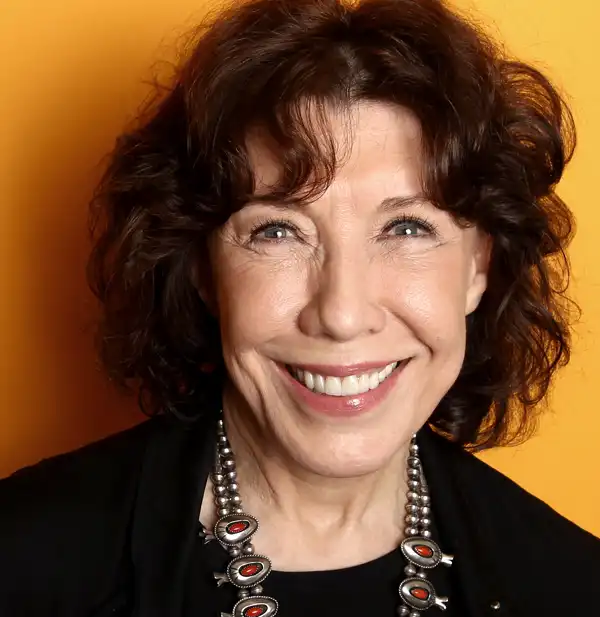
Mary Jean "Lily" Tomlin was born on September 1, 1939, in Detroit, Michigan, the daughter of Lillie Mae Ford and Richard Tomlin. Her parents were Southern Baptists who had moved north from Kentucky during the Great Depression, part of the enormous migration of Southern workers drawn to Detroit's booming automobile industry. Lily grew up in an apartment building near the center of the city, surrounded by a collection of neighbors whose voices, mannerisms and personalities provided an accidental education for a future character comedian.
Long before she had professional ambitions, Tomlin discovered that she could imitate people.
This was useful.
It was also potentially dangerous when the people being imitated lived in the same apartment building.
She spent hours observing neighbors and relatives and recreating them for her own amusement. Rather than simply telling jokes, Tomlin learned to build entire personalities. She noticed how people spoke, moved, complained, boasted and attempted to disguise their insecurities. Those observations would eventually become the foundation of a comedy career built around characters rather than conventional punch lines.
Tomlin graduated from Cass Technical High School in Detroit and enrolled at Wayne State University. She initially planned to study medicine, which would have produced an entirely different career and possibly some unusually entertaining physical examinations. Her direction changed after she auditioned for a college play.
Acting won.
She switched her attention toward theater and began performing comedy in Detroit clubs before moving to New York City. During the 1960s, Tomlin worked the Greenwich Village comedy circuit and appeared in clubs alongside a generation of performers who were reshaping American comedy.
Her television breakthrough came in 1969 when she joined the cast of NBC's Rowan & Martin's Laugh-In.
Laugh-In was fast, colorful, absurd and perfectly suited to Tomlin's ability to create memorable characters in tiny bursts of screen time. The show was already a cultural phenomenon, but Tomlin quickly became one of its most recognizable performers.
Among her most famous creations was Ernestine, the imperious telephone operator.
Ernestine sat at an old-fashioned switchboard, wearing her headset and treating customers with the kind of cheerful contempt normally associated with organizations that know perfectly well you have nowhere else to go. Her nasal voice, snorting laugh and repeated "one ringy-dingy, two ringy-dingy" became instantly recognizable.
Ernestine's favorite weapon was bureaucracy.
She could insult callers, invade their privacy and remind them that the telephone company was enormously powerful. "We don't care. We don't have to. We're the phone company," became one of the character's most celebrated attitudes.
Anyone who has spent forty minutes navigating an automated customer-service system may reasonably conclude that Ernestine did not disappear.
She was promoted.
Then there was Edith Ann.
Edith was a precocious five-and-a-half-year-old girl who sat in an enormous rocking chair and offered observations about adults, childhood and life with complete confidence. Tomlin performed the character physically as well as vocally, making herself appear tiny against the oversized furniture.
Edith Ann frequently concluded her pronouncements with, "And that's the truth," followed by an emphatic raspberry.
The character became so popular that Tomlin recorded albums as Edith Ann and continued returning to her for years. An animated television special, Edith Ann: A Few Pieces of the Puzzle, later earned Tomlin a Daytime Emmy Award.
Other Tomlin characters included Mrs. Earbore, the Tasteful Lady; Lucille the Rubber Freak; and various eccentric women who allowed Tomlin to explore American behavior from different angles. Her comedy was unusual because the characters were rarely simple caricatures. Even the ridiculous ones possessed recognizable human qualities.
Tomlin left Laugh-In in the early 1970s but was already moving rapidly into recordings, television specials and film.
Her 1971 comedy album This Is a Recording, built largely around Ernestine, became a major success. It reached the Billboard charts and earned Tomlin the Grammy Award for Best Comedy Recording.
That made her one of the rare people to win a Grammy largely by being unpleasant to imaginary telephone customers.
Film presented an entirely different challenge.
Tomlin made her movie debut in Robert Altman's sprawling 1975 drama Nashville. Rather than casting her as an obvious comic figure, Altman gave her the role of Linnea Reese, a gospel singer and mother of two deaf children who becomes involved with a visiting rock star played by Keith Carradine.
Tomlin's understated dramatic performance surprised audiences accustomed to Ernestine and Edith Ann. She received nominations for both the Academy Award and Golden Globe for Best Supporting Actress.
For a first film role, an Oscar nomination is a reasonably encouraging performance review.
Nashville established something that would become important throughout Tomlin's career: she was not merely a comedian who occasionally acted. She was an accomplished actor whose comedy happened to be extraordinary.
She followed Nashville with an eclectic series of films. In The Late Show in 1977, she starred opposite Art Carney in a comedy-mystery that earned strong reviews. The following year brought Moment by Moment, co-starring John Travolta, a romantic drama that was rather less enthusiastically received.
Tomlin survived.
Comedy came roaring back with 9 to 5 in 1980.
Tomlin starred alongside Jane Fonda and Dolly Parton as Violet Newstead, one of three women working for the thoroughly obnoxious Franklin Hart Jr., played by Dabney Coleman. The women fantasize about eliminating their sexist, egotistical boss and eventually find themselves holding him prisoner while improving the workplace.
As one does.
The film became an enormous box-office success and one of the defining workplace comedies of its era. Its themes of unequal pay, sexual harassment, workplace discrimination and women being overlooked for promotion gave the comedy a sharper edge than its cheerful surface suggested.
Tomlin's Violet was the experienced employee who knew the business inside and out but repeatedly watched less capable men advance ahead of her. Her frustration helped ground the film, while her chemistry with Fonda and Parton transformed the trio into one of cinema's most memorable comic teams.
The friendship between Tomlin and Jane Fonda would become particularly important decades later.
Tomlin continued through the 1980s with films including The Incredible Shrinking Woman, in which household chemicals cause her character to become progressively smaller. She also starred opposite Steve Martin in All of Me in 1984, playing a wealthy dying woman whose soul accidentally becomes trapped inside Martin's body.
The premise required Martin to perform much of the physical comedy, but Tomlin's voice and character were essential to the film's success. Their performances turned an utterly ridiculous supernatural premise into a critically admired comedy.
Meanwhile, Tomlin had been developing some of her most ambitious work for the stage.
Her longtime creative and personal partner Jane Wagner wrote The Search for Signs of Intelligent Life in the Universe, a one-woman show in which Tomlin portrayed multiple characters whose seemingly separate lives gradually became interconnected.
The show opened on Broadway in 1985 and became a major critical success. Tomlin won the Tony Award for Best Actress in a Play.
Performing a one-person show is an unforgiving business. If the chemistry among the cast isn't working, there is nobody else to blame.
Tomlin simply became the entire cast.
Her collaboration with Wagner stretched back to 1971, when Tomlin invited her to work on an Edith Ann project. Wagner became Tomlin's principal writer and creative collaborator, helping develop television specials, stage productions and character material that shaped much of Tomlin's career.
Their relationship was also personal.
Tomlin and Wagner became a couple during the early 1970s, although they kept much of their private life away from publicity during an era when openly acknowledging a same-sex relationship could have had serious career consequences. They remained together for more than four decades before marrying on December 31, 2013.
By then, anybody still waiting to see whether the relationship would work probably had enough evidence.
Tomlin's film career continued with projects including Big Business, The Player, Short Cuts, Blue in the Face, Flirting with Disaster, Tea with Mussolini, The Kid, I Heart Huckabees, A Prairie Home Companion, The Walker, Admission and Grandma.
The 2015 film Grandma provided one of her strongest later-career roles. Tomlin played Elle Reid, a sharp-tongued lesbian poet who spends the day helping her teenage granddaughter raise money for an abortion. The film placed Tomlin at the center of the story and allowed her to combine caustic humor with grief, vulnerability and affection.
Her performance earned widespread acclaim and a Golden Globe nomination.
Television never disappeared from Tomlin's career either.
She played Deborah Fiderer, the private secretary to President Josiah Bartlet, on The West Wing, earning Emmy nominations for her work. She appeared on Will & Grace, Desperate Housewives, Damages, NCIS, Web Therapy and numerous other programs, accumulating a television résumé nearly as varied as her film work.
She also provided the voice of Ms. Frizzle on the animated educational series The Magic School Bus beginning in the 1990s.
Ms. Frizzle was the gloriously unconventional teacher who took her students inside the human body, beneath the ocean, into outer space and practically anywhere else that would have caused an ordinary school district's insurance provider to terminate coverage immediately.
Tomlin won a Daytime Emmy for the role and returned to voice the character's older sister, Professor Frizzle, in The Magic School Bus Rides Again.
Then, more than thirty years after 9 to 5, Jane Fonda came calling again.
Grace and Frankie premiered on Netflix in 2015, starring Tomlin as Frankie Bergstein and Fonda as Grace Hanson. Their characters are longtime acquaintances whose husbands, played by Martin Sheen and Sam Waterston, announce that they are in love with each other and plan to marry.
Grace is polished, wealthy, organized and conventional.
Frankie is artistic, eccentric, spiritual and quite possibly capable of having a meaningful conversation with a houseplant.
Naturally, they become roommates.
The series followed the women as they rebuilt their lives, launched businesses, dealt with their adult children, navigated dating and confronted the realities of aging. Rather than treating older women as background characters, Grace and Frankie placed two women in their seventies and eighties squarely at the center of a comedy about friendship, sexuality, work, family and independence.
Tomlin's Frankie seemed almost designed to use every tool she had accumulated over decades of character comedy. Frankie could be absurd without becoming foolish and sentimental without becoming saccharine. Tomlin received multiple Emmy nominations and other honors for the performance.
Grace and Frankie ran for seven seasons, concluding in 2022 after 94 episodes. At the time, it became Netflix's longest-running original series by episode count.
Tomlin and Fonda's friendship continued away from the screen, and the two reunited yet again in the 2022 film Moving On and the 2023 sports comedy 80 for Brady, alongside Sally Field and Rita Moreno.
The cast of 80 for Brady was itself rather wonderful: four enormously accomplished actresses playing football fans traveling to see Tom Brady in the Super Bowl.
Between Tomlin, Fonda, Field and Moreno, the film contained enough awards to require reinforced shelving.
Tomlin's honors across her career are formidable. She has won multiple Primetime Emmy Awards, a Daytime Emmy, two Tony Awards and a Grammy. She has received the Mark Twain Prize for American Humor, the Kennedy Center Honors and the Screen Actors Guild Life Achievement Award.
In 2003, she received the Mark Twain Prize, joining the small group of comedians recognized for having a profound influence on American humor. In 2014, she was celebrated with the Kennedy Center Honors, and in 2017 she received SAG-AFTRA's Life Achievement Award.
The collection puts Tomlin among the relatively small number of performers who have earned major recognition across television, recordings and theater.
Yet awards explain only part of her importance.
Tomlin emerged during a period when female comedians were often expected either to conform to narrow ideas about femininity or make themselves the target of the joke. Her characters did something different. Ernestine possessed power. Edith Ann possessed certainty. Frankie possessed complete indifference toward what conventional society expected her to be.
Tomlin was also an early master of character-based observational comedy. Instead of simply standing behind a microphone telling audiences what was ridiculous about American life, she created people who embodied the ridiculousness.
And remarkably, she has kept doing it.
More than half a century separates Ernestine's telephone switchboard from Frankie Bergstein's adventures with Grace. The technology changed from operators physically connecting telephone calls to streaming television delivered instantly across the world.
Lily Tomlin remained funny through all of it.
On September 1, 2026, Lily Tomlin celebrates her 87th birthday after a professional career spanning more than six decades.
She has been a telephone operator, five-year-old philosopher, gospel singer, office supervisor, shrinking housewife, teacher, presidential secretary, grandmother and free-spirited artist. She has performed alone on Broadway, opposite some of Hollywood's greatest actors and inside an animated school bus with absolutely no regard for conventional educational safety standards.
More importantly, she helped expand what female comedy could look and sound like.
There is something wonderfully appropriate about Lily Tomlin still being celebrated at 87. Edith Ann always insisted she knew the truth, Ernestine knew she controlled the telephone company, and Frankie Bergstein never saw any compelling reason to behave her age.
Perhaps they knew something.
And that's the truth.
Pbbbbbt!