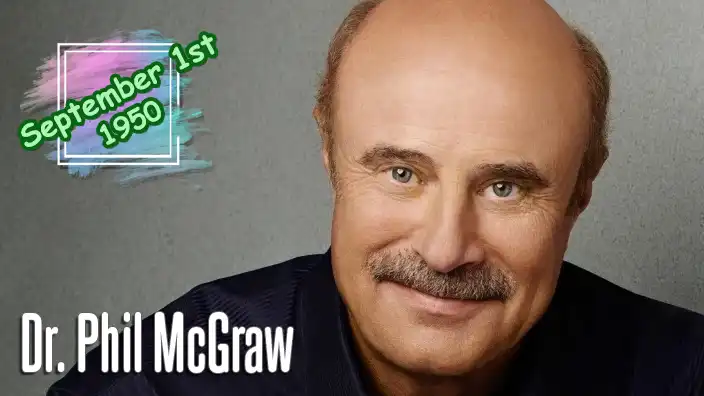
September 1, 1950, in Vinita, Oklahoma
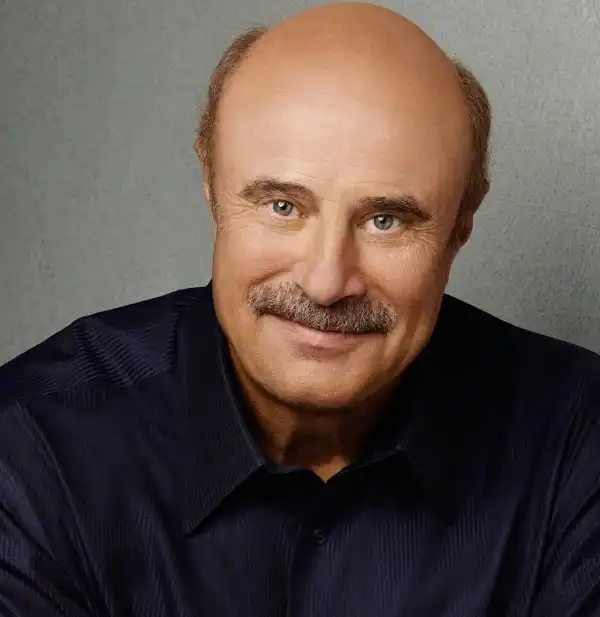
Phillip Calvin McGraw was born on September 1, 1950, in Vinita, Oklahoma, the son of Joseph J. McGraw Jr. and Anne Geraldine Stevens. He grew up with three sisters, Deana, Donna and Brenda, spending portions of his childhood in Oklahoma and Texas. His father worked in the oilfields before pursuing his own education in psychology, and the family eventually moved to Kansas while Joseph McGraw worked toward that goal. Long before millions of television viewers knew him simply as Dr. Phil, young Phil was considerably more interested in athletics than daytime television.
McGraw grew into a formidable young football player, eventually standing about 6 feet 4 inches tall and playing linebacker. He attended Shawnee Mission North High School in Kansas and received a football scholarship to the University of Tulsa, where he played under coach Glenn Dobbs. His time with the team included one particularly unpleasant piece of football history: Tulsa's 100–6 loss to the University of Houston in 1968. When your team concedes 100 points, the post-game tactical discussion can probably be shortened considerably.
Football did not become McGraw's career. He transferred and eventually earned a bachelor's degree in psychology from Midwestern State University in Wichita Falls, Texas, in 1975. He continued his education at North Texas State University, now the University of North Texas, earning a master's degree in experimental psychology and a Ph.D. in clinical psychology in 1979. His doctoral training established the professional foundation behind the "Dr." that would later become inseparable from his public identity.
After completing his doctorate, McGraw entered private practice with his father in Wichita Falls. He was licensed as a psychologist in Texas and practiced clinical psychology, but traditional one-on-one therapy did not prove to be the direction he wanted to follow indefinitely. McGraw became increasingly interested in broader approaches to human behavior, communication and decision-making, interests that eventually moved him away from conventional clinical practice and toward seminars and consulting.
He became involved with Pathways, a self-improvement seminar program, before moving into an entirely different field in 1989 when he co-founded Courtroom Sciences, Inc. The company applied behavioral science and psychology to litigation, helping attorneys understand how juries might respond to cases, witnesses and arguments. Its work included mock trials, jury selection, witness preparation, mediation and behavioral analysis. McGraw therefore spent years studying how ordinary people reacted to complicated disputes before he ever began studying complicated families in front of television cameras.
Courtroom Sciences became involved in high-profile litigation, and one particular case completely altered McGraw's career.
In 1996, Oprah Winfrey became embroiled in a lawsuit brought by Texas cattlemen following comments about beef made on The Oprah Winfrey Show. Her legal team hired Courtroom Sciences to assist with trial strategy. McGraw worked with Winfrey and her attorneys during the case, which ultimately ended successfully for her in 1998.
Winfrey was impressed.
This turned out to be rather important.
She invited McGraw to appear on The Oprah Winfrey Show, initially as an expert on relationships and life strategies. His appearances quickly became popular with viewers. McGraw's style differed from the soft, soothing language often associated with television psychology. He was direct, plainspoken and frequently confrontational, encouraging guests to accept responsibility for their choices rather than spend an hour constructing elaborate explanations for why absolutely everything was somebody else's doing.
His expressions became part of his appeal. "Get real" was closely associated with him, as was his habit of asking people how their current behavior was working for them. The underlying idea was simple: if someone repeatedly follows the same approach and repeatedly gets a disastrous result, perhaps another approach deserves consideration.
It was hardly revolutionary philosophy.
But delivered by a 6-foot-4 Texan with a bald head, magnificent mustache and little patience for nonsense, it made extremely effective television.
McGraw became a regular presence on Oprah's program beginning in the late 1990s. The exposure introduced him to millions of viewers and led naturally toward a program of his own. With Winfrey's Harpo Productions involved, Dr. Phil premiered in September 2002.
It was an immediate success.
The syndicated hour-long program became the highest-rated new syndicated television show since the launch of The Oprah Winfrey Show sixteen years earlier. What could easily have been a short-lived spin-off instead developed into one of the defining daytime programs of its era.
The format placed McGraw in front of individuals, couples and families facing problems ranging from marital breakdowns and rebellious teenagers to addiction, financial disputes, weight problems, family estrangement, compulsive behavior and mental-health crises. Some episodes dealt with relatively ordinary relationship conflicts. Others involved situations so extraordinary that viewers could reasonably wonder how everyone involved had managed to arrive at the studio without first encountering a judge.
McGraw's approach emphasized personal accountability, behavior and practical action. He repeatedly reminded guests that television was not a substitute for proper treatment and frequently arranged professional resources for people appearing on the program. According to the show's official biography, Dr. Phil provided more than $35 million in off-camera resources to guests during its long run.
The program also attracted criticism.
Critics questioned the ethics of discussing complicated psychological, addiction and family problems in a television format designed partly for entertainment. Some former guests and media reports accused the production of exploiting vulnerable people or failing to protect individuals struggling with addiction and other serious conditions. The show's representatives strongly disputed accusations that staff deliberately endangered guests and defended its practices and the treatment resources it provided.
McGraw's professional status also occasionally caused confusion among viewers. Although he holds a legitimate doctorate in clinical psychology and was previously a licensed psychologist in Texas, he stopped practicing clinical psychology and allowed his Texas license to lapse. His television role therefore should not be confused with providing individual clinical treatment to guests or viewers.
Whatever one thought of the format, its popularity was undeniable. Dr. Phil became one of America's dominant daytime talk programs and remained on the air for more than two decades. The show received dozens of Daytime Emmy nominations and won several PRISM Awards recognizing portrayals of substance abuse and addiction. McGraw himself became one of the most instantly recognizable personalities on American television.
The American Psychological Association awarded him a Presidential Citation in 2006 for his contributions to psychology through public communication. The citation recognized his ability to bring psychological concepts and discussions about mental health to an enormous mainstream audience. In 2015, McGraw was inducted into the Broadcasting & Cable Hall of Fame, and in 2020 he received a star on the Hollywood Walk of Fame.
Television also made him an extremely successful author.
McGraw wrote numerous books dealing with relationships, behavior, weight, families and personal improvement. His titles include Life Strategies, Relationship Rescue, Self Matters, Family First, The Ultimate Weight Solution and The 20/20 Diet. Multiple books became No. 1 New York Times bestsellers, and his work has been published internationally in dozens of languages.
The books followed essentially the same philosophy that made his television appearances successful: identify what someone is actually doing, examine the results and stop pretending an ineffective strategy will magically become effective simply because it has been repeated enthusiastically.
McGraw also expanded into podcasting. Phil in the Blanks, launched in 2019, allowed him to conduct longer interviews and discussions outside the restrictions of daytime television. He subsequently developed true-crime programming, including Mystery and Murder: Analysis by Dr. Phil, applying his interest in behavior and forensic psychology to criminal cases.
His earlier career in trial consulting also inspired fictional television.
McGraw's Courtroom Sciences experience helped provide the basis for the CBS drama Bull, starring Michael Weatherly as trial consultant Dr. Jason Bull. McGraw served as a co-creator and executive producer of the series, which premiered in 2016 and ran for six seasons. The fictional Bull was not intended as a literal portrayal of McGraw, although the connection between the character's trial-science work and McGraw's earlier career was unmistakable.
McGraw became involved in numerous other media ventures, frequently working with his eldest son, Jay McGraw. Jay became a television producer and executive and helped develop projects including The Doctors, the medical talk show launched in 2008. Father and son also became involved in telemedicine through Doctor On Demand, an online healthcare service connecting patients with medical and mental-health professionals.
After more than twenty years, McGraw announced in 2023 that the original daytime production of Dr. Phil would conclude. The final season of new episodes under the long-established syndicated format brought an extraordinary run to a close. For somebody whose national television career had effectively begun as Oprah Winfrey's occasional expert, more than two decades with his own daily program represented a remarkable piece of broadcasting longevity.
Retirement, however, was apparently never seriously on the menu.
McGraw launched Merit Street Media and returned with Dr. Phil Primetime, moving his familiar interview and discussion format into a new media operation. The venture expanded his interests beyond the traditional daytime talk-show structure into news, commentary, interviews and other programming. His official platform has continued carrying Dr. Phil programming and his podcasts, keeping him firmly in public life well after the end of his original syndicated show's production.
His career has also increasingly included interviews and programs involving major social and political issues, criminal cases and current events. That expansion has sometimes placed him in more contentious territory than the relationship disputes that originally made him a daytime television fixture. McGraw has never seemed especially troubled by contentious territory. A man who spent years voluntarily putting himself between feuding spouses for television probably developed a fairly high tolerance for disagreement.
McGraw's personal life has been notably stable compared with many of the domestic catastrophes discussed on his program. His first marriage, to Debbie Higgins McCall, was annulled. In 1976, he married Robin Jo Jameson, better known publicly as Robin McGraw. She became a familiar presence on Dr. Phil, frequently appearing in the studio audience and participating in programs and charitable projects.
Phil and Robin have two sons, Jay and Jordan. Jay pursued a career in television production, publishing and business, while Jordan became a musician. The family has expanded to include daughters-in-law and grandchildren, a subject McGraw discusses with considerably more softness than he generally displayed when confronting an argumentative television guest.
Philanthropy has also occupied an important part of Phil and Robin McGraw's work. The charitable organization associated with them has supported projects involving children, families and domestic violence. McGraw has also testified before congressional committees on subjects including foster children, prescription medication, bullying, addiction and family issues.
It is easy to caricature Dr. Phil.
The bald head, mustache, Texas accent, catchphrases and television confrontations have been imitated endlessly. His public persona became sufficiently recognizable that comedians barely needed to say his name before audiences understood the impression.
Behind that persona, however, is an unusual professional journey.
He earned a genuine doctorate in clinical psychology, practiced psychology, moved into trial science, helped a future media billionaire through a major lawsuit, became her television expert and then created a broadcasting career lasting decades. Along the way, he became a bestselling author, producer, podcaster and media entrepreneur.
His methods have generated both devoted fans and determined critics, and a fair assessment of McGraw's career needs room for both. Supporters credit him with making conversations about addiction, relationships and mental health accessible to millions of viewers. Critics argue that complicated human problems do not always belong within the dramatic machinery of daytime television.
Both perspectives help explain why he has remained such a prominent figure.
Dr. Phil has never been particularly easy to ignore.
On September 1, 2026, Phil McGraw celebrates his 76th birthday. More than a quarter-century has passed since his appearances with Oprah Winfrey first made him nationally recognizable, yet he continues producing programs, podcasts and interviews.
For someone who has spent much of his television career asking other people whether what they are doing is working, McGraw can answer that question about his own broadcasting career fairly easily.
Seventy-six years old, more than two decades at the top of daytime television and still behind a microphone?
Apparently, it's working.