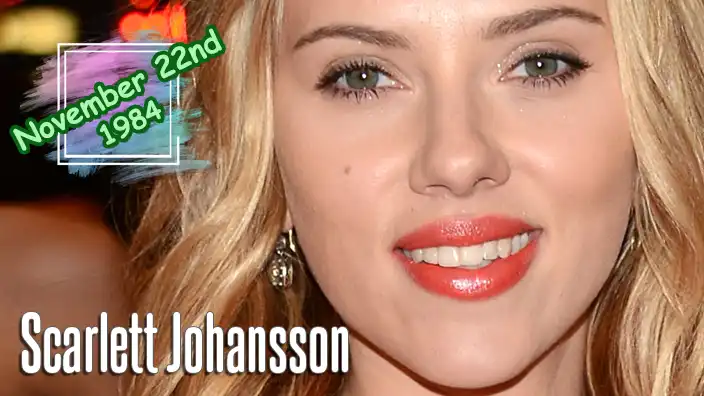
Scarlett Ingrid Johansson was born on November 22, 1984, in New York City. The American actress and singer is internationally recognized for her performances in Lost in Translation, Girl with a Pearl Earring, The Avengers, Lucy, Marriage Story, and Jojo Rabbit. Her career has encompassed independent dramas, romantic comedies, science fiction, action adventures, animated films, and Broadway theater, establishing her as one of the most commercially successful and critically acclaimed performers of her generation.
Johansson's distinctive voice, expressive performances, and ability to portray emotionally complicated characters have contributed to a career that began during childhood and developed into international stardom. She has received two Academy Award nominations, a BAFTA Award, a Tony Award, and numerous other honors. Her work in the Marvel Cinematic Universe introduced her to an enormous global audience, while her performances in independent films demonstrated her ability to explore challenging characters and unconventional storytelling.
Johansson was born into a family with strong connections to the arts and entertainment. Her father, Karsten Olaf Johansson, is a Danish-born architect, while her mother, Melanie Sloan, comes from a Jewish family with roots in Eastern Europe and worked as a producer. Her paternal grandfather, Ejner Johansson, was a Danish art historian, writer, and screenwriter. Scarlett grew up alongside her siblings, including her older sister Vanessa, older brother Adrian, and twin brother Hunter. She also has an older paternal half-brother, Christian.
Growing up in Manhattan provided Johansson with early exposure to theater, film, and the performing arts. She developed an interest in acting during childhood and began attending auditions while still very young. Her enthusiasm for performance was evident long before she understood the professional demands of the entertainment industry. Like many aspiring child actors, she initially experienced rejection, but her determination eventually helped her secure opportunities in television and film.
Johansson studied at the Lee Strasberg Theatre Institute and attended the Professional Children's School in Manhattan, an educational institution known for accommodating students pursuing careers in entertainment and the arts. Her training introduced her to acting techniques that emphasized emotional authenticity and character development, qualities that would become central to her later performances.
Her earliest professional appearances included work in television and stage productions, but her feature-film debut arrived in 1994 with North, directed by Rob Reiner. Johansson portrayed Laura Nelson in the comedy starring Elijah Wood as a boy who becomes dissatisfied with his parents and embarks on an unusual search for replacements. Although the film received unfavorable reviews, it provided Johansson with valuable experience working on a major Hollywood production.
She continued appearing in films throughout the mid-1990s, including Just Cause, starring Sean Connery and Laurence Fishburne, and If Lucy Fell, released in 1996. These early roles allowed her to develop her skills while working alongside established performers.
Her first significant critical breakthrough came with Manny & Lo (1996), an independent drama directed by Lisa Krueger. Johansson portrayed Amanda, known as Manny, a young girl who runs away with her pregnant teenage sister, Laurel, played by Aleksa Palladino. The sisters attempt to survive on their own while navigating the difficulties of poverty, responsibility, and impending motherhood.
Johansson's performance attracted considerable critical attention for its naturalism and emotional maturity. Despite her limited professional experience, she demonstrated an ability to portray a complicated character without relying on exaggerated expressions or conventional child-actor mannerisms. The role earned her an Independent Spirit Award nomination for Best Female Lead, establishing her as a promising young performer in independent cinema.
In 1998, Johansson appeared in The Horse Whisperer, directed by and starring Robert Redford. She portrayed Grace MacLean, a teenager who suffers severe physical and emotional trauma following a riding accident that also injures her beloved horse. Her mother, played by Kristin Scott Thomas, seeks the assistance of a gifted horse trainer in Montana, hoping that he can help both Grace and the animal recover.
The film provided Johansson with a demanding dramatic role that required her to communicate grief, anger, vulnerability, and emotional withdrawal. Her performance received widespread praise and helped introduce her to mainstream audiences. Working with Redford also provided valuable experience in a production that emphasized character development and emotional storytelling.
The Horse Whisperer became an important milestone because it demonstrated that Johansson could handle substantial dramatic material while still a young performer. Her portrayal of Grace suggested a maturity that would become increasingly evident as she transitioned into adult roles.
In 2001, Johansson appeared in Ghost World, directed by Terry Zwigoff and based on the graphic novel by Daniel Clowes. She portrayed Rebecca, a cynical teenager whose friendship with Enid, played by Thora Birch, becomes strained as the two young women approach adulthood. The film explored alienation, friendship, identity, and the uncomfortable transition from adolescence to independence.
Ghost World became a critically acclaimed cult favorite, particularly among audiences who appreciated its unconventional humor and observations about modern society. Johansson's understated performance provided an effective contrast to Birch's more openly rebellious character, demonstrating her ability to contribute to ensemble storytelling through subtle emotional reactions.
That same year, she appeared in the Coen brothers' black-and-white crime drama The Man Who Wasn't There, starring Billy Bob Thornton and Frances McDormand. Johansson portrayed Birdy Abundas, a teenage pianist whose ambitions and personal circumstances become entangled with the film's troubled central character. The production introduced her to the Coen brothers' distinctive filmmaking style, combining dark humor, moral uncertainty, and carefully constructed visual storytelling.
Her transition from child actress to adult performer reached a decisive point in 2003 with two critically acclaimed films that demonstrated her remarkable range. The first was Lost in Translation, directed by Sofia Coppola and starring Bill Murray. Johansson portrayed Charlotte, a young American woman accompanying her photographer husband to Tokyo, where she finds herself isolated and uncertain about her marriage and future.
Charlotte develops an unexpected friendship with Bob Harris, an aging American movie star played by Murray, who is visiting Japan to film a whiskey advertisement. Both characters experience loneliness and emotional disconnection despite their very different circumstances. Their relationship develops through quiet conversations, shared experiences, and an understanding that neither seems able to find elsewhere.
Johansson's performance was distinguished by its restraint and emotional sensitivity. Rather than relying on dramatic confrontations, she communicated Charlotte's uncertainty through subtle expressions, thoughtful silences, and moments of quiet observation. Her chemistry with Murray provided the film's emotional foundation, creating a relationship that was intimate without depending on conventional romantic storytelling.
Lost in Translation became a major critical success, earning four Academy Award nominations, including Best Picture, and winning Best Original Screenplay for Coppola. Johansson received the BAFTA Award for Best Actress in a Leading Role, establishing her as an internationally respected dramatic performer.
The film also demonstrated her ability to portray emotional complexity through minimal dialogue, a skill that would remain important throughout her career. Charlotte's experiences reflected the uncertainty of early adulthood, when familiar expectations begin to feel inadequate and the future appears both exciting and deeply confusing. It was a performance that proved an actor could communicate an enormous amount simply by looking out of a hotel window and wondering what on earth she was supposed to do next.
Her second major film of 2003 was Girl with a Pearl Earring, directed by Peter Webber and based on Tracy Chevalier's novel. Johansson portrayed Griet, a young servant employed in the household of Dutch painter Johannes Vermeer, played by Colin Firth. Set in seventeenth-century Delft, the film explores the complicated relationship between the artist and the young woman who becomes the subject of one of his most famous paintings.
Johansson's performance relied heavily on facial expressions and controlled physical behavior, reflecting the limited social freedom available to her character. Griet's intelligence, curiosity, and artistic sensitivity emerge gradually as she develops an understanding of Vermeer's work. The film's carefully composed cinematography echoed the visual qualities of Dutch Golden Age painting, creating an atmosphere in which silence and observation became essential storytelling elements.
Her portrayal earned nominations for both a Golden Globe and a BAFTA Award, further confirming her ability to handle demanding dramatic roles. The extraordinary contrast between Lost in Translation and Girl with a Pearl Earring demonstrated that Johansson could move convincingly between contemporary emotional realism and historical drama.
Following her breakthrough in 2003, Johansson became increasingly sought after by filmmakers interested in performers capable of combining glamour with emotional complexity. In 2004, she appeared in A Love Song for Bobby Long, portraying Pursy Will, a young woman who returns to New Orleans following her mother's death and discovers two men living in the family home. The film starred John Travolta and Gabriel Macht and explored grief, friendship, regret, and the difficulties of rebuilding damaged relationships. Johansson's performance earned a Golden Globe nomination, reinforcing her growing reputation as a leading dramatic actress.
That same year, she appeared in In Good Company, starring Dennis Quaid and Topher Grace. Johansson portrayed Alex Foreman, a college student whose romantic involvement with her father's much younger boss creates an uncomfortable situation for everyone concerned. The film combined workplace comedy with family drama, giving Johansson an opportunity to demonstrate her natural comic timing. The situation was complicated enough to make an ordinary father-daughter disagreement seem positively relaxing.
In 2005, Johansson starred in Match Point, directed by Woody Allen. The psychological thriller follows Chris Wilton, a former tennis professional who marries into a wealthy British family while becoming romantically involved with Nola Rice, an aspiring American actress portrayed by Johansson. Their relationship develops into a dangerous affair involving jealousy, ambition, and moral compromise. Johansson's performance was praised for its intensity and emotional vulnerability, earning her another Golden Globe nomination.
She reunited with Allen for Scoop (2006), a mystery comedy starring Hugh Jackman and Allen himself, and later appeared in Vicky Cristina Barcelona (2008), alongside Rebecca Hall, Javier Bardem, and Penélope Cruz. In the latter film, Johansson portrayed Cristina, an adventurous young American whose summer in Spain becomes complicated by an unconventional romantic relationship. These collaborations allowed her to explore characters whose personal desires frequently conflicted with their expectations of ordinary life.
Johansson also appeared in The Island, directed by Michael Bay and starring Ewan McGregor. The science-fiction action thriller follows two residents of a mysterious facility who discover that their apparently protected existence conceals a disturbing secret. Johansson portrayed Jordan Two Delta, whose determination to escape contributes to a series of elaborate action sequences. The production introduced her to large-scale science-fiction filmmaking, an area that would become increasingly important later in her career.
In 2006, she appeared in Christopher Nolan's The Prestige, starring Hugh Jackman and Christian Bale as rival magicians whose professional competition becomes an increasingly dangerous obsession. Johansson portrayed Olivia Wenscombe, a stage assistant whose involvement with both performers contributes to the film's complicated web of deception. The production combined historical drama, mystery, and science fiction, allowing Johansson to contribute to a story in which almost everyone was hiding something. Considering the number of secrets involved, it was probably wise not to believe anyone who claimed there was nothing up their sleeve.
Her film career continued expanding with productions including The Nanny Diaries (2007), The Other Boleyn Girl (2008), and He's Just Not That Into You (2009). In The Other Boleyn Girl, Johansson portrayed Mary Boleyn opposite Natalie Portman as Anne Boleyn, exploring the complicated relationships surrounding King Henry VIII. The historical drama provided another opportunity to work in an elaborate period production, complete with royal intrigue, political ambition, and family disagreements that could have extremely unpleasant consequences.
Johansson's career underwent a major transformation in 2010 when she joined the Marvel Cinematic Universe as Natasha Romanoff, also known as Black Widow, in Iron Man 2. The film starred Robert Downey Jr. as Tony Stark and introduced Johansson as a mysterious operative whose remarkable fighting abilities and intelligence concealed her true identity as an agent of S.H.I.E.L.D.
Natasha Romanoff was a highly trained spy and assassin whose background involved espionage, manipulation, and dangerous missions. Unlike many of Marvel's superheroes, she possessed no supernatural powers, advanced mechanical armor, or magical abilities. Her effectiveness depended on combat training, intelligence, adaptability, and an extraordinary capacity for remaining calm while everyone around her was doing something spectacularly foolish.
Johansson underwent extensive physical training to prepare for the role, developing the strength, coordination, and combat techniques required for the character's demanding action sequences. Her performance established Black Widow as a confident and resourceful figure capable of holding her own alongside characters possessing considerably more impressive physical advantages.
She returned in The Avengers, directed by Joss Whedon, joining an ensemble that included Robert Downey Jr., Chris Evans, Chris Hemsworth, Mark Ruffalo, and Jeremy Renner. The film brought together several established superheroes to confront an alien invasion threatening Earth.
Johansson's Black Widow provided an important balance within the team. While characters such as Thor and the Hulk relied on extraordinary physical power, Natasha frequently solved problems through intelligence, strategy, and psychological manipulation. Her ability to remain composed during dangerous situations made her particularly effective when dealing with unpredictable personalities.
The Avengers became a worldwide commercial phenomenon, earning more than $1.5 billion at the box office and establishing the interconnected Marvel franchise as one of cinema's most successful entertainment properties. Johansson's participation introduced her to an enormous international audience and transformed Black Widow into one of the most recognizable female superheroes in modern popular culture.
She continued portraying Natasha Romanoff in Captain America: The Winter Soldier (2014), where her character developed a complicated partnership with Steve Rogers, played by Chris Evans. The film combined superhero action with political thriller elements, exploring surveillance, institutional corruption, and questions surrounding personal loyalty.
Johansson's performance emphasized Natasha's intelligence, emotional restraint, and gradual willingness to trust others. Her chemistry with Evans provided moments of humor and emotional warmth within an otherwise tense story. Black Widow's ability to combine sophisticated espionage with dry sarcasm became one of the character's defining qualities.
She reprised the role in Avengers: Age of Ultron (2015), Captain America: Civil War (2016), Avengers: Infinity War (2018), and Avengers: Endgame (2019). Across these films, Natasha developed from a guarded intelligence operative into a central member of the Avengers whose loyalty to her colleagues became increasingly important.
Her relationship with Bruce Banner, portrayed by Mark Ruffalo, introduced an additional emotional dimension, while her longstanding friendship with Clint Barton, played by Jeremy Renner, provided insight into her personal history. Johansson portrayed Natasha as a character whose confidence and professional competence concealed guilt, regret, and a desire to make amends for earlier actions.
In Avengers: Endgame, Natasha's storyline reached an emotional conclusion when she sacrificed herself to help the remaining Avengers reverse the devastation caused by Thanos. The scene became one of the film's most significant emotional moments, emphasizing her transformation from a former assassin into someone willing to surrender everything for the people she regarded as family.
Johansson returned to the character in Black Widow, released in 2021. Set between the events of Captain America: Civil War and Avengers: Infinity War, the film explored Natasha's past and her complicated relationships with individuals connected to her earlier life.
The production featured Florence Pugh as Yelena Belova, David Harbour as Alexei Shostakov, and Rachel Weisz as Melina Vostokoff. Their interactions introduced a mixture of family drama, espionage, action, and humor, allowing Johansson to explore aspects of Natasha's personality that had received comparatively little attention in earlier Marvel productions.
The film also addressed the character's experiences within the fictional Red Room training program and her efforts to confront the people responsible for exploiting young women as assassins. Johansson served as an executive producer, contributing to the development of a story centered on the character she had portrayed for more than a decade.
Although Black Widow became one of her most commercially successful roles, Johansson continued pursuing independent and unconventional productions throughout her years with Marvel. In 2013, she appeared in Don Jon, written and directed by Joseph Gordon-Levitt. She portrayed Barbara Sugarman, a confident young woman whose relationship with the central character becomes complicated by unrealistic expectations surrounding romance and intimacy.
That same year, Johansson delivered one of her most unusual performances in Her, directed by Spike Jonze. The film starred Joaquin Phoenix as Theodore Twombly, a lonely writer who develops a romantic relationship with an advanced artificial-intelligence operating system named Samantha, voiced by Johansson.
Although Johansson never physically appears on screen, her voice performance provides the emotional foundation for the relationship. Samantha develops a distinctive personality characterized by curiosity, humor, affection, and an increasingly complicated understanding of existence. Johansson communicates these qualities entirely through vocal expression, creating a character whose emotional presence feels convincing despite the absence of a physical body.
Her performance received widespread critical praise and earned the Best Actress award at the Rome Film Festival. The film demonstrated the extraordinary importance of vocal acting, proving that a performer could create a compelling character without appearing on camera. For an actress internationally recognized for her screen presence, disappearing completely while remaining the emotional center of a film was a particularly impressive achievement.
Johansson also starred in Under the Skin (2013), directed by Jonathan Glazer. The experimental science-fiction thriller follows a mysterious extraterrestrial being who assumes the appearance of a woman and travels through Scotland, luring unsuspecting men into disturbing encounters.
The film relied heavily on atmospheric imagery, minimal dialogue, and unconventional storytelling. Johansson's performance was deliberately restrained, presenting a character whose unfamiliarity with human behavior gradually develops into curiosity and confusion. The production received considerable critical acclaim and became an important example of her willingness to participate in challenging independent cinema.
In 2014, Johansson starred in Lucy, directed by Luc Besson. She portrayed a young woman who develops extraordinary mental and physical abilities after exposure to an experimental substance. The film combined action, science-fiction speculation, and philosophical questions about human consciousness.
Although its central scientific premise was fictional, Lucy became a major international box-office success. Johansson's performance required her to portray a character whose personality gradually changed as her abilities expanded beyond ordinary human limitations. It also provided another opportunity for her to demonstrate that she could carry a major action film without relying on an established superhero franchise.
Her voice-acting career expanded with The Jungle Book, directed by Jon Favreau, in which she voiced Kaa, the enormous python who attempts to hypnotize Mowgli. Johansson's distinctive voice contributed an atmosphere of danger and fascination to the character, creating a memorable interpretation of the familiar Disney villain.
She also voiced Ash, a teenage porcupine and aspiring rock musician, in Sing and its sequel, Sing 2 (2021). Her performance combined comedy, emotional vulnerability, and musical ability, allowing her to reach younger audiences through animated entertainment.
Johansson's interest in music extended beyond her film performances. In 2008, she released Anywhere I Lay My Head, an album consisting primarily of interpretations of songs by Tom Waits. The project reflected her appreciation for unconventional musical arrangements and atmospheric vocal performances.
In 2009, she collaborated with singer-songwriter Pete Yorn on Break Up, an album inspired by classic male-female vocal partnerships. The recordings demonstrated another aspect of her creative interests, although acting remained the central focus of her professional career.
Johansson's Broadway career also achieved significant recognition. In 2010, she appeared in a revival of Arthur Miller's A View from the Bridge, starring opposite Liev Schreiber. She portrayed Catherine, a young woman whose relationship with her protective uncle becomes increasingly complicated as she approaches adulthood.
The production required Johansson to work within the demanding structure of live theater, where performances must be sustained without the assistance of editing or repeated takes. Her portrayal earned the Tony Award for Best Featured Actress in a Play, establishing her as an accomplished stage performer as well as a successful film actress.
She returned to Broadway in 2013 with Tennessee Williams's Cat on a Hot Tin Roof, portraying Maggie, a determined woman struggling with the emotional and marital complications surrounding her troubled husband. The production allowed her to explore another celebrated dramatic role and reinforced her commitment to theater despite the demands of her film career.
In 2017, Johansson starred in Ghost in the Shell, a live-action adaptation of the influential Japanese manga and anime franchise. She portrayed Major Mira Killian, a cybernetically enhanced operative whose investigation into dangerous technological crimes leads her to question her own identity and origins.
The film featured elaborate visual effects and explored themes of consciousness, artificial intelligence, and the relationship between humanity and technology. Its casting generated controversy, with critics questioning the decision to cast a white American actress in a role associated with a Japanese franchise. The debate became part of a broader discussion about representation and casting practices in Hollywood.
Johansson continued demonstrating her comedic abilities in Rough Night (2017), portraying Jess Thayer, a woman whose bachelorette celebration becomes an increasingly disastrous adventure. The film featured an ensemble cast including Kate McKinnon, Jillian Bell, Ilana Glazer, and Zoë Kravitz.
The production combined outrageous comedy with themes of friendship, responsibility, and the challenges of maintaining relationships through changing circumstances. Although the film received mixed reviews, it allowed Johansson to embrace a more exaggerated comic style than audiences typically associated with her dramatic performances.
In 2019, Johansson delivered two of the most acclaimed performances of her career, earning Academy Award nominations for both. The first was Marriage Story, directed by Noah Baumbach and starring Adam Driver. The film follows Nicole and Charlie Barber, a married couple whose separation develops into an emotionally exhausting divorce involving lawyers, family relationships, professional ambitions, and difficult questions about parenting.
Johansson portrayed Nicole, an actress attempting to establish an independent professional identity after years of supporting her husband's theatrical career. Her performance explored frustration, resentment, affection, vulnerability, and the painful realization that a relationship can end even when both individuals retain genuine feelings for one another.
The film's emotional intensity depended heavily on the performances of Johansson and Driver, whose characters frequently struggled to communicate their feelings without causing additional harm. Their arguments were sometimes devastating because they emerged from recognizable human experiences rather than exaggerated dramatic circumstances.
Johansson's portrayal received widespread critical acclaim and earned her an Academy Award nomination for Best Actress. The performance demonstrated her ability to communicate emotional complexity with remarkable authenticity, creating a character whose decisions were understandable even when they caused pain to others.
Her second major performance of 2019 came in Jojo Rabbit, directed by Taika Waititi. The satirical comedy-drama follows a young German boy during World War II whose imaginary friend is an absurd version of Adolf Hitler. Johansson portrayed Rosie Betzler, the boy's mother, who secretly opposes the Nazi regime while attempting to protect her son from its destructive ideology.
Rosie is warm, courageous, humorous, and deeply compassionate, providing an emotional contrast to the propaganda and intolerance surrounding her family. Johansson's performance combined playful comedy with profound emotional seriousness, creating a character whose humanity became central to the film's message.
Her portrayal earned an Academy Award nomination for Best Supporting Actress, making Johansson one of the relatively few performers to receive nominations in both acting categories during the same Oscar ceremony. Jojo Rabbit also won the Academy Award for Best Adapted Screenplay, recognizing Waititi's unconventional approach to a difficult historical subject.
The contrast between Marriage Story and Jojo Rabbit demonstrated Johansson's extraordinary versatility. In one film, she portrayed a contemporary woman struggling through a painful divorce; in the other, she played a courageous mother attempting to preserve compassion during one of history's darkest periods. Both performances required emotional honesty, but their settings, styles, and dramatic demands were entirely different.
Following her acclaimed work in 2019, Johansson continued balancing major studio productions with independent films and creative collaborations. In 2023, she appeared in Wes Anderson's Asteroid City, portraying Midge Campbell, a famous actress attending a junior astronomy convention in a fictional American desert town during the 1950s.
The film featured an ensemble cast including Jason Schwartzman, Tom Hanks, Bryan Cranston, Tilda Swinton, and Edward Norton. Johansson's performance combined dry humor, emotional restraint, and Anderson's distinctive theatrical dialogue. Her character's relationship with a grieving photographer, played by Schwartzman, provided moments of unexpected tenderness within the film's elaborate structure.
In 2024, Johansson starred opposite Channing Tatum in Fly Me to the Moon, a romantic comedy-drama set against the background of NASA's preparations for the Apollo 11 Moon landing. She portrayed Kelly Jones, a marketing specialist hired to improve the space agency's public image during the intense political and technological competition surrounding the American space program.
The film combined historical fiction, romantic comedy, and an exploration of public relations during the Space Race. Johansson's character was intelligent, ambitious, and skilled at manipulating public perceptions, creating an entertaining contrast with Tatum's more straightforward NASA launch director. She also served as a producer, reflecting her increasing involvement in developing projects beyond her acting responsibilities.
That same year, Johansson voiced Elita-1 in Transformers One, an animated science-fiction adventure exploring the early relationship between Optimus Prime and Megatron. Her performance added another major animated franchise to a filmography that already included Disney, Illumination, and Marvel productions.
In 2025, Johansson joined another enormously successful entertainment franchise with Jurassic World Rebirth, directed by Gareth Edwards. She portrayed Zora Bennett, a covert-operations specialist leading a dangerous mission to obtain genetic material from dinosaurs for medical research. The film combined science-fiction adventure, elaborate action sequences, and the familiar Jurassic tradition of highly trained professionals discovering that enormous prehistoric predators are not particularly interested in following the itinerary.
Johansson had long expressed enthusiasm for the Jurassic Park franchise, making her participation a personally meaningful professional opportunity. The production allowed her to return to physically demanding action filmmaking while portraying a capable leader confronting extraordinary dangers. After spending years battling alien armies as Black Widow, she had apparently decided that dinosaurs represented a refreshing change of pace, although the insurance premiums were probably just as unpleasant.
Johansson also appeared in Wes Anderson's The Phoenician Scheme (2025), portraying Cousin Hilda in another stylized ensemble comedy. Her continuing collaborations with Anderson reflected her interest in filmmakers whose distinctive visual approaches and unconventional storytelling create opportunities for memorable supporting performances.
A particularly important professional milestone arrived in 2025 when Johansson made her feature-film directing debut with Eleanor the Great, starring June Squibb, Erin Kellyman, Jessica Hecht, and Chiwetel Ejiofor. The comedy-drama follows Eleanor Morgenstein, an elderly woman attempting to rebuild her life after the death of her closest friend. Following a move to New York City, Eleanor becomes involved in a misunderstanding that develops into a complicated exploration of grief, identity, friendship, and the consequences of telling stories that do not belong to us.
The film premiered in the Un Certain Regard section of the 2025 Cannes Film Festival and was released in American theaters that September. Directing allowed Johansson to approach filmmaking from a new creative perspective, overseeing performances, storytelling, and the emotional development of characters rather than concentrating exclusively on her own role. The project demonstrated her desire to expand beyond acting and participate more directly in shaping the stories presented on screen.
In 2026, Johansson's filmography expanded with Paper Tiger, directed by James Gray. The crime drama featured an ensemble including Adam Driver and Miles Teller, adding another character-driven production to her career. Her continuing work with independent filmmakers alongside major commercial franchises reflected a professional approach that had remained consistent since her early successes in Lost in Translation and Girl with a Pearl Earring.
Outside her acting career, Johansson's personal life has frequently attracted media attention. She married actor Ryan Reynolds in 2008, and the couple divorced in 2011. She later married French journalist and businessman Romain Dauriac in 2014, with whom she has a daughter, Rose Dorothy. Their marriage ended in divorce in 2017.
In 2020, Johansson married comedian and Saturday Night Live writer Colin Jost. The couple welcomed a son, Cosmo, in 2021. Their relationship has occasionally provided material for Jost's comedy, particularly through the playful and sometimes embarrassing jokes exchanged during Saturday Night Live's Weekend Update segments. Being married to a professional comedian apparently comes with certain risks, especially when that comedian has access to a nationwide television audience.
Johansson has also become a familiar presence on Saturday Night Live, hosting the program multiple times and demonstrating her enthusiasm for sketch comedy. Her appearances have allowed her to parody her public image, experiment with exaggerated characters, and participate in the kind of ridiculous situations that would probably leave Black Widow questioning whether humanity deserved to be rescued.
Throughout her career, Johansson has supported numerous charitable causes and participated in public discussions about women's rights, healthcare, and the entertainment industry. She has also spoken about the importance of professional independence and fair treatment for performers, particularly as the film industry has adapted to changing distribution methods and new technologies.
In 2021, Johansson became involved in a widely publicized legal dispute with Disney over the release of Black Widow, which was distributed simultaneously in theaters and through the company's streaming service. She argued that the release arrangement affected contractual compensation connected to the film's theatrical performance. The dispute was eventually settled, drawing attention to the complicated financial relationships between actors, studios, and streaming platforms.
The case became part of a broader industry conversation about how performers should be compensated when films are distributed through multiple channels. Johansson's willingness to challenge a major entertainment company demonstrated that her influence within Hollywood extended beyond her on-screen performances.
Her distinctive voice has also contributed to her professional identity. Whether portraying Samantha in Her, Kaa in The Jungle Book, or Ash in Sing, Johansson has demonstrated an ability to create recognizable characters through vocal performance alone. Her slightly husky delivery and controlled emotional expression have become familiar qualities, allowing her to communicate humor, vulnerability, confidence, and mystery without relying on physical appearance.
Johansson's career has been distinguished by an unusual balance between independent artistic recognition and enormous commercial success. Many performers become associated primarily with either critically acclaimed dramas or major studio franchises, but she has consistently maintained a presence in both. Her filmography includes intimate character studies, elaborate historical productions, experimental science fiction, romantic comedies, animated adventures, and some of the highest-grossing superhero films ever produced.
Her performances frequently explore characters confronting questions of identity, independence, emotional connection, and personal responsibility. From Charlotte's uncertainty in Lost in Translation to Nicole's determination in Marriage Story and Natasha Romanoff's efforts to reconcile her past in the Marvel films, Johansson has repeatedly portrayed women attempting to understand their place within complicated personal and social circumstances.
Scarlett Johansson's professional achievements demonstrate the possibilities available to performers willing to take creative risks and resist becoming permanently associated with a single type of role. Her career began with small childhood performances, developed through acclaimed independent films, expanded into international blockbuster success, and eventually included major theater awards and feature-film directing.
And perhaps the most remarkable aspect of her career is the extraordinary variety of fictional problems she has confronted. She has survived alien invasions, navigated complicated romances, encountered dangerous dinosaurs, explored alternate emotional realities, and helped save the universe on several occasions.
Considering that impressive list of accomplishments, Scarlett Johansson has probably earned the right to enjoy a quiet afternoon without anyone asking her to rescue civilization. Although, knowing Hollywood, somebody is undoubtedly preparing another emergency.
References & Sources