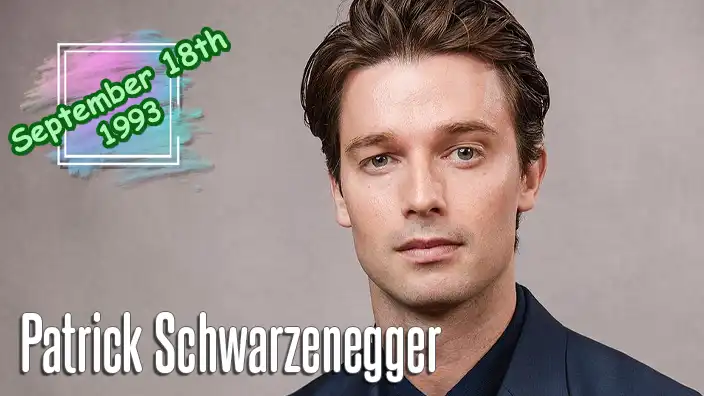
September 18, 1993, in Santa Monica, California
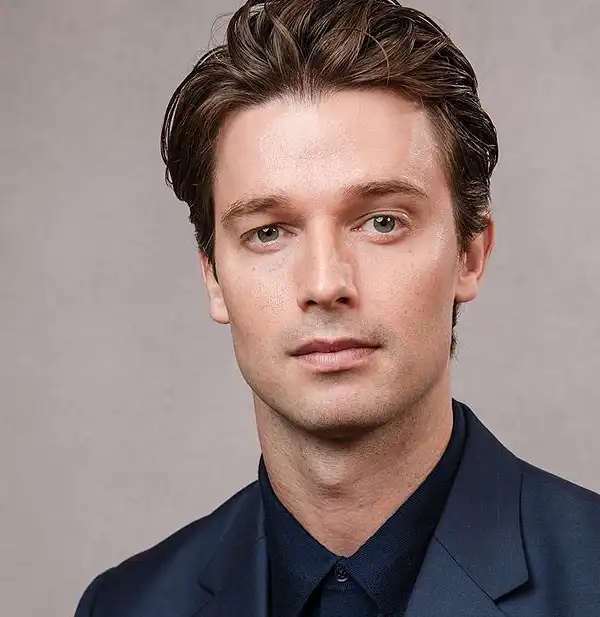
Patrick Schwarzenegger entered the entertainment business carrying one of the most recognizable surnames in Hollywood, which is simultaneously an advantage and a rather substantial piece of luggage. His father, Arnold Schwarzenegger, had already been a bodybuilding champion, international movie star and governor of California. His mother, Maria Shriver, had established her own distinguished career as a journalist and member of the Kennedy family. Patrick therefore grew up surrounded by extraordinary achievement, public attention and expectations that would have been difficult to avoid even if he had decided to become an accountant. Instead, he chose acting and entrepreneurship, thereby ensuring that comparisons with his family would follow him directly into the office.
Patrick Arnold Shriver Schwarzenegger was born on September 18, 1993, in Santa Monica, California, and grew up in Los Angeles. He is one of four children born to Arnold Schwarzenegger and Maria Shriver, alongside sisters Katherine and Christina and brother Christopher, and he also has a paternal half-brother, Joseph Baena. Through his mother, Patrick is part of the Shriver and Kennedy families; his maternal grandmother, Eunice Kennedy Shriver, was a sister of President John F. Kennedy and the founder of the Special Olympics, while his maternal grandfather, Sargent Shriver, was the first director of the Peace Corps and the Democratic nominee for vice president in 1972.
With that family history, an ordinary childhood was probably never realistically available, but Patrick's parents attempted to instill a strong work ethic and an understanding that a famous surname was not itself a profession. He became interested in both acting and business while young, two pursuits that would eventually develop side by side rather than one replacing the other. Schwarzenegger took acting lessons and began learning the practical side of performance while simultaneously displaying an entrepreneurial streak that appeared long before his acting career became established.
His first screen appearance came in the 2006 comedy The Benchwarmers, when he was still a boy. The film starred Rob Schneider, David Spade and Jon Heder as three grown men who form a baseball team and take on youth squads, a premise best approached without consulting the official rules of Little League. Schwarzenegger's role was small, but it provided an early look at a movie set and allowed him to begin gaining experience without immediately being expected to carry a film simply because audiences recognized his last name.
As a teenager, Schwarzenegger was already experimenting with business. He helped establish Project360, a philanthropic clothing venture designed around products connected with charitable causes. The project reflected an interest in combining commerce with social impact, an approach that would return much later in his business career. Rather than treating entrepreneurship as something to pursue if acting failed, Schwarzenegger increasingly viewed business and entertainment as parallel careers.
Education became an important part of that plan. Schwarzenegger attended the University of Southern California, graduating from USC's Marshall School of Business with a degree in business administration and a minor in cinematic arts. It was an unusually appropriate combination: learn how businesses operate while studying the industry in which you intend to work. Schwarzenegger has said that his father encouraged the business education, pointing out that actors might spend only part of each year actually making films and ought to understand what to do with both their time and their money during the remainder.
Acting continued while he was at university. Schwarzenegger appeared in Stuck in Love, the romantic drama starring Greg Kinnear, Jennifer Connelly, Lily Collins and Logan Lerman, and subsequently turned up in Grown Ups 2. He also appeared in the music video for Ariana Grande's “Right There.” None of these roles instantly established him as a major actor, but they allowed him to accumulate experience gradually while continuing his education rather than attempting to leap immediately from famous son to leading man.
His first substantial starring opportunity arrived with Midnight Sun in 2018. Schwarzenegger played Charlie Reed opposite Bella Thorne's Katie Price, a young woman with xeroderma pigmentosum, a rare condition that makes exposure to sunlight extremely dangerous. Because Katie can venture outdoors safely only after sunset, her relationship with Charlie develops largely at night. The film gave Schwarzenegger a conventional romantic-leading-man role and placed considerably more responsibility on him than his earlier supporting appearances.
Midnight Sun also demonstrated the challenge Schwarzenegger faced in establishing an acting identity. Being young, handsome and carrying a famous surname made it easy for people to assume that leading roles had simply materialized. Yet acting careers are rarely sustained by genealogy alone. Audiences may initially look because they recognize the name, but they will not continue watching indefinitely as a courtesy to somebody's parents. Schwarzenegger therefore continued taking varied roles rather than trying to imitate his father's action career.
That distinction became increasingly noticeable. Patrick did not attempt to become Arnold Schwarzenegger 2.0, complete with machine guns, enormous muscles and increasingly inventive methods of destroying property. His choices leaned toward drama, thrillers and character-driven television, allowing him to develop in a different direction. The 2019 psychological horror film Daniel Isn't Real was particularly useful in demonstrating that he was willing to play darker material. Schwarzenegger portrayed Daniel, the imaginary childhood friend of Miles Robbins' troubled protagonist, whose return proves considerably less comforting than imaginary friends traditionally advertise.
He followed with projects including Echo Boomers and Moxie before joining a formidable ensemble in the HBO limited series The Staircase. Based on the complicated real-life case surrounding novelist Michael Peterson and the death of his wife Kathleen, the series starred Colin Firth and Toni Collette, with Schwarzenegger playing their son Todd Peterson. Working in a cast containing performers of that caliber gave him an opportunity to operate within serious dramatic material far removed from romantic leads and youthful supporting roles.
The Staircase was followed by another significant television part in Gen V, the college-set spin-off from the superhero series The Boys. Schwarzenegger played Luke Riordan, better known as Golden Boy, a powerful and highly regarded student at Godolkin University whose abilities include manipulating fire. In the universe of The Boys, however, being young, attractive, enormously powerful and apparently destined for superhero greatness is generally a reliable indication that something appalling is about to happen.
Golden Boy allowed Schwarzenegger to enter superhero territory without following the conventional heroic formula. Gen V shares the parent series' taste for violence, corporate corruption, dark humor and the unpleasant consequences of giving superpowers to people who are already struggling with ordinary human problems. Although his role was not designed as a long-running conventional superhero lead, Golden Boy became an important presence in the series and introduced Schwarzenegger to another substantial television audience.
In 2024, he took on the role of Tim Tebow in American Sports Story: Aaron Hernandez. The anthology series examined the rise and fall of NFL player Aaron Hernandez, with Schwarzenegger portraying Tebow during the portion of the story involving their shared football world. Playing a recognizable living person brought another challenge, requiring him to portray someone audiences already knew rather than inventing a character entirely from scratch.
Then came The White Lotus.
For the third season of Mike White's acclaimed HBO series, Schwarzenegger was cast as Saxon Ratliff, eldest son of a wealthy American family vacationing at an exclusive resort in Thailand. The Ratliff family included Jason Isaacs as patriarch Timothy, Parker Posey as Victoria and Sarah Catherine Hook and Sam Nivola as siblings Piper and Lochlan. As anyone familiar with The White Lotus already understood, arriving at an expensive tropical resort with your wealthy family was less a holiday than an announcement that several layers of dysfunction were about to be excavated.
Saxon initially appears almost aggressively pleased with himself. He is privileged, materialistic, obsessed with status and sex, and thoroughly convinced that his worldview requires very little revision. Schwarzenegger played the character without trying to make him immediately likable, which was essential. Saxon's confidence needed to be sufficiently excessive that the audience could understand him before the series gradually exposed the insecurity, confusion and family dynamics underneath it.
The role proved to be Schwarzenegger's major breakthrough. The White Lotus already had a reputation for taking accomplished performers and giving them complicated characters within ensembles where apparently trivial conversations could reveal enormous amounts about class, money, desire and self-deception. Saxon gave Schwarzenegger substantially more to work with than the handsome-young-man roles that had occasionally characterized the early stages of his career.
Filming also required an extended stay in Thailand, where the cast worked for months creating the third season. Schwarzenegger later described the experience as an important period of growth both professionally and personally. The role attracted widespread attention and altered perceptions of him as an actor, bringing a level of scrutiny and recognition that earlier projects had not generated to the same degree.
There was also a delightful family connection surrounding The White Lotus. Arnold Schwarzenegger publicly supported his son's performance while joking about the amount of nudity involved. Considering the elder Schwarzenegger began The Terminator by arriving naked in Los Angeles and demanding somebody else's clothes, boots and motorcycle, parental objections on that particular subject would have been difficult to sustain.
Patrick's career outside acting is every bit as important to understanding him. He has spent years investing in consumer businesses, particularly food and beverage companies, and became involved with brands including Blaze Pizza, Super Coffee, Liquid I.V. and OLIPOP. His approach has frequently involved becoming more than a passive investor, using his business education and experience to understand branding, growth and consumer behavior.
One of his most significant ventures is MOSH, the nutrition company he co-founded with his mother, Maria Shriver, in 2021. The company was developed around brain health and initially focused on protein bars containing ingredients marketed toward supporting both brain and body nutrition. The venture grew partly from Shriver's long-standing work concerning Alzheimer's disease and brain-health research, making it both a commercial project and one with a personal family connection.
MOSH also committed money toward Alzheimer's research, giving the company a social mission alongside its commercial objectives. The business began by selling directly to consumers before expanding into physical retail. By 2023, the company had raised outside investment to accelerate that expansion after reporting more than $10 million in direct-to-consumer sales during its early years. The company continued growing as its products moved onto retail shelves, turning what could easily have been dismissed as another celebrity-branded product into a substantial operating business.
The combination of acting and entrepreneurship makes Schwarzenegger's career unusually interesting. Hollywood has plenty of actors who invest their earnings, and plenty of businesspeople occasionally wander in front of a camera. Schwarzenegger has deliberately pursued both disciplines from an early stage. He studied them together at USC, developed investments while building his acting credits and has repeatedly described business as something he intends to continue regardless of what happens in Hollywood.
That dual approach may also have helped him cope with the peculiar advantages and disadvantages of his family name. There is no sensible argument that being the son of Arnold Schwarzenegger and Maria Shriver provides no opportunities. Of course it does. Schwarzenegger himself has acknowledged the doors that his background can open. The more difficult question is what someone does after receiving access to those doors, particularly when every achievement risks being attributed to the family name and every failure receives additional attention because of it.
His career has therefore developed relatively gradually. There was no immediate attempt to place him at the center of an enormous action franchise. Instead came supporting roles, independent films, television ensembles, a romantic drama, psychological horror, true-crime drama, superhero satire and eventually The White Lotus. The progression resembles an actor accumulating experience rather than someone attempting to inherit a movie-star position.
That patience has become increasingly valuable. By the time Saxon Ratliff arrived, Schwarzenegger had already spent years working on screen and could take advantage of the complexity Mike White's writing offered. The character may have been unpleasant, arrogant and spectacularly lacking in self-awareness, but he was memorable—and being memorable in an ensemble containing Parker Posey, Walton Goggins, Carrie Coon, Jason Isaacs and several other formidable performers is no small achievement.
The business side has developed in much the same way. What began with a teenage clothing venture expanded into investments and eventually into co-founding and operating a growing consumer brand. Acting and entrepreneurship are very different pursuits, but both reward persistence, judgment and the ability to survive when an idea does not immediately work.
Patrick Schwarzenegger may never completely escape comparisons with his parents, and perhaps there is no reason he should try. Family history is part of his story. His father's journey from Austria to bodybuilding and Hollywood is extraordinary, while his mother's journalism and the public-service tradition of the Shriver and Kennedy families form an equally significant inheritance.
The more interesting story, however, is what Patrick Schwarzenegger has been doing with that inheritance.
He has steadily assembled a career that looks less like an imitation of either parent and increasingly like his own peculiar combination of Hollywood and business. Midnight Sun established him as a leading man, The Staircase strengthened his dramatic credentials, Gen V introduced him to the superhero crowd, American Sports Story gave him a real-life figure to portray, and The White Lotus provided the breakthrough role that forced considerably more viewers to pay attention.
Meanwhile, when the cameras stop rolling, there is apparently a protein-bar company to run and another investment to examine.
Arnold Schwarzenegger once demonstrated that it was possible to combine bodybuilding, movies, business and politics into one extraordinarily improbable career. His son seems to have inherited at least one unmistakable family characteristic: apparently, one occupation simply isn't enough.