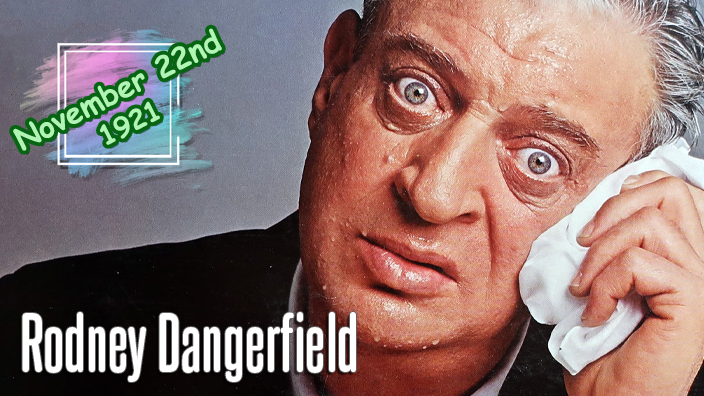
November 22, 1921, in Deer Park, New York
 October 5, 2004, in Los Angeles, California

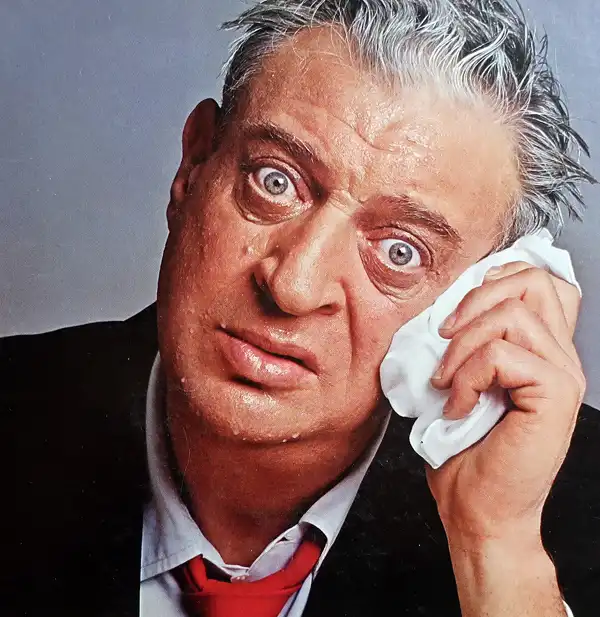
Rodney Dangerfield was born Jacob Rodney Cohen on November 22, 1921, in Deer Park, New York. He became one of America's most recognizable stand-up comedians, building a remarkable entertainment career around the unforgettable catchphrase, "I don't get no respect!" His distinctive delivery, exaggerated expressions, and seemingly endless collection of self-deprecating jokes made him a favorite with audiences who appreciated comedy delivered at machine-gun speed.
His childhood, however, was considerably less amusing than the stories he eventually told onstage. His father, Phil Roy, was a vaudeville performer who used the stage name Roy, while his mother, Dorothy, struggled to provide a stable family environment. Dangerfield experienced an unhappy upbringing marked by financial difficulties and family tensions. Those early experiences helped shape the insecure, perpetually mistreated character he would later develop into one of comedy's most successful acts. Unlike comedians who presented themselves as clever winners, Dangerfield found his audience by portraying himself as the fellow who couldn't catch a break even if someone threw it directly into his hands.
Dangerfield began writing jokes as a teenager and eventually performed under the name Jack Roy. Success did not arrive immediately. His early attempts at establishing a career in show business brought more disappointment than applause, and he eventually abandoned professional comedy to support his family. He worked in various occupations, including selling aluminum siding, while the entertainment industry continued quite happily without realizing what it was missing. Fortunately for comedy audiences, Dangerfield wasn't finished with show business. He was merely taking an unusually long intermission.
During the early 1960s, the struggling performer reinvented himself as Rodney Dangerfield, adopting a stage name that would become synonymous with self-deprecating humor. His new comedic identity revolved around a man who received absolutely no respect from his wife, his children, his doctor, his neighbors, or practically anyone else unfortunate enough to appear in one of his jokes. Even imaginary strangers seemed determined to make his life miserable.
The genius of Dangerfield's comedy was its simplicity. He didn't need elaborate stories, complicated characters, or lengthy explanations. A typical performance consisted of rapid-fire jokes, delivered with remarkable timing and accompanied by nervous gestures, exaggerated facial expressions, and his trademark habit of adjusting his necktie. His jokes frequently explored marriage, childhood, appearance, and everyday frustrations, transforming ordinary disappointments into extraordinary punchlines.
His famous catchphrase became much more than a repeated complaint. It was the foundation of an instantly recognizable comedic personality. Dangerfield portrayed himself as the ultimate underdog, a man whose wife was unimpressed, whose children were disrespectful, and whose doctor seemed to regard his continued existence as a medical inconvenience. Audiences loved him because his fictional misfortunes made their own problems seem considerably more manageable.
Behind the apparent chaos was a disciplined professional who spent years perfecting his material. Dangerfield carefully developed and refined jokes, paying close attention to audience reactions and eliminating anything that failed to produce the desired laugh. His performances appeared spontaneous, but their effectiveness depended on extraordinary preparation and an understanding of comedic rhythm. He could deliver more jokes in a few minutes than some comedians managed during an entire evening, leaving audiences laughing while desperately trying to catch up.
Rodney Dangerfield's big breakthrough came on March 5, 1967, when he appeared on The Ed Sullivan Show, one of America's most influential television variety programs. His performance introduced millions of viewers to the nervous, unlucky comedian who couldn't understand why the entire world seemed determined to make his life difficult. The response was enthusiastic, and Dangerfield became a recurring guest, eventually making numerous appearances on the program. After years of struggling to attract attention, he had finally found a national audience willing to listen to his complaints about being ignored.
His growing popularity led to appearances on The Tonight Show Starring Johnny Carson, The Dean Martin Show, and other major television programs. Dangerfield became particularly associated with Johnny Carson's late-night show, where his rapid-fire jokes and exaggerated expressions were perfectly suited to television. Carson's audiences appreciated his ability to generate laughter almost immediately, often without needing elaborate setups. Dangerfield's performances were so densely packed with punchlines that viewers barely had time to recover from one joke before another arrived.
Dangerfield also became a successful nightclub performer, appearing regularly in Las Vegas and other entertainment centers. His performances attracted audiences who enjoyed traditional stand-up comedy, where a comedian stood before a microphone and relied on timing, personality, and carefully constructed jokes rather than elaborate theatrical effects. His unmistakable stage presence, complete with a dark suit, white shirt, and red tie, became as familiar as his catchphrase. If the audience saw him adjusting his tie, they knew another complaint about life's unfairness was about to arrive.
In 1980, Rodney Dangerfield achieved a major cinematic breakthrough with the sports comedy Caddyshack, directed by Harold Ramis. The film featured an impressive cast that included Chevy Chase, Bill Murray, Ted Knight, and Michael O'Keefe. Dangerfield played Al Czervik, a loud, wealthy, extravagantly dressed real estate developer who arrives at an exclusive country club and immediately disrupts its carefully maintained atmosphere of upper-class dignity.
Al Czervik was practically designed for Dangerfield's comedic talents. He was obnoxious, outspoken, wealthy, and completely uninterested in following the social conventions of the country club's established membership. While Judge Elihu Smails, played by Ted Knight, represented the pompous traditions of privileged society, Czervik represented everything those traditions were intended to exclude. Dangerfield's character treated the golf course like his personal amusement park, cheerfully insulting the members while demonstrating that money could buy an expensive membership but apparently not a functioning volume control.
Although Caddyshack received mixed reviews when it was initially released, it eventually became one of the most beloved golf comedies in American cinema. Dangerfield's performance was particularly memorable because his character injected an almost continuous stream of jokes into the proceedings. His confrontations with Ted Knight provided some of the film's funniest moments, while his outrageous clothing and complete disregard for country club etiquette made Al Czervik an unforgettable character.
For Dangerfield, Caddyshack represented an important turning point. He had already established himself as a successful comedian, but the film demonstrated that his distinctive personality could translate effectively to the big screen. Hollywood had discovered that the man who complained about receiving no respect could attract considerable attention at the box office. The country club might not have appreciated his presence, but movie audiences certainly did.
Following the success of Caddyshack, Rodney Dangerfield starred in Easy Money, a 1983 comedy that he also helped write. He portrayed Monty Capuletti, a hard-living photographer whose habits include gambling, drinking, smoking, and generally enjoying everything that sensible people are advised to avoid. When his wealthy mother-in-law dies, Monty discovers that he can inherit a substantial fortune, but only if he abandons his unhealthy lifestyle. For a man whose idea of personal improvement probably involved buying a larger refrigerator, the conditions present a considerable challenge.
The film allowed Dangerfield to expand his familiar comedic personality into a leading role while exploring themes of temptation, family relationships, and the difficulty of changing established habits. Although Easy Money did not achieve the commercial success of his later films, it demonstrated his ability to carry a feature-length comedy and helped establish him as a recognizable Hollywood leading man.
His greatest starring success arrived with Back to School, released in 1986. Dangerfield played Thornton Melon, a wealthy, self-made businessman who decides to enroll in college alongside his son. His intentions are admirable, but his approach to higher education is somewhat unconventional. Rather than quietly attending lectures and completing assignments, Thornton uses his considerable fortune to transform college life into an extravagant personal adventure.
The film cleverly contrasts academic traditions with Thornton's practical business experience and complete disregard for conventional student behavior. Dangerfield's character hires experts to complete assignments, throws enormous parties, and attempts to solve academic difficulties with the same financial enthusiasm that made him successful in business. His interactions with university professors, particularly the pompous Dr. Barbay, provide opportunities for the kind of confrontational comedy that Dangerfield performed so effectively.
Back to School became a major box-office success, earning more than $100 million domestically and further establishing Dangerfield as a bankable comedy star. The film also featured appearances by Robert Downey Jr., Sally Kellerman, Burt Young, and comedian Sam Kinison. Its popularity demonstrated that audiences were happy to watch Dangerfield play a wealthy troublemaker who could purchase almost anything except the approval of people determined to look down on him.
Rodney Dangerfield's influence extended far beyond his own performances. In 1969, he established Dangerfield's, a comedy nightclub in Manhattan that became an important venue for established entertainers and aspiring stand-up performers. The club provided comedians with opportunities to develop their material, gain experience before live audiences, and attract the attention of entertainment industry professionals.
Dangerfield understood the difficulties facing inexperienced comedians because he had spent years struggling to establish his own career. Rather than treating younger performers as competition, he frequently supported them and helped introduce their talents to wider audiences. His encouragement became especially significant during the 1980s, when stand-up comedy experienced a period of enormous popularity across the United States.
Through his HBO Young Comedians specials, Dangerfield helped provide national exposure for performers who would eventually become major entertainment figures. Among the comedians associated with these programs were Jerry Seinfeld, Jim Carrey, Roseanne Barr, Sam Kinison, Tim Allen, and Bob Saget. Although their comedic styles differed considerably, they benefited from opportunities that Dangerfield helped create.
His willingness to support emerging performers revealed a side of his personality that contrasted sharply with his perpetually miserable stage character. Offstage, Dangerfield was widely regarded as generous toward fellow comedians and genuinely interested in helping talented newcomers succeed. The man who supposedly received no respect was quietly earning plenty of it from an entire generation of performers.
Throughout the 1990s, Rodney Dangerfield continued appearing in films and television productions, demonstrating that his appeal extended beyond the successful comedies of the previous decade. In 1991, he provided the voice of the title character in Rover Dangerfield, an animated musical comedy about a Las Vegas showgirl's dog who unexpectedly finds himself living on a farm. The character was essentially Dangerfield in canine form, complete with familiar complaints about his unfortunate circumstances. Apparently, even being man's best friend wasn't enough to guarantee him any respect.
In 1992, he starred in Ladybugs, a sports comedy about a businessman who becomes involved in coaching a girls' soccer team. The film relied heavily on mistaken identities and outrageous situations, giving Dangerfield another opportunity to portray an ordinary man whose attempts to improve his circumstances produce increasingly ridiculous consequences.
One of his most surprising performances came in Oliver Stone's controversial 1994 film Natural Born Killers, where he portrayed the abusive father of Mallory Knox, played by Juliette Lewis. The role was a dramatic departure from his familiar comedic performances, presenting a disturbing character whose behavior contributed to the film's examination of violence and dysfunctional family relationships. Dangerfield's appearance demonstrated that his acting abilities extended beyond telling jokes, although audiences accustomed to his cheerful complaints might have found the transformation unsettling.
His later film credits included Meet Wally Sparks (1997), The Godson (1998), My 5 Wives (2000), and Little Nicky (2000), in which he played Lucifer. His distinctive voice, facial expressions, and comedic personality remained recognizable regardless of the production. Even when the material was less successful, Dangerfield possessed the unusual ability to make a scene memorable simply by appearing in it.
Rodney Dangerfield's popularity was not limited to television, movies, and nightclub performances. He also released successful comedy recordings, allowing fans to enjoy his rapid-fire routines without leaving their living rooms. His albums captured the distinctive rhythm of his performances, including his nervous delivery, unexpected punchlines, and familiar complaints about family life and personal misfortune.
His 1980 comedy album No Respect earned him the Grammy Award for Best Comedy Recording in 1981. The recognition was particularly appropriate for a performer whose entire professional identity revolved around insisting that nobody appreciated him. Winning one of the recording industry's most prestigious awards must have presented a considerable challenge to his carefully maintained reputation for being overlooked.
In 1983, Dangerfield ventured into the music industry with Rappin' Rodney, a novelty rap recording that combined his familiar comedy with the growing popularity of hip-hop. The accompanying music video featured Dangerfield delivering complaints about his life in a musical setting, demonstrating that his self-deprecating personality could adapt to contemporary entertainment trends. It was an unusual career move for a traditional stand-up comedian, but Dangerfield had never been particularly concerned about appearing fashionable.
His recordings and television specials helped preserve performances that might otherwise have disappeared with the nightclub audiences who originally enjoyed them. They also introduced his comedy to younger generations who discovered that jokes about marriage, money, appearance, and everyday frustrations rarely become obsolete.
Despite his enormous professional success, Rodney Dangerfield experienced considerable personal difficulties throughout his life. His troubled childhood and early career disappointments left lasting impressions, and he spoke openly about periods of depression and insecurity. The contrast between his public personality and private experiences was striking. Onstage, his unhappiness was exaggerated for comic effect; away from the spotlight, some of those emotional struggles were genuine.
Dangerfield married Joyce Indig in 1951, and the couple had two children, Brian and Melanie. Their relationship was complicated, and they divorced, remarried, and eventually divorced again. In 1993, Dangerfield married Joan Child, who remained his wife until his death. His family relationships and personal experiences frequently provided inspiration for his comedy, although the exaggerated disasters described in his routines were not intended as literal accounts of his home life.
In 2004, he published his autobiography, It's Not Easy Bein' Me: A Lifetime of No Respect but Plenty of Sex and Drugs. The book explored his difficult upbringing, professional struggles, relationships, and experiences in the entertainment industry. Its candid approach offered readers a more complicated portrait of the man behind the jokes, revealing the determination and vulnerability that existed beneath his familiar stage persona.
Dangerfield also became an unexpected pioneer of celebrity involvement with the internet. His official website, Rodney.com, launched in February 1995 and is widely credited as one of the earliest celebrity websites, with IMDb identifying him as the first entertainer to establish one. For a comedian who began his career when radio and vaudeville were dominant forms of entertainment, embracing the emerging online world demonstrated a willingness to adapt that might have surprised those who regarded him simply as an old-fashioned joke teller.
Rodney Dangerfield continued performing and making public appearances despite experiencing serious health problems during his later years. In 2004, he underwent heart valve replacement surgery, after which he developed complications. He died on October 5, 2004, in Los Angeles, California, leaving behind a remarkable career that had spanned stand-up comedy, television, motion pictures, recordings, and live entertainment.
His final resting place is at Westwood Village Memorial Park Cemetery in Los Angeles. Even his gravestone reflects the humor that defined his career, bearing the memorable epitaph, "There goes the neighborhood." It was a fitting farewell for a comedian who spent decades convincing audiences that his mere presence was enough to cause everyone else considerable distress.
Dangerfield's contribution to American comedy was substantial. He helped popularize a style of stand-up built around rapid-fire one-liners, exaggerated insecurity, and self-deprecating observations. His instantly recognizable character influenced generations of comedians, while his willingness to support emerging performers helped shape the careers of numerous entertainers who became household names.
His movies remain popular with audiences who appreciate broad comedy, outrageous characters, and the kind of humor that doesn't require an instruction manual. Caddyshack and Back to School, in particular, continue to introduce new viewers to his distinctive personality. His comedy may reflect the attitudes and conventions of its era, but his central theme remains remarkably universal: almost everyone has experienced a moment when they felt overlooked, unappreciated, or treated unfairly.
Rodney Dangerfield spent much of his professional life pretending that nobody respected him. In reality, he earned admiration from audiences, fellow performers, and entertainment professionals around the world. His career demonstrated that persistence, originality, and an extraordinary ability to make people laugh could overcome years of disappointment.
And after everything he accomplished, one suspects that if someone had told him how much he was admired, he would have adjusted his tie, looked thoroughly miserable, and found a way to turn the compliment into another joke.
References & Sources