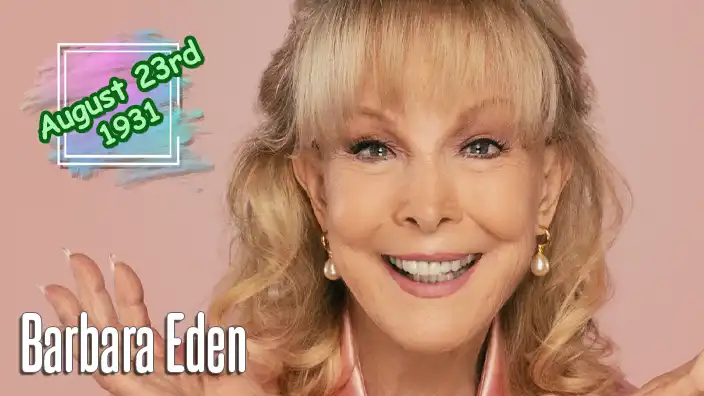
August 23, 1931, in Tucson, Arizona

Barbara Eden was born Barbara Jean Morehead on August 23, 1931, in Tucson, Arizona. Following her parents' divorce, she moved with her mother to San Francisco, where she grew up during the difficult years of the Great Depression. Her mother later remarried, and Barbara eventually took her stepfather's surname, Huffman.
Music was an important part of Eden's early life. She sang in church choirs and, as a teenager, performed with local bands in San Francisco nightclubs. She studied singing at the San Francisco Conservatory of Music and acting at the Elizabeth Holloway School of Theatre, developing the combination of musical and dramatic skills that would serve her throughout a remarkably varied entertainment career.
Her beauty also brought attention. In 1951, Eden was elected Miss San Francisco, but acting rather than beauty competitions became her professional goal. She began appearing on television during the 1950s, an era when the rapidly expanding medium created enormous opportunities for young performers willing to move between comedy, drama, westerns and variety programs.
Eden's early television résumé became impressively diverse. She appeared in series including I Love Lucy, Perry Mason, Gunsmoke, Father Knows Best, The Andy Griffith Show, The Millionaire and Adventures in Paradise. These guest roles gave her experience working across practically every popular television genre of the period.
One of her earliest regular television roles came in the syndicated comedy How to Marry a Millionaire, based loosely on the 1953 Marilyn Monroe, Betty Grable and Lauren Bacall movie. Eden played Loco Jones, one of three women determined to find wealthy husbands.
The series ran from 1957 to 1959 and helped establish Eden as a television performer. Hollywood soon began offering movie roles as well.
Eden appeared opposite Gary Crosby, Barry Coe and Sal Mineo in the 1960 drama A Private's Affair. That same year, she starred with legendary entertainer Elvis Presley in Flaming Star, playing Roslyn Pierce in one of Presley's more dramatic films.
Working with Elvis gave Eden a front-row seat to one of the greatest celebrity phenomena of the era. Presley was already an enormous star, but Flaming Star attempted to demonstrate that he could handle a serious dramatic role rather than simply wait for somebody to conveniently place a guitar nearby.
Eden continued making films during the early 1960s, appearing in Voyage to the Bottom of the Sea in 1961 and The Wonderful World of the Brothers Grimm in 1962. She also starred in Five Weeks in a Balloon, directed by Irwin Allen.
She was building a respectable career as a working actress, but in 1965 she was offered the role that would permanently change her life.
Producer Sidney Sheldon was developing a fantasy sitcom about an astronaut who discovers a beautiful genie imprisoned inside a bottle. The idea became I Dream of Jeannie, and Barbara Eden was selected to play the title character.
The series premiered on NBC on September 18, 1965.
Larry Hagman played astronaut Captain—later Major—Anthony Nelson, who lands on a deserted island following a space mission. While awaiting rescue, Tony discovers an unusual bottle. He opens it, smoke emerges, and suddenly he has a 2,000-year-old genie eager to serve her new master.
This should have made Tony Nelson the luckiest astronaut in American history.
It did not.
Jeannie could grant practically any wish and perform extraordinary magic with a blink and a nod. Unfortunately for Tony, she was also impulsive, jealous, mischievous and deeply in love with him. Her attempts to help regularly produced disasters that Tony then had to explain without mentioning the fairly significant detail that a magical woman was living in his house.
Eden's performance made the premise work.
Jeannie could have become merely a collection of magical tricks and glamorous costumes, but Eden gave her an enormously likable personality. She was innocent without being foolish, mischievous without being malicious and powerful enough to rearrange reality while remaining completely baffled by ordinary human relationships.
The chemistry between Eden and Larry Hagman became central to the show's appeal. Hagman's increasingly exasperated reactions provided the perfect counterweight to Eden's cheerful chaos. Tony would desperately attempt to maintain a normal military career while Jeannie blinked elephants, historical figures, exotic locations and assorted complications into existence.
Then Tony's best friend, Major Roger Healey, played by Bill Daily, discovered Jeannie's secret.
Roger immediately reached the entirely reasonable conclusion that having access to a genie was wonderful and Tony needed to stop complaining.
Tony's commanding officer, Dr. Alfred Bellows, played by Hayden Rorke, was another essential ingredient. Bellows repeatedly witnessed inexplicable events involving Tony but could never obtain enough evidence to prove anything. The poor man spent five years being given perfectly good reasons to believe Major Nelson had lost his mind, only to have the evidence vanish immediately before he could demonstrate it.
The famous Jeannie costume became one of television's most recognizable outfits. Designed in the style of a brightly colored harem costume, it included billowing trousers, a fitted vest and veil.
The costume also produced one of television history's more amusing controversies: Jeannie's navel.
Network standards of the era were remarkably concerned about whether Eden's belly button might appear on television. The costume was therefore carefully designed and positioned to keep it covered. Jeannie could transport people through time, summon objects from thin air and alter reality itself, but apparently a visible navel might have brought down Western civilization.
The first season of I Dream of Jeannie was filmed in black and white. Beginning with the second season, the show switched to color, allowing Jeannie's bright pink costume and elaborately decorated bottle to become even more visually distinctive.
The bottle itself was not originally manufactured specifically for the series. The production used a decorative Jim Beam whiskey decanter that was repainted and modified to create Jeannie's magical home. A liquor bottle thus became one of the most famous pieces of television real estate of the 1960s.
During the show's fifth and final season, Tony and Jeannie finally married. This changed the central relationship significantly, and even series creator Sidney Sheldon later questioned whether marrying the characters weakened the original premise.
I Dream of Jeannie ended in 1970 after five seasons and 139 episodes.
The show never became the highest-rated sitcom of its era during its original run, but something interesting happened afterward: it refused to disappear.
Syndication introduced Jeannie to generation after generation of viewers. The simple fantasy premise traveled well internationally, and Eden's instantly recognizable character became deeply embedded in popular culture. Long after many successful programs from the same period faded from everyday memory, people still knew exactly what somebody meant by folding their arms and blinking dramatically.
Eden did not stop working when Jeannie's bottle was placed back on the shelf.
She continued appearing extensively in television movies, theatrical productions and guest roles. In 1971, she starred in the television movie The Feminist and the Fuzz alongside David Hartman. Other television projects followed throughout the 1970s.
In 1978, Eden starred opposite Harper Valley's collection of fictional hypocrites in Harper Valley PTA, inspired by Jeannie C. Riley's famous 1968 country song. Eden played Stella Johnson, a widowed mother who confronts the judgmental members of her daughter's school PTA.
The film was successful enough to inspire a television series, also starring Eden, which premiered in 1981. The role gave her another opportunity to lead a comedy series while playing a character considerably different from Jeannie.
Eden also demonstrated that the musical abilities she had developed before becoming an actress had not disappeared. She performed in stage productions and musical theater, appearing in shows including The Sound of Music, South Pacific, The Pajama Game, Gentlemen Prefer Blondes and Woman of the Year.
Jeannie, meanwhile, continued occasionally escaping from the bottle.
Eden returned to her famous role in the 1985 television movie I Dream of Jeannie... Fifteen Years Later. She again played Jeannie in I Still Dream of Jeannie in 1991. Larry Hagman did not return as Tony Nelson in either production, but Eden's presence provided the essential connection to the original series.
She also reunited with Hagman professionally years after their sitcom ended. Eden made guest appearances on Dallas, the enormously successful prime-time drama in which Hagman played the scheming oil baron J.R. Ewing.
Seeing Jeannie and Major Nelson reunited in the considerably less innocent world of the Ewing family offered longtime viewers a particularly enjoyable bit of television history.
Eden continued acting into the 21st century, appearing in projects including Sabrina the Teenage Witch, Army Wives and the Hallmark movie Always and Forever. She also remained a frequent guest at television celebrations, conventions and events honoring classic entertainment.
In 1988, Barbara Eden received a star on the Hollywood Walk of Fame, recognizing her contribution to television.
She became an author as well. In 2011, Eden published her memoir Jeannie Out of the Bottle, recounting her career, marriages, experiences in Hollywood and memories of the television series that made her internationally famous.
Her personal life contained considerable hardship behind the cheerful public image. Eden was married three times. Her first marriage, to actor Michael Ansara, lasted from 1958 until 1974. Their son, Matthew Ansara, was born in 1965 and died in 2001 at the age of 35. Eden later wrote candidly about the devastating loss and her son's struggles with addiction.
She married Charles Fegert in 1977, with that marriage ending in divorce several years later. In 1991, she married architect and real-estate developer Jon Eicholtz.
Eden's career has now stretched across more than seven decades, an extraordinary span encompassing the golden age of network television, the rise of color broadcasting, cable television, home video, streaming and the modern rediscovery of classic sitcoms.
Yet Jeannie remains the character most closely connected with her name.
That isn't necessarily a burden. Some performers spend entire careers hoping to create one character audiences will remember. Barbara Eden created one whose costume, bottle, gestures and personality remain recognizable more than half a century after the series ended.
More importantly, Eden's performance is the reason the character endured.
The special effects on I Dream of Jeannie were charming but simple. The plots were deliberately ridiculous. The basic premise could be summarized in one sentence. What kept audiences watching was Eden's ability to make Jeannie delightful even when her latest attempt to “help” had transformed Tony Nelson's perfectly ordinary day into complete chaos.
Her smile suggested Jeannie genuinely believed everything would work out.
Tony's expression generally suggested otherwise.
Barbara Eden became an enduring part of American television history because she brought warmth, comic timing and personality to one of the medium's most famous fantasy characters. From her early appearances alongside Elvis Presley and on classic television programs to Harper Valley PTA, stage productions and decades of appearances celebrating I Dream of Jeannie, she built a career far larger than one magical bottle.
Still, if Barbara Eden happens to fold her arms and blink in your direction, it would probably be wise to stand clear.
You never know where the elephant is going to appear.