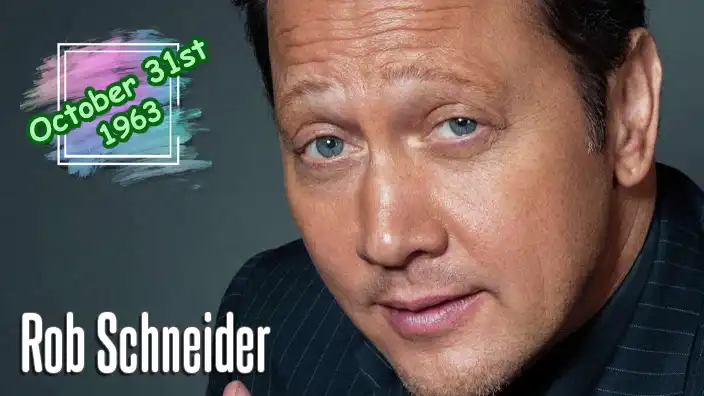
October 31, 1963, in San Francisco, California

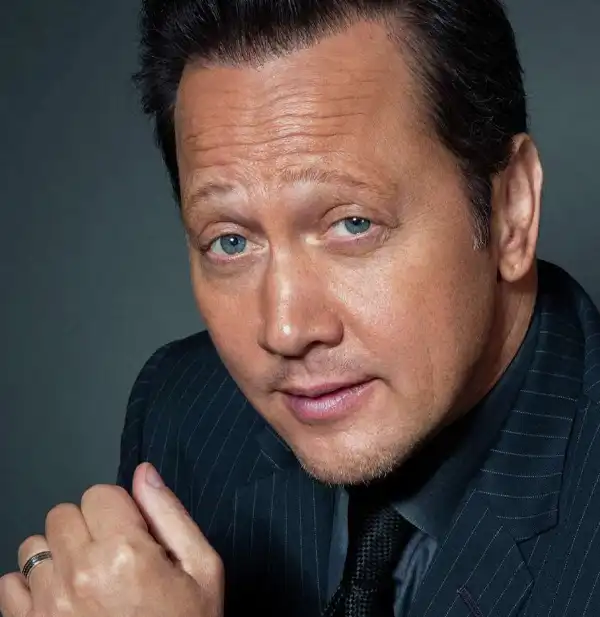
Rob Schneider, born Robert Michael Schneider on October 31, 1963, in San Francisco, California, is an American comedian, actor, screenwriter, director, and producer best known for his work on Saturday Night Live and a collection of outrageous Hollywood comedy films. With his unmistakable delivery, willingness to play ridiculous characters, and a talent for turning even the smallest supporting role into a memorable performance, Schneider became a familiar face in American entertainment. From Deuce Bigalow: Male Gigolo and The Animal to The Hot Chick and numerous collaborations with Adam Sandler, Schneider has built a career around the simple principle that if something looks completely absurd, there's probably a joke hiding in it somewhere.
Schneider grew up in Pacifica, a coastal community near San Francisco, in a family that exposed him to a mixture of cultures and traditions. His mother, Pilar, was a former kindergarten teacher and school board president, while his father, Marvin Schneider, worked in real estate. His mother's family included Filipino ancestry, an influence Schneider would later incorporate into his comedy and personal storytelling. Growing up in the San Francisco Bay Area during the 1960s and 1970s also exposed him to a vibrant entertainment scene, where unconventional humor, political satire, and experimental performances were part of the local culture. Schneider developed an early appreciation for comedians who challenged expectations, particularly Richard Pryor, Peter Sellers, Gene Wilder, and the British comedy troupe Monty Python.
His interest in comedy emerged during his teenage years, when he began writing jokes and experimenting with stand-up performances. While attending Terra Nova High School in Pacifica, Schneider discovered that making people laugh could be more rewarding than following a conventional career path. He eventually began performing in local comedy clubs and other venues around San Francisco, where audiences were not always particularly forgiving. Stand-up comedy required him to develop confidence, timing, and the ability to recover quickly when a joke failed spectacularly. These early performances helped establish his energetic delivery and unpredictable sense of humor, qualities that would become trademarks of his later television and film work.
As Schneider gained experience on the comedy circuit, he began opening performances for established entertainers, including Jay Leno, Jerry Seinfeld, and Dana Carvey. Sharing the stage with successful comedians provided valuable exposure and allowed him to refine his material before larger audiences. In 1987, he made an important national television appearance on Late Night with David Letterman, introducing his comedy to viewers beyond the California club scene. His breakthrough continued when he appeared on HBO's 13th Annual Young Comedians Special, where his performance attracted the attention of television producers. Among those watching was Lorne Michaels, the influential creator and executive producer of Saturday Night Live, who recognized Schneider's potential.
In 1990, Schneider joined the writing staff of NBC's legendary sketch comedy program Saturday Night Live, beginning one of the most important chapters of his career. He soon moved in front of the cameras, becoming a featured performer and eventually a regular cast member. During his time on the program from 1990 to 1994, Schneider worked alongside a remarkable collection of emerging comedy stars, including Adam Sandler, Chris Farley, David Spade, Chris Rock, and Phil Hartman. This era of Saturday Night Live became particularly memorable for its energetic sketches, eccentric characters, and performers who seemed perfectly comfortable abandoning every last shred of dignity in pursuit of a laugh.
Among Schneider's most recognizable Saturday Night Live creations was Richard Laymer, commonly known as the Copy Guy, an irritating office employee who enthusiastically invented nicknames for coworkers while operating a photocopier. His endlessly repeated greetings and exaggerated friendliness transformed an ordinary workplace annoyance into a popular recurring sketch. Schneider also portrayed characters such as Tiny Elvis and the Sensitive Naked Man, demonstrating his ability to turn peculiar ideas into memorable television comedy. The Copy Guy character became especially associated with Schneider, proving that a comedian could achieve national recognition by doing little more than standing beside office equipment and making everyone wish the copier had a mute button.
Schneider's contributions to Saturday Night Live extended beyond his performances. His work as a writer earned him three Primetime Emmy Award nominations for outstanding writing in a variety or music program. The experience taught him the demanding process of creating television comedy under tight deadlines, where sketches could be written, rewritten, rehearsed, and occasionally discarded within days. It also introduced him to a group of performers who would become longtime professional collaborators. In particular, his friendship with Adam Sandler would play an important role in shaping his film career, eventually producing numerous appearances in comedies that became favorites among audiences who appreciated broad humor and cheerful absurdity.
Schneider began building his Hollywood film career while still associated with Saturday Night Live, appearing in movies such as Necessary Roughness (1991), Home Alone 2: Lost in New York (1992), and Surf Ninjas (1993). These early roles allowed him to explore different comedic characters and develop experience working in feature films. He also appeared in Judge Dredd (1995), starring Sylvester Stallone, where Schneider portrayed the talkative and frequently terrified Herman "Fergee" Ferguson. Although the science-fiction action film received mixed reviews, Schneider's character provided comic relief amid the futuristic violence and stern declarations of justice. Apparently, even a dystopian police state needs somebody whose primary responsibility is making sarcastic remarks.
His first major starring success arrived with Deuce Bigalow: Male Gigolo in 1999, a comedy in which Schneider played an unsuccessful aquarium cleaner who accidentally finds himself working as a male escort. The film embraced outrageous situations, physical comedy, and an intentionally ridiculous central character who repeatedly discovers that life can become considerably more complicated than expected. Despite largely unfavorable critical reviews, the movie performed well commercially and developed a following among fans of unconventional comedy. Schneider also contributed to the screenplay, helping establish himself as a performer capable of carrying a feature film rather than simply appearing in supporting roles.
The popularity of Deuce Bigalow: Male Gigolo led to the sequel Deuce Bigalow: European Gigolo in 2005, which transported the unfortunate protagonist into another series of increasingly absurd situations. Although the sequel received harsh criticism, it reinforced Schneider's willingness to embrace outrageous comedy without worrying excessively about artistic respectability. His films frequently divided critics and audiences, with reviewers questioning their reliance on crude humor while supporters enjoyed their energetic performances and deliberately ridiculous premises. Schneider's approach suggested that he was considerably more interested in making moviegoers laugh than convincing film critics that he was secretly preparing to perform Shakespeare.
In 2001, Schneider starred in The Animal, portraying Marvin Mange, a police department employee whose life changes dramatically after an experimental medical procedure leaves him with animal characteristics. The movie provided numerous opportunities for exaggerated physical comedy as Marvin struggled to control instincts that were entirely inappropriate for ordinary human behavior. Schneider co-wrote the screenplay and helped produce the film, demonstrating his increasing involvement behind the camera. The following year, he starred in The Hot Chick (2002), playing a petty criminal who mysteriously exchanges bodies with a popular teenage girl portrayed by Rachel McAdams. The film required Schneider to perform a series of exaggerated mannerisms and awkward social situations, further establishing his reputation for embracing unusual comedy concepts.
Throughout his film career, Schneider maintained a particularly productive relationship with Adam Sandler and the Happy Madison production company. He appeared in numerous Sandler-associated films, including The Waterboy (1998), Big Daddy (1999), Little Nicky (2000), Mr. Deeds (2002), 50 First Dates (2004), The Longest Yard (2005), and Grown Ups (2010). His appearances often involved eccentric supporting characters, unexpected cameos, or enthusiastic encouragement delivered at precisely the wrong moment. One of his most recognizable contributions was the catchphrase "You can do it!", which became associated with several of his comedy appearances. His recurring presence in Sandler's films created a familiar sense of comic camaraderie, with audiences frequently wondering when Schneider would appear and what ridiculous character he would portray next.
Schneider continued expanding his filmography with movies such as The Benchwarmers (2006), in which he starred alongside David Spade and Jon Heder as one of three socially awkward adults competing against children's baseball teams. The comedy combined underdog storytelling with exaggerated physical humor and became another recognizable entry in his career. He also took greater creative control with Big Stan (2007), a prison comedy that he directed, produced, and starred in. Playing a fraudulent businessman preparing for incarceration, Schneider explored a combination of martial arts action and comedy. The project demonstrated his interest in filmmaking beyond acting and his willingness to take responsibility for developing an entire production.
Television remained an important part of Schneider's career after his departure from Saturday Night Live. In 2012, he starred in the CBS sitcom Rob, portraying a man adjusting to life with his wife's close-knit Mexican-American family. Although the series lasted only one season, it reflected Schneider's continuing interest in family relationships and cultural differences as subjects for comedy. He later created and starred in Real Rob, a semi-autobiographical comedy series that premiered on Netflix in 2015. The program incorporated fictionalized versions of Schneider's professional and personal experiences, with his then-wife Patricia Azarcoya Schneider appearing alongside him. By blending scripted situations with elements of reality television, Real Rob offered audiences a deliberately exaggerated look at the complications of living and working in the entertainment industry.
In addition to live-action performances, Schneider developed a substantial career in voice acting. He provided voices for animated productions including Eight Crazy Nights (2002), Norm of the North (2016), and Leo (2023). Voice acting allowed him to use his distinctive vocal delivery and comedic timing without the physical demands of performing elaborate slapstick routines. His involvement in family-oriented animation also introduced him to younger audiences who might not have been familiar with his earlier, more adult-oriented comedy films. For a performer whose career had included male escorts, body-swapping teenagers, and animal instincts, providing the voice of a cartoon polar bear was practically a respectable change of profession.
Despite his extensive television and film work, Schneider continued returning to stand-up comedy, the profession that originally launched his entertainment career. His live performances have explored family life, relationships, cultural differences, aging, and contemporary social issues. In 2020, Netflix released his comedy special Rob Schneider: Asian Momma, Mexican Kids, which drew upon his family background and experiences as a husband and father. His stand-up career has also included tours across the United States and appearances at major comedy venues. Unlike movie productions, where unsuccessful jokes can be edited or repeated, stand-up requires immediate audience reactions, a challenge Schneider has continued to embrace throughout his career.
Schneider's personal life has also attracted public attention. He is the father of three daughters, including singer and songwriter Elle King, whose successful music career includes the hit songs Ex's & Oh's and Drunk (And I Don't Wanna Go Home), recorded with Miranda Lambert. King followed a musical path distinct from her father's comedy career, establishing herself as a prominent performer in pop, rock, and country music. Their relationship has occasionally been the subject of public discussion, particularly after King spoke about difficult experiences during her upbringing. Schneider publicly expressed regret about aspects of their relationship, illustrating that even families accustomed to entertaining audiences can experience complicated personal challenges.
Beyond entertainment, Schneider has become known for expressing strong opinions on political, cultural, and public health issues. His comments on vaccination policies, government authority, and freedom of expression have generated both support and criticism. Some audiences appreciate his willingness to speak openly about controversial subjects, while others have challenged his statements, particularly those concerning vaccines and public health. These controversies have made him an increasingly polarizing public figure outside his comedy work. Regardless of the debates surrounding his opinions, his professional career remains closely associated with the development of American sketch comedy and the commercially successful Hollywood comedies of the 1990s and 2000s.
Schneider has also supported charitable and educational initiatives, including the Rob Schneider Music Foundation, which was established to help provide music education opportunities for students. His involvement reflected an appreciation for the importance of arts education and the opportunities that creative programs can provide for young people. Having developed his own career through performance, writing, and years of practical experience, Schneider has frequently emphasized the value of creative expression. His professional journey demonstrates how opportunities in entertainment can emerge from persistence, experimentation, and the willingness to perform before audiences who may or may not appreciate the joke.
Rob Schneider's career represents a distinctive chapter in modern American comedy, combining television sketch performances, commercially successful films, voice acting, writing, directing, and stand-up entertainment. Although his work has frequently attracted mixed critical reactions, he has maintained a recognizable presence in popular culture through memorable characters, recurring catchphrases, and long-standing collaborations with fellow comedians. From his early performances in San Francisco clubs to the bright lights of Saturday Night Live and Hollywood, Schneider has demonstrated an enduring commitment to making audiences laugh. And considering some of the characters he has portrayed, it seems fair to conclude that he has never allowed the pursuit of personal dignity to interfere with the pursuit of a good punchline.
IMDb – Rob Schneider – Biography, filmography, television credits, awards, and personal details. IMDb – Rob Schneider Biography – Early life, family background, and entertainment career. Rob Schneider – Official Website – Stand-up performances, projects, books, and professional activities. Laugh Factory – Rob Schneider – Stand-up background, television breakthrough, and film collaborations. TV Guide – Rob Schneider Biography – Career milestones, awards, personal background, and comedy influences. American Film Institute – Rob Schneider Filmography – Selected film credits and production history. Fandango – Rob Schneider Biography – Comedy career, Saturday Night Live performances, and major films. NBC Los Angeles – Rob Schneider Gets Personal in His First Netflix Comedy Special – Stand-up comedy, family background, and Netflix special.References & Sources