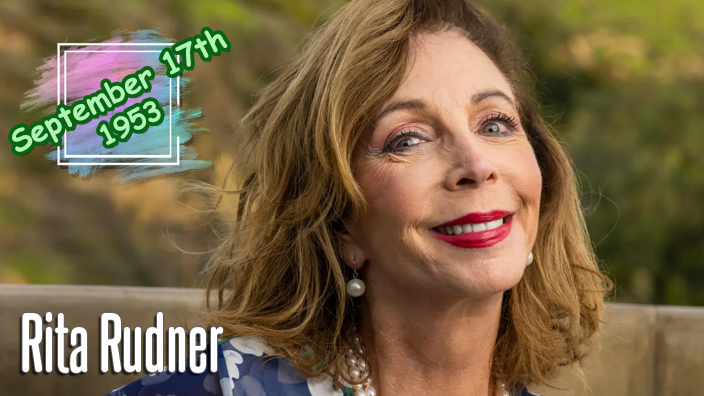
September 17, 1953, in Miami, Florida

Rita Rudner was born on September 17, 1953, in Miami, Florida. Long before stand-up comedy became her profession, however, Rudner intended to make her living with her feet rather than her punchlines. She began studying dance as a child and pursued it seriously enough to leave Florida for New York City while still a teenager, determined to become a professional dancer.
The gamble worked. Rudner found employment as a dancer and became part of the Broadway world, appearing in several major musical productions during the 1970s and early 1980s. Her Broadway credits included Follies, Mack & Mabel and Annie. She was also part of the original Broadway cast of Annie, one of the era's biggest theatrical successes.
Professional dancing gave Rudner something that would later prove extremely useful in comedy: an understanding of timing. Dancers know that arriving half a beat early or late can change everything. Stand-up comedians learn much the same lesson, although missing the beat generally results in uncomfortable silence rather than colliding with another dancer.
As Rudner approached her late twenties, she began considering what would come after dancing. A dancer's professional career can be physically demanding and comparatively short, and she recognized that she would eventually need another occupation. She looked at stand-up comedy and noticed something important: there were relatively few women working prominently in the field.
So she decided to become one.
It was hardly the most obvious career transition. Broadway dancer to nightclub comedian is not a route normally presented by school guidance counselors. Rudner nevertheless began studying comedy with the same seriousness she had brought to dance, watching established comedians perform and analyzing how jokes were constructed and delivered.
She started appearing at New York comedy clubs during the late 1970s and early 1980s, gradually developing a stage persona that distinguished her from louder and more aggressive performers. Instead of pacing the stage and firing jokes at the audience, Rudner generally stood elegantly before them and spoke in a calm, almost conversational voice.
Then she slipped in the knife.
Her material frequently examined relationships, marriage, dating, men, women and the absurdities of everyday social behavior. Rudner's jokes often begin with an observation that sounds perfectly innocent before taking an unexpected turn. The contrast between her polished appearance, soft delivery and sharply constructed punchlines became her trademark.
Television provided the next major step. During the 1980s, Rudner began appearing regularly on comedy and variety programs, including The Tonight Show Starring Johnny Carson. For comedians of that era, a successful appearance with Carson could transform a career. The program provided a national audience and, more importantly, an unofficial stamp of approval from one of the most influential figures in American comedy.
Rudner became a frequent television presence, appearing on Late Night with David Letterman and other programs while building a reputation as one of the country's leading stand-up comedians. HBO and cable television further expanded the audience for stand-up during the period, and Rudner was ideally positioned to benefit.
Her first solo HBO special, Rita Rudner's One Night Stand, aired in 1989. Other specials followed, including Born to Be Mild and Married Without Children. The titles themselves captured her comic sensibility: take a familiar phrase, give it a small twist and allow the audience half a second to realize what just happened.
Born to Be Mild became particularly associated with Rudner's comedy persona. Where stand-up traditionally celebrated rebelliousness and excess, Rudner found humor in restraint, relationships and ordinary domestic life. She did not need to pretend she had just escaped from a motorcycle gang. There was quite enough material available from husbands.
Her success extended to the United Kingdom, where her comedy found an enthusiastic audience. Rudner hosted and appeared in television productions for British audiences and became more internationally recognizable than many American stand-up performers whose careers remained centered almost entirely at home.
Film also entered the picture. Rudner appeared in movies including Peter's Friends, Kenneth Branagh's 1992 ensemble comedy-drama starring Branagh, Stephen Fry, Emma Thompson, Hugh Laurie and Imelda Staunton. Rudner played Carol Benson, an American accompanying her husband to a New Year's reunion at an English country house.
The film allowed her to work within an ensemble containing some formidable British comic and dramatic talent. Rather than simply appearing as a stand-up comedian dropped into a movie, Rudner played a character whose insecurities and relationship problems contributed to the increasingly complicated reunion.
She also appeared in films such as Gleaming the Cube and Golda's Balcony, while accumulating television acting credits and appearances as herself. IMDb lists her work across acting, writing and producing, reflecting the extent to which her career eventually expanded beyond simply performing a nightclub set.
Writing became another major part of Rudner's professional life. She has written books combining humor, relationships and observations about everyday life, including Naked Beneath My Clothes, Rita Rudner's Guide to Men, Tickled Pink and Turning the Tables.
Her literary voice is recognizably the same one audiences hear onstage. Rudner's comedy depends heavily on carefully structured language, making the transition from spoken joke to written humor particularly natural. Where some physical comedians lose an essential ingredient when reduced to the printed page, Rudner's humor often begins with the sentence itself.
Her personal and professional lives also became closely connected through her marriage to British producer and writer Martin Bergman. The couple married in 1988, and Bergman became an important creative collaborator. Together they wrote the screenplay for Peter's Friends, and their partnership subsequently extended into theatrical productions and other entertainment projects.
Rudner and Bergman also became parents to an adopted daughter, Molly. Marriage and family life naturally provided Rudner with additional material because a comedian specializing in relationships is unlikely to allow decades of married life to pass without taking notes.
By the turn of the millennium, Rudner's career acquired another defining location: Las Vegas.
Stand-up comedians had performed in Las Vegas for generations, but extended residencies offered a different kind of career. Instead of constantly traveling from city to city, a performer could establish a permanent show and allow the audience to come to them. Rudner became exceptionally successful at it.
She began a Las Vegas run at the MGM Grand before moving to New York-New York Hotel & Casino and later Harrah's. Her performances attracted tourists looking for comedy that was clever, sophisticated and comparatively clean, making her particularly well suited to audiences containing several generations of the same family.
Rudner's residency at New York-New York became one of the most successful comedy runs in Las Vegas. She performed thousands of shows in the city and sold well over a million tickets during her long association with Las Vegas entertainment. At a time when the Strip increasingly became associated with major musical residencies, Rudner demonstrated that a woman with a microphone, a dress and a very large supply of observations about marriage could occupy plenty of seats too.
Her comedy also suited Las Vegas in an unusual way. The city is famous for spectacle: enormous theaters, elaborate costumes, pyrotechnics, dancers, fountains and occasionally enough lighting to make daylight seem underfunded. Rudner offered almost the opposite. Her principal special effect was a pause before the punchline.
That restraint became one of her greatest strengths.
Rudner has frequently been described as a clean comedian, although "clean" can be misleading if it suggests blandness. Her jokes can be pointed and adult, but she generally avoids relying heavily on profanity or graphic material. Instead, she constructs jokes around language, assumptions and the differences she observes between people.
Marriage has provided an especially rich supply of material. Husbands and wives misunderstand one another, people behave differently while dating than after marriage, and men and women can apparently occupy the same house while maintaining entirely different interpretations of what is happening inside it. Rudner has mined those differences for decades without needing to turn her performances into angry lectures.
Her delivery is crucial. She often speaks slowly and precisely, allowing audiences time to follow the setup before the punchline changes its meaning. There is rarely any need to announce that a joke has arrived. The laugh does that for her.
Rudner's theatrical work eventually moved beyond conventional stand-up as well. She and Bergman created solo and stage pieces that combined comedy with storytelling and acting. Among them was Rita Rudner: Live from Las Vegas, while later projects demonstrated her interest in more structured theatrical forms.
She also performed in Two's a Crowd, a musical comedy she co-wrote with Bergman. The production centered on two very different people who discover that a hotel reservation mistake has left them sharing the same room. For a comedian who spent decades examining relationships between men and women, trapping two strangers together in a hotel room was less a theatrical premise than an opportunity to open a fresh notebook.
Another solo theatrical work, Staged, allowed Rudner to draw upon her experiences as a Broadway dancer before she became famous as a comedian. Such performances brought her career full circle, reconnecting the stand-up performer with the theater world where she had begun decades earlier.
That early Broadway training helps explain something distinctive about Rudner's stage presence. Even when she appears simply to be standing and talking, there is considerable control behind the performance. She understands posture, pacing, rhythm and how to hold an audience's attention without unnecessary movement. The dancer never entirely disappeared; she merely stopped doing eight shows a week in tap shoes.
Over the years, Rudner has received recognition from the comedy and entertainment industries while maintaining a remarkably durable career. She has appeared in numerous television specials, performed internationally and become one of the female comedians most closely associated with long-running Las Vegas entertainment.
Her longevity is particularly noteworthy because stand-up comedy changes quickly. Styles fall in and out of fashion, television platforms disappear, comedy clubs close, and audiences develop new expectations. Rudner's fundamental approach, however, requires very little technological updating. Human beings continue dating, marrying, arguing, shopping and misunderstanding one another, thereby ensuring that her raw materials remain abundantly available.
She has also managed something difficult for any performer whose career becomes associated with a particular style: remaining recognizable without becoming a caricature of herself. The elegant clothes, soft voice and carefully measured delivery remain part of the package, but the jokes continue to depend on observation rather than nostalgia.
Rita Rudner's career is therefore an unusual combination of Broadway discipline and nightclub comedy. She began as a dancer surrounded by orchestras, costumes and choreographed ensembles, then discovered that she could command a stage alone with little more than a microphone and carefully chosen words.
It turned out she didn't need the chorus line after all.
She just needed the timing.