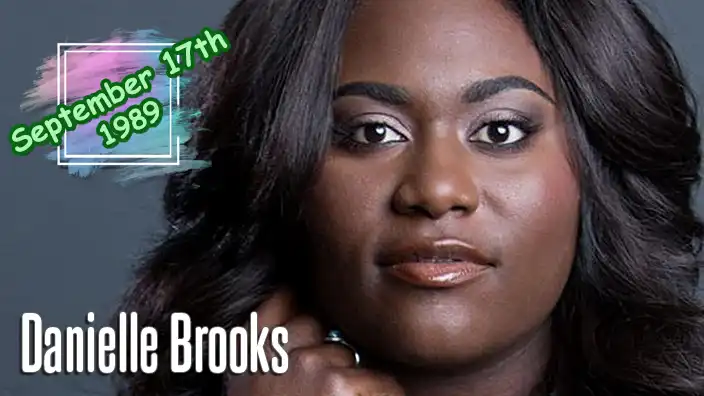
September 17, 1989, in Augusta, Georgia
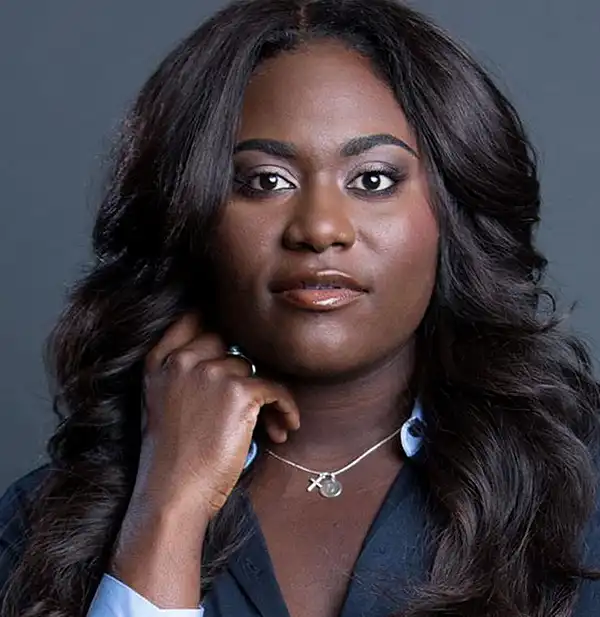
Danielle Brittany Brooks was born on September 17, 1989, in Augusta, Georgia, and grew up in South Carolina. Raised in a religious family, with a father who was a deacon and a mother who was a minister, Brooks became involved in performing while still young. Church provided one of her earliest stages, giving her opportunities to sing and perform before audiences long before Broadway, Hollywood or streaming television came calling.
Her interest in acting developed seriously during her teenage years. Brooks attended the South Carolina Governor's School for the Arts & Humanities, an intensive residential arts program that helped prepare her for professional training. From there she headed for one of the most famous performing arts schools in the world: the Juilliard School in New York City.
Juilliard is not generally known for handing out diplomas because someone looks promising and has shown up regularly. Its drama program is famously demanding, and Brooks graduated in 2011 after developing the classical training that would later underpin performances ranging from Shakespeare to prison comedy-drama and superhero mayhem.
She did not have to wait long for her breakthrough.
In 2013, Brooks joined the cast of a new Netflix series called Orange Is the New Black. Based on Piper Kerman's memoir, the series followed the inmates and staff of the fictional Litchfield Penitentiary. Brooks played Tasha "Taystee" Jefferson, initially intended as a relatively limited character.
Taystee had other ideas.
Brooks' performance quickly made the character one of the show's most popular and important figures. Taystee could be exuberantly funny, intelligent, loyal, vulnerable, angry and heartbreaking — sometimes within the same episode. Brooks gave her a warmth and energy that immediately attracted attention, but as the series progressed, the writers increasingly entrusted her with some of its heaviest dramatic material.
The early Taystee frequently supplied comedy, particularly through her friendship with Poussey Washington, played by Samira Wiley. Their relationship became one of the emotional centers of the series. Their conversations, jokes and arguments gave the fictional prison an important sense of ordinary human friendship within an extraordinary environment.
Then Orange Is the New Black became considerably darker.
Following Poussey's death, Taystee emerged as a central figure in the prison uprising and demanded accountability for what had happened to her friend. Brooks' performance shifted accordingly. The character who had once provided some of the show's brightest comic moments became one of its strongest vehicles for exploring grief, injustice, institutional failure and the consequences of incarceration.
That development allowed Brooks to demonstrate a dramatic range that went far beyond the comic charisma that had first made Taystee memorable.
Orange Is the New Black became one of the defining programs of the early streaming era. It ran for seven seasons and earned 21 Primetime Emmy nominations, winning four. Its large ensemble cast was repeatedly recognized by the Screen Actors Guild, and Brooks shared in ensemble honors for the series.
While many actors would have been perfectly content with a successful television series occupying their schedule, Brooks decided Broadway looked inviting too.
In 2015, she made her Broadway debut as Sofia in the revival of The Color Purple.
It was not exactly a timid choice for a first Broadway role.
The Color Purple, based on Alice Walker's Pulitzer Prize-winning novel, tells the story of Celie and the women around her in the American South. Sofia is proud, outspoken and fiercely unwilling to submit quietly to mistreatment. The role had already been made famous on screen by Oprah Winfrey in Steven Spielberg's 1985 film, a performance that earned Winfrey an Academy Award nomination.
Brooks joined a Broadway company that included Cynthia Erivo as Celie and Jennifer Hudson as Shug Avery. The production opened at the Bernard B. Jacobs Theatre in December 2015 and became a major critical and awards success.
Brooks' Sofia was impossible to ignore.
Her performance earned her a Tony Award nomination for Best Featured Actress in a Musical as well as a Drama Desk Award, an Outer Critics Circle Award and a Theatre World Award. The cast recording also brought Brooks a Grammy Award as part of the company of the acclaimed revival.
For an actor making her Broadway debut, that is a fairly efficient way of announcing one's arrival.
The role also established an association that would become enormously important later in Brooks' career. Sofia's strength is obvious, but the character requires far more than volume and defiance. Her story contains humor, confidence, cruelty, trauma and resilience. Brooks understood that complexity, finding both the enormous personality and the wounded humanity underneath it.
After leaving the Broadway production, Brooks continued balancing stage and screen work.
Her film appearances included I Dream Too Much, Time Out of Mind, The Day Shall Come and Clemency. In Clemency, she appeared alongside Alfre Woodard in a serious drama examining the emotional and moral consequences of capital punishment. The film won the Grand Jury Prize in the U.S. Dramatic Competition at the Sundance Film Festival.
Brooks also returned to the New York stage in 2019 for Shakespeare in the Park's production of Much Ado About Nothing, directed by Kenny Leon. She played Beatrice, one of Shakespeare's great comic heroines — quick-witted, independent and fully prepared to verbally dismantle Benedick whenever circumstances required it.
For Brooks, moving from contemporary television to Shakespeare was not as great a leap as it might have appeared. Her Juilliard training had included classical theater, and Beatrice gave her another opportunity to combine comedy with emotional depth. Her performance brought additional theater recognition and demonstrated that Taystee and Sofia had certainly not defined the limits of her range.
Then came Mahalia Jackson.
Brooks portrayed the legendary gospel singer in the 2021 television film Robin Roberts Presents: Mahalia. Taking on a real cultural icon presented a different challenge from playing a fictional character, particularly one with a voice and public persona as recognizable as Jackson's.
Brooks was also a co-executive producer on the project. That work earned her a Primetime Emmy nomination for Outstanding Television Movie, adding producing to a résumé already containing substantial achievements in acting and singing.
Meanwhile, Brooks had entered a considerably stranger corner of television.
She joined the DC universe in Peacemaker, created by James Gunn and starring John Cena as Christopher Smith, the violently enthusiastic title character first introduced in The Suicide Squad. Brooks plays Leota Adebayo, a character created specifically for the series rather than taken directly from the comics.
Adebayo begins as something of an outsider among a collection of assassins, government operatives and deeply peculiar individuals attempting to prevent a catastrophic threat. Her relative normality provides an audience entry point into the madness surrounding her.
Of course, "normal" is a flexible concept when your colleagues include Peacemaker, Vigilante and a bald eagle named Eagly.
Brooks brings warmth and humor to the role while also giving Adebayo her own moral conflicts, particularly through her complicated relationship with her mother, Amanda Waller. The series provided Brooks with another opportunity to mix comedy and drama, this time with considerably more explosions.
And then Sofia came knocking again.
A film adaptation of the stage musical The Color Purple entered production, bringing Alice Walker's story back to the big screen nearly four decades after Steven Spielberg's film. Fantasia Barrino, who had previously played Celie on Broadway, was cast as Celie, with Taraji P. Henson as Shug Avery.
Danielle Brooks returned as Sofia.
That meant she was not merely reprising a character. She was taking a performance originally created for the stage and rebuilding it for the intimacy of a movie camera. Broadway rewards performances capable of reaching the back of a theater; cinema can capture the smallest movement of an eye.
Brooks made the transition.
The 2023 film allowed her to preserve Sofia's formidable personality while giving greater attention to the quieter moments of the character's journey. The result brought Brooks some of the strongest reviews of her screen career and a long list of awards recognition.
Most importantly, Danielle Brooks received an Academy Award nomination for Best Supporting Actress for her performance as Sofia.
It created a remarkable piece of career symmetry: the role that had brought her a Tony nomination for her Broadway debut now brought her an Oscar nomination for the film adaptation.
Very few actors get a role that changes their career once.
Sofia managed it twice.
Brooks also received Golden Globe, Critics Choice, BAFTA and Screen Actors Guild recognition during the film's awards run, cementing her transition from celebrated television and stage performer to Academy Award-nominated film actress.
There was also something particularly appropriate about Brooks inheriting Sofia's cinematic legacy. Oprah Winfrey, who played Sofia in the 1985 film and received an Oscar nomination for the performance, was one of the producers of the musical adaptation. Decades after Winfrey first brought Sofia to movie audiences, Brooks became the second actress to receive Academy Award recognition for playing the character.
Brooks has also continued working behind the scenes and supporting the theatrical community. She co-founded Black Women on Broadway with Amber Iman and Jocelyn Bioh, an organization created to celebrate and support the contributions of Black women working in theater.
Her career has also included voice acting, music and producing. She released the EP Four, co-writing its songs, and one of her songs, "Seasons," appeared in the series finale of Orange Is the New Black. Her voice work has included animated productions such as The Angry Birds Movie, Close Enough and Karma's World.
Brooks married Dennis Gelin in 2022. The couple have a daughter, born in 2019. Although Brooks' professional life has become increasingly public, she has spoken openly about motherhood, body confidence and the challenges of building a career in an entertainment industry that has historically maintained narrow ideas about who gets to be a leading performer.
That makes the trajectory of her career particularly interesting.
Taystee could easily have become the role that defined Danielle Brooks permanently. It was enormously popular, lasted seven seasons and arrived early in her professional career. Instead, Brooks used the opportunity as a foundation rather than a ceiling.
She went from Litchfield Penitentiary to Broadway, from Shakespeare to gospel legend Mahalia Jackson, from the lunatic superhero world of Peacemaker to an Academy Award nomination.
And through all of it runs one particularly stubborn character named Sofia.
Brooks has said that playing Sofia taught her important lessons, and it is easy to understand why the role remained significant to her. Sofia refuses to become smaller simply because other people would find her easier to manage that way. There is something of that determination in Brooks' own career: she has moved between mediums and genres without allowing one successful role to determine what should come next.
There is also a satisfying circularity to it.
A Juilliard graduate landed an early television role that unexpectedly became enormous. She used that success to return to the theater, made her Broadway debut in one of American musical theater's most demanding roles, earned a Tony nomination, continued expanding into film and television, and eventually returned to that same character on the big screen.
This time, the Academy came calling.
Not bad for playing Sofia twice.
Although, considering the results, Danielle Brooks might reasonably want to keep the costume somewhere safe.