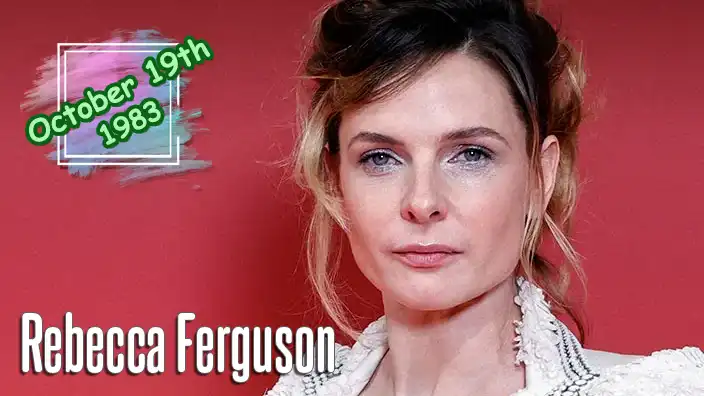
October 19, 1983, in Stockholm, Sweden


Rebecca Ferguson is a Swedish actress whose commanding screen presence, emotional versatility, and impressive action performances have established her as an internationally recognized film and television star. Born Rebecca Louisa Ferguson Sundström on October 19, 1983, in Stockholm, Sweden, she is best known for portraying MI6 agent Ilsa Faust in the Mission: Impossible film series and Lady Jessica Atreides in Denis Villeneuve's science-fiction epic Dune. Her other notable performances include Elizabeth Woodville in The White Queen, Jenny Lind in The Greatest Showman, Rose the Hat in Doctor Sleep, and Juliette Nichols in the acclaimed science-fiction television series Silo. Throughout her career, Ferguson has demonstrated an extraordinary ability to portray intelligent, determined, and frequently dangerous women whose actions can change the course of a story. Whether confronting international criminals, manipulating the political future of a desert planet, or investigating a mysterious underground civilization, she rarely appears to be someone who needs rescuing. More often, everyone else should probably be asking her for help.
Rebecca Ferguson grew up in Stockholm's Vasastaden district, where her upbringing reflected both Swedish and British cultural influences. Her father was Swedish, while her mother, Rosemary Ferguson, was British, with Scottish and Northern Irish family roots. Raised speaking both Swedish and English, Rebecca developed an early familiarity with different languages and cultural traditions, an advantage that would later prove valuable in her international acting career. She attended Adolf Fredrik's Music School in Stockholm, an institution recognized for its emphasis on musical education and choral performance. Her early training introduced her to singing, dance, and the discipline required for artistic performance, although she did not initially set out to become a major Hollywood actress. Like many young people, she explored different interests before discovering that pretending to be someone else could eventually become a very respectable profession.
Ferguson's artistic education extended beyond the classroom. She studied several forms of dance, including ballet, tap, jazz, street dance, and Argentine tango, developing physical coordination and an appreciation for movement that would later become important in her action roles. Her enthusiasm for dance continued into adulthood, and she eventually taught Argentine tango in Sweden. The experience provided a useful foundation for acting, particularly in productions requiring precise choreography, balance, and physical confidence. Anyone who has watched her move through a complicated fight sequence in Mission: Impossible might reasonably suspect that years of dance training were considerably more useful than they first appeared. After all, both tango and international espionage require excellent timing, complete concentration, and the ability to anticipate what another person intends to do next. The principal difference is that tango partners are generally discouraged from attempting to kill one another.
Rebecca Ferguson began working as a model during her early teenage years, appearing in magazines and television advertisements. These assignments introduced her to professional cameras and the entertainment industry, although her first significant acting opportunity arrived while she was still attending school. In 1999, she was cast as Anna Gripenhielm in the Swedish television soap opera Nya tider, or New Times. The series followed the relationships and personal difficulties of characters from different social backgrounds, with Ferguson portraying a young woman from a privileged family. Her performance introduced her to Swedish television audiences and provided valuable experience in serialized storytelling, where actors must develop characters over numerous episodes while adapting to changing dramatic circumstances.
The success of Nya tider brought Ferguson public recognition in Sweden, but it also introduced her to the pressures associated with becoming recognizable at a young stage of her career. Rather than immediately pursuing international fame, she gradually stepped away from the intense attention surrounding television work and explored other aspects of life. She later moved to the picturesque coastal town of Simrishamn in southern Sweden, where she enjoyed a quieter environment away from Stockholm's entertainment industry. During this period, she worked in different occupations and continued teaching dance, maintaining a connection to performance without concentrating exclusively on acting. The decision reflected an independent approach to her career, demonstrating that she was willing to move at her own pace rather than follow the conventional expectations surrounding a young television personality.
Her early screen credits included the Swedish-American television drama Ocean Ave., which premiered in 2002. Set in Florida, the series combined romance, family conflicts, and the complicated relationships associated with wealthy communities. Ferguson's participation provided an early connection to international television production, although the program did not establish her as a major overseas star. In 2004, she appeared in the Swedish horror film Drowning Ghost, known in Sweden as Strandvaskaren, portraying Amanda. The supernatural thriller followed students confronting a disturbing legend associated with their school, introducing Ferguson to the horror genre long before she would become recognizable for portraying one of Stephen King's most frightening villains. Her early career was developing across several genres, even if Hollywood had not yet discovered what she could accomplish.
An unexpected opportunity helped bring Ferguson back toward a more prominent acting career. In 2011, Swedish filmmaker Richard Hobert encountered her at a market in Simrishamn and subsequently cast her in his drama A One-Way Trip to Antibes. Ferguson portrayed Maria in the film, which followed an elderly man confronting difficult family circumstances and the possibility of manipulation by those around him. The production offered her an opportunity to return to substantial dramatic acting after spending time away from major television commitments. The circumstances surrounding her casting have become a frequently repeated part of her professional story, illustrating how unpredictable the entertainment industry can be. Some actors spend years attending auditions and waiting for the telephone to ring. Ferguson was reportedly discovered while going about her ordinary business at a local market. It certainly makes grocery shopping sound considerably more promising.
Her international breakthrough arrived in 2013 when she starred as Elizabeth Woodville in the BBC historical drama The White Queen. Based on novels by Philippa Gregory, the miniseries explored the political struggles, marriages, betrayals, and shifting alliances surrounding England's Wars of the Roses during the fifteenth century. Ferguson portrayed Elizabeth, a widowed noblewoman whose marriage to King Edward IV placed her at the center of a dangerous struggle for royal power. The production required her to portray a woman navigating the competing demands of love, motherhood, ambition, and survival within a political environment where family connections could determine whether someone occupied a throne or disappeared into a prison.
Ferguson's performance in The White Queen attracted widespread critical attention for its emotional intensity and commanding presence. Her Elizabeth Woodville combined intelligence, determination, vulnerability, and a willingness to challenge powerful opponents. Rather than presenting the historical queen as a passive figure swept along by political events, Ferguson portrayed her as an active participant in the struggle for influence and security. The series also required elaborate period costumes, complex dialogue, and the ability to communicate political tension through relatively restrained interactions. Her performance earned a Golden Globe nomination for Best Actress in a Miniseries or Television Film, introducing her to a much broader international audience and establishing her as a performer capable of carrying a major historical drama.
The success of The White Queen proved especially important because it attracted the attention of Tom Cruise, who was preparing another installment in the enormously successful Mission: Impossible franchise. After seeing Ferguson's performance, Cruise became interested in her suitability for the role of Ilsa Faust, a mysterious British intelligence operative whose loyalties and motivations would remain central to the next film. Ferguson subsequently auditioned and secured the role in Mission: Impossible – Rogue Nation (2015), directed by Christopher McQuarrie. The casting transformed her professional career, introducing her to the demands of a major Hollywood action franchise and placing her alongside one of cinema's most recognizable leading actors.
In Mission: Impossible – Rogue Nation, Ferguson portrayed Ilsa Faust, an MI6 agent operating undercover within a dangerous criminal organization known as the Syndicate. Her character repeatedly crosses paths with Ethan Hunt, played by Tom Cruise, while pursuing objectives that do not always align with his mission. Ilsa's intelligence, combat abilities, and uncertain loyalties make her both an invaluable ally and a potential threat. Ferguson approached the role with a combination of physical confidence, emotional restraint, and subtle humor, creating a character who could compete with Hunt without becoming dependent upon him. Unlike many conventional action-film heroines, Ilsa was not simply waiting to be rescued or explained to the audience. She had her own objectives, made her own decisions, and frequently appeared to understand the situation better than the people attempting to control it.
Preparing for Rogue Nation required Ferguson to undertake demanding physical training, including extensive work in martial arts, fight choreography, and stunt performance. She trained intensively for several weeks, developing the strength, coordination, and confidence required for complicated action sequences. Her background in dance proved particularly useful, allowing her to approach combat choreography with an understanding of rhythm and movement. Ferguson performed many of her own stunts, contributing to the physical authenticity of her character. One of the film's most memorable sequences involved Ilsa confronting opponents during an elaborate performance at the Vienna State Opera, combining suspense, violence, and the elegance of a classical musical setting. The scene demonstrated that an evening at the opera can become considerably more exciting when the audience includes international assassins.
Mission: Impossible – Rogue Nation became a major box-office success and established Ferguson as an international action star. Critics and audiences responded positively to her performance, particularly the way she balanced Ilsa's formidable physical abilities with emotional complexity. The character developed a distinctive relationship with Ethan Hunt, built upon mutual respect, professional suspicion, and an attraction complicated by their competing responsibilities. Ferguson's interpretation helped ensure that Ilsa Faust became more than a temporary supporting character, creating a figure whose popularity would lead to appearances in subsequent installments of the franchise.
In 2016, Ferguson appeared in several films that demonstrated her ability to move beyond action cinema. She starred in Despite the Falling Snow, a romantic drama set partly during the Cold War, portraying two related characters across different periods of the story. The film explored espionage, political loyalty, and personal sacrifice, allowing her to combine romantic and dramatic material with historical intrigue. She also appeared in Florence Foster Jenkins, starring Meryl Streep and Hugh Grant, portraying Kathleen Weatherley. The comedy-drama followed the extraordinary true story of a wealthy New York socialite who pursued a singing career despite possessing a voice that was, to put it diplomatically, considerably more enthusiastic than accurate.
That same year, Ferguson appeared in the psychological thriller The Girl on the Train, based on Paula Hawkins's bestselling novel. The film starred Emily Blunt as Rachel Watson, a troubled woman who becomes entangled in a mystery involving disappearance, deception, and unreliable memories. Ferguson portrayed Anna Watson, the new wife of Rachel's former husband, Tom, played by Justin Theroux. The role required her to participate in a story where personal relationships were shaped by suspicion, manipulation, and concealed truths. Although Anna initially appears to occupy a relatively straightforward position within the narrative, the unfolding investigation reveals that the characters' lives are considerably more complicated than they seem. Ferguson's performance contributed to the film's tense atmosphere and demonstrated her ability to work effectively within a psychological ensemble drama.
In 2017, Ferguson appeared in the science-fiction horror film Life, starring Jake Gyllenhaal and Ryan Reynolds. She portrayed Dr. Miranda North, a member of an international crew aboard the International Space Station who discovers that a sample collected from Mars contains an extraordinary extraterrestrial organism. Unfortunately, the organism develops into something considerably less friendly than the scientists initially anticipated. The film combined claustrophobic suspense with the dangers of scientific exploration, requiring Ferguson to portray a professional attempting to maintain control as the situation deteriorated. The production also offered an important lesson for future space travelers: when an unfamiliar organism begins displaying aggressive behavior, perhaps the correct response is not to continue poking it.
Another memorable performance came in The Greatest Showman (2017), the musical drama starring Hugh Jackman as entertainer P. T. Barnum. Ferguson portrayed Jenny Lind, the celebrated nineteenth-century Swedish opera singer whose extraordinary voice earned her international fame and the nickname the Swedish Nightingale. The character becomes involved in Barnum's ambitious entertainment ventures, creating professional opportunities and emotional complications. Although Ferguson had a musical background, Jenny Lind's singing voice in the film was provided by Loren Allred, whose performance contributed to the popular song "Never Enough." Ferguson's portrayal emphasized Lind's elegance, confidence, and complicated relationship with Barnum, allowing her to participate in a visually elaborate musical production that differed considerably from her recent action and thriller roles.
In 2018, Ferguson returned as Ilsa Faust in Mission: Impossible – Fallout, again starring opposite Tom Cruise and directed by Christopher McQuarrie. The film followed Ethan Hunt and his team as they attempted to prevent a catastrophic terrorist attack while navigating betrayal, international intelligence operations, and increasingly dangerous assignments. Ilsa returned with her own mission and conflicting responsibilities, creating further complications for Hunt. Ferguson's performance once again combined physical intensity with emotional restraint, reinforcing the character's position as one of the franchise's most compelling figures. The film received widespread critical acclaim, with particular praise for its action sequences, direction, and the chemistry among its principal performers.
Ferguson's involvement in Fallout included demanding combat scenes, motorcycle sequences, and elaborate stunt choreography. Her willingness to undertake physical preparation contributed to the credibility of Ilsa Faust, whose skills were presented as the result of professional training rather than convenient cinematic magic. The relationship between Ilsa and Ethan continued developing through shared dangers and difficult choices, creating emotional stakes alongside the spectacular action. Ferguson demonstrated that a character could be both formidable and vulnerable without sacrificing either quality. It was also reassuring to discover that, despite the franchise's title, at least one person involved in these missions occasionally appeared to have a sensible plan.
In 2019, Ferguson explored a particularly sinister character in Doctor Sleep, director Mike Flanagan's adaptation of Stephen King's novel and a sequel to The Shining. She portrayed Rose the Hat, the charismatic and ruthless leader of a supernatural group known as the True Knot. The group survives by feeding upon the psychic energy of individuals possessing extraordinary abilities, particularly children with the gift known as the shining. Ferguson's Rose combined elegance, charm, and terrifying cruelty, creating a villain whose pleasant appearance concealed an extraordinary capacity for violence. Her performance became one of the film's most widely praised elements, demonstrating her ability to transform the qualities that made her convincing as a heroic intelligence operative into something deeply unsettling.
Rose the Hat represented an important departure from Ferguson's more sympathetic characters. Rather than portraying a woman struggling against dangerous circumstances, she played someone actively responsible for creating them. Her performance relied upon a disturbing combination of warmth, confidence, and complete indifference to the suffering of others. The character's distinctive appearance, particularly her trademark hat, helped create a recognizable horror villain whose menace came as much from personality as supernatural power. Ferguson approached the role with enthusiasm, demonstrating that playing an irredeemably dangerous character could provide considerable creative satisfaction. Anyone who had previously admired Ilsa Faust's confidence might have found Rose's similar composure considerably less reassuring.
Ferguson's other 2019 film appearances included The Kid Who Would Be King, in which she portrayed the sorceress Morgana, and Men in Black: International, where she played the dangerous alien arms dealer Riza Stavros. These productions continued her association with fantasy and science fiction, allowing her to portray characters whose motivations and abilities extended well beyond ordinary human experience. In The Kid Who Would Be King, she embraced the theatrical possibilities of a legendary supernatural villain, while Men in Black: International offered another opportunity to combine action, humor, and elaborate science-fiction spectacle. By this point, Ferguson had played enough formidable characters that an ordinary romantic comedy might have seemed like a suspiciously peaceful assignment.
One of the most significant roles of Ferguson's career arrived in 2021 with Denis Villeneuve's adaptation of Frank Herbert's influential science-fiction novel Dune. Set in a distant future shaped by powerful noble houses, religious organizations, and competition over a valuable substance known as spice, the film starred Timothée Chalamet as Paul Atreides. Ferguson portrayed Lady Jessica, Paul's mother and a member of the mysterious Bene Gesserit sisterhood, whose members possess extraordinary powers developed through generations of physical and mental training. Jessica occupies a complicated position within the story, balancing loyalty to Duke Leto Atreides, devotion to her son, and obligations to an organization pursuing its own long-term political and religious objectives.
Lady Jessica became one of the emotional foundations of Dune, with Ferguson portraying a woman whose outward composure concealed fear, determination, and profound maternal love. The character's Bene Gesserit training required her to maintain extraordinary control over her body and emotions, yet her personal decisions placed her in conflict with the sisterhood's plans. Ferguson communicated these contradictions through subtle expressions, controlled movements, and moments of intense vulnerability. Her performance helped audiences understand the personal consequences of the film's enormous political and religious conflicts, ensuring that Jessica remained a recognizable human figure within a vast and unfamiliar fictional universe.
The production of Dune required Ferguson to work in demanding desert environments, elaborate costumes, and complex scenes involving invented languages and unfamiliar cultural traditions. Villeneuve's film emphasized atmosphere, scale, and careful world-building, creating a cinematic experience that differed from conventional science-fiction adventures. Ferguson's performance contributed significantly to the story's emotional credibility, particularly during scenes involving Paul's growing awareness of his extraordinary abilities and the dangers facing House Atreides. The film received widespread acclaim for its visual achievements, performances, music, and ambitious adaptation of Herbert's novel. For Ferguson, it represented another opportunity to portray a formidable woman whose decisions carried consequences extending far beyond her immediate family.
She returned as Lady Jessica in Dune: Part Two (2024), which continued Paul's journey among the Fremen people of Arrakis. Jessica's role became increasingly complicated as she assumed a powerful religious position and helped influence the beliefs and political expectations surrounding her son. Ferguson portrayed the character's transformation with an unsettling mixture of maternal devotion, spiritual authority, and calculated manipulation. Her performance illustrated the moral ambiguities central to Herbert's story, particularly the dangers associated with religious prophecy, political power, and charismatic leadership. Jessica was no longer simply protecting her son from danger; she was helping shape events that could transform an entire civilization. It was a considerable promotion from managing family difficulties, although the paperwork must have been dreadful.
Beyond Dune, Ferguson continued exploring science fiction with the film Reminiscence (2021), starring Hugh Jackman. She portrayed Mae, a mysterious woman whose relationship with a specialist in memory-reconstruction technology becomes central to a complicated investigation. Set in a future world affected by rising sea levels and environmental change, the film combined romance, mystery, and speculative technology. Ferguson's character brought emotional ambiguity to the story, requiring audiences to question appearances, motives, and the reliability of memories. The production reunited her with Hugh Jackman following The Greatest Showman, although the circumstances were considerably less cheerful than performing musical numbers beneath theatrical spotlights.
In 2023, Ferguson took on another major science-fiction role when she began starring as Juliette Nichols in the Apple TV+ series Silo, based on Hugh Howey's bestselling novels. The drama takes place in a vast underground structure housing thousands of people who believe that the outside world is too dangerous for human survival. Strict rules govern the inhabitants' lives, while the true history of the silo and the circumstances surrounding its existence remain shrouded in secrecy. Ferguson portrayed Juliette, a skilled engineer working in the mechanical levels whose determination to investigate suspicious events leads her into increasingly dangerous confrontations with the authorities controlling the community.
Juliette Nichols provided Ferguson with a character defined by intelligence, practical ability, and an unwillingness to accept convenient explanations. Unlike Lady Jessica's carefully controlled political influence or Ilsa Faust's sophisticated espionage skills, Juliette's strengths arise primarily from engineering knowledge, persistence, and an instinctive distrust of authority. She is comfortable repairing machinery, investigating technical failures, and confronting problems that others would prefer to ignore. Ferguson's performance captures the character's stubbornness, vulnerability, and growing determination as she discovers that the world she has always known may be built upon deliberate deception. The series became a critical success, with Ferguson also serving as an executive producer.
Silo continued beyond its first season, allowing Ferguson to develop Juliette's character through increasingly complex revelations about the underground civilization. The series' mixture of mystery, science fiction, political control, and human relationships provided substantial dramatic opportunities, while its claustrophobic setting emphasized the psychological pressures of living in a confined environment. Ferguson's ability to portray determination without making Juliette invulnerable helped establish the character as an engaging protagonist. It also suggested that if society ever finds itself living underground, the most valuable person in the community may not be a politician or a celebrity, but the engineer who knows how to keep the ventilation system working.
In 2023, Ferguson also returned to the Mission: Impossible franchise in Dead Reckoning, once again portraying Ilsa Faust. The film followed Ethan Hunt and his allies as they confronted a powerful artificial intelligence capable of manipulating information and threatening global security. Ilsa's involvement added emotional significance to the story, particularly because of the history she shared with Hunt. Her character's fate became one of the film's most consequential developments, marking a dramatic turning point in the franchise. Ferguson's three-film portrayal of Ilsa had established the character as a distinctive presence within modern action cinema, combining independence, intelligence, and physical credibility with emotional depth.
Ferguson's later film work included A House of Dynamite (2025), directed by Kathryn Bigelow, in which she portrayed Captain Olivia Walker. The political thriller examined the response to a potential nuclear crisis, placing characters under extraordinary pressure as they confronted decisions with potentially catastrophic consequences. The film added another serious dramatic production to Ferguson's filmography, allowing her to portray a professional operating within a high-stakes institutional environment. Her career had already involved fictional global threats, supernatural dangers, and interplanetary conflicts, but the prospect of a nuclear emergency demonstrated that Hollywood was still finding new ways to make her working days unpleasant.
In 2026, Ferguson appeared in Mercy, a science-fiction thriller starring Chris Pratt, portraying an artificial intelligence judge involved in a futuristic criminal justice system. She also joined Cillian Murphy in Peaky Blinders: The Immortal Man, portraying the mysterious Kaulo in the continuation of the acclaimed British crime drama. Another 2026 project, The Magic Faraway Tree, featured Ferguson as Dame Snap in a fantasy adventure adapted from Enid Blyton's children's stories. These productions demonstrated the continuing variety of her career, moving between artificial intelligence, historical crime drama, and family fantasy. Her return as Lady Jessica in Dune: Part Three, scheduled for release later in 2026, also promised another chapter in one of her most recognizable cinematic roles.
Outside acting, Ferguson has generally maintained a relatively private personal life. She has two children and is married to businessman Rory St. Clair Gainer. Her family life has remained largely separate from the publicity surrounding her major film productions, reflecting a preference for protecting personal relationships from excessive public attention. Despite her international success, she has retained strong connections to Sweden and has spoken about the importance of family, ordinary routines, and maintaining a sense of perspective within the entertainment industry. Her ability to move between major Hollywood productions and a quieter personal life suggests an appreciation for the distinction between professional recognition and everyday happiness.
Throughout her career, Rebecca Ferguson has received numerous honors and nominations, including a Golden Globe nomination for The White Queen and recognition for her performances in science-fiction and action productions. Her achievements reflect an unusual combination of classical dramatic ability, physical confidence, and a willingness to portray characters who challenge conventional expectations. She has worked alongside major international stars, including Tom Cruise, Hugh Jackman, Timothée Chalamet, Emily Blunt, Ewan McGregor, and Cillian Murphy, while collaborating with directors such as Denis Villeneuve, Christopher McQuarrie, and Kathryn Bigelow. Yet her performances rarely depend upon the reputation of those surrounding her. She consistently creates characters whose intelligence, independence, and emotional complexity command attention in their own right.
Rebecca Ferguson's birthday on October 19 provides an opportunity to celebrate an actress whose career has developed from Swedish television to some of the most ambitious international film and television productions of recent decades. From the royal intrigue of The White Queen to the dangerous assignments of Mission: Impossible, the political and spiritual conflicts of Dune, and the mysteries of Silo, she has repeatedly demonstrated her ability to bring compelling characters to life across different genres. Her performances combine elegance with determination, emotional vulnerability with strength, and dramatic intensity with an occasional welcome sense of humor. Whether audiences remember her as Ilsa Faust, Lady Jessica, Juliette Nichols, or Rose the Hat, Rebecca Ferguson has earned recognition as a performer capable of making even the most extraordinary fictional worlds feel convincing. And if Hollywood ever decides to produce a film in which a Swedish actress must defeat international criminals, negotiate with alien civilizations, repair an underground nuclear reactor, and save humanity before lunchtime, there is already an obvious choice for the leading role.