September 23, 1930, in Albany, Georgia
 June 10, 2004, in Beverly Hills, California
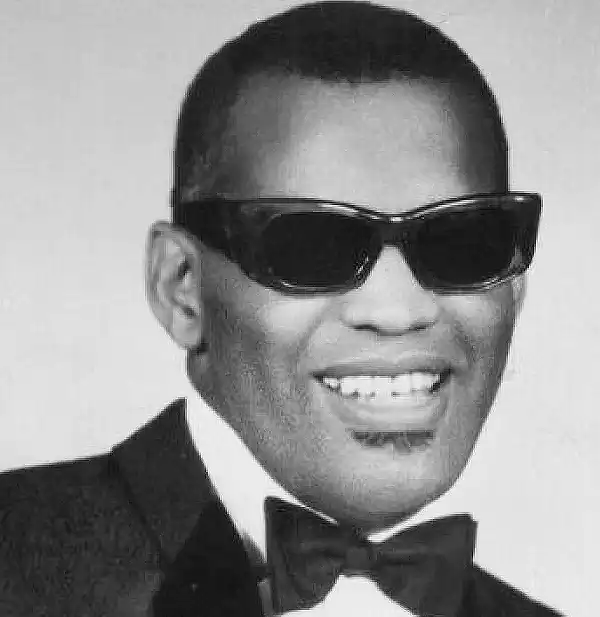
Ray Charles Robinson was born on September 23, 1930, in Albany, Georgia, and spent much of his childhood in Greenville, Florida. His early years were marked by hardship that would have overwhelmed many people before they had even reached adulthood. His younger brother George drowned in a washtub accident when Ray was a small child, an event he witnessed and remembered throughout his life. Soon afterward, Ray began losing his sight, probably as a result of glaucoma, and by the time he was seven he was blind. His mother, Aretha Robinson, was determined that blindness would not become an excuse for dependence and pushed her son toward self-reliance with a toughness that Charles later credited as one of the foundations of his life.
He attended the Florida School for the Deaf and the Blind in St. Augustine, where his musical abilities developed rapidly. Charles learned piano, organ, clarinet, saxophone and trumpet, while also learning to read and write music in Braille. His formal musical education exposed him to classical composers, but outside the classroom he absorbed the blues, jazz, gospel and country music that surrounded him. He had already begun playing piano as a youngster after becoming fascinated by the instrument at a local café, and music increasingly became both his livelihood and his language.
His mother died while Charles was still a teenager, leaving him essentially on his own. He began working professionally as a musician in Florida before eventually traveling to Seattle, Washington, in 1948. There he became part of the local music scene and formed the McSon Trio. Seattle also brought him into contact with another ambitious young musician, Quincy Jones, beginning a friendship that would last for decades.
Charles's earliest recordings reveal a musician still finding his own voice. His singing and piano playing were strongly influenced by artists such as Nat King Cole and Charles Brown, and he was good enough at imitating established styles to earn work. But imitation was never going to make Ray Charles into Ray Charles. During the early 1950s, his sound began changing as he combined the emotional intensity and call-and-response traditions of gospel music with secular blues and rhythm and blues.
His signing with Atlantic Records became a decisive moment. Working with figures including Ahmet Ertegun and Jerry Wexler, Charles found an environment in which experimentation was encouraged rather than tidied away. Recordings such as “Mess Around,” “It Should've Been Me” and “I've Got a Woman” revealed a performer developing an increasingly distinctive style. “I've Got a Woman,” released in the mid-1950s, was particularly important, adapting elements of gospel music into an exuberant secular performance that helped establish the emerging sound eventually known as soul.
That mixture was controversial. Gospel music carried profound religious meaning within African American communities, and using its musical vocabulary for songs about romance, desire and everyday life struck some listeners as inappropriate. Charles did it anyway. The result was not simply gospel with different words but a powerful synthesis of blues, jazz, rhythm and blues and church traditions. His voice could plead, growl, shout, laugh and ache, sometimes within a few measures, while his piano playing supplied a rhythmic drive that was equally distinctive.
Then came “What'd I Say.” Developed partly from an improvised performance when Charles and his band needed to fill time at the end of a dance, the song became one of his defining recordings. Its electric piano riff, rhythmic pulse and increasingly enthusiastic vocal exchanges between Charles and his backing singers created something electrifying. Released in 1959, “What'd I Say” became a major crossover success and helped push Charles beyond the R&B market into mainstream American popular music.
His backing singers became an essential part of that sound. Originally known as the Cookies before evolving into the Raelettes, the female vocal group supplied the gospel-style responses that became a signature of Charles's performances. The interaction between Charles and the Raelettes could sound like a church service that had taken a wrong turn on the way to Sunday morning and ended up having a considerably more entertaining Saturday night.
By the beginning of the 1960s, Charles had moved from Atlantic to ABC-Paramount, negotiating a contract that gave him an unusual degree of artistic and financial control. Among its important provisions was ownership of his master recordings, an extraordinarily valuable arrangement at a time when performers frequently surrendered such rights to record companies. Charles was not simply learning how to control his music; he was learning how to control the business surrounding it.
The hits continued. “Georgia on My Mind,” his interpretation of the Hoagy Carmichael and Stuart Gorrell song, became one of the recordings most closely associated with Charles. His warm, yearning performance turned the song into a standard all over again and earned him Grammy recognition. In 1979, the state of Georgia designated Charles's version of “Georgia on My Mind” as its official state song, giving a recording by a man born in Georgia and raised in Florida a permanent place in the state's cultural identity.
“Hit the Road Jack” followed and became another signature recording. Written by Percy Mayfield, the song featured Charles sparring musically with Margie Hendricks and the Raelettes as a woman firmly informs an unwanted gentleman that his continued presence is no longer required. Charles's increasingly desperate replies do him absolutely no good whatsoever. The record became a major hit and remains one of those songs capable of turning a simple instruction to leave the premises into a communal singalong.
Charles's most audacious move came when he turned toward country music. In 1962 he released Modern Sounds in Country and Western Music, an album that challenged both musical categories and racial assumptions within the American recording industry. Charles took country standards and approached them with combinations of jazz, pop orchestration, gospel feeling and R&B phrasing. Songs associated with predominantly white country audiences suddenly carried the unmistakable musical personality of Ray Charles.
The album was enormously successful. His recording of Don Gibson's “I Can't Stop Loving You” became one of the biggest hits of his career, while other selections demonstrated that the supposed walls separating American musical traditions were considerably flimsier than the record industry liked to pretend. Charles understood that country music, blues and gospel shared emotional and historical connections. Heartbreak, loneliness, faith and longing did not require separate filing cabinets.
Modern Sounds in Country and Western Music became one of the landmark albums of American popular music. It broadened Charles's audience, strengthened his crossover success and demonstrated that an African American R&B star could interpret country material without surrendering his own musical identity. Decades later, musicians across country, soul and pop continued to cite the record as an important influence.
Charles refused to remain confined to recordings alone. He appeared in films and television programs, sometimes as himself and occasionally as a character. One of his best-known movie appearances came in The Blues Brothers in 1980. Playing the proprietor of Ray's Music Exchange, Charles demonstrates an electric piano while the surrounding shop erupts into “Shake a Tail Feather.” The scene is pure Ray Charles: technically there is a plot occurring somewhere, but once he starts playing, nobody particularly cares.
His screen appearances contributed to his public persona without replacing the music at its center. Charles could be humorous and self-aware about his celebrity, and later generations encountered him through television commercials, guest appearances and film performances as readily as through radio. Yet behind the familiar smile and dark glasses remained a formidable working musician who maintained an extensive touring schedule for much of his career.
His personal life was far less orderly than his musical arrangements. Charles married twice and fathered twelve children with several women. His relationships with women, including members of the Raelettes, became part of his complicated private history. His autobiography, Brother Ray: Ray Charles' Own Story, written with David Ritz, did not attempt to manufacture a spotless public figure. Charles could be candid about his appetites, mistakes and contradictions.
One of the most serious struggles of his life involved heroin. Charles used the drug for many years and had several encounters with law enforcement related to narcotics. Following an arrest in the 1960s, he entered treatment and ultimately stopped using heroin. He later spoke openly about his addiction. The episode became another part of a life in which extraordinary professional discipline existed alongside periods of profoundly destructive personal behavior.
Charles was also involved, willingly or otherwise, in the racial politics of the United States during the civil rights era. In 1961, he canceled a scheduled performance in Augusta, Georgia, after learning that the audience would be segregated. The circumstances and subsequent legal consequences have sometimes been simplified in later retellings, but the cancellation became associated with his opposition to segregated performances. Like many Black entertainers of his generation, Charles had built a career while traveling through a country in which racial discrimination affected accommodations, venues, transportation and daily life.
His importance to music became increasingly undeniable as the decades passed. Charles was among the inaugural inductees into the Rock and Roll Hall of Fame in 1986. He also received numerous Grammy Awards during his career, along with a Grammy Lifetime Achievement Award. The Kennedy Center honored him in 1986, and he received the National Medal of Arts in 1993.
Calling Charles a soul musician is accurate but incomplete. He was an accomplished jazz musician with a deep understanding of harmony, an interpreter of country music, a blues singer, a pianist rooted in boogie-woogie and gospel traditions, and a pop performer capable of reaching enormous audiences. He could perform a sentimental ballad followed by an earthy rhythm-and-blues number and make both sound entirely natural. Genre labels were useful for record-store shelves; Ray Charles seemed considerably less interested in them.
His influence can be heard in generations of singers and musicians who followed him. Soul performers inherited the emotional combination of gospel technique and secular material that Charles helped popularize. Rock singers borrowed his vocal intensity. Country artists admired his interpretations of their repertoire. Jazz musicians respected his musicianship. Pop performers learned from his ability to cross markets without sanding away the characteristics that made him distinctive.
The nickname “The Genius” was therefore more than record-company enthusiasm. Charles possessed an unusual ability to hear connections between forms of music that the industry treated as separate products. Where executives saw categories, he heard songs. A melody could begin life as country, pass through gospel harmony, acquire a jazz arrangement and emerge sounding unmistakably like Ray Charles.
His blindness inevitably became part of his public story, but Charles resisted allowing it to define either his personality or his career. He traveled, worked, recorded, conducted business and pursued hobbies with considerable independence. He was known to play chess using a specially adapted board and was fiercely resistant to being treated as helpless. The independence demanded by his mother during his childhood remained evident throughout his life.
In later years, Charles continued recording and performing despite declining health. His final studio project, Genius Loves Company, paired him with artists including Elton John, Norah Jones, B.B. King, Bonnie Raitt, Willie Nelson and Van Morrison. The album demonstrated the extraordinary breadth of his influence: musicians from several genres could sit beside Charles without the collaborations seeming forced because he had spent his career moving comfortably among those genres himself.
Ray Charles died on June 10, 2004, at his home in Beverly Hills, California, from complications related to liver disease. Genius Loves Company was released after his death and became one of the most commercially successful albums of his career. It subsequently won multiple Grammy Awards, including Album of the Year, giving Charles one final remarkable chapter in a recording career that had already stretched across more than half a century.
His life received renewed attention through the 2004 film Ray, directed by Taylor Hackford and starring Jamie Foxx. Foxx's performance earned the Academy Award for Best Actor, while the film introduced another generation to Charles's music and complicated personal history. Charles had been involved with the project before his death and was able to experience portions of the production, although he did not live to see the completed film released.
Ray Charles left behind far more than a collection of famous recordings. He helped reshape the vocabulary of American popular music by demonstrating that gospel, blues, jazz, country, R&B and pop were not isolated territories requiring passports at the border. They were branches of a much larger musical family, and Charles seemed perfectly happy inviting the entire family into the studio.
Put on “What'd I Say,” “Georgia on My Mind,” “Hit the Road Jack” and “I Can't Stop Loving You” one after another and they barely seem to belong in the same category. The common ingredient is Ray Charles himself. His voice, piano, phrasing and instinct turned whatever he touched into something immediately recognizable. Plenty of musicians crossed genres. Ray Charles had the considerably rarer ability to make the genres cross him.