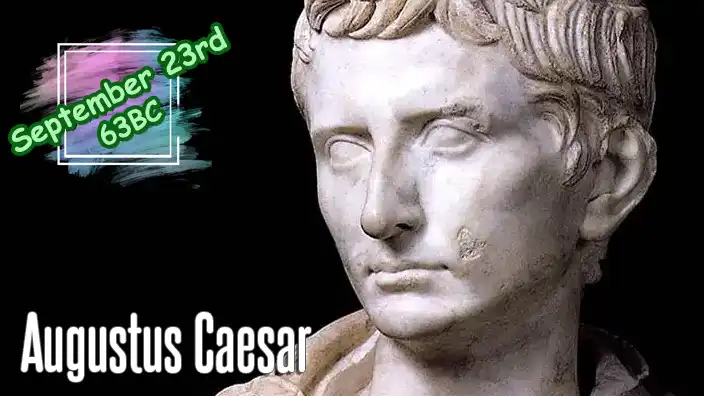
September 23, 63 BC, in Rome, Italy
 August 19, 14 AD, in Nola, Italy
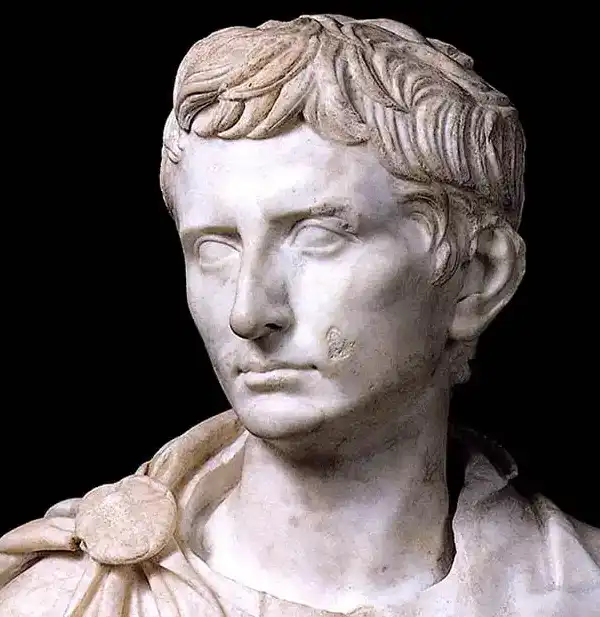
Born Gaius Octavius on September 23, 63 BC, Augustus did not enter the world looking like the inevitable master of Rome. His family was prosperous and politically respectable, but it did not belong to the highest tier of Rome's old aristocracy. His mother, Atia, however, was the niece of Julius Caesar, giving the young Octavius a family connection that would change his life and, eventually, the course of Roman history. His father died while Octavius was still young, and although the boy began entering Roman public life, nothing yet suggested that he would one day become the most powerful man in the Mediterranean world.
That changed dramatically with the assassination of Julius Caesar on March 15, 44 BC. Caesar's will revealed that he had adopted Octavius as his son and made him his principal heir. The young man consequently took the name Gaius Julius Caesar Octavianus, although historians generally call him Octavian during this period to avoid the understandable confusion caused by Rome's habit of giving half the ruling class variations of the same handful of names. More importantly, Octavian inherited Caesar's name, fortune and political legacy. He did not, however, inherit Caesar's power automatically. That he would have to acquire for himself.
It was an astonishingly dangerous inheritance. Mark Antony, one of Caesar's leading supporters, was already an established military and political figure, while Caesar's assassins Brutus and Cassius remained formidable opponents. Octavian nevertheless proved remarkably adept at navigating the chaos. He raised troops, cultivated Caesar's veterans and entered the brutal struggle for control of Rome. In 43 BC, Octavian, Antony and Marcus Aemilius Lepidus formed what became known as the Second Triumvirate, an officially recognized political arrangement granting them extraordinary powers to reorganize the Roman state.
There was nothing particularly gentle about the process. The triumvirs instituted proscriptions in which political opponents were declared enemies and could be killed while their property was confiscated. Among the most famous victims was the statesman and orator Cicero. Octavian's later image as the calm, dignified father of Roman stability can sometimes obscure just how ruthless his climb to power had been. The polished marble portraits came later. First came armies, executions, confiscations and civil war.
The triumvirs defeated Brutus and Cassius at the Battle of Philippi in 42 BC, but cooperation among Rome's new masters was never likely to last. Lepidus was gradually pushed aside, leaving Octavian dominant in the western territories and Antony powerful in the east. Antony's political and personal relationship with Cleopatra VII of Egypt increasingly became a central issue in the struggle between the two men. Octavian's propaganda presented Antony as a Roman leader who had fallen under the influence of a foreign queen, while Octavian positioned himself as the defender of Roman tradition and Italy.
The rivalry culminated in the Battle of Actium on September 2, 31 BC, where the forces of Octavian, commanded at sea largely through the considerable talents of Marcus Vipsanius Agrippa, defeated those of Antony and Cleopatra. The following year Antony and Cleopatra died in Egypt, and Octavian annexed Egypt to Roman control. With his principal rivals gone, Octavian was now the undisputed master of the Roman world. The awkward question was what exactly he intended to do with it.
Julius Caesar had discovered the occupational hazards associated with appearing too much like a king in republican Rome, and Octavian had learned the lesson. Instead of openly abolishing the Roman Republic and declaring himself monarch, he carefully preserved its institutions and terminology. The Senate still met. Consuls were still elected. Magistrates continued to hold familiar offices. Rome could therefore reassure itself that the Republic remained alive, even though genuine political and military authority was increasingly concentrated in the hands of one man.
In 27 BC, Octavian formally transferred certain extraordinary powers back to the Senate and Roman people. The Senate responded by granting him the honorific name Augustus, carrying associations of dignity, reverence and authority. This carefully choreographed settlement is traditionally regarded as the beginning of the Roman Empire. Augustus preferred the designation princeps, meaning roughly "first citizen" or "first among citizens," rather than king. It was a political masterstroke: Rome had acquired what was effectively a monarchy while continuing to use the furniture and vocabulary of a republic.
Augustus strengthened this arrangement during subsequent constitutional settlements, accumulating powers associated with different republican offices without necessarily holding all those offices permanently. His tribunician authority gave him significant civil powers, while his imperium provided authority over important provinces and their armies. The result was the Principate, a system in which republican institutions continued to function but the emperor occupied a dominant position above them. Augustus had discovered that absolute-looking power was considerably easier for Romans to swallow when served with traditional republican garnish.
The transformation was not merely constitutional. Augustus inherited a Roman world exhausted by generations of civil conflict, and much of his achievement lay in making government predictable again. He reorganized provincial administration, regularized aspects of taxation and created a more permanent professional military establishment. Soldiers increasingly served fixed terms and could expect retirement benefits, while a military treasury was established to help fund those obligations. The army became more closely tied to the imperial government rather than functioning merely as a collection of forces personally loyal to whichever ambitious general happened to be paying them that month — an arrangement that had previously produced rather too many generals marching on Rome.
Augustus also maintained and expanded Rome's infrastructure. Roads, aqueducts, temples and public buildings were constructed or repaired throughout his reign. In his own account of his achievements, the Res Gestae Divi Augusti, he claimed to have restored 82 temples in Rome alone and described extensive work on roads, water supplies and public buildings. He completed projects begun by Julius Caesar and constructed the Forum of Augustus, including the Temple of Mars Ultor, or Mars the Avenger.
The famous claim traditionally associated with Augustus — that he found Rome built of brick and left it clothed in marble — captures something genuine about the transformation of the capital, even if it should not be interpreted as a literal municipal building report. Monumental architecture became an important part of the Augustan program. Buildings, statues, coins and inscriptions communicated ideas about stability, Roman tradition, military success and the restoration of order. Augustus understood something politicians have never subsequently forgotten: if you are going to change the political system, it helps enormously to make the place look impressive while doing it.
The Ara Pacis Augustae, the Altar of Augustan Peace, became one of the most recognizable expressions of the new age. Commissioned by the Senate following Augustus's return from campaigns in Spain and Gaul, the monument celebrated peace, prosperity, family and Roman religious tradition. That peace had, of course, been achieved after years of extremely violent warfare, demonstrating that Roman definitions of peace could occasionally involve defeating everybody first.
The relative stability associated with Augustus became closely connected with the broader idea of the Pax Romana, the long period during which much of the Roman-controlled Mediterranean experienced comparatively stable imperial government. It was certainly not universal peace. Roman armies continued campaigning on the frontiers, rebellions occurred, and imperial expansion remained violent. Nevertheless, compared with the repeated civil wars that had torn apart the late Republic, Augustus's reign provided a degree of political continuity that Romans had not enjoyed for decades.
His foreign policy combined conquest with diplomacy. Roman influence expanded in parts of Europe, and Egypt became an imperial province. Augustus also achieved a significant diplomatic success with Parthia in 20 BC when Roman military standards lost decades earlier by Marcus Licinius Crassus and other commanders were returned. Augustus celebrated their recovery as a major victory despite obtaining them through negotiation rather than battlefield conquest — proof that even in ancient Rome there were occasions when bringing something home without invading anyone could still make excellent publicity.
Not every military venture succeeded. The most notorious disaster of Augustus's reign came in AD 9, when three Roman legions commanded by Publius Quinctilius Varus were destroyed by an alliance of Germanic forces led by Arminius in the Teutoburg Forest. The defeat ended Roman ambitions for straightforward permanent expansion deep into Germania east of the Rhine. The historian Suetonius later recorded the tradition that Augustus was deeply affected by the catastrophe and repeatedly cried out for Varus to give him back his legions. Whether every dramatic detail of that account should be taken literally is uncertain, but the scale of the military disaster is not.
Augustus was equally interested in regulating Roman society. He introduced laws dealing with marriage, adultery and family life, partly intended to encourage marriage and legitimate children among Rome's upper classes. These measures reflected his wider program of presenting traditional Roman morality as a foundation of the restored state. Unfortunately for Augustus, his own family proved spectacularly uncooperative with the public-relations campaign.
His only biological child, Julia the Elder, was born to his second wife, Scribonia. Augustus divorced Scribonia and married Livia Drusilla, who remained his wife for the rest of his life. Augustus and Livia had no surviving children together, making succession an increasingly complicated family puzzle. Julia became central to his dynastic plans and was married successively to Marcellus, Marcus Agrippa and eventually Livia's son Tiberius. Augustus adopted Julia and Agrippa's sons Gaius and Lucius and apparently intended them for prominent roles, but both died before him. Another grandson, Agrippa Postumus, was eventually exiled.
Julia herself became entangled in scandal and was accused of adultery in violation of the very moral legislation promoted by her father. Augustus exiled her. The episode exposed one of the great contradictions of his reign: the ruler who sought to legislate traditional family morality could exercise enormous authority over an empire but had considerably less success persuading his own relatives to cooperate with the program.
The succession problem eventually brought Tiberius to the foreground. Tiberius was Livia's son from her earlier marriage and an experienced general who had already performed important military duties for Augustus. After the deaths or removal of other potential successors, Augustus adopted Tiberius. The arrangement was not necessarily Augustus's original preference, but Roman imperial succession was already demonstrating a principle it would repeat frequently over the centuries: plans are excellent until relatives start dying.
Augustus also reshaped Roman culture. His reign coincided with an extraordinary literary period associated with writers including Virgil, Horace, Ovid and Livy. Virgil's Aeneid, in particular, connected Rome's origins with the legendary Trojan hero Aeneas and placed the Roman story within a grand historical and divine framework. Augustus and his associate Maecenas encouraged literary patronage, although the relationship between poets and the Augustan regime was more complicated than simple government sponsorship.
Ovid discovered those complications personally. In AD 8, Augustus banished the poet to Tomis on the Black Sea. Ovid famously attributed his downfall to "a poem and a mistake," although precisely what the mysterious mistake involved remains uncertain. His Ars Amatoria, with its playful instruction on romantic affairs, hardly fitted comfortably beside Augustus's campaign for traditional sexual morality. Whatever the full reason, Ovid learned that irritating the first citizen could result in a very long journey east.
Augustus was careful about his public image. Surviving portraits generally depict him as youthful, composed and idealized rather than allowing him visibly to grow old. Hundreds of portraits of Augustus are known, and the consistency of their appearance demonstrates how deliberately imperial imagery was controlled. The calm face familiar from statues such as the Augustus of Prima Porta was not simply a portrait of a man; it presented an image of permanent authority, order and controlled strength.
Yet the surviving literary accounts also preserve a more human Augustus. Suetonius describes details of his habits, family relationships, humor, health and domestic life, although ancient biographies must always be approached with caution because they freely mixed documented information, anecdote, gossip and moral storytelling. Augustus apparently lived less extravagantly in private than his enormous political position might suggest. Behind the monumental statues and ceremonial titles was a ruler who still had to contend with family quarrels, troublesome heirs, political conspiracies and the ancient Roman equivalent of paperwork.
One of the most revealing documents associated with him is the Res Gestae Divi Augusti, an account of his achievements prepared near the end of his life and intended for public display. Copies were erected throughout the empire, and the most complete surviving version was preserved at Ankara in modern Turkey. It is an extraordinary historical source, although hardly an impartial autobiography. Augustus carefully describes his offices, military achievements, benefactions, building projects and honors while presenting his authority as compatible with the restored Republic. It is, in effect, Augustus explaining Augustus — and Augustus had an extremely competent publicity department headed by Augustus.
He died at Nola in southern Italy on August 19, AD 14. His body was returned to Rome, where an elaborate funeral was held, and his remains were placed in the great mausoleum he had constructed in the Campus Martius. The Senate subsequently declared him divine, transforming the former Gaius Octavius into Divus Augustus. Tiberius succeeded him, demonstrating that the political structure Augustus had created could survive the death of its founder.
That may have been Augustus's greatest achievement. Julius Caesar had accumulated extraordinary power but was murdered before he could establish a durable political system around it. Augustus did something more subtle. He took control of the Roman world, wrapped his authority in familiar republican traditions, created institutions capable of surviving him and provided a model that later emperors could inherit. The Senate remained, elections continued for a time, magistrates retained their ancient titles and Rome continued to insist that it had not acquired a king. Meanwhile, an emperor occupied the center of the entire arrangement.
The system was neither democratic nor peaceful in the modern sense, and Augustus's path to power had involved civil war, political executions and ruthless elimination of rivals. His later rule also depended ultimately upon control of military force. Yet his long period of government brought stability after the catastrophic final decades of the Roman Republic, established administrative patterns that endured well beyond his lifetime and permanently changed the political structure of the Mediterranean world.
More than two thousand years later, traces of Augustus remain almost absurdly easy to find. His buildings and monuments survive, his portrait fills museums, his political settlement occupies historians, and the eighth month of the modern calendar carries his name. Even the titles adopted by later rulers echoed his legacy: "Augustus" became an imperial title, while Caesar eventually contributed to words such as Kaiser and Tsar. Gaius Octavius had begun as the young heir of a murdered dictator and finished as the model against which Roman emperors would be measured for centuries.