September 23, 1959, in Newark, New Jersey
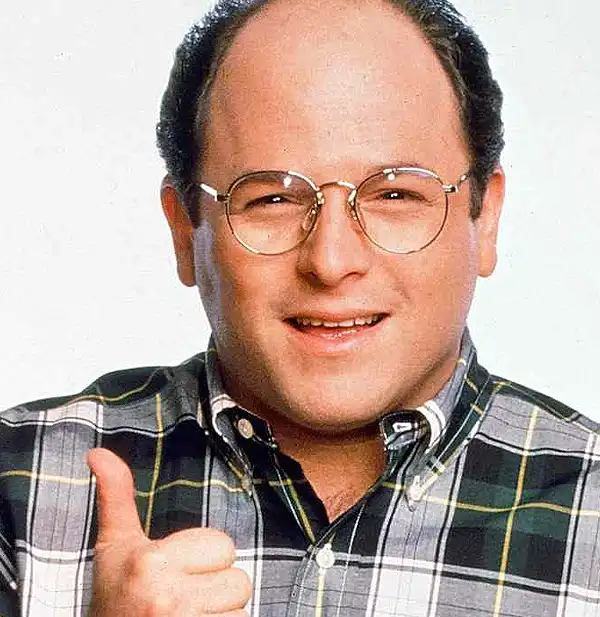
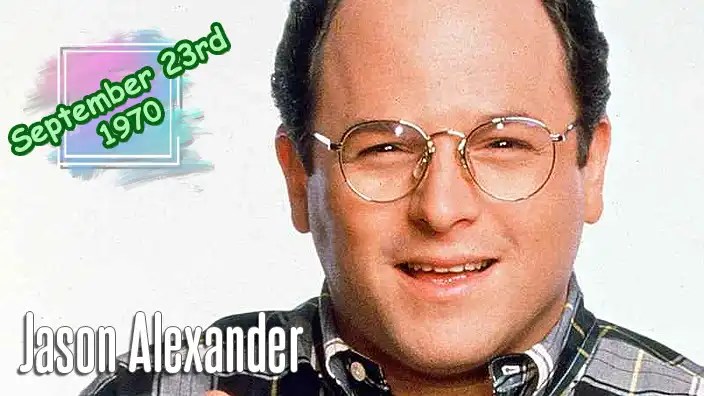
Jason Alexander was born Jay Scott Greenspan on September 23, 1959, in Newark, New Jersey, and grew up in Livingston. Long before millions of viewers knew him as George Costanza, Alexander developed an interest in performing that initially centered on something rather different from acting: magic. He dreamed of becoming a professional magician, an ambition that makes a surprising amount of sense considering that his eventual career involved convincing audiences that Jason Alexander and George Costanza were somehow the same person.
His interests gradually shifted toward theater, particularly after he discovered that performing offered possibilities beyond sleight of hand. Alexander attended Boston University but left before completing his degree when professional opportunities began arriving. The decision worked out rather well. Broadway became an important part of his early career, and the stage provided the foundation for the timing, physical comedy and vocal control that would later become so recognizable on television.
Alexander appeared in several Broadway productions during the 1980s, including Stephen Sondheim and George Furth's Merrily We Roll Along. The musical's original Broadway production was famously short-lived, but its reputation grew enormously over subsequent decades. Alexander continued working steadily in theater and eventually appeared in productions including The Rink, Broadway Bound and Jerome Robbins' Broadway. His theatrical résumé established him as a genuine song-and-dance performer rather than an actor who happened to wander onto Broadway between television jobs.
His performance in Jerome Robbins' Broadway brought one of the biggest honors of his stage career. Alexander won the Tony Award for Best Actor in a Musical in 1989. The sprawling revue celebrated the work of legendary director and choreographer Jerome Robbins, requiring performers capable of handling demanding material drawn from some of Broadway's most famous productions. Alexander's success demonstrated an aspect of his talent that viewers who know him primarily as George Costanza can easily overlook: the man can sing, dance and command a Broadway stage.
Television and film were also becoming increasingly important. Alexander appeared in commercials and television programs and began accumulating film roles. One of his memorable early movie performances came in Pretty Woman in 1990, starring Richard Gere and Julia Roberts. Alexander played Philip Stuckey, the unpleasant lawyer and business associate of Gere's Edward Lewis. Anyone encountering Alexander through Pretty Woman before discovering Seinfeld could therefore be forgiven for wondering why television had subsequently decided to let this deeply disagreeable fellow become funny.
By then, however, Alexander had landed the role that would define a major portion of his career. Seinfeld, created by Jerry Seinfeld and Larry David, began life as The Seinfeld Chronicles before developing into one of the most influential television comedies ever made. Alexander played George Costanza, the neurotic childhood friend of Jerry Seinfeld's fictionalized version of himself. Alongside Julia Louis-Dreyfus as Elaine Benes and Michael Richards as Cosmo Kramer, the four characters formed a group whose friendship was held together partly by affection and partly by their shared ability to behave appallingly.
George Costanza became one of television comedy's great characters precisely because he possessed so many characteristics that conventional sitcom protagonists were supposed to avoid. He could be cheap, dishonest, jealous, petty, lazy, insecure and astonishingly self-absorbed. He lied about employment, relationships and personal achievements with remarkable enthusiasm, usually constructing elaborate schemes to solve problems that could have been resolved much more easily by simply telling the truth.
Alexander's performance prevented George from becoming merely unpleasant. His frustration, panic and perpetual sense of injustice made the character strangely sympathetic even when George was clearly responsible for his own predicament. Alexander could turn a widening of the eyes, a change in vocal pitch or an explosion of indignation into a punchline before the dialogue itself had even arrived.
The character was heavily influenced by Seinfeld co-creator Larry David. Alexander has explained that he initially approached George in a manner influenced by Woody Allen, but gradually realized that many of George's seemingly ridiculous experiences were based on things David had actually done or thought. Once Alexander recognized the connection, his interpretation shifted. George Costanza increasingly became, in broad terms, Larry David filtered through Jason Alexander's considerable comic machinery.
The result was extraordinary. George's unemployment, disastrous romances, battles with his parents and endless attempts to gain advantages requiring minimal effort supplied Seinfeld with some of its most memorable stories. Whether pretending to be an architect named Art Vandelay, attempting to preserve a high score on an arcade machine or becoming obsessed with whether a romantic partner had placed him in the dreaded relationship category of “It's not you, it's me,” George approached trivial matters with the urgency normally reserved for international diplomacy.
George's parents, Frank and Estelle Costanza, provided an explanation for at least some of his emotional condition. Played by Jerry Stiller and Estelle Harris, they created a household where ordinary conversation could escalate into shouting before anyone had established what the disagreement was actually about. Alexander's scenes with Stiller and Harris became some of the show's funniest, with George simultaneously reverting to childhood and desperately attempting to escape it.
Among the character's most celebrated storylines was “The Opposite,” in which George concludes that every instinct he has ever followed has been wrong. He therefore decides to do the opposite of whatever he would normally do. The strategy promptly improves his life. He gains confidence, meets a woman and secures employment with the New York Yankees. It is perhaps the only self-improvement philosophy ever developed around the principle that one's own judgment should never, under any circumstances, be trusted.
George's employment with the Yankees produced another rich period for the character. Working under a fictionalized George Steinbrenner — usually filmed from behind and voiced principally by Larry David — George somehow survives within the organization despite behavior that would ordinarily produce an escort to the parking lot. Alexander excelled at portraying George's strange combination of cowardice and misplaced confidence, particularly whenever authority figures were involved.
Another celebrated episode, “The Marine Biologist,” places George at the center of one of Seinfeld's finest pieces of storytelling. After Jerry falsely tells a woman that George is a marine biologist, George finds himself expected to rescue a beached whale. His later account of the incident builds toward the revelation that the whale's blowhole had been obstructed by one of Kramer's golf balls. Alexander's delivery turns the monologue into something approaching heroic epic poetry — if heroic epic poetry involved a dishonest unemployed man, a Titleist and absolutely no marine biology qualifications.
Then there was “The Contest,” an episode whose subject was famously discussed without the script explicitly naming it. George initiates the competition after being caught by his mother in an embarrassing private moment, and the four principal characters wager on who can exercise the greatest self-control. The episode became one of the most celebrated examples of Seinfeld taking material considered unsuitable for network television and constructing a clever comedy around what could not be said.
Alexander received multiple Primetime Emmy Award nominations for his work on Seinfeld, although he never won the award for playing George. That fact became something of an enduring curiosity considering the acclaim surrounding the performance. He did, however, receive other recognition, including a Screen Actors Guild Award as part of the show's ensemble, while Seinfeld itself accumulated major awards and became a defining television series of the 1990s.
The series concluded in 1998 while still enormously popular. For Alexander, escaping George Costanza's gravitational pull afterward was inevitably difficult. When an actor spends nearly a decade creating one of television's most recognizable characters, audiences tend to greet subsequent performances with the vague expectation that Art Vandelay might be mentioned at any moment.
Alexander nevertheless continued working extensively across television, film, theater, voice acting and directing. His film credits include Shallow Hal, in which he appeared alongside Jack Black and Gwyneth Paltrow, and numerous other comedies and dramas. He also appeared as himself or fictionalized versions of himself in television projects willing to take advantage of his connection with Seinfeld.
His voice became nearly as busy as his face. Alexander provided the voice of Hugo in Disney's animated The Hunchback of Notre Dame and returned for its sequel. He contributed voices to numerous animated television series and films, finding another outlet for the expressive vocal abilities that had served George Costanza so well. Animation allowed Alexander to create characters without audiences immediately expecting them to complain about parking spaces.
He also worked as a director, including directing episodes of television series and feature films. His understanding of comedy from both stage and screen made directing a natural extension of his performing career. Alexander has additionally taught, spoken publicly about acting and performance, and participated in theatrical productions long after Seinfeld ended.
The stage remained especially important. Alexander returned repeatedly to live theater, appearing in and directing productions and demonstrating that Broadway had never simply been an early stop on the road to television fame. His theatrical background explains much about his performance style: George's physical reactions are often almost choreographed, while Alexander's ability to build a scene resembles the carefully controlled escalation required in stage comedy.
Alexander has also performed in musical concerts and theatrical events showcasing a singing voice that may surprise anyone whose primary memory of him involves George Costanza unsuccessfully attempting to preserve his dignity. His Broadway training was extensive, and his Tony Award predates Seinfeld. In another universe, Jason Alexander might primarily have been known as a musical-theater star who occasionally appeared on television. George Costanza had other plans.
His talents extend into another unexpected area: poker. Alexander has participated in major poker tournaments and celebrity events, bringing the same thoughtful competitiveness to the card table that George Costanza would presumably have replaced with cheating, panic and an elaborate story involving an imaginary importer-exporter.
Alexander has never appeared resentful of the character that dominates his public recognition. Instead, he has frequently discussed Seinfeld, George and the show's production with considerable affection and insight. He has reunited with his former castmates in various settings, including appearances connected with Larry David's Curb Your Enthusiasm, where the boundary between performer and character became deliberately tangled.
A particularly elaborate Curb Your Enthusiasm storyline reunited Alexander, Jerry Seinfeld, Julia Louis-Dreyfus and Michael Richards around a fictional Seinfeld reunion. Rather than producing a conventional reunion special, David constructed an entire season around the attempt to make one. The result allowed audiences to revisit the characters while simultaneously mocking the very idea of television reunions. It was an appropriately complicated solution from the man whose personality had helped inspire George Costanza.
Alexander's career demonstrates how misleading a single iconic role can be. George Costanza is so memorable that he can obscure the performer behind him, yet Alexander was already a Tony-winning Broadway actor when Seinfeld became a phenomenon. His abilities as a singer, dancer, dramatic actor, director and voice performer existed before George and continued long afterward.
Still, there is no escaping the magnificent catastrophe that is George Costanza, nor should there be. Alexander took a character filled with qualities that ought to have made him unbearable and turned him into someone audiences could watch endlessly. George failed upward, downward and sideways. He wanted success without effort, admiration without achievement and relationships without inconvenience. Whenever life offered him two possible choices, he possessed an almost supernatural ability to select the one that would cause the greatest trouble.
Jason Alexander, meanwhile, did almost precisely the opposite. He trained seriously, worked steadily, mastered several areas of performance and built a career spanning Broadway, television, film, animation and directing. Perhaps that is the ultimate difference between actor and character. George Costanza once discovered that doing the opposite of his instincts improved his life. Jason Alexander apparently figured that out before George did.