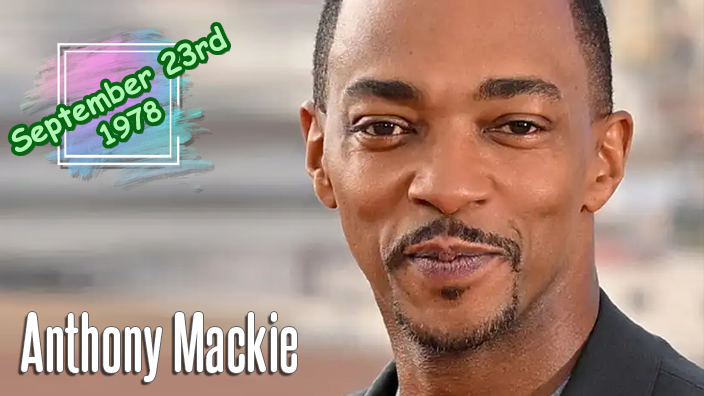
September 23, 1978, in New Orleans, Louisiana
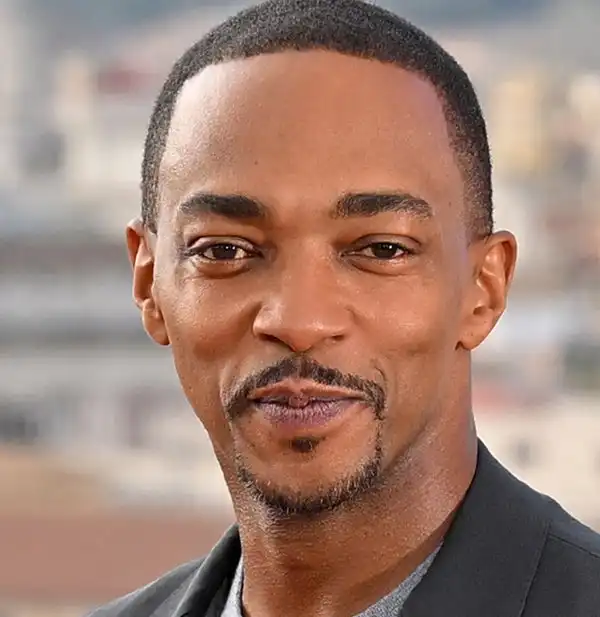
Anthony Dwane Mackie was born on September 23, 1978, in New Orleans, Louisiana, and grew up in a large family in the city. His father, Willie Mackie Sr., owned a roofing business, providing his children with a close look at the realities of hard physical work and running a family enterprise. Anthony eventually chose a rather different profession, one involving fewer shingles but considerably more explosions, although members of the Mackie family continued the roofing business.
His interest in performing led him to study at the New Orleans Center for Creative Arts before attending the North Carolina School of the Arts. He later graduated from the drama division of the Juilliard School in New York City, one of America's most prestigious performing arts institutions. That classical theatrical training would become important to a career that has ranged from intimate stage performances to standing in front of enormous green screens while pretending that something very large is attempting to destroy the planet.
Mackie's professional career developed quickly after Juilliard. One of his important early stage roles came when he served as an understudy for Don Cheadle in Suzan-Lori Parks' play Topdog/Underdog. Theater remained a significant part of his early career, and he appeared in productions including Talk, which earned him an Obie Award. His stage work established Mackie as a serious dramatic performer before mainstream movie audiences became familiar with his face.
His first feature-film appearance came in 8 Mile, the 2002 drama starring Eminem. Mackie played Clarence, better known in the film's rap-battle world as Papa Doc, the formidable opponent facing Eminem's B-Rabbit. Although Mackie's screen time was relatively limited, the climactic confrontation became one of the film's most memorable sequences. Papa Doc discovers the unfortunate disadvantage of entering a rap battle against a protagonist who has already insulted himself so thoroughly that there is very little ammunition left.
Mackie quickly moved into more substantial roles. He starred in Brother to Brother, portraying Perry, a young gay Black artist who develops a friendship with an elderly man connected to the Harlem Renaissance. The independent film gave Mackie the opportunity to demonstrate the dramatic range that would characterize much of his career, earning considerable critical attention and an Independent Spirit Award nomination.
He also appeared in Spike Lee's She Hate Me and later worked with Lee again in Miracle at St. Anna. Mackie's willingness to move between independent films, politically charged dramas, historical stories and commercial productions prevented him from being easily confined to a single type of role. He could play vulnerable, intimidating, funny, angry or quietly observant depending upon what the story required.
In 2006, Mackie appeared in Half Nelson, starring Ryan Gosling as a troubled schoolteacher. Mackie played Frank, a neighborhood drug dealer whose relationship with one of the teacher's students complicates the film's moral landscape. Rather than presenting Frank as a simple villain, the performance contributed to a story in which the characters' lives and choices were deliberately messy. It was exactly the sort of material that suited an actor interested in character rather than merely screen time.
Mackie's profile rose further with The Hurt Locker, Kathryn Bigelow's tense Iraq War drama. He played Sergeant J. T. Sanborn, a member of a U.S. Army explosive ordnance disposal team working alongside Jeremy Renner's Staff Sergeant William James and Brian Geraghty's Specialist Owen Eldridge. Sanborn is disciplined and professional, increasingly frustrated by James's willingness to take extraordinary risks while handling devices specifically designed to explode.
The film required Mackie to communicate much of Sanborn's emotional state through restraint. The character is surrounded by danger but cannot afford theatrical panic because remaining functional is part of staying alive. His relationship with James becomes one of the film's central tensions, placing two very different attitudes toward combat beside one another. The Hurt Locker received widespread acclaim and won six Academy Awards, including Best Picture and Best Director.
The success of The Hurt Locker increased Mackie's visibility, but he continued choosing a varied assortment of projects rather than pursuing only conventional leading-man roles. He appeared in Notorious, portraying rapper Tupac Shakur, and joined Matt Damon and Emily Blunt in the science-fiction romantic thriller The Adjustment Bureau. He also appeared in Real Steel, the futuristic boxing film in which enormous robots settle disagreements by punching one another with considerably less paperwork than professional human boxing.
Mackie returned to the world of political and historical drama in films including The Fifth Estate and All the Way. He portrayed Martin Luther King Jr. in the latter, an HBO adaptation of Robert Schenkkan's play about President Lyndon B. Johnson and the struggle surrounding civil rights legislation. Playing one of the most recognizable figures in American history required something more than physical imitation, and Mackie approached King as a political leader operating within an enormously complicated historical moment.
He also appeared in Michael Bay's Pain & Gain, alongside Mark Wahlberg and Dwayne Johnson. The dark crime comedy, based on a bizarre real criminal case, allowed Mackie to display another side of his screen personality. By this point, his résumé had become wonderfully difficult to summarize: independent drama, war movie, science fiction, historical drama, comedy, crime film and robots had all made appearances. Then Marvel called.
Mackie entered the Marvel Cinematic Universe as Sam Wilson in Captain America: The Winter Soldier, released in 2014. Wilson is introduced while jogging around the National Mall in Washington, D.C., where Steve Rogers repeatedly laps him at super-soldier speed while cheerfully announcing, “On your left.” It is an efficient introduction to the character because Sam responds not with reverence toward Captain America but with irritation, humor and immediate likability.
Sam Wilson is a military veteran who had served as a pararescueman using an experimental winged flight system. After leaving active duty, he works helping other veterans adjust to civilian life. That background gives Wilson an immediate connection with Steve Rogers, who is himself struggling to find his place in a world radically different from the one he knew. Their friendship becomes one of the most important relationships in the later Captain America films.
When Rogers needs help confronting the conspiracy inside S.H.I.E.L.D., Wilson joins him and becomes the Falcon. Equipped with mechanical wings, considerable combat ability and a refreshing willingness to point out when everyone around him is being ridiculous, Falcon quickly became a popular MCU character. Mackie's performance balanced action with humor without turning Wilson into comic relief. He was Steve Rogers' friend and equal partner rather than merely the fellow who happened to fly.
Mackie returned briefly in Avengers: Age of Ultron and appeared in Ant-Man, where Falcon's encounter with Scott Lang became one of the film's funniest sequences. Lang breaks into the Avengers facility expecting a straightforward burglary and instead discovers that one of the Avengers happens to be at work that day. Falcon's subsequent request that Captain America never be told about the incident makes the defeat considerably more enjoyable.
Sam Wilson became increasingly important in Captain America: Civil War. When political pressure divides the Avengers over the Sokovia Accords, Wilson sides with Steve Rogers. His loyalty is rooted not simply in friendship but in his own judgment about authority and responsibility. Mackie's Falcon remained one of the more grounded personalities in a story involving super-soldiers, royalty, androids, enhanced humans and an airport terminal that probably never recovered its security deposit.
He subsequently appeared in Avengers: Infinity War and Avengers: Endgame, participating in the enormous conclusion to the Infinity Saga. The closing moments of Endgame fundamentally changed Sam Wilson's future. An elderly Steve Rogers gives Sam his Captain America shield, symbolically selecting him as the person to continue the legacy. Sam's reaction makes clear that he understands the weight of what he has been handed. It is not merely a weapon or costume accessory but a symbol carrying decades of expectations.
Marvel explored that responsibility in the Disney+ series The Falcon and the Winter Soldier, pairing Mackie with Sebastian Stan as Bucky Barnes. The series begins with Sam reluctant to accept the Captain America identity, believing the shield should be placed in a museum rather than carried by him. The U.S. government instead appoints John Walker as a new Captain America, setting in motion a story examining legacy, race, patriotism and what the symbol of Captain America is supposed to represent.
The series also expanded Sam beyond his superhero identity. Viewers saw his relationship with his sister Sarah, his family's financial difficulties in Louisiana and his attempts to preserve the family fishing boat. Those quieter scenes gave Mackie material far removed from aerial battles and elaborate action sequences. Saving the world is apparently one thing; convincing a bank that an Avenger represents a reasonable loan risk is another matter entirely.
By the conclusion of The Falcon and the Winter Soldier, Sam accepts the shield and formally assumes the identity of Captain America. Importantly, he does so as Sam Wilson rather than attempting to become another version of Steve Rogers. His Captain America retains the Falcon wings and draws upon his own military experience, family background and understanding of the world. Mackie's journey through the MCU had therefore evolved from supporting character to the bearer of one of Marvel's most recognizable identities.
That transition moved fully onto the big screen with Captain America: Brave New World. Mackie took center stage as Sam Wilson's Captain America, with the character confronting threats and political complications without the super-soldier serum that enhanced Steve Rogers. Sam instead depends upon training, technology, judgment and an impressive pair of wings. Flying directly toward people who can throw automobiles remains questionable from an occupational-health perspective, but superheroes rarely appear to consult risk-assessment forms.
Outside Marvel, Mackie continued maintaining the variety that had defined his earlier career. He starred in the Netflix science-fiction series Altered Carbon, taking over the role of Takeshi Kovacs for the show's second season. The series takes place in a future where human consciousness can be transferred between bodies, allowing Mackie to play an established character whose physical appearance had completely changed — a premise that certainly eliminates the usual awkward conversation when a television series changes its lead actor.
He appeared in the science-fiction film Synchronic and starred in Outside the Wire, playing an android military officer opposite Damson Idris. He also appeared in the anthology series Black Mirror in the episode “Striking Vipers,” another technologically driven story that explored identity and human relationships in unexpected ways. Science fiction clearly became a recurring feature of Mackie's career, although he continued alternating it with drama and action.
Mackie also took on the role of John Doe in the television adaptation of the video game Twisted Metal. The post-apocalyptic action comedy gave him an opportunity to lean heavily into humor while driving through a violent wasteland populated by eccentric characters, heavily armed vehicles and a homicidal clown. After years spent with the Avengers, Mackie was presumably already accustomed to unusual coworkers.
His connection to New Orleans has remained an important part of his life and career. Rather than becoming completely detached from his hometown after finding Hollywood success, Mackie has invested in projects and businesses there and has frequently spoken about his Louisiana roots. His upbringing provides another connection with Sam Wilson, whose MCU family story is also based in Louisiana.
Mackie's career is particularly notable because Marvel arrived after he had already established himself as a trained and accomplished dramatic actor. Captain America did not create Anthony Mackie from scratch. By the time he first strapped on Falcon's wings, he had worked in theater, independent cinema, historical dramas, major studio pictures and an Academy Award-winning Best Picture.
That foundation helps explain why Sam Wilson developed into something more substantial than another costumed figure in an increasingly crowded superhero universe. Mackie could deliver the jokes and handle the action, but he could also make Sam's friendship with Steve Rogers believable, convey his hesitation about accepting the shield and carry the more personal material surrounding his family and military service. The costume changed; the acting underneath it did not.
From Papa Doc facing B-Rabbit in 8 Mile to Sergeant Sanborn trying to survive The Hurt Locker, Falcon soaring through the Marvel Cinematic Universe and finally Captain America carrying the shield himself, Anthony Mackie has built a career around refusing to remain in one lane. Considering that one of his best-known characters routinely travels with mechanical wings, staying in a lane probably wasn't going to work anyway.