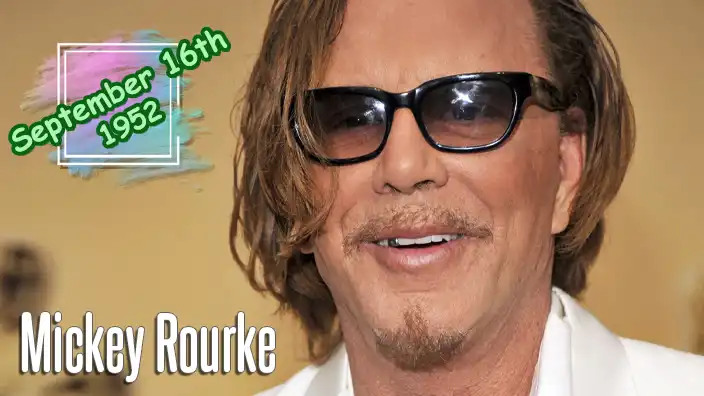
September 16, 1952, in Schenectady, New York
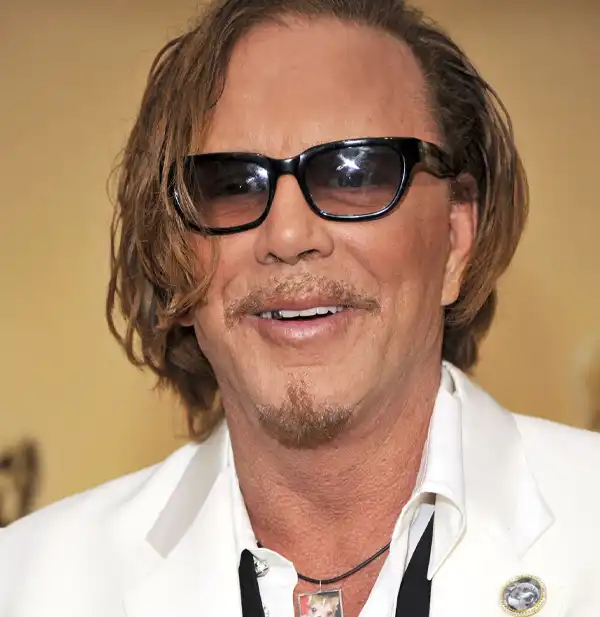
Philip Andre "Mickey" Rourke Jr. was born on September 16, 1952, in Schenectady, New York. His parents separated when he was young, and after his mother remarried, the family moved to South Florida. Rourke spent much of his youth in Miami, where boxing became an important part of his life long before Hollywood entered the picture. He trained at Miami's famous 5th Street Gym and competed as an amateur boxer, developing an attachment to the sport that would eventually have an enormous and rather unusual effect on his acting career.
Boxing came naturally to Rourke, but repeated concussions led him to step away from the ring while still young. Acting gradually took its place. He moved to New York and studied acting, including work associated with the Actors Studio, immersing himself in the Method tradition that had produced performers he admired. Rourke approached acting with the same intensity he brought to boxing, and his screen style developed around an unusual combination of toughness and vulnerability. He could look dangerous while speaking barely above a murmur, and filmmakers soon realized that the camera liked watching him think.
His earliest movie appearances were small, including a part in Steven Spielberg's 1941 in 1979, but Rourke began attracting serious attention with Lawrence Kasdan's Body Heat in 1981. His role as Teddy Lewis, an arsonist who assists William Hurt's character, occupied relatively little screen time, yet Rourke made an impression far larger than the part. It was the sort of performance that causes audiences to wonder who that fellow was and casting directors to start looking for his telephone number.
Barry Levinson's Diner followed in 1982 and provided Rourke with his real breakthrough. Set in Baltimore in 1959, the film followed a group of young men confronting the uncomfortable realization that adulthood had arrived whether they were prepared for it or not. Rourke played Robert "Boogie" Sheftell, a charming hairdresser and compulsive gambler whose confidence frequently exceeded his good judgment. Surrounded by a cast that included Kevin Bacon, Daniel Stern, Steve Guttenberg, Tim Daly, Paul Reiser and Ellen Barkin, Rourke emerged as one of the film's most compelling presences.
His career accelerated rapidly. Francis Ford Coppola cast him as the mysterious Motorcycle Boy in Rumble Fish in 1983, opposite Matt Dillon. Shot largely in stylized black and white, the film gave Rourke a role perfectly matched to his screen persona: detached, thoughtful, dangerous and almost mythic in the eyes of his younger brother. He followed it with The Pope of Greenwich Village in 1984, starring alongside Eric Roberts in a crime drama about two cousins whose attempt at easy money goes disastrously wrong.
By the middle of the decade, Rourke had become one of Hollywood's most distinctive leading men. In Michael Cimino's Year of the Dragon in 1985, he played Stanley White, a highly decorated New York police captain waging an obsessive campaign against organized crime in Chinatown. The film was controversial, violent and uncompromising, and Rourke's performance matched its intensity. He was not developing a reputation for playing cheerful accountants who went home at five and spent their evenings tending roses.
Then came 9½ Weeks.
Adrian Lyne's 1986 erotic drama paired Rourke with Kim Basinger in a story about an intense and increasingly troubling relationship between Wall Street businessman John Gray and art gallery employee Elizabeth McGraw. The film initially received a mixed response in the United States but developed an enormous international following and became one of the defining erotic dramas of the decade. It also transformed Rourke into an international sex symbol, a designation he never appeared entirely comfortable carrying.
The film's reputation grew considerably after its theatrical release, and its imagery became deeply embedded in 1980s popular culture. Rourke's quiet, controlled performance was central to its atmosphere. John Gray could be charming and seductive while remaining emotionally elusive and increasingly controlling. The role capitalized on Rourke's ability to suggest danger without needing to advertise it with flashing lights.
Rather than settle comfortably into conventional leading-man roles, Rourke continued choosing darker and stranger material. Alan Parker's Angel Heart in 1987 cast him as Harry Angel, a shabby private investigator hired by the mysterious Louis Cyphre, played by Robert De Niro, to locate a missing singer. What begins as detective noir gradually descends into supernatural horror as Angel's investigation leads him through New York and New Orleans toward revelations he would have been much happier never discovering.
That same year brought Barfly, directed by Barbet Schroeder from a screenplay by Charles Bukowski. Rourke played Henry Chinaski, Bukowski's fictional alter ego, opposite Faye Dunaway. The character was an alcoholic writer inhabiting bars, cheap rooms and the edges of Los Angeles society. Rourke abandoned the polished image associated with 9½ Weeks and delivered a deliberately shambling, unglamorous performance that remains among the most acclaimed of his early career.
By the end of the 1980s, however, Rourke's relationship with Hollywood had become increasingly difficult. His choice of projects became uneven, his reputation for clashes and unpredictable behavior grew, and several films failed to match the promise of his earlier work. He appeared in movies including Johnny Handsome, Wild Orchid, Desperate Hours and Harley Davidson and the Marlboro Man, but the momentum that had once seemed capable of carrying him to the very top of Hollywood began to disappear.
Then Rourke did something few major movie actors would seriously contemplate. He returned to boxing.
In 1991, Rourke stepped away from his Hollywood career and became a professional boxer. This was no celebrity exhibition gimmick conducted with oversized gloves and plenty of photographers. He trained and fought professionally, compiling an unbeaten record across eight bouts, with six victories and two draws. He sparred with accomplished fighters and took the sport seriously, but boxing extracted a considerable physical price. Injuries included damage to his nose and cheekbone, and reconstructive surgery followed.
Rourke retired from professional boxing in 1994 and began the difficult process of rebuilding an acting career that Hollywood had largely learned to live without. The transition was not immediate. He worked steadily, but many of his roles were supporting parts or appeared in films receiving little attention. There were notable exceptions, including Francis Ford Coppola's The Rainmaker, Vincent Gallo's Buffalo '66, Steve Buscemi's Animal Factory, Sean Penn's The Pledge, Robert Rodriguez's Once Upon a Time in Mexico and Tony Scott's Man on Fire.
Those smaller appearances gradually reminded filmmakers what Rourke could do. The charisma was different now—rougher, more battered and carrying the visible history of the years between—but the screen presence remained. Instead of attempting to recreate the handsome romantic lead of 9½ Weeks, Rourke increasingly embraced character roles that made use of what life had written across him.
Robert Rodriguez and Frank Miller's Sin City provided the breakthrough.
Released in 2005, Sin City adapted Miller's graphic novels with a highly stylized visual approach that attempted to reproduce their stark black-and-white artwork on screen. Rourke played Marv, a massive, scarred street fighter who awakens beside a murdered woman and sets out to discover who killed her. Buried beneath extensive prosthetic makeup, Rourke delivered a performance that was simultaneously brutal, funny, sentimental and strangely touching.
Marv was almost perfectly suited to the second phase of Rourke's career. The character was physically damaged, regarded as disposable by much of society and nevertheless possessed his own fierce code of loyalty. Critics responded enthusiastically, and Rourke suddenly found himself being discussed again not as a cautionary Hollywood story but as a formidable actor. The comeback had begun, although its biggest chapter was still ahead.
Director Darren Aronofsky cast Rourke as Randy "The Ram" Robinson in The Wrestler, released in 2008. Randy is a professional wrestler whose glory days are far behind him. He performs in small venues, works at a supermarket between matches and continues punishing a body that is increasingly incapable of enduring the punishment. Outside the ring, he struggles with loneliness, a broken relationship with his daughter and his feelings for Cassidy, an aging stripper played by Marisa Tomei.
The parallels between Rourke and Randy were impossible to miss. Both had experienced fame, physical punishment, professional decline and the difficulty of trying to return after the world had moved on. Yet the performance worked because Rourke did more than simply play a thinly disguised version of himself. Randy could be enormous and intimidating in the ring but painfully vulnerable outside it, particularly when attempting to reconnect with his estranged daughter, played by Evan Rachel Wood.
Rourke's performance turned The Wrestler into one of the defining films of his career. The movie won the Golden Lion at the Venice Film Festival, while Rourke collected major acting honors including the Golden Globe for Best Actor in a Motion Picture – Drama, the BAFTA Award for Best Actor and the Independent Spirit Award. He also received an Academy Award nomination for Best Actor, eventually losing the Oscar to Sean Penn for Milk.
It was an extraordinary reversal. The actor who had once seemed determined to dismantle his own Hollywood career was suddenly standing on awards stages receiving some of the finest reviews of his life. More importantly, The Wrestler reminded audiences that beneath the stories about boxing, feuds, career mistakes and personal turmoil was an actor of considerable ability.
Major studio work followed again. Rourke played Ivan Vanko, also known as Whiplash, opposite Robert Downey Jr. in Iron Man 2 in 2010. Armed with electrically charged whips and a personal grievance against the Stark family, Vanko gave Rourke entry into the rapidly expanding Marvel Cinematic Universe. The same year, he joined Sylvester Stallone, Jason Statham, Jet Li and other action veterans in The Expendables, playing Tool, a former mercenary who now operates a tattoo parlor.
He subsequently appeared as King Hyperion in the fantasy action film Immortals, returned as Marv in Sin City: A Dame to Kill For and continued working across independent films and lower-budget productions. His later career has remained characteristically unpredictable, which is perhaps the only predictable thing about Mickey Rourke.
His career has always resisted a tidy narrative. It would be tempting to describe it simply as rise, fall and triumphant comeback, but Rourke's story is considerably messier than that. He made excellent films and poor ones, accepted roles he later regretted, rejected opportunities, developed a difficult professional reputation, left acting for boxing, suffered serious physical consequences and spent years trying to recover his position in an industry that is rarely patient with anyone.
That complicated history is precisely what made The Wrestler so powerful. Audiences were not merely watching Randy Robinson attempt to reclaim something he had lost. They were watching Mickey Rourke, an actor whose own career had accumulated enough scars to make Randy's story feel frighteningly authentic. The line between actor and character never disappeared entirely, and the film benefited enormously from it.
Rourke's best performances have always contained that tension between toughness and vulnerability. The Motorcycle Boy in Rumble Fish, Harry Angel in Angel Heart, Henry Chinaski in Barfly, Marv in Sin City and Randy Robinson in The Wrestler are very different men, yet each carries damage close to the surface. Rourke has been particularly effective playing characters who appear capable of winning a fight but may have considerably more trouble surviving themselves.
Few Hollywood careers have taken such an unconventional route. Mickey Rourke went from amateur boxer to acclaimed actor, from international sex symbol to professional fighter, from Hollywood outsider to Oscar nominee. Along the way he accumulated triumphs, disasters, bruises, second chances and enough stories to keep biographers occupied for a very long time.
Hollywood loves a comeback story, particularly after it has spent years assuming the comeback will never happen. Mickey Rourke gave it one of the best.