Soaking up the sun on May Ray Day is basically nature’s version of plugging yourself into a charging...
Your family doctor is the one person who’s seen you at your absolute worst—feverish, frazzled, and...
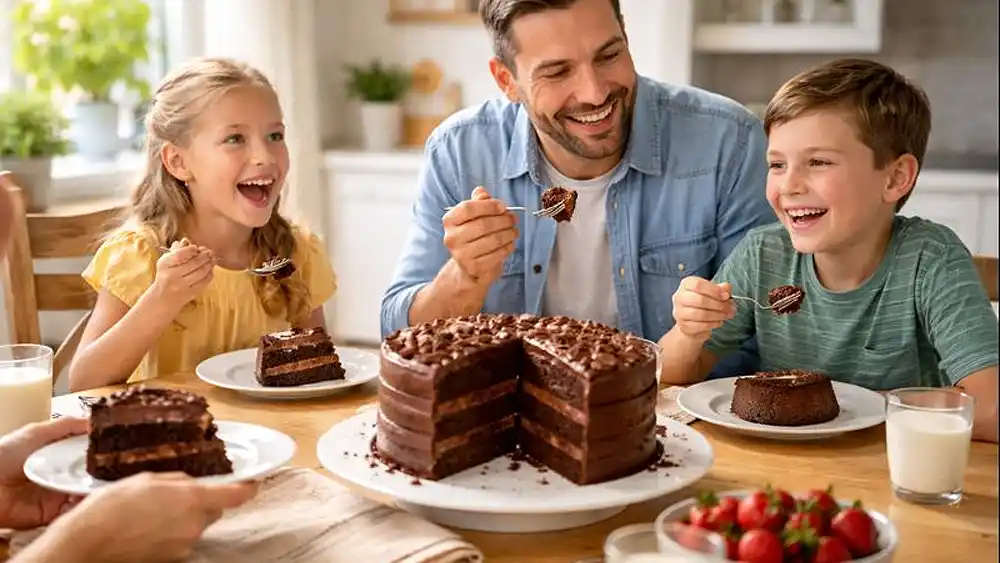
Devil’s Food Cake isn’t just dessert—it’s a full-blown chocolate seduction with frosting. It’s the kind of...
Teachers are the only people who can silence a room with just a look, explain fractions using...
Wildflowers are like the rebels of the plant world—no landscaping plan, no permission, and...
Nurses are the calm in the chaos, the caffeine-fueled superheroes in sneakers, and the only people...
Somewhere between inventing peanut butter and landing on the moon, America also perfected the art...
Navigating the world of payroll, benefits, and compliance without help is a bit like trying to juggle...
Etiquette is often described as "the art of knowing which fork to use," but in reality, it’s more...
Spending a whole week without screens sounds noble in theory—like running a marathon or eating...
Skin cancer is one of those things that shows up uninvited, like a telemarketer, except this one...
Fostering is one of the most generous things a person can do, because it’s basically opening your...
Moving is the one life event that makes you question every purchase you’ve ever made, including...
Returning Youth Month is basically society’s way of saying, “Okay… deep breath… let’s do this...
Jewish American Heritage Month is the perfect time to celebrate a history packed with brilliance,...
Miniature Garden Month is basically for people who love gardening… but also love the idea of being in...
Asparagus is one of the few vegetables that manages to feel both fancy and slightly mischievous at...
Visiting the dentist is basically agreeing to pay someone good money to lean over you with sharp...
Learning to play the drums is basically deciding you want to sound cool… and then discovering you...
Wildfire Awareness Month is nature’s polite way of reminding us that forests, grasslands, and dry...
Correcting your posture is one of those things that sounds easy until you realize you’ve been...
Pete Townshend didn’t just play guitar — he turned it into a weapon, a windmilling,...
Eleanor Tomlinson has a knack for bringing period dramas to life with warmth and spark, most...
André the Giant was exactly what his name promised — a true giant, not just in size but in...
Grace Jones is the definition of bold — a singer, actress, and fashion icon who never met a...
Malcolm X was one of the most electrifying and influential voices of the civil rights era, a man who...
If there were an award for “Most Likely to Say the Wrong Thing at Exactly the Right Time,” Jason...
Not every actor gets to glide from period dramas to political intrigue with the ease of someone...

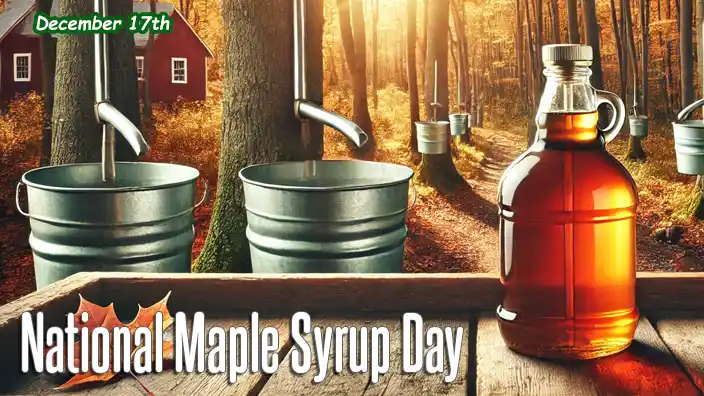
Maple syrup is nature's way of reminding us that even trees have hidden talents. Who knew that...
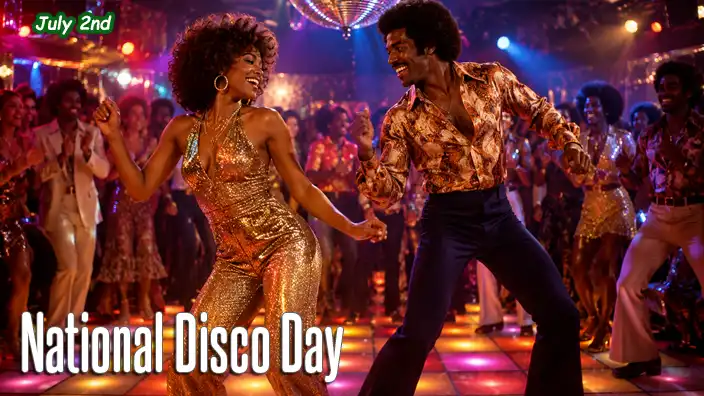
Some songs politely ask you to tap your foot. Disco skips the introductions, grabs you by the...
World Password Day is the annual reminder that 123456, your dog's name, and the word “password” are not...
Visiting the dentist is basically agreeing to pay someone good money to lean over you with sharp...
Somewhere between chugging green smoothies and stress-eating an entire pizza lies the sweet spot of...
Digging into the medicine cabinet is like playing archaeologist in your own bathroom: you might...
On September 14, 1814, lawyer Francis Scott Key was inspired to write the poem that eventually became the lyrics of the United States national anthem, “The Star-Spangled Banner.” During the War of 1812, British forces had captured Washington, D.C., and burned several major public buildings before turning their attention toward Baltimore. Key became involved after his friend, physician William Beanes, was taken prisoner by the British. He helped negotiate Beanes' release, but because the Americans had learned details of the planned attack, they were required to remain with the British fleet until the assault on Baltimore was completed.
From aboard a vessel in the Patapsco River, Key watched as British ships bombarded Fort McHenry through the night of September 13 and into the morning of September 14. When daylight came, the enormous American flag flying above the fort was still visible, showing that the defenders had held their position and the British attack had failed. Moved by the sight, Key began writing verses that became a four-stanza poem titled “Defence of Fort M'Henry.” It was soon published and sung to the melody of “To Anacreon in Heaven,” a British song composed by John Stafford Smith. Over time, Key's poem became better known by the title of its opening imagery, “The Star-Spangled Banner.”
Key, born August 1, 1779, in Maryland, was a prominent lawyer who later served as U.S. attorney for the District of Columbia. His song became increasingly associated with patriotic and official occasions, and President Woodrow Wilson directed that it be played at appropriate military and naval ceremonies in 1916. Congress formally designated “The Star-Spangled Banner” as the national anthem, with President Herbert Hoover signing the measure into law on March 3, 1931. Key did not live to see what became of his composition; he died on January 11, 1843, decades before his hastily written verses became the official musical symbol of the United States.
On September 14, 1964, Kellogg's introduced the toaster pastry that would become Pop-Tarts, although the company was not the first to announce the idea. Rival Post had already publicized plans for a shelf-stable, fruit-filled pastry called Country Squares but revealed the concept before the product was ready for widespread sale. Kellogg's recognized the opportunity and moved quickly, turning to William “Bill” Post, then working at the Hekman Biscuit Company in Michigan, to help develop a pastry that could survive both the supermarket shelf and a trip through the family toaster. Post and his team experimented with dough, fillings and production methods, with his children reportedly serving as enthusiastic taste testers along the way.
Kellogg's initially considered calling its creation Fruit Scones before settling on the far more memorable Pop-Tarts, a name that played nicely with the popularity of Pop Art during the 1960s. The original unfrosted pastries appeared in four flavors—strawberry, blueberry, brown sugar cinnamon and apple currant—and the early test market was enormously successful. Demand quickly outran supply, forcing Kellogg's to publish advertisements apologizing to customers because it had run out. Frosting arrived a few years later after the company developed a version capable of surviving toaster temperatures without melting into a sugary disaster, followed by sprinkles, additional flavors and Milton the Toaster, an animated mascot who helped promote the increasingly popular breakfast treat.
What began as a hurried response to a competitor became one of Kellogg's most recognizable products. William Post is frequently described as the inventor of Pop-Tarts, although he always emphasized that their creation was a team effort, and Kellogg's has also credited company executive William “Doc” Thompson and the people involved in developing the product. Over the following decades, Pop-Tarts expanded far beyond those original four flavors and became as much a snack as a breakfast food. Billions are now sold annually—a remarkable outcome for something that began with a few people looking at two pieces of dough with filling between them and essentially asking, “Do you reckon we can put this in a toaster?”
On September 14, 1974, Eric Clapton reached No. 1 on the Billboard Hot 100 with “I Shot the Sheriff,” a song written and recorded the previous year by Bob Marley and the Wailers for their album Burnin'. It became the only No. 1 single of Clapton's career in the United States, but the man singing it had been surprisingly uncomfortable about releasing it. Clapton admired Marley's original and understood reggae well enough to worry that his own recording didn't capture what made the music special. He later recalled thinking that his version shouldn't even be included on his album 461 Ocean Boulevard, much less released as a single, because he felt it wasn't fair to Marley and that his interpretation had given the song too much of a white rock feel. His American bandmates were considerably more enthusiastic, and eventually Clapton allowed himself to be persuaded.
His concern became even more understandable when the record took off. Marley's version had already been released, but Clapton's recording suddenly carried the song onto mainstream American radio and all the way to the top of the chart. Clapton subsequently spoke with Marley and was relieved to discover that the songwriter appeared pleased with what he had done. Marley later recalled that Clapton had asked him about the meaning of the song, while Clapton remembered struggling to understand parts of Marley's explanation. Whatever uncertainty remained about the interpretation, there seemed to be no lasting uncertainty about Marley's acceptance of the cover.
The irony was that the recording Clapton worried might unfairly overshadow Bob Marley ultimately helped bring enormous attention to him. Island Records founder Chris Blackwell later described Clapton's cover as a major breakthrough for Marley, because one of rock's biggest stars had effectively pointed his enormous audience toward the Jamaican songwriter whose work he admired. The official Bob Marley history similarly credits Clapton's recording with significantly increasing Marley's international profile. So while September 14, 1974, marks Eric Clapton reaching No. 1, the longer story belongs to both musicians: Clapton received the biggest American single of his career from a Bob Marley song, while millions of listeners who heard Clapton's version were given a reason to discover the man who had written it in the first place.
On September 14, 1982, Princess Grace of Monaco died at the age of 52, one day after suffering serious injuries when the car she was driving left a steep mountain road above Monaco. Her youngest daughter, Princess Stéphanie, was traveling with her and survived. Before becoming European royalty, Princess Grace had been Grace Kelly of Philadelphia, one of Hollywood's most celebrated stars of the 1950s. In a remarkably brief film career, she became known for an elegant screen presence that made her particularly memorable in Alfred Hitchcock's Dial M for Murder, Rear Window and To Catch a Thief. She also starred opposite Gary Cooper in High Noon and won the Academy Award for Best Actress for her performance alongside Bing Crosby in The Country Girl.
Born in Philadelphia on November 12, 1929, Kelly studied acting at the American Academy of Dramatic Arts in New York and supported herself through modeling and television work while pursuing stage roles. After appearing on Broadway and making her way into motion pictures, her rise was extraordinarily rapid. By the middle of the 1950s she was one of Hollywood's leading actresses, working with stars including James Stewart, Cary Grant, Clark Gable, Ava Gardner and Frank Sinatra. Yet at the height of that success, Kelly walked away from Hollywood. After meeting Prince Rainier III of Monaco in 1955, she married him in an elaborate ceremony the following April and became Princess Grace. Her final feature film, the musical High Society, was released in 1956, bringing an acting career of only a few years to a close.
Princess Grace and Prince Rainier had three children—Caroline, Albert and Stéphanie—and she spent the remainder of her life carrying out royal and charitable duties in Monaco. On September 13, 1982, while driving home with Stéphanie, Grace lost control of her Rover on the winding road near Monaco and the vehicle plunged down a steep slope. Early reports attributed the crash to a stroke suffered while she was driving, although the precise circumstances surrounding the accident have remained the subject of discussion. Stéphanie escaped with injuries, but Grace suffered devastating trauma and died the following day. Her death prompted mourning far beyond the tiny principality she had made her home, closing an extraordinary life that had taken her from Philadelphia to Broadway, from Hollywood stardom and an Academy Award to becoming one of the world's most recognizable princesses.
On September 14, 1994, Major League Baseball officially canceled the remainder of its season, including the postseason and World Series, after a players' strike that had begun on August 12 showed no sign of ending. It was an extraordinary moment for America's pastime: for the first time since 1904, there would be no World Series, and for the first time since the championship series began in 1903, its cancellation resulted from a labor dispute. At the center of the conflict were long-running disagreements between team owners and the Major League Baseball Players Association over salaries, revenue sharing, free agency and the owners' desire for a salary cap. Acting commissioner Bud Selig finally called off the remainder of the season with hundreds of regular-season games already lost.
The cancellation was particularly painful because the 1994 season had been producing some remarkable baseball. The Montreal Expos owned the best record in the majors at 74–40 and appeared capable of making the deepest postseason run in franchise history, while the New York Yankees led the American League East at 70–43. Individual achievements disappeared with the schedule as well. San Francisco's Matt Williams had already hit 43 home runs and Seattle's Ken Griffey Jr. had 40, giving both a chance to challenge Roger Maris' then-record of 61 in a season. Perhaps the most tantalizing unfinished story belonged to San Diego Padres great Tony Gwynn, who was batting .394 when play stopped and pursuing something no major leaguer had accomplished since Ted Williams hit .406 in 1941.
The dispute continued through the winter and into the following spring, with replacement players even appearing during 1995 spring training before a federal court injunction helped bring the strike to an end on April 2. Regular major-league players returned and the 1995 season eventually began, but the damage was considerable. Attendance suffered, fans expressed anger at both players and owners, and many people within baseball later described the canceled World Series as a lasting scar on the sport. There was no champion, no postseason heroics and no opportunity to discover whether Montreal could complete its remarkable season, whether Gwynn could reach .400, or whether Williams or Griffey could catch Maris. The 1994 season simply stopped—and baseball was left forever wondering how one of its most promising years might have ended.