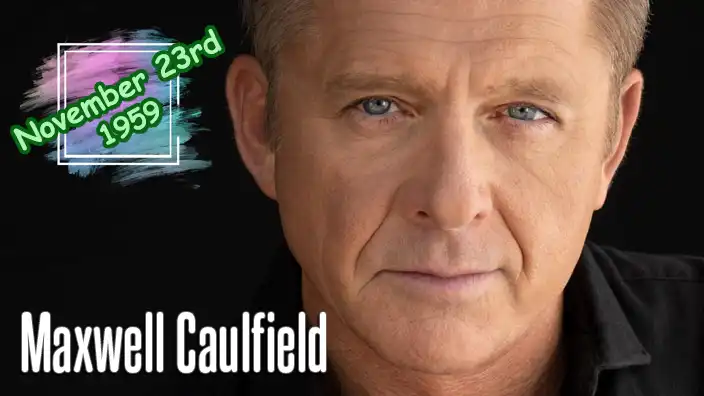
November 23, 1959, in Belper, England


Maxwell Caulfield, born Maxwell Peter John Newby on November 23, 1959, in Belper, Derbyshire, England, is a British-American actor whose extensive career encompasses film, television, Broadway, London's West End, and regional theater. Best known for portraying Michael Carrington in the 1982 musical comedy Grease 2, Miles Colby in the glamorous television drama The Colbys, and Rex Manning in the cult classic Empire Records, Caulfield has developed a reputation for versatility, resilience, and a willingness to embrace characters ranging from romantic leading men to thoroughly unpleasant villains. His professional journey has included Hollywood publicity campaigns, disappointing box-office returns, successful stage productions, and unexpected revivals of films once dismissed by critics. Few actors have experienced quite so many dramatic changes in fortune without needing to hire a television soap opera writer to explain them.
Caulfield was born to Peter Newby and Oriole Rosalind Findlater, spending his early childhood in England before his family circumstances changed significantly. Following his parents' divorce, his mother remarried, and Maxwell eventually moved to the United States. His upbringing was not always easy, and he experienced considerable instability during his teenage years. According to accounts of his early life, he left home while still a teenager and began supporting himself through various jobs. These experiences encouraged independence and determination, qualities that would become particularly important when he entered the unpredictable entertainment industry. While some aspiring actors begin their careers with supportive families, expensive training, and carefully arranged auditions, Caulfield's route was considerably less straightforward.
His interest in acting developed during his youth, although his earliest professional opportunities were somewhat unconventional. Before establishing himself as a dramatic actor, Caulfield worked as a dancer in London, including performances at the famous Windmill Theatre. The venue had a long history of theatrical entertainment, particularly revue productions that challenged traditional ideas of propriety. His early work gave him practical experience performing before audiences and helped him develop the confidence required for a career on stage. It also provided a rather unusual introduction to show business, particularly compared with actors whose first professional achievement involved playing a tree in a school production.
In 1978, Caulfield moved to New York City, determined to establish himself in American theater. He began seeking acting opportunities while supporting himself through ordinary jobs, including working at a theater concession stand. His arrival coincided with a period of considerable experimentation in New York's theatrical community, where Off-Broadway productions frequently explored challenging subjects and unconventional characters. Caulfield's striking appearance, confident stage presence, and willingness to take risks helped him attract attention from casting directors and theater professionals.
One of his earliest important theatrical achievements came in 1979 when he appeared in the Off-Broadway production Class Enemy. His performance earned him a Theatre World Award, an honor recognizing outstanding Broadway and Off-Broadway debuts. The award provided valuable professional recognition and established him as a promising young performer. At a time when he was still developing his career, the distinction helped demonstrate that his abilities extended beyond his appearance. Being handsome might attract attention, but maintaining an acting career requires considerably more than looking impressive in a publicity photograph.
Caulfield continued building his theatrical reputation through productions including The Elephant Man, Salonika, and Entertaining Mr. Sloane. These performances exposed him to challenging dramatic material and opportunities to work alongside experienced performers. His appearance in The Elephant Man was particularly significant because the production involved a physically and emotionally demanding role requiring careful characterization rather than conventional glamour. During this period, he also met British actress Juliet Mills, who would become an important figure in his personal and professional life.
Caulfield's striking looks and growing theatrical reputation eventually attracted the attention of Hollywood casting directors. In the early 1980s, film studios were searching for young actors capable of appealing to teenage audiences, particularly following the enormous success of musical films such as Grease. Caulfield appeared to possess the necessary combination of charisma, acting ability, and leading-man appeal. When Paramount Pictures began developing a sequel to the enormously successful 1978 musical starring John Travolta and Olivia Newton-John, he emerged as a promising candidate for one of its central roles.
In 1982, Caulfield achieved his major Hollywood breakthrough when he starred as Michael Carrington in Grease 2, opposite Michelle Pfeiffer. The film followed a new group of students at Rydell High School, with Caulfield portraying a polite, intelligent British exchange student who falls for Stephanie Zinone, the confident leader of the Pink Ladies. Unlike the original film, in which a rebellious young man attempted to win the affection of a comparatively innocent girl, Grease 2 reversed the formula. Michael needed to transform himself into a mysterious motorcycle rider to attract Stephanie's attention, proving once again that teenage romance in musical films rarely benefits from straightforward communication.
The production featured elaborate musical numbers, colorful costumes, energetic dancing, and a soundtrack designed to capture the spirit of the original film. Caulfield performed songs including "Charades" and participated in several of the film's major musical sequences. His character's transformation from studious newcomer to leather-jacketed motorcycle rider provided the central romantic storyline. Unfortunately, despite the enthusiasm surrounding its release, Grease 2 failed to match the commercial and critical success of its predecessor.
Critics were largely unimpressed, and the film performed poorly at the box office compared with expectations. For Caulfield, who had been promoted as a potential new Hollywood leading man, the disappointment proved particularly damaging. The entertainment industry had enthusiastically introduced him as a rising star, only to become considerably less interested when the film failed to generate the anticipated success. It was a harsh lesson in Hollywood economics: when a movie succeeds, everyone involved is a visionary; when it fails, the leading actor may suddenly discover that nobody remembers where they put his telephone number.
The experience had a significant effect on Caulfield's early film career. He later spoke openly about the difficulties he encountered following Grease 2, explaining that the negative response limited his opportunities in major Hollywood productions. Although the film's failure was hardly the responsibility of one actor, its commercial performance became closely associated with his name. Nevertheless, Caulfield refused to abandon his profession, returning to theater and pursuing roles that allowed him to demonstrate his abilities beyond the expectations of teenage stardom.
Ironically, Grease 2 would eventually experience a remarkable change in reputation. Over the following decades, the film developed a devoted cult following, with audiences embracing its energetic musical numbers, playful romantic storyline, and unapologetically extravagant 1980s atmosphere. Songs such as "Cool Rider" became particular favorites, while Caulfield's performance gained renewed appreciation. The film's transformation from commercial disappointment to nostalgic favorite demonstrated that cinematic popularity does not always follow a predictable timetable. Sometimes a movie simply needs several decades to find the audience that appreciates it.
Following Grease 2, Caulfield appeared in the 1984 romantic science-fiction comedy Electric Dreams, directed by Steve Barron. The film explored an unusual romantic triangle involving a man, a woman, and a computer that develops human-like emotions. Caulfield portrayed Bill, contributing to a production that combined romance, technology, and music during an era when personal computers were becoming increasingly common. The film has since developed its own nostalgic following, particularly among audiences interested in the imaginative technological storytelling of the 1980s.
In 1985, Caulfield appeared opposite Charlie Sheen in the dark crime drama The Boys Next Door, directed by Penelope Spheeris. The film followed two troubled young men whose reckless behavior escalates into a violent crime spree. Caulfield portrayed Roy Alston, a deeply disturbed character whose anger and destructive impulses lead to increasingly serious consequences. The role represented a dramatic departure from his romantic image in Grease 2, allowing him to explore a darker and more psychologically complicated personality.
The Boys Next Door demonstrated Caulfield's willingness to challenge audience expectations and embrace difficult material. His performance revealed an intensity that contrasted sharply with the clean-cut image associated with his earlier musical role. Although the film did not become a major commercial success, it attracted attention for its unsettling subject matter and uncompromising portrayal of violence. The production also reinforced Caulfield's determination to develop as a character actor rather than remain confined to the narrow opportunities available to conventional Hollywood heartthrobs.
A major television opportunity arrived in 1985 when Caulfield joined the cast of the ABC prime-time soap opera Dynasty and its spin-off The Colbys. The original series had become a cultural phenomenon, attracting enormous audiences with its extravagant lifestyles, wealthy families, elaborate costumes, romantic betrayals, and business disputes that frequently seemed to require more champagne than legal advice. The Colbys expanded the fictional universe by introducing another wealthy family whose personal relationships were every bit as complicated as their financial arrangements.
Caulfield portrayed Miles Colby, the handsome, impulsive, and frequently troublesome son of powerful businessman Jason Colby, played by legendary actor Charlton Heston. The series featured an impressive ensemble cast including Barbara Stanwyck, Stephanie Beacham, Katharine Ross, and Emma Samms. Working alongside such established performers provided Caulfield with valuable experience and significant television exposure. His character became involved in romantic rivalries, family conflicts, and elaborate personal scandals, all of which were essential ingredients in the prime-time soap opera formula.
Miles Colby's most memorable storyline involved his complicated relationship with Fallon Carrington, played by Emma Samms, and the romantic rivalry involving his brother Jeff Colby, portrayed by John James. The tangled relationships created considerable tension within the wealthy fictional family, particularly as hidden identities, unexpected revelations, and competing loyalties complicated the situation. Caulfield brought a mixture of arrogance, vulnerability, and emotional intensity to Miles, creating a character whose behavior was frequently infuriating but rarely boring.
The Colbys premiered in November 1985 and ran for two seasons, concluding in 1987. Despite its prestigious cast and substantial production budget, the series struggled to achieve the enormous ratings success enjoyed by Dynasty. Nevertheless, it developed a loyal audience and became memorable for its extravagant storytelling, particularly its extraordinary final episode involving a mysterious spacecraft. The cliffhanger became one of the most unusual moments in prime-time soap opera history, suggesting that when writers run out of conventional family scandals, extraterrestrial visitors are apparently a perfectly reasonable alternative.
Caulfield's portrayal of Miles Colby became one of his most recognizable television performances, introducing him to audiences who had not necessarily seen his earlier films. The role demonstrated his ability to handle melodramatic material while maintaining emotional credibility, an important skill in productions where characters might experience several major personal crises before the next commercial break. His involvement with Dynasty and The Colbys helped establish him as a familiar television personality during the 1980s.
Following the conclusion of The Colbys, Caulfield continued working in film and television, appearing in productions that explored different genres. His film credits included the supernatural horror drama The Supernaturals, the vampire comedy Sundown: The Vampire in Retreat, and the horror sequel Waxwork II: Lost in Time. These projects allowed him to move between action, comedy, horror, and fantasy, demonstrating his versatility even when major Hollywood leading roles remained difficult to secure.
In 1993, Caulfield appeared in the historical war drama Gettysburg, directed by Ronald F. Maxwell. Based on Michael Shaara's Pulitzer Prize-winning novel The Killer Angels, the film depicted the pivotal American Civil War battle fought in Pennsylvania in July 1863. Caulfield portrayed Union Colonel Strong Vincent, a military officer remembered for his important role in defending Little Round Top during the battle. The film featured an extensive ensemble cast, including Jeff Daniels, Tom Berenger, Martin Sheen, and Sam Elliott.
His portrayal of Colonel Vincent provided an opportunity to explore a historical figure whose leadership and determination contributed to one of the Civil War's most significant engagements. The role required Caulfield to convey military authority, courage, and the pressure of battlefield decision-making. Unlike the extravagant family disputes of The Colbys, the drama of Gettysburg involved events with profound historical consequences. It was also a production in which the costumes were considerably less fashionable, although the military uniforms probably required fewer last-minute adjustments than the wardrobes of wealthy television soap opera characters.
Another important film role arrived in 1995 when Caulfield portrayed Rex Manning in Empire Records, directed by Allan Moyle. The comedy-drama followed a group of young employees at an independent record store struggling with personal problems and the threat of corporate takeover. The ensemble cast included Liv Tyler, Renée Zellweger, Anthony LaPaglia, Robin Tunney, Ethan Embry, and Rory Cochrane. Caulfield played Rex Manning, an aging pop star whose visit to the store creates considerable excitement, embarrassment, and irritation among the employees.
Rex Manning was deliberately exaggerated, combining vanity, self-importance, questionable fashion choices, and an unwavering belief in his own irresistible appeal. Caulfield embraced the character's ridiculous personality, delivering a performance that became one of the film's most memorable elements. Rex's carefully maintained image and fading celebrity status provided opportunities for sharp comedy, particularly as the younger characters responded to his behavior with considerably less enthusiasm than he expected. The character also offered Caulfield an opportunity to poke fun at the entertainment industry's obsession with celebrity and appearance.
Like Grease 2, Empire Records initially performed poorly at the box office and received mixed reviews. However, the film gradually developed a passionate cult following through home video, television broadcasts, and streaming services. Its portrayal of youthful rebellion, friendship, independent music culture, and workplace camaraderie resonated with audiences who discovered it after its original release. Rex Manning became an especially popular character, eventually inspiring an unofficial annual celebration known as Rex Manning Day.
Fans celebrate Rex Manning Day on April 8, the date associated with the fictional singer's visit to the record store. The occasion has become a nostalgic tradition among admirers of Empire Records, with viewers revisiting the film, sharing favorite moments, and celebrating its distinctive 1990s atmosphere. For Caulfield, the character's enduring popularity represents one of the more amusing developments of his career. After all, not every actor can claim that playing an insufferably vain fictional pop star eventually inspired an annual celebration.
Caulfield continued appearing in independent films and supporting roles throughout the 1990s. His credits included The Real Blonde, directed by Tom DiCillo, and The Man Who Knew Too Little, starring Bill Murray. These productions allowed him to work with established filmmakers and explore different approaches to comedy and dramatic storytelling. Although he did not return to the level of Hollywood publicity that accompanied Grease 2, he remained active and continued developing a varied professional résumé.
His television appearances during this period included guest roles in popular programs such as Murder, She Wrote, Beverly Hills, 90210, and other American dramas. These appearances demonstrated his continuing appeal as a recognizable performer capable of portraying romantic interests, suspicious strangers, authority figures, and morally ambiguous characters. His distinctive appearance and confident delivery made him particularly effective in roles requiring charm that might conceal less admirable intentions.
Caulfield also contributed his voice to the animated television series Spider-Man, portraying Alistair Smythe, a scientist whose involvement with advanced technology and dangerous villains creates serious problems for the superhero. Voice acting required Caulfield to communicate personality and emotion without relying on facial expressions or physical movement, providing another opportunity to demonstrate his versatility. His performance contributed to a series that became an important part of 1990s superhero animation.
In 2002, Caulfield entered the world of video games when he provided the voice of James Bond in James Bond 007: Nightfire. The action game allowed players to assume the role of the famous British secret agent during an international espionage adventure involving dangerous villains, sophisticated gadgets, and elaborate missions. Caulfield's distinctive British voice made him a suitable choice for the character, adding another unusual achievement to his career. Although he never portrayed Bond in an official theatrical film, he could legitimately claim to have played 007, which is considerably more than most actors can say.
During the 2000s, Caulfield returned to British television, appearing in two of the country's established drama series. From 2003 to 2004, he portrayed Jim Brodie in the BBC medical drama Casualty, a long-running program exploring the professional and personal lives of hospital staff. The role allowed him to work within a British television production environment while developing a character involved in emotionally demanding storylines. His experience in American prime-time drama provided a useful foundation for the fast-paced storytelling and complicated relationships common in continuing television series.
Caulfield subsequently joined the cast of the ITV soap opera Emmerdale in 2009, portraying Mark Wylde, a wealthy businessman whose apparently respectable life concealed significant secrets. The character became involved in major storylines concerning family relationships, deception, and the consequences of maintaining a complicated double life. Caulfield brought sophistication and underlying tension to the role, creating a character whose polished exterior gradually revealed increasingly serious personal problems.
His time on Emmerdale introduced him to a new generation of British television viewers and demonstrated his continuing ability to perform within long-running ensemble dramas. The role also provided another opportunity to portray a wealthy man whose family relationships were considerably less stable than his bank account. Considering his earlier experiences in The Colbys, Caulfield was exceptionally well qualified to understand that fictional prosperity rarely guarantees domestic happiness.
Throughout his career, theater has remained one of Caulfield's most important professional commitments. His extensive stage credits include productions of The Elephant Man, Sleuth, An Inspector Calls, The Woman in Black, Cactus Flower, and Tryst. These performances have taken him to Broadway, Off-Broadway theaters, London's West End, and regional stages across the United States and Britain. His theatrical work has allowed him to explore characters and dramatic material that differ significantly from the roles typically available in film and television.
In 2007, Caulfield appeared as Billy Flynn in the long-running musical Chicago, performing in London's West End and subsequently on Broadway. Billy Flynn, the smooth-talking lawyer who manipulates publicity and legal proceedings to benefit his clients, provided an ideal opportunity for Caulfield to combine singing, acting, and theatrical charisma. The role required confidence, musical timing, and the ability to portray a character whose moral principles were flexible enough to qualify for an Olympic gymnastics competition.
His appearance in Chicago demonstrated that the musical abilities displayed in Grease 2 remained an important part of his professional skill set. Performing in a major theatrical production requires considerable stamina and discipline, particularly when actors must deliver demanding musical numbers repeatedly before live audiences. Caulfield's success in the production reinforced his reputation as an experienced stage performer whose abilities extended beyond the screen.
Caulfield has also appeared in touring theatrical productions alongside his wife, Juliet Mills, and her sister, actress Hayley Mills. In 2015, the three performers toured Australia in the comedy Legends!, written by James Kirkwood Jr. The production offered audiences an opportunity to see members of a distinguished acting family working together on stage. Their shared experience and professional familiarity contributed to the production's appeal, while the opportunity to tour internationally reflected Caulfield's continuing commitment to live performance.
His relationship with Juliet Mills has been one of the most enduring aspects of his personal life. The couple met while working in theater and married on December 2, 1980. Juliet, the daughter of celebrated British actor Sir John Mills and writer Mary Hayley Bell, had already established a successful acting career through productions including Nanny and the Professor. Their marriage attracted considerable public attention because Juliet was eighteen years older than Maxwell, an age difference that entertainment journalists seemed to find endlessly fascinating.
Despite early speculation about their relationship, Caulfield and Mills have maintained a remarkably enduring marriage. Their shared profession has allowed them to understand the unusual demands of acting, including extended rehearsals, travel, unpredictable schedules, and periods of professional uncertainty. Caulfield became stepfather to Juliet's children, Sean and Melissa, and the couple have frequently spoken warmly about their relationship. Their marriage has lasted through the changing fortunes of Hollywood careers, television success, theatrical commitments, and the many challenges associated with working in entertainment.
His connection to the Mills family also made Caulfield the son-in-law of Sir John Mills, one of Britain's most distinguished actors, and the brother-in-law of Hayley Mills, the celebrated actress known for films including Pollyanna and The Parent Trap. The family's extensive involvement in theater and cinema created an environment in which acting was both a profession and a shared passion. Family gatherings presumably included enough entertainment industry experience to produce several television documentaries, although ordinary disagreements about dinner arrangements were probably just as common as in any other household.
In more recent years, Caulfield has continued working in film and television, appearing in productions including Modern Family, NCIS, and the biographical drama series Pam & Tommy. In the latter, he portrayed publisher Bob Guccione, founder of Penthouse magazine, contributing to a series examining celebrity, privacy, media culture, and the entertainment industry during the 1990s. The role demonstrated his ability to portray recognizable real-life personalities as well as fictional characters.
In 2024, Caulfield appeared in the Netflix holiday romantic comedy The Merry Gentlemen, starring Britt Robertson and Chad Michael Murray. The film followed a former dancer attempting to save her family's struggling performance venue through an unconventional Christmas entertainment production. Caulfield portrayed Danny, contributing to a story that combined family relationships, romance, dancing, and seasonal celebration. The production returned him to a lighter style of entertainment, reflecting the versatility that has characterized his career.
That same year, Caulfield appeared in the Paramount+ drama series Landman, portraying the governor of Texas. Created by Taylor Sheridan and Christian Wallace, the series explored the complex world of the oil industry in West Texas, featuring Billy Bob Thornton in the central role. Caulfield's appearance placed him within another major contemporary television production, demonstrating his continuing presence in the industry decades after his first major Hollywood breakthrough.
He also appeared in the continuing digital drama The Bay, portraying Sir Thomas Kenway. The series has developed a following through its dramatic storylines, complicated relationships, and ensemble performances. Caulfield's involvement reflected his continued willingness to work across traditional television and newer distribution platforms, adapting to an industry that has changed considerably since the days when three major American networks dominated prime-time entertainment.
In May 2026, Caulfield appeared in the long-running ABC daytime drama General Hospital, portraying Apollo, a New York art gallery owner. The appearance added another recognizable American television institution to his résumé. Having previously survived the extravagant family conflicts of The Colbys and the tangled relationships of Emmerdale, he was certainly familiar with the dramatic possibilities of daytime television, where an ordinary conversation can occasionally reveal three family secrets and a previously unknown relative.
In April 2026, Caulfield participated in the TCM Classic Film Festival in Hollywood, joining a special presentation of Grease 2. His appearance highlighted the film's enduring appeal and its transformation into a nostalgic favorite among audiences who appreciate its musical performances and playful 1980s atmosphere. The event offered an opportunity to revisit a production that had once threatened to derail his Hollywood career but had subsequently become one of his most recognizable achievements. The entertainment industry can be wonderfully unpredictable, particularly when yesterday's disappointment becomes tomorrow's beloved cult classic.
Caulfield's professional longevity reflects a determination to continue working regardless of changing trends or industry expectations. Rather than relying exclusively on his early reputation as a romantic leading man, he has embraced character roles, independent productions, television dramas, and theatrical performances. His career illustrates the importance of adaptability in an industry where commercial success can be fleeting and public attention often moves rapidly toward the next fashionable performer.
His experience also offers an interesting perspective on the relationship between critical reception and long-term popularity. Both Grease 2 and Empire Records struggled during their original theatrical releases, yet both developed enthusiastic audiences in subsequent decades. Caulfield's involvement in these productions has given him a distinctive place in popular culture, particularly among viewers who appreciate films that have found new life through nostalgia, home entertainment, and dedicated fan communities.
Unlike performers whose careers follow a predictable path from early success to established stardom, Caulfield has experienced a series of unexpected developments. His journey has included theatrical recognition, Hollywood disappointment, prime-time television fame, cult-film popularity, and continued professional reinvention. These experiences have contributed to his reputation as a resilient actor who values the craft of performance rather than depending entirely on celebrity status.
From his early struggles in England and New York to the musical excitement of Grease 2, the extravagant family rivalries of The Colbys, the unforgettable comedy of Empire Records, and decades of theatrical performances, Maxwell Caulfield has built a career characterized by persistence, versatility, and an enduring love of acting. His work has entertained audiences across generations, while his personal and professional resilience has allowed him to remain active in an industry famous for its unpredictable fortunes. Whether portraying a romantic motorcycle rider, a wealthy troublemaker, a fading pop star, or a sophisticated stage character, Caulfield continues to demonstrate that a successful acting career is measured by far more than one film's opening weekend. And somewhere, on April 8, another group of devoted fans will undoubtedly be celebrating Rex Manning Day, proving that Hollywood fame sometimes arrives by the most unexpected route.
References & Sources