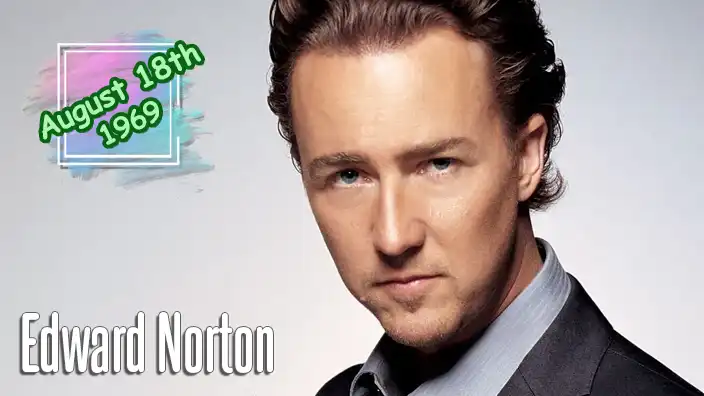
August 18, 1969, in Boston, Massachusetts
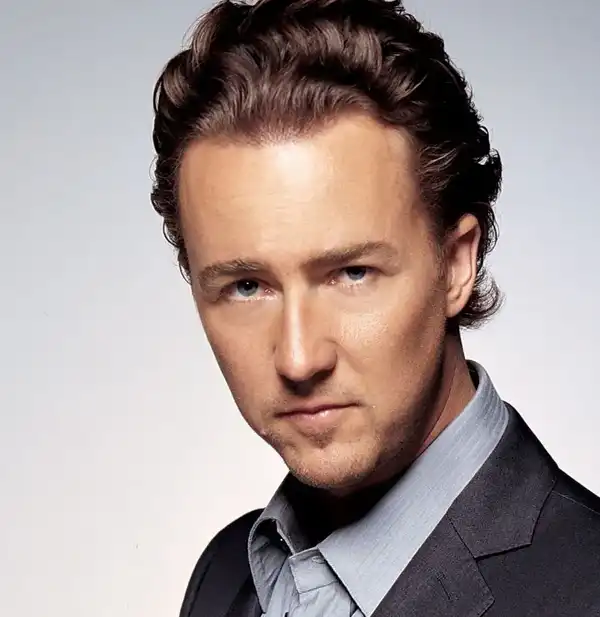
Edward Harrison Norton was born on August 18, 1969, in Boston, Massachusetts, and grew up in Columbia, Maryland. His father, Edward Mower Norton Jr., was an environmental lawyer and conservation advocate who worked in government and later with environmental organizations. His mother, Lydia Robinson "Robin" Rouse, was an English teacher who died of a brain tumor in 1997.
Norton grew up with a younger brother, James, and younger sister, Molly. His maternal grandfather, James Rouse, was an influential urban planner and real-estate developer who founded The Rouse Company and helped develop Columbia, Maryland, the planned community where Norton was raised. Rouse was also instrumental in developing projects including Boston's Faneuil Hall Marketplace and Baltimore's Harborplace.
Norton's interest in acting began early. After seeing a production of the musical Cinderella as a child, he became fascinated with theater and began performing when he was still very young. By his teenage years, acting had become a serious pursuit rather than simply a childhood hobby.
He graduated from Wilde Lake High School in Columbia in 1987 and attended Yale University, where he studied history. While at Yale, Norton continued acting in university productions alongside students who would also enter the entertainment business. He graduated in 1991 with a Bachelor of Arts degree.
His route from Yale to Hollywood was hardly direct. Norton moved to Japan and worked in Osaka for Enterprise Foundation, the nonprofit organization established by his grandfather. He learned some Japanese and spent time examining housing and community-development issues before eventually returning to the United States and pursuing acting more seriously in New York.
Norton became involved with the Signature Theatre Company and performed in Edward Albee's Fragments. His stage work helped bring him to the attention of casting professionals at precisely the right moment, because Hollywood was searching for a young actor capable of handling an unusually demanding role.
That role was Aaron Stampler in Primal Fear.
Released in 1996, Primal Fear starred Richard Gere as defense attorney Martin Vail, who represents a shy altar boy accused of murdering a Catholic archbishop. Norton was a virtually unknown actor when he was cast, reportedly beating thousands of other hopefuls for the role. Explaining exactly why his performance caused such a sensation would spoil the film for anyone who has somehow managed to avoid learning its secrets, but Norton demonstrated an astonishing degree of control for a first major movie performance.
Hollywood noticed immediately.
Norton won the Golden Globe Award for Best Supporting Actor and received an Academy Award nomination for Best Supporting Actor. It was an extraordinary beginning to a film career. Most actors spend years hoping somebody will notice them. Norton essentially arrived, performed for a couple of hours and made it impossible not to.
His remarkable debut was followed quickly by roles in Woody Allen's Everyone Says I Love You and Miloš Forman's The People vs. Larry Flynt, both released in 1996. Rather than being overwhelmed by the attention surrounding Primal Fear, Norton immediately demonstrated an interest in working with established filmmakers and choosing varied material.
Two years later came one of the most demanding performances of his career. In American History X, Norton played Derek Vinyard, a violent neo-Nazi whose imprisonment forces him to confront the hatred that has shaped his life. Norton underwent a significant physical transformation for the role, adding considerable muscle to portray Derek as an intimidating figure.
The performance earned Norton an Academy Award nomination for Best Actor. The film itself was difficult, violent and deliberately uncomfortable, dealing with racism, extremism, family influence and the consequences of hatred. Norton's performance remains one of the roles most closely associated with his career.
Then, in 1999, came Fight Club.
Directed by David Fincher and adapted from Chuck Palahniuk's novel, Fight Club starred Norton as an unnamed office worker suffering from insomnia and profound dissatisfaction with his consumer-driven existence. His life changes after he meets charismatic soap salesman Tyler Durden, played by Brad Pitt, and the two establish an underground fighting club.
Helena Bonham Carter co-starred as Marla Singer, while Meat Loaf appeared as Robert "Bob" Paulson. The movie combined black comedy, psychological drama, social satire and violence into something that initially divided critics and underperformed expectations at the North American box office.
Then something interesting happened: Fight Club refused to disappear.
Home-video audiences embraced it, its dialogue entered popular culture and the film gradually became one of the defining cult movies of the late 1990s. Norton's exhausted, bewildered performance provided the necessary counterweight to Pitt's swaggering Tyler Durden. The movie's continuing popularity ensured that Norton would forever be associated with a certain club whose first two rules make writing about it unnecessarily complicated.
Norton entered the new millennium by stepping behind the camera. He directed and starred in the 2000 romantic comedy Keeping the Faith, alongside Ben Stiller and Jenna Elfman. Norton played a Catholic priest whose lifelong friendship with a rabbi becomes complicated when both men develop feelings for the same woman. The film demonstrated that his interests extended beyond intense psychological dramas and characters who looked as though a good night's sleep might prevent several catastrophes.
He continued working across a broad range of films during the early 2000s. His projects included The Score with Robert De Niro and Marlon Brando, Death to Smoochy, Red Dragon, 25th Hour and The Italian Job. Spike Lee's 25th Hour, released in 2002, gave Norton another particularly acclaimed role as convicted drug dealer Monty Brogan spending his final day of freedom before beginning a prison sentence.
In 2005, Norton appeared as King Baldwin IV in Ridley Scott's historical epic Kingdom of Heaven. The character, suffering from leprosy, spends much of the film concealed behind a silver mask. Norton reportedly chose not to be prominently credited in the film's marketing because he believed revealing the actor behind the mask would diminish the character's impact.
The following year brought The Illusionist, in which Norton played Eisenheim, a mysterious magician in turn-of-the-century Vienna. The film paired him with Jessica Biel and Paul Giamatti and became a critical and commercial success. Norton's restrained performance suited the enigmatic character particularly well, providing another example of his ability to make an audience wonder exactly how much his character knows.
In 2008, Norton entered the world of superhero movies as Bruce Banner in The Incredible Hulk. The film became the second entry in what developed into the Marvel Cinematic Universe, following Iron Man. Norton played Banner as a scientist attempting to control the enormous green creature produced whenever anger gets the better of him — an arrangement that makes ordinary stress-management advice seem woefully inadequate.
Norton did not continue in the role after The Incredible Hulk. Marvel subsequently cast Mark Ruffalo as Bruce Banner beginning with The Avengers in 2012. The circumstances surrounding the change generated considerable media discussion, but Norton's single appearance remains part of the early history of the Marvel Cinematic Universe.
During the following years, Norton increasingly appeared in ensemble films and character roles. He starred in Leaves of Grass and Stone, appeared in Wes Anderson's Moonrise Kingdom, and played a corrupt former government official in The Bourne Legacy. His collaboration with Anderson became particularly productive, with Norton later appearing in The Grand Budapest Hotel, Isle of Dogs and The French Dispatch.
One of Norton's greatest later-career successes arrived with Alejandro González Iñárritu's Birdman or (The Unexpected Virtue of Ignorance) in 2014. Michael Keaton starred as Riggan Thomson, a faded superhero-film actor attempting to restore his artistic reputation by mounting a Broadway production. Norton played Mike Shiner, an acclaimed but spectacularly difficult stage actor whose dedication to authenticity tends to become everybody else's emergency.
The role allowed Norton to be arrogant, unpredictable and extremely funny while gently playing with his own reputation as an intensely involved performer. His performance earned him his third Academy Award nomination, this time for Best Supporting Actor. Birdman went on to win the Academy Award for Best Picture.
Norton joined another large ensemble in Collateral Beauty in 2016 before lending his voice to Wes Anderson's stop-motion animated film Isle of Dogs in 2018. He also appeared in Alita: Battle Angel in a small role that positioned him for potential future installments.
In 2019, Norton returned to directing with Motherless Brooklyn, a project he had spent many years developing. He wrote the screenplay, directed, produced and starred in the film, adapting Jonathan Lethem's novel while moving the story's setting from the contemporary era of the book to 1950s New York.
Norton played Lionel Essrog, a private investigator with Tourette syndrome who investigates the murder of his mentor. The film featured a substantial cast including Bruce Willis, Gugu Mbatha-Raw, Alec Baldwin, Willem Dafoe and Bobby Cannavale. Although Motherless Brooklyn was not a major box-office success, it demonstrated the extent of Norton's filmmaking ambitions and his willingness to spend years bringing a complicated project to the screen.
His later work has continued to balance major studio productions with filmmaker-driven projects. Norton appeared as billionaire Miles Bron in Rian Johnson's Glass Onion: A Knives Out Mystery in 2022. The murder mystery placed Daniel Craig's detective Benoit Blanc among a collection of wealthy and thoroughly suspicious guests gathered on Bron's private Greek island.
Miles Bron gave Norton another opportunity to use comedy alongside drama. The character's enormous confidence is not always accompanied by an equivalent quantity of wisdom, a combination Norton plays with considerable enthusiasm. Saying much more would risk interfering with the pleasures of the mystery, but the role became another memorable addition to his collection of men whom audiences should perhaps hesitate before trusting.
Norton also appeared in Wes Anderson's Asteroid City in 2023, playing playwright Conrad Earp. His continuing collaborations with Anderson have allowed him to become part of the filmmaker's recurring ensemble of performers, appearing in both live-action and animated productions.
In 2024, Norton portrayed folk musician Pete Seeger in A Complete Unknown, the Bob Dylan biographical drama starring Timothée Chalamet as Dylan. His performance earned considerable acclaim and added another historical figure to a career already notable for its variety.
Norton's activities away from acting have been almost as extensive as his filmography. He has long been involved in environmental conservation, sustainable development and social causes, interests connected partly to the work of both his father and grandfather. In 2010, United Nations Secretary-General Ban Ki-moon appointed Norton a United Nations Goodwill Ambassador for Biodiversity.
He has also been deeply involved in charitable fundraising and technology. Norton co-founded CrowdRise, an online fundraising platform designed to help charities and individuals raise money for causes. The company was acquired by GoFundMe in 2017. His business interests have included technology investments and ventures well outside the conventional activities of a Hollywood actor.
Norton has generally kept his private life considerably quieter than many celebrities of comparable fame. He married Canadian film producer Shauna Robertson in 2012 after several years together. The couple have a son, Atlas, born in 2013, and have largely kept their family life away from the entertainment press.
His reputation within the film industry has often emphasized his intense involvement in the creative process. Norton has contributed to scripts, editing and production decisions on various projects and has sometimes developed a reputation for being demanding. Whatever one makes of that reputation, it reflects a consistent pattern throughout his career: Norton appears interested in how an entire film works, not merely in arriving on set, saying his lines and locating the catering table.
That involvement has also made his filmography unusually selective. Norton has never seemed interested in appearing in several movies every year simply for the sake of remaining visible. Instead, his career contains periods of intense activity followed by stretches in which he concentrates on producing, directing, writing, business interests or environmental work.
Edward Norton celebrates his birthday on August 18, sharing both the date and year of his birth with fellow actor Christian Slater. From his startling arrival in Primal Fear to American History X, Fight Club, The Illusionist, Birdman, Glass Onion and his work behind the camera, Norton has built one of the more distinctive careers of his generation.
Three Academy Award nominations across several decades demonstrate the critical respect his performances have earned, but Norton's career is broader than awards alone. He has moved between enormous studio productions and independent films, worked repeatedly with distinctive directors, directed his own projects and maintained substantial interests outside Hollywood.
And after Primal Fear, Fight Club and Glass Onion, audiences should probably have learned one useful rule about Edward Norton movies: if his character seems perfectly straightforward when you first meet him, pay attention.
There may be paperwork later.