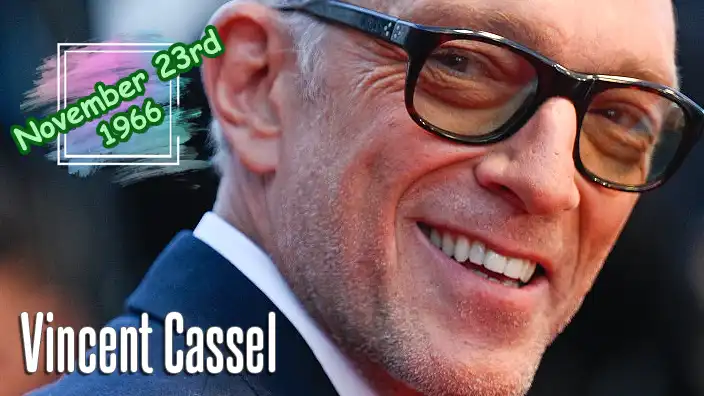
November 23, 1966, in Paris, France

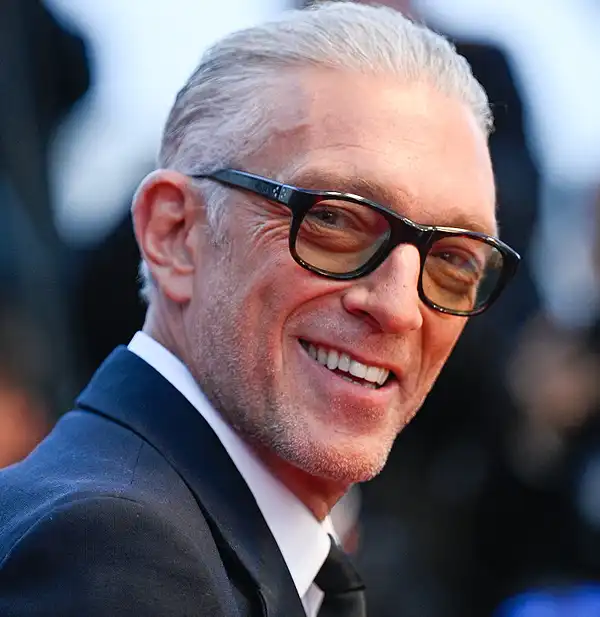
Vincent Cassel, born Vincent Crochon on November 23, 1966, in Paris, France, is an internationally acclaimed French actor, producer, and one of European cinema's most distinctive performers. Known for his intense screen presence, expressive features, physical versatility, and remarkable ability to portray morally complicated characters, Cassel has established a career spanning French independent films, Hollywood blockbusters, psychological thrillers, historical dramas, and television productions. His performances in La Haine, Black Swan, Eastern Promises, and the Ocean's film series have earned him recognition across the world. Whether playing a troubled young man, an international criminal, a demanding ballet director, or a sophisticated thief, Cassel brings an unpredictable energy to his characters that keeps audiences wondering whether they should admire him, fear him, or quietly check that their wallets are still where they left them.
Born into a family deeply connected to the entertainment industry, Vincent grew up surrounded by the performing arts. His father, Jean-Pierre Cassel, was a celebrated French actor whose career included appearances in films directed by prominent filmmakers such as Luis Buñuel and Claude Chabrol. His mother, Sabine Litique, worked as a journalist. Growing up in Paris exposed Vincent to a rich cultural environment filled with cinema, theater, music, and artistic discussion. However, being the son of a successful actor did not automatically guarantee an easy route into the profession. Cassel would eventually establish his own reputation through unconventional roles and performances that frequently challenged audiences' expectations.
Although his father's career provided an early introduction to acting, Cassel initially explored other interests, including circus performance and acrobatics. He trained at the École du Cirque Annie Fratellini, developing physical skills that would later become valuable in his film career. Acrobatics requires discipline, coordination, timing, and the ability to recover gracefully when gravity expresses a different opinion about your intentions. These abilities contributed to Cassel's unusually physical approach to acting, allowing him to perform demanding movement sequences and inhabit characters with a distinctive combination of elegance and aggression.
Cassel subsequently studied acting and began pursuing opportunities in theater and television. During his early professional years, he worked to establish an identity separate from his famous father, choosing roles that emphasized his own personality and abilities. His first screen appearances included small parts in French productions, gradually introducing him to filmmakers and casting directors. Like many actors beginning their careers, he faced the challenge of finding meaningful work while developing the experience necessary to compete for larger roles. Fortunately, his distinctive appearance, intensity, and willingness to embrace unconventional characters made him difficult to overlook.
His breakthrough arrived in 1995 with the critically acclaimed French drama La Haine, directed by Mathieu Kassovitz. The film follows three young men living in the economically disadvantaged suburbs of Paris during a period of social unrest and tension between residents and police. Cassel portrayed Vinz, an angry young Jewish man whose frustration and desire for revenge threaten to lead him toward violence. His performance was raw, energetic, and deeply convincing, capturing the emotional volatility of a character struggling with identity, injustice, and the consequences of his own decisions.
La Haine, filmed in striking black and white, became one of the most influential French films of the 1990s. Its examination of social inequality, police violence, alienation, and urban unrest resonated with audiences far beyond France. The film won the Best Director award at the 1995 Cannes Film Festival and established Cassel as a major emerging talent. His portrayal of Vinz earned César Award nominations for Best Actor and Most Promising Actor, marking an important turning point in his career. The performance demonstrated his ability to portray troubled characters without reducing them to simple villains, a quality that would become central to many of his later roles.
Following the success of La Haine, Cassel appeared in several ambitious French productions that further developed his reputation for challenging material. In 1996, he starred in L'Appartement, a romantic mystery directed by Gilles Mimouni. The film featured Italian actress Monica Bellucci, with whom Cassel would begin a long personal and professional relationship. Their on-screen chemistry attracted considerable attention, and the production helped establish Cassel as a performer capable of combining emotional vulnerability with his characteristic intensity.
His international profile continued growing through films such as Dobermann, a violent French crime thriller in which he portrayed the charismatic leader of a criminal gang. The film's exaggerated action, dark humor, and confrontational style made it a controversial but memorable entry in French genre cinema. Cassel embraced the role with enthusiasm, creating a character whose confidence and recklessness made him both entertaining and dangerous. It was another reminder that Hollywood did not have a monopoly on cinematic criminals, particularly when French filmmakers were willing to supply them with fast cars, questionable judgment, and exceptionally stylish jackets.
In 1998, Cassel appeared in Elizabeth, the historical drama starring Cate Blanchett as Queen Elizabeth I. Playing the Duke of Anjou, Cassel demonstrated his ability to move into English-language international productions while retaining his distinctive European screen presence. The film introduced him to a wider audience and provided valuable experience working within a major historical production. His performance added a colorful and unpredictable element to the political intrigue surrounding the young English queen, proving that complicated royal courtship could be every bit as dramatic as modern criminal activity.
Cassel continued taking risks with provocative projects, including the 2000 psychological thriller The Crimson Rivers, in which he starred alongside Jean Reno. Directed by Mathieu Kassovitz, the film follows investigators uncovering a disturbing series of crimes in the French Alps. Cassel played detective Max Kerkerian, a determined and unconventional investigator whose methods occasionally suggested that police procedure was more of a general recommendation than a strict requirement. The film became an international success and strengthened his reputation as a leading actor in European thrillers.
In 2001, Cassel appeared in the controversial French film Brotherhood of the Wolf, directed by Christophe Gans. Set in eighteenth-century France, the film combined historical mystery, martial arts, horror, and political intrigue, creating an unusual cinematic experience that attracted international attention. Cassel portrayed Jean-François de Morangias, an aristocratic character whose apparent sophistication concealed darker qualities. The production allowed him to demonstrate his physical abilities and talent for portraying deeply unsettling personalities. Few actors could make an eighteenth-century nobleman seem quite so dangerous without even needing to draw a sword.
That same period brought one of the most controversial projects of Cassel's career, the 2002 French psychological drama Irréversible, directed by Gaspar Noé. Starring Cassel alongside Monica Bellucci and Albert Dupontel, the film tells a disturbing story of violence, revenge, and tragedy through a reverse chronological structure. Its graphic content and uncompromising presentation generated intense debate among critics and audiences. Cassel's emotionally charged performance contributed to the film's reputation as a challenging and provocative work of cinema, demonstrating his willingness to participate in projects that explored difficult subjects without attempting to make them comfortable or easily digestible.
Cassel gained further Hollywood recognition when he portrayed François Toulour, also known as the Night Fox, in Ocean's Twelve in 2004. Starring alongside George Clooney, Brad Pitt, Matt Damon, and an impressive ensemble cast, Cassel played a wealthy and exceptionally skilled French thief who challenged Danny Ocean's criminal team. His character combined arrogance, athleticism, and considerable charm, most memorably during an elaborate sequence involving acrobatic movements through a security system protected by laser beams. Cassel's earlier circus training undoubtedly came in handy, although most professional burglars would probably prefer simply finding somebody who had forgotten to lock a door.
He returned as the Night Fox in Ocean's Thirteen in 2007, continuing his association with one of Hollywood's most successful modern heist franchises. The role introduced Cassel to audiences who might never have encountered his French-language films and demonstrated his ability to hold his own among some of Hollywood's biggest stars. His performance was stylish, playful, and slightly ridiculous in precisely the way the films required. While George Clooney's character preferred elaborate planning and teamwork, Cassel's Night Fox appeared to believe that an expensive suit and an impressive display of gymnastics could solve almost any problem.
In 2007, Cassel delivered another notable performance in Eastern Promises, directed by David Cronenberg. The crime thriller starred Viggo Mortensen as a mysterious figure connected to London's Russian criminal underworld, while Cassel portrayed Kirill, the unstable and emotionally conflicted son of a powerful crime boss. His performance revealed the character's insecurity, desperation, and volatility beneath a privileged exterior. Working alongside Mortensen and Naomi Watts, Cassel contributed to a tense and critically acclaimed film that explored loyalty, identity, and the brutal consequences of organized crime.
One of the most significant achievements of Cassel's career came with his portrayal of notorious French criminal Jacques Mesrine in the two-part biographical crime drama Mesrine: Killer Instinct and Mesrine: Public Enemy No. 1, both released in 2008. Directed by Jean-François Richet, the films chronicled the life of a criminal whose robberies, prison escapes, and confrontations with authorities made him infamous in France. Cassel underwent physical transformations and portrayed Mesrine across different stages of his life, capturing the character's charisma, violence, contradictions, and increasingly reckless behavior.
His portrayal of Mesrine received widespread critical acclaim and earned him the César Award for Best Actor in 2009, one of the highest honors in French cinema. The performance required extraordinary commitment, as Cassel explored the personality of a man who cultivated a public image of rebellion while committing serious crimes. Rather than romanticizing Mesrine, the films presented a complex and often disturbing portrait of criminal ambition. Cassel's ability to make such a deeply flawed character compelling without excusing his actions demonstrated the maturity and range he had developed throughout his career.
In 2010, Cassel reached another international audience with his performance in Black Swan, directed by Darren Aronofsky. The psychological thriller starred Natalie Portman as Nina Sayers, a dedicated ballet dancer whose pursuit of perfection gradually leads to psychological collapse. Cassel portrayed Thomas Leroy, the demanding and manipulative artistic director of a prestigious New York ballet company. His character pushed Nina toward increasingly extreme emotional and physical demands, contributing to the film's atmosphere of obsession, insecurity, and psychological tension.
Black Swan became a major critical and commercial success, earning five Academy Award nominations and winning Natalie Portman the Oscar for Best Actress. Cassel's portrayal of Thomas Leroy was particularly effective because he avoided presenting the character as a straightforward villain. Instead, he created a sophisticated, intimidating, and morally ambiguous figure whose pursuit of artistic excellence often crossed personal boundaries. His performance demonstrated that a character could be deeply unsettling without carrying a weapon or committing an obvious crime. Sometimes a demanding ballet director with a sharp tongue and an unreasonable rehearsal schedule is quite frightening enough.
Cassel's international career continued with appearances in films including A Dangerous Method, David Cronenberg's 2011 historical drama exploring the relationship between pioneering psychologists Carl Jung and Sigmund Freud. Cassel portrayed Otto Gross, a controversial psychoanalyst whose unconventional ideas and personal behavior challenged established professional boundaries. The role allowed him to explore intellectual rebellion and psychological complexity in a very different setting from his earlier crime thrillers.
He also appeared in the 2013 crime thriller Trance, directed by Danny Boyle, portraying Franck, a criminal involved in an elaborate art theft and psychological manipulation. The film combined suspense, shifting memories, and unreliable perceptions, giving Cassel another opportunity to inhabit a character whose motivations remained uncertain. His ability to project authority while suggesting underlying danger made him particularly effective in stories where appearances could not be trusted. By this stage, audiences had learned that whenever Vincent Cassel entered a room looking exceptionally calm, somebody was probably about to have a very complicated afternoon.
Cassel returned to major French productions with the 2014 fantasy romance Beauty and the Beast, directed by Christophe Gans and starring Léa Seydoux. He portrayed the Beast, bringing emotional depth and physical intensity to the familiar fairy-tale character. The elaborate production combined visual effects, fantasy, romance, and dramatic storytelling, allowing Cassel to explore themes of transformation, guilt, and redemption. It also provided an unusual opportunity for an actor frequently associated with intimidating human characters to play an actual beast, which presumably simplified certain casting discussions.
In 2015, Cassel starred in the French drama Mon roi, directed by Maïwenn, alongside Emmanuelle Bercot. The film examined a passionate but destructive romantic relationship, with Cassel portraying Georgio, a charismatic and emotionally manipulative man whose behavior creates turmoil for his partner. His performance highlighted the contradictions of a character capable of affection, selfishness, charm, and cruelty. The film received attention at the Cannes Film Festival, where Bercot shared the Best Actress award, and further demonstrated Cassel's talent for portraying relationships that are psychologically complicated rather than conventionally romantic.
Cassel appeared in the 2016 action thriller Jason Bourne, starring Matt Damon. Playing the ruthless operative known as the Asset, he brought his physical intensity to a major Hollywood espionage franchise. His character pursued Bourne through elaborate action sequences and dangerous confrontations, providing a formidable adversary for the film's central character. Cassel's performance relied heavily on movement, expression, and physical presence, proving that an actor does not necessarily need lengthy speeches to communicate menace. Sometimes a determined expression and a very large collection of weapons will do the job perfectly well.
His work during the following years included the 2018 French historical adventure The Emperor of Paris, in which he portrayed Eugène François Vidocq, the former criminal who became a pioneering figure in French criminal investigation. The role brought Cassel into another period setting, allowing him to combine action, historical drama, and a character whose experiences blurred the boundaries between lawbreaking and law enforcement. Vidocq's remarkable transformation from criminal to investigator provided a particularly appropriate subject for an actor whose career had featured so many memorable figures on both sides of the law.
Cassel also appeared in the science-fiction horror film Underwater, released in 2020 and starring Kristen Stewart. Set aboard a deep-sea research facility threatened by catastrophic structural damage and mysterious creatures, the film featured Cassel as Captain Lucien, a senior member of the crew attempting to lead survivors to safety. The role presented him as a figure of authority and responsibility rather than an obvious antagonist, demonstrating his ability to portray leadership under extraordinary pressure. Considering the circumstances, even his famously intense expression seemed entirely reasonable when confronted with the prospect of being trapped thousands of feet beneath the ocean.
In 2020, Cassel appeared in the HBO science-fiction television series Westworld, portraying Engerraund Serac, a powerful and secretive businessman associated with an advanced artificial intelligence system. His character became a central antagonist during the show's third season, combining extraordinary wealth, technological influence, and a disturbing belief that humanity's future could be controlled through sophisticated predictive systems. Cassel's performance brought elegance and menace to the role, demonstrating his effectiveness in television as well as cinema. It also raised an important question: if somebody offers to control the future of civilization while wearing an extremely expensive suit, should anyone really trust him?
Cassel continued expanding his international filmography with projects including the 2023 French adventure The Three Musketeers: D'Artagnan and its companion film The Three Musketeers: Milady. In these adaptations of Alexandre Dumas' classic novel, he portrayed Athos, one of the legendary musketeers. The films featured elaborate costumes, sword fights, political intrigue, and historical adventure, allowing Cassel to portray a seasoned warrior whose troubled past contributed to his complicated personality. His interpretation of Athos combined experience, melancholy, and physical authority, making him a convincing member of the famous trio whose unofficial motto might reasonably have been, "One for all, and somebody please explain why we're fighting again."
In 2024, Cassel appeared in David Cronenberg's The Shrouds, a science-fiction drama exploring grief, mortality, and technology. He portrayed Karsh, a businessman who develops an unusual technological system following the death of his wife. The film reunited Cassel with Cronenberg, continuing a professional association that had previously produced memorable performances in Eastern Promises and A Dangerous Method. The project allowed him to explore a deeply personal and emotionally vulnerable character, illustrating his continuing interest in unconventional stories that challenge traditional cinematic expectations.
Cassel's career has also extended into television productions outside the United States. In the 2023 Apple TV+ thriller series Liaison, he starred alongside Eva Green in a story involving international espionage, cyberattacks, and political intrigue. The production combined French and English dialogue, reflecting Cassel's ability to move comfortably between different languages and national film industries. His multilingual abilities and international experience have become important advantages in a career that frequently crosses cultural and geographical boundaries.
Outside acting, Cassel has maintained a strong interest in physical fitness, dance, and martial arts, particularly the Brazilian martial art capoeira. His athletic abilities have contributed to the distinctive physicality of many of his performances, allowing him to approach movement and action sequences with unusual confidence. He has also developed a close connection with Brazil, spending significant time in the country and embracing aspects of its culture. His familiarity with different languages and cultural environments has helped shape his international identity as an actor who feels equally comfortable working in European and American productions.
Cassel's personal life has attracted considerable public attention, particularly his relationship with Italian actress Monica Bellucci. The couple met while working on L'Appartement in 1996 and married in 1999. They became one of European cinema's most recognizable celebrity couples, appearing together in several films while maintaining successful individual careers. Their daughters, Deva and Léonie, were born during their marriage. The couple separated in 2013 after fourteen years of marriage, but their professional achievements and shared appearances remain an important part of European film history.
In 2018, Cassel married French model Tina Kunakey, with whom he welcomed a daughter, Amazonie, in 2019. Their relationship subsequently ended. Cassel later began a relationship with Brazilian model Narah Baptista, and the couple welcomed a son, Caetano, in January 2025. Despite the public interest surrounding his relationships, Cassel has generally maintained a degree of privacy regarding his family life, balancing his international celebrity with an effort to protect personal matters from excessive attention.
Throughout his career, Cassel has resisted becoming permanently associated with any single type of character. Although he is frequently cast as criminals, antagonists, and morally ambiguous figures, his performances reveal a much broader range. He has portrayed vulnerable individuals, historical personalities, romantic leads, authority figures, intellectuals, and emotionally conflicted men whose outward confidence conceals deeper insecurities. His ability to combine charisma with unpredictability makes him particularly effective in films that explore the complicated motivations behind human behavior.
His achievements have earned recognition from major film festivals, critics, and industry organizations, particularly in France, where he remains one of the country's most respected contemporary actors. His César Award victory for Mesrine stands among his most significant honors, while his international performances have introduced French cinema's distinctive dramatic traditions to audiences around the world. Cassel has also demonstrated that European actors can build successful Hollywood careers without abandoning their national film industries or sacrificing the artistic independence that originally made them interesting.
From the troubled streets of La Haine to the demanding rehearsal rooms of Black Swan, the elaborate criminal schemes of Ocean's Twelve, and the historical adventures of The Three Musketeers, Vincent Cassel has built a remarkable career through intensity, versatility, and a willingness to embrace challenging characters. His performances frequently explore the darker and more complicated aspects of human nature, yet they remain compelling because of the intelligence and emotional depth he brings to each role. Whether portraying a criminal mastermind, a tortured artist, or a sophisticated villain, Cassel continues to remind audiences that cinema's most interesting characters are not always the people anyone would particularly want living next door.
References & Sources