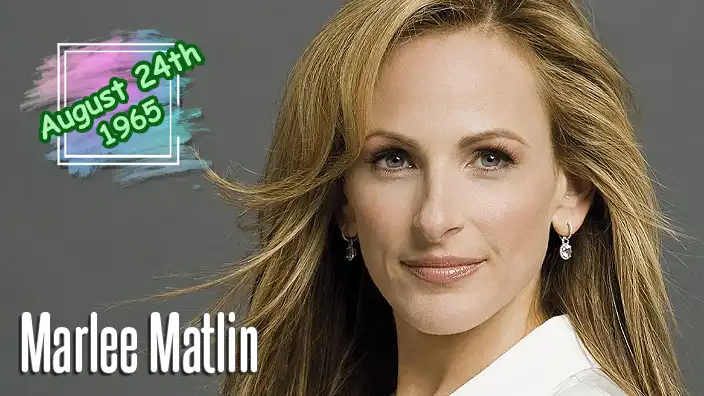
August 24, 1965, in Morton Grove, Illinois
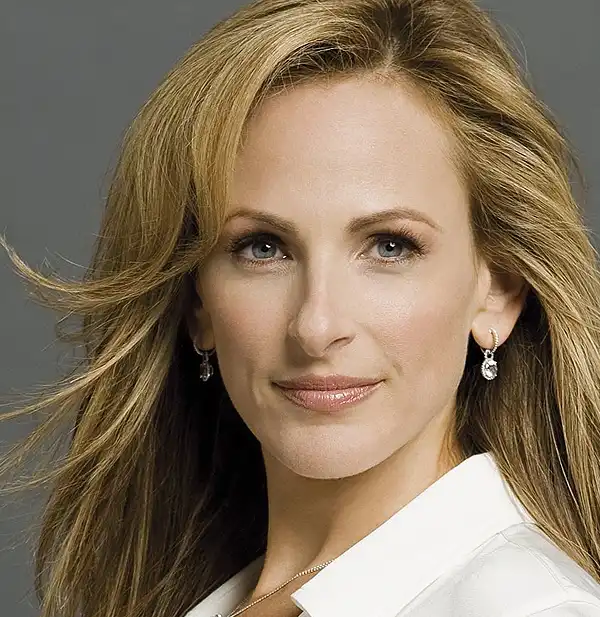
Marlee Matlin made her movie debut and promptly won an Academy Award, which is a rather inconvenient standard to set for your second job. From Children of a Lesser God to CODA, she has spent four decades acting, producing and advocating for greater opportunities for deaf performers—while demonstrating that Hollywood's limitations were considerably more restrictive than her own.
Marlee Beth Matlin was born on August 24, 1965, in Morton Grove, Illinois, and grew up in the Chicago area. She is the youngest of three children born to Libby and Donald Matlin.
Matlin lost most of her hearing when she was 18 months old following an illness. She became profoundly deaf in her right ear and retained limited hearing in her left. Rather than allowing deafness to exclude her from performance, she began acting as a child and developed an enthusiasm for the stage that would eventually take her considerably farther than anyone could reasonably have predicted.
Her early acting experience came through the International Center on Deafness and the Arts, where she appeared in children's theatrical productions. At seven years old, she played Dorothy in a production of The Wizard of Oz. Other stage work followed throughout her childhood.
Matlin attended John Hersey High School in Arlington Heights, Illinois, and later studied criminal justice at Harper College. Acting remained important to her, although at the time she was hardly following a conventional path toward Hollywood.
Then Children of a Lesser God changed everything.
Matlin had performed in a stage production of Mark Medoff's play when she attracted the attention that eventually led to her casting in the 1986 film adaptation. She played Sarah Norman, a deaf woman working as a custodian at a school for deaf students who develops a complicated relationship with a hearing teacher, James Leeds, played by William Hurt.
It was Matlin's feature-film debut.
Her performance earned widespread acclaim, and at the 59th Academy Awards in 1987, Matlin won the Oscar for Best Actress. She was just 21 years old when she received the award, making her the youngest winner of the Best Actress category at the time. She also became the first deaf performer to win an Academy Award.
Not bad for one's first movie.
The role also earned Matlin a Golden Globe Award for Best Actress in a Motion Picture – Drama. Suddenly, an actress who had never before appeared in a feature film was standing among Hollywood's most celebrated performers.
Following such an extraordinary debut could easily have become a career-long burden. Instead, Matlin moved steadily into film and television, building a body of work that demonstrated she wasn't going to be defined by a single performance.
She starred opposite Billy Joel in the 1989 film The Marrying Man and appeared in other movie projects, but television soon became an especially important part of her career.
From 1991 to 1993, Matlin starred as Assistant District Attorney Tess Kaufman in the television series Reasonable Doubts, alongside Mark Harmon. Her performance brought further Golden Globe recognition and demonstrated that a deaf actress could carry a mainstream network television series without her deafness needing to become the sole purpose of every storyline.
That should hardly have been revolutionary. In early-1990s television, unfortunately, it rather was.
Matlin subsequently became a familiar presence across American television, appearing in an unusually broad collection of dramas, comedies and political series.
One of her best-known recurring roles came on The West Wing, where she played Joey Lucas, a political pollster and campaign strategist. Introduced during the show's first season, Joey was intelligent, confident and perfectly capable of holding her own among the rapid-fire political operatives surrounding President Josiah Bartlet.
The character communicated using American Sign Language, with interpreter Kenny Thurman, played by Bill O'Brien, frequently accompanying her. Importantly, Joey's deafness was part of the character without becoming her entire personality.
Matlin also appeared on Seinfeld, playing Laura, a deaf lineswoman at the U.S. Open whose lip-reading ability becomes central to one of the show's typically escalating misunderstandings. She later appeared in programs including ER, The Practice, Law & Order: Special Victims Unit, Desperate Housewives, My Name Is Earl and Nip/Tuck.
Her recurring performance as attorney Melody Bledsoe on The L Word introduced her to another generation of television viewers, while roles on Switched at Birth and Quantico further expanded an already lengthy résumé.
Matlin has also appeared as herself in reality and competition television. In 2008, she competed on Dancing with the Stars, partnered with professional dancer Fabian Sanchez. Dancing without being able to hear the music might sound like a substantial disadvantage, but Matlin has rarely shown much interest in accepting other people's definitions of what she ought to find difficult.
Her career has also included considerable work beyond acting.
Matlin published her first novel, Deaf Child Crossing, in 2002, followed by additional books for younger readers. In 2009, she published the memoir I'll Scream Later, discussing her career, childhood, relationships, addiction and personal experiences with considerable candor.
Throughout her public life, Matlin has been an outspoken advocate for deaf people and for authentic representation in entertainment. She has pushed Hollywood to hire deaf actors for deaf characters, increase accessibility and recognize that deaf performers should have access to the same range of roles available to hearing actors.
Those efforts became especially significant as Hollywood slowly began reconsidering how disability and deafness were represented on screen.
Then came CODA.
Released in 2021, CODA tells the story of Ruby Rossi, played by Emilia Jones, the only hearing member of a deaf family. Ruby loves singing but feels responsible for helping her parents and brother with the family's fishing business.
Matlin played Ruby's mother, Jackie Rossi, while Troy Kotsur played her father, Frank, and Daniel Durant played her brother, Leo. Crucially, the deaf members of the Rossi family were portrayed by deaf actors.
Matlin reportedly made it clear during development that she would not support the film if hearing actors were cast as the deaf family members. The filmmakers ultimately assembled a largely deaf principal cast for the Rossi family, a decision that became fundamental to the authenticity of the finished film.
CODA became an enormous critical success.
At the 94th Academy Awards in 2022, the film won Best Picture, becoming the first film distributed by a streaming service to win the Academy's top award. Troy Kotsur won Best Supporting Actor, becoming the first deaf male actor to win an acting Oscar and the second deaf performer overall—following Matlin's historic victory 35 years earlier.
The Screen Actors Guild also awarded the CODA cast its prize for Outstanding Performance by a Cast in a Motion Picture, another historic achievement for a cast prominently featuring deaf performers.
For Matlin, CODA represented something larger than another successful movie. Decades after she had entered Hollywood as a young deaf actress with remarkably few established paths to follow, she was part of a production demonstrating what could happen when deaf actors were given substantial, complex and ordinary human roles.
Her influence has extended into industry advocacy as well. Matlin has worked with organizations supporting deaf and hard-of-hearing people and has spoken repeatedly about accessibility, captioning and employment opportunities. She has also served as a prominent public voice encouraging greater inclusion both within entertainment and beyond it.
In 2023, Matlin became the first deaf person to serve on the Academy of Motion Picture Arts and Sciences' Board of Governors, another milestone in a career that has accumulated quite a collection of them.
Her personal life has remained comparatively stable despite spending most of her adulthood in the entertainment industry. Matlin married police officer Kevin Grandalski in 1993, and they have four children.
Nearly four decades after Children of a Lesser God, Matlin's Academy Award remains historically significant. But focusing entirely upon that Oscar risks missing the larger story.
She didn't simply arrive, win an award and become an interesting footnote in Academy Awards history. She continued working.
She appeared in major television series, performed comedy, drama and political satire, wrote books, raised a family, advocated for other deaf performers and eventually helped bring a film such as CODA to audiences.
Marlee Matlin's career has therefore been about considerably more than being the first deaf performer to win an Oscar. She helped ensure she wouldn't remain the only one.
And considering she accomplished the first part with her very first movie, Hollywood probably should have realized from the beginning that she wasn't planning on doing things the easy way.