August 24, 1988, in Harlow, England
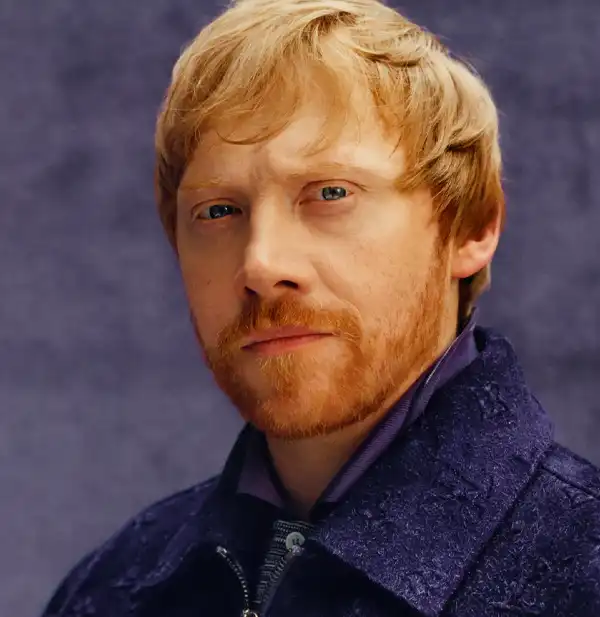
Rupert Grint spent ten years playing a wizard who was terrified of spiders, perpetually hungry and remarkably good at surviving situations that should have required considerably more adult supervision. Fortunately, Grint proved there was much more to him than Ron Weasley, building a varied career in film, television and theater while remaining one of the most recognizable redheads on the planet.
Born Rupert Alexander Lloyd Grint on August 24, 1988, in England, Grint grew up in Hertfordshire as the eldest of five children. Long before Hogwarts came calling, he had developed an interest in acting through school productions and local drama activities. Among his early theatrical achievements was playing Rumplestiltskin, which presumably provided useful preparation for spending the next decade surrounded by witches, wizards, trolls and people with extremely complicated names.
Grint was only 11 when the search began for actors to play Harry Potter, Hermione Granger and Ron Weasley in the film adaptation of J.K. Rowling's enormously successful Harry Potter and the Sorcerer's Stone. Unlike a seasoned child actor backed by an impressive résumé, Grint approached the opportunity with enthusiasm and considerable nerve. His audition included a homemade video in which he performed a rap explaining why he should be chosen to play Ron.
It worked.
Grint joined Daniel Radcliffe and Emma Watson as the three young actors who would become the faces of one of the biggest movie franchises in history. Harry Potter and the Sorcerer's Stone arrived in theaters in 2001, with Grint immediately establishing Ron as much more than Harry Potter's redheaded sidekick.
Ron was funny, loyal, occasionally jealous, frequently bewildered and usually ready with precisely the expression audiences themselves might have worn when something enormous and unpleasant appeared in a Hogwarts corridor. Grint's natural comic timing became one of the character's defining qualities, but he also handled Ron's more serious moments as the character matured.
The role became Grint's life for much of his childhood and adolescence. He appeared as Ron in all eight Harry Potter films, beginning with Harry Potter and the Sorcerer's Stone and concluding with Harry Potter and the Deathly Hallows – Part 2 in 2011.
Growing up while starring in an international film phenomenon was hardly a conventional education. Grint and the other young cast members received tutoring while working on the films, allowing them to continue their studies around the demanding production schedule. Grint completed his formal education after taking his GCSE examinations in 2004.
During the Potter years, he also began demonstrating that he could work outside the wizarding world. In 2002, he appeared in the comedy Thunderpants, playing Alan A. Allen, the extraordinarily intelligent friend of a boy whose unfortunate digestive condition becomes the basis of the story. It was certainly one way to prove that an actor wasn't going to spend his entire career waving a wand.
He later starred in Driving Lessons alongside Julie Walters, who Potter audiences already knew as Ron's formidable mother, Molly Weasley. Released in 2006, the film gave Grint a much different role as a shy teenager developing an unlikely friendship with an eccentric retired actress.
Once the Harry Potter series ended, Grint faced the challenge familiar to actors who become internationally famous for one character at a very young age: convincing audiences that he could be somebody else.
Rather than trying to manufacture an instant blockbuster career, Grint pursued an eclectic collection of projects.
His post-Potter film work included the World War II drama Into the White, the biographical film CBGB, the comedy Moonwalkers and other productions that allowed him to move considerably farther away from Ron Weasley. He also ventured onto the stage, appearing in the West End production of Jez Butterworth's Mojo and later making his Broadway debut in It's Only a Play, appearing alongside an experienced cast that included Nathan Lane and Matthew Broderick.
Television eventually became an especially productive part of Grint's career.
He starred as Daniel Glass in the dark comedy Sick Note, a man mistakenly diagnosed with a terminal illness who discovers that people suddenly treat him much better when they think he's dying. Naturally, instead of immediately correcting the misunderstanding like a sensible human being, Daniel allows matters to become increasingly ridiculous.
Grint also played Charlie Cavendish-Scott in the television adaptation of Snatch, appearing throughout the show's 2017–2018 run and serving as an executive producer. The series, loosely inspired by Guy Ritchie's 2000 film, revolved around a group of young hustlers who become entangled with organized crime after discovering stolen gold.
In 2018, Grint appeared as Inspector Crome in the television adaptation of Agatha Christie's The ABC Murders, starring opposite John Malkovich as Hercule Poirot. It was another substantial departure from the character who had defined Grint's early career.
One of his most prominent later television roles came with Servant, the psychological horror series created by Tony Basgallop and executive produced by M. Night Shyamalan. Grint played Julian Pearce throughout the Apple TV+ series, which ran from 2019 to 2023. His performance combined cynicism, dark humor and emotional vulnerability and earned him recognition for his work, including a Hollywood Critics Association Television Award for supporting actor in a streaming drama.
Grint returned to feature-film horror in M. Night Shyamalan's Knock at the Cabin in 2023. Playing Redmond, one of four strangers who confront a vacationing family with an extraordinary and terrifying demand, Grint again showed his willingness to choose characters far removed from the comfortable familiarity of Ron Weasley.
For all his efforts to establish an independent acting career, Grint has never entirely escaped Hogwarts—and there is little indication that he particularly resents the association. The Harry Potter films became a defining cultural experience for an entire generation, and Ron Weasley remains one of the series' most beloved characters.
Grint has also retained a refreshingly eccentric streak away from acting. One of the most famous examples is his ownership of an ice cream van, something he had wanted since childhood. Becoming internationally famous and wealthy enough to buy almost anything and choosing an ice cream van suggests that somewhere beneath the celebrity exterior remains a man who understands life's proper priorities.
His fear of spiders is equally well documented. Grint has spoken about suffering from arachnophobia, which made Ron's encounters with enormous spiders in Harry Potter and the Chamber of Secrets considerably less dependent upon acting technique than audiences might have assumed.
Another wonderfully appropriate story concerns director Alfonso Cuarón, who asked the three principal young actors to write essays about their characters while preparing Harry Potter and the Prisoner of Azkaban. Emma Watson reportedly produced a lengthy essay, Daniel Radcliffe completed the assignment, and Grint didn't hand one in—reasoning that Ron probably wouldn't have done it either.
That may be one of the finest examples of method acting ever achieved through avoiding homework.
More than two decades after audiences first saw him sitting aboard the Hogwarts Express, Rupert Grint remains inseparable from Ron Weasley in popular culture. Yet his career since Harry Potter has demonstrated an appetite for unusual characters, dark comedy, horror, crime drama and theater rather than simply attempting to reproduce the enormous commercial success of his childhood.
Ron Weasley made Rupert Grint famous. Everything afterward has given him the opportunity to show what else he can do—and he has done it without having to defeat another Dark Lord, which probably makes getting to work in the morning considerably easier.