August 24, 1973, in Washington, D.C.
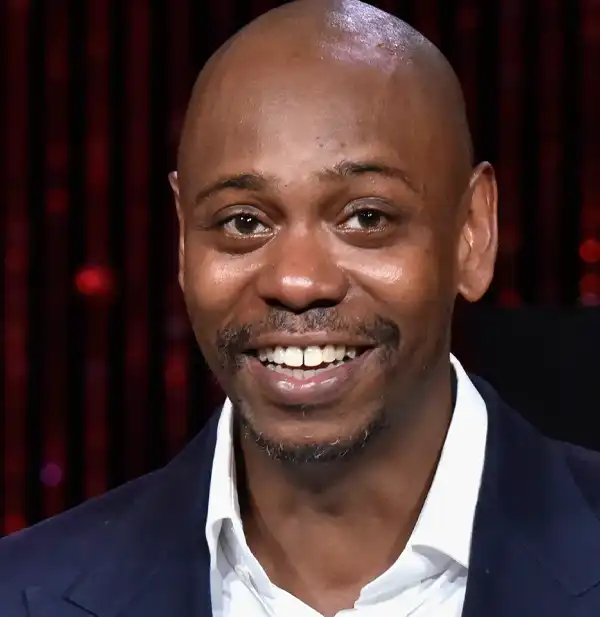
Dave Chappelle has built a career by walking onto a stage, looking perfectly relaxed and then saying something guaranteed to make half the audience laugh while the other half suddenly wonders whether laughing is socially advisable. From Chappelle's Show to award-winning stand-up specials, he has become one of America's most influential comedians—and one who has rarely shown much interest in taking the comfortable route.
David Khari Webber Chappelle was born on August 24, 1973, in Washington, D.C. His parents were both academics: his father, William David Chappelle III, was a professor, while his mother, Yvonne Seon, was an educator whose career included university work and African studies. Following his parents' separation, Chappelle divided his time between Washington, where he primarily lived with his mother, and Ohio, where he spent summers with his father. Comedy fascinated him from an early age, with performers including Richard Pryor and Eddie Murphy providing inspiration for a youngster who was already beginning to imagine himself making a living by making other people laugh.
Chappelle attended Washington's Duke Ellington School of the Arts, where he studied theater arts and graduated in 1991. Rather than following the university route one might expect from a family filled with academics, he headed for New York City and began pursuing stand-up comedy. It was not an immediately gentle introduction to the profession. During Amateur Night at Harlem's legendary Apollo Theater, the young Chappelle was famously booed off the stage. Instead of abandoning comedy and finding a quieter occupation in which strangers were less likely to yell at him, he later described the experience as liberating. Once you've been booed off the Apollo, an unimpressed table of six people in a comedy club loses much of its terror.
He continued working the New York comedy circuit and gradually developed the qualities that would become trademarks of his performances: an easygoing delivery, exceptional storytelling and a willingness to tackle uncomfortable subjects involving race, politics, class and American culture. National television appearances followed, including Def Comedy Jam and appearances on late-night programs. Hollywood noticed him as well, and in 1993 he appeared as Ahchoo in Mel Brooks' Robin Hood: Men in Tights. Still barely 20, Chappelle already displayed the relaxed comic delivery that would eventually make him instantly recognizable.
Movie roles continued throughout the 1990s. Chappelle appeared in The Nutty Professor, Con Air, You've Got Mail, Blue Streak and other films, often making memorable appearances without necessarily being the central character. In 1998, he co-wrote and starred in Half Baked, playing Thurgood Jenkins in a marijuana comedy that received mixed reviews upon release but subsequently developed a considerable cult following. The movie strengthened his popularity with younger audiences, but film was never going to be where Chappelle made his largest cultural impact. Television was waiting, and in January 2003 it arrived with very little concern for good manners.
Created by Chappelle and Neal Brennan, Chappelle's Show premiered on Comedy Central as a combination of prerecorded sketches, stand-up introductions and musical performances. Chappelle frequently portrayed multiple characters while the series attacked racial stereotypes, celebrity culture, advertising, politics, entertainment and American social conventions. The show became enormously popular, and sketches involving Clayton Bigsby, the Racial Draft, Lil Jon and Charlie Murphy's stories about encounters with Rick James and Prince quickly escaped from television and entered everyday conversation. For a period in the early 2000s, merely mentioning Rick James in public carried a significant risk that somebody nearby would begin quoting Chappelle's Show.
The program's success transformed Chappelle from a respected comedian into a cultural phenomenon. Comedy Central offered him an extraordinarily lucrative agreement to continue the series, reportedly worth around $50 million. Yet while production of the third season was underway in 2005, Chappelle abruptly left the show and traveled to South Africa. Speculation exploded, with reports suggesting everything from exhaustion and personal problems to far more dramatic explanations. Chappelle rejected many of those stories and later discussed his discomfort with the pressures surrounding the program, the business arrangements involved and the ways some viewers were interpreting its racial humor.
Walking away from one of television's hottest programs—and a reported $50 million agreement—became almost as famous as the show itself. Most people would need to discover that $50 million came with an angry crocodile attached before considering leaving it behind, but Chappelle chose creative and personal independence instead. Comedy Central eventually aired material from the unfinished third season as Chappelle's Show: The Lost Episodes in 2006, but Chappelle remained largely outside mainstream television for several years.
He never actually abandoned comedy. Chappelle continued performing stand-up, sometimes appearing unexpectedly at clubs and occasionally delivering marathon sets lasting several hours. Instead of immediately trying to recreate his television success, he gradually rebuilt his relationship with performing on his own terms. By the early 2010s, those appearances were becoming more frequent and prominent. He headlined the Oddball Comedy & Curiosity Festival in 2013 and staged a celebrated series of performances at New York's Radio City Music Hall the following year.
His return to mainstream prominence accelerated dramatically in 2016 when he hosted Saturday Night Live immediately following the U.S. presidential election. The appearance earned him a Primetime Emmy Award for Outstanding Guest Actor in a Comedy Series and reminded a huge television audience why Chappelle had once been considered one of the most important comedians of his generation. Soon afterward, he entered into a major agreement with Netflix that produced a succession of stand-up specials and effectively launched the second great phase of his career.
Those specials included The Age of Spin, Deep in the Heart of Texas, Equanimity, The Bird Revelation, Sticks & Stones, The Closer and The Dreamer. They earned Chappelle numerous honors, including multiple Emmy and Grammy Awards, while once again placing him at the center of American comedy. His performances retained the conversational storytelling of his earlier work but increasingly tackled subjects involving politics, race, celebrity, gender, sexuality and freedom of expression.
Not everyone found the material funny. Some of Chappelle's comedy, particularly jokes involving transgender people, generated intense criticism. The Closer in 2021 became the center of public protests and arguments about comedy, artistic freedom and the treatment of transgender people. Supporters defended Chappelle's willingness to challenge audiences and social conventions, while critics argued that some of his material was harmful and demeaning. Chappelle largely responded in the manner he has throughout his career: he continued performing and discussing contentious subjects rather than attempting to become less controversial.
His achievements within comedy have nevertheless been substantial. In 2019, Chappelle received the Kennedy Center's Mark Twain Prize for American Humor, joining a distinguished group of recipients that includes Richard Pryor, George Carlin, Carol Burnett, Eddie Murphy, Lily Tomlin and Steve Martin. The honor recognized not simply his success at telling jokes but his influence on American comedy and culture. His stand-up recordings and specials have also brought multiple Grammy Awards, while his television work has earned multiple Primetime Emmys.
Despite decades of celebrity, Chappelle has maintained an unusually strong connection to life outside Hollywood. He has lived for many years near Yellow Springs, Ohio, with his wife, Elaine Mendoza Erfe, whom he married in 2001, and their three children. Chappelle has frequently spoken warmly about the community and has organized performances and events in the area. During the COVID-19 pandemic, he hosted socially distanced outdoor comedy performances in Ohio, bringing prominent comedians and musicians to the area while conventional entertainment venues were largely closed.
His relationship with Chappelle's Show eventually produced another unexpected chapter. In 2020, Chappelle publicly complained that the terms of his original contract meant he was not receiving compensation when the program was licensed to streaming platforms. Netflix removed the series from its service at his request. After discussions involving the rights holders, Chappelle later announced that the dispute had been resolved, and the program returned to streaming. For an entertainer who had once shocked Hollywood by walking away from his most successful creation, regaining a measure of control over that creation years later carried considerable significance.
Chappelle has occasionally returned to dramatic acting as well. In 2018, he appeared in Bradley Cooper's A Star Is Born, playing George "Noodles" Stone, a longtime friend of Cooper's troubled musician Jackson Maine. The restrained performance offered a reminder that the man known for outrageous sketches and provocative stand-up could also settle comfortably into a straightforward dramatic role without needing to turn every scene into a comedy routine.
Stand-up, however, remains the foundation of Chappelle's career. His approach differs from comedians who depend upon a rapid sequence of setup and punchline. Chappelle frequently tells long stories, allowing seemingly unrelated details to accumulate before revealing how they connect. He is equally comfortable allowing silence into a performance, pausing while an uncomfortable idea settles over the room before deciding whether to relieve the tension or make matters considerably worse. Given a choice, he has demonstrated a rather impressive preference for considerably worse.
More than three decades after beginning his professional career, Dave Chappelle occupies an unusual position in American entertainment. He achieved enormous success, deliberately walked away from it, spent years working outside the mainstream and then returned to become arguably even more successful. He created one of the most influential sketch-comedy programs of the 21st century, accumulated Emmys and Grammys, received the Mark Twain Prize and remained stubbornly resistant to allowing networks, streaming services, critics or audiences to determine precisely what kind of comedian he should become.
Whether every viewer agrees with every joke has almost become beside the point. Dave Chappelle has built his career around making audiences laugh, making them uncomfortable and occasionally making them argue about why they laughed in the first place. Considering that he once stood on the Apollo stage while an audience enthusiastically booed him, difficult rooms clearly stopped frightening him a very long time ago.