September 25, 1951, in Oakland, California
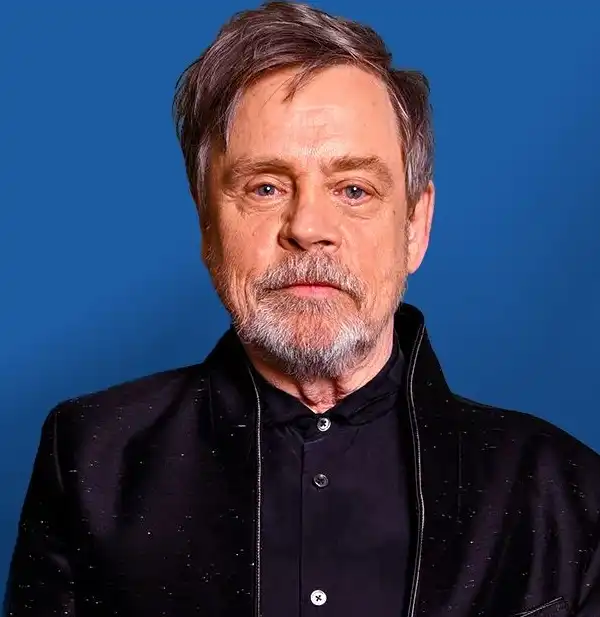
Mark Richard Hamill was born on September 25, 1951, in Oakland, California, one of seven children born to Virginia Suzanne and William Thomas Hamill. His father was a captain in the United States Navy, which meant the Hamill family moved frequently as Mark grew up. His childhood included periods in California, Virginia, New York and even Japan, giving the future traveler of imaginary galaxies considerable real-world experience packing his belongings and heading somewhere new.
Being one of seven children may also have contributed to Hamill's early interest in entertaining people. He later recalled that as the middle child he discovered that puppet shows, magic tricks and performances were effective ways of attracting attention. What begins as an attempt to be noticed around the dinner table can apparently end with several billion people knowing precisely who you are.
Hamill attended schools in several locations because of his father's naval career and eventually graduated from Nile C. Kinnick High School in Japan. After returning to California, he studied theater arts at Los Angeles City College and began pursuing professional acting. Television provided much of his earliest work, with appearances in programs including The Bill Cosby Show, Cannon, Room 222 and The Partridge Family.
He also landed a recurring role on the daytime soap opera General Hospital, playing Kent Murray, and later starred in the television series The Texas Wheelers. These jobs were helping Hamill establish himself as a working young actor, although nothing suggested that action figures bearing his likeness would eventually occupy cupboards, display cases and the occasional entire room in homes around the world.
Then George Lucas began casting a science-fiction movie.
Hamill had previously auditioned unsuccessfully for Lucas's American Graffiti, but another opportunity came when the filmmaker began searching for actors to play three central characters in a space adventure called Star Wars. Hamill auditioned for Luke Starkiller, as the character was then known, alongside Harrison Ford, who was being considered for Han Solo.
The character eventually became Luke Skywalker, and Hamill got the job.
At the time, Star Wars was anything but a guaranteed success. George Lucas's story involved robots, strange creatures, mystical powers, spaceships, a masked villain and dialogue containing phrases such as "restraining bolt" and "thermal exhaust port." Even many of the people making the film were uncertain what audiences would make of it.
Hamill played Luke as an eager, sometimes whiny young man frustrated by his isolated life on the desert planet Tatooine. He dreams of adventure but remains tied to the moisture farm operated by his aunt and uncle. Then two droids arrive, one carrying a message from a princess, and Luke's previously uneventful existence collapses with remarkable efficiency.
Guided by Obi-Wan Kenobi, played by Alec Guinness, Luke learns about the Force and his father's connection to the Jedi Knights. He joins Han Solo, Princess Leia Organa, Chewbacca and the droids C-3PO and R2-D2 in the fight against the Galactic Empire, eventually climbing into an X-wing fighter and destroying the Death Star.
Released in 1977, Star Wars became a cultural phenomenon on a scale few people had anticipated. Movie theaters experienced enormous lines, merchandise disappeared from stores and characters that had existed only in George Lucas's imagination became household names. Hamill, Harrison Ford and Carrie Fisher were abruptly among the most recognizable young actors in the world.
Hamill's earnestness was essential to the movie. Han Solo could be cynical and Princess Leia could be impatient, but Luke had to believe in the adventure completely. If the actor playing Luke appeared embarrassed by lightsabers, droids or the Force, audiences might have followed his example. Hamill instead treated Luke's journey sincerely and allowed everyone else to come along.
Shortly before Star Wars was released, Hamill was involved in an automobile accident that resulted in injuries to his face, including a broken nose. Over the years, wildly exaggerated stories developed claiming that his face had required extensive reconstruction. Hamill himself repeatedly corrected those accounts, explaining that the accident had become considerably more dramatic in retelling than it actually was.
After the extraordinary success of Star Wars, Hamill appeared in the 1978 comedy-adventure Corvette Summer, playing a young man searching for a customized Corvette that has been stolen. The movie provided an opportunity to demonstrate that he could exist onscreen without carrying a lightsaber, although escaping Luke Skywalker's shadow was already proving difficult.
He returned to the galaxy in The Empire Strikes Back in 1980. The sequel gave Hamill considerably more demanding material as Luke traveled to Dagobah to train with Jedi Master Yoda, confronted his own impatience and ultimately faced Darth Vader.
The production was physically grueling for Hamill. He trained extensively in preparation for the film, including fencing, karate, kendo and bodybuilding, and performed demanding sequences in difficult conditions. Much of Luke's Dagobah material also required Hamill to perform opposite Yoda, an extraordinarily sophisticated puppet operated and voiced by Frank Oz. The success of those scenes depended heavily upon Hamill behaving as though the small green figure was completely alive.
Then came one of cinema's most famous revelations.
Luke confronts Darth Vader in Cloud City, loses both the lightsaber duel and his right hand, and discovers that the villain he believed murdered his father is actually his father. The revelation changed the entire direction of the trilogy and gave Hamill the difficult task of selling enormous emotional devastation while hanging above a seemingly bottomless shaft.
Between the second and third Star Wars films, Hamill appeared in Samuel Fuller's war film The Big Red One, playing Private Griff alongside Lee Marvin. The movie provided a much darker and more grounded role than Luke Skywalker and eventually became regarded as an important entry in Fuller's career.
Hamill returned as Luke in 1983's Return of the Jedi. The character had changed considerably from the restless farm boy audiences met six years earlier. Dressed largely in black and carrying himself with greater confidence, Luke had developed into a powerful Jedi Knight.
Yet the character's greatest achievement was ultimately not defeating Darth Vader in combat. Luke refused to surrender to hatred and remained convinced that some goodness survived within his father. When Emperor Palpatine attempted to kill Luke, Vader turned against his master and saved his son, completing the redemption Luke had believed possible.
The original trilogy concluded with Luke helping defeat the Empire and seeing the redeemed spirit of his father alongside Obi-Wan and Yoda. Hamill had taken the character from adolescent impatience through loss, failure and temptation to maturity, providing the emotional spine of one of cinema's most famous trilogies.
The difficulty came afterward.
Being Luke Skywalker was an extraordinary achievement, but it was also a formidable piece of typecasting. Hamill found that casting directors had difficulty separating the actor from the Jedi hero. Harrison Ford successfully moved into films such as Raiders of the Lost Ark and Blade Runner, while Hamill increasingly turned toward theater for roles that allowed him to demonstrate a broader range.
He appeared on Broadway in The Elephant Man, taking on the demanding role of John Merrick. His theatrical work also included Amadeus, in which he played Mozart, along with Harrigan 'n Hart, The Nerd and other productions. His performance in Harrigan 'n Hart earned him a Drama Desk Award nomination.
Hamill continued appearing in films and television, but another branch of his career gradually became enormously important.
Voice acting freed him from the face everyone associated with Luke Skywalker.
Hamill had actually performed voice work before Star Wars, including animation during the 1970s, but his career behind the microphone expanded dramatically in later years. Without being physically recognizable, he could become characters utterly unlike the heroic young Jedi.
And then he laughed.
In 1992, Hamill began voicing the Joker in Batman: The Animated Series. The casting initially seemed surprising. Luke Skywalker was one of popular culture's great heroes; the Joker was one of its most notorious villains. Hamill embraced the contrast enthusiastically.
His Joker voice could shift from playful and theatrical to genuinely threatening within seconds. Most distinctive was the laugh—or rather, the laughs. Hamill developed different varieties of Joker laughter to fit different emotions and situations, treating laughter almost as another form of dialogue.
The performance became enormously popular. For many Batman fans, Hamill became as closely associated with the Joker's voice as he was with Luke Skywalker's face. He returned to the role repeatedly in animated television, movies and video games, including Batman: Mask of the Phantasm, Batman Beyond: Return of the Joker, Batman: The Killing Joke and the celebrated Batman: Arkham game series.
His performance as the Joker in Batman: Arkham City earned Hamill a BAFTA Games Award for Best Performer. The actor who had once struggled against being typecast as an upright hero had achieved the peculiar distinction of becoming equally famous for playing a homicidal clown.
The Joker was only part of Hamill's enormous voice-acting career. He voiced Hobgoblin in the 1990s Spider-Man animated series, Fire Lord Ozai in Avatar: The Last Airbender, Skips in Regular Show and numerous characters across animation, movies and video games. His voice credits eventually became so extensive that viewers could encounter Mark Hamill without realizing they had encountered Mark Hamill.
He also continued live-action acting, appearing in projects including Village of the Damned, Jay and Silent Bob Strike Back, Sushi Girl, Brigsby Bear and Kingsman: The Secret Service. He frequently displayed a willingness to poke fun at his own fame, particularly his permanent association with Star Wars.
Decades after Return of the Jedi, however, Luke Skywalker came calling again.
Disney's acquisition of Lucasfilm led to a new trilogy continuing the original story, and Hamill returned alongside Harrison Ford and Carrie Fisher. Star Wars: The Force Awakens premiered in 2015, although audiences expecting plenty of Luke received what may be one of cinema's most elaborate entrances.
Luke appears only at the very end.
After spending much of the movie searching for him, Rey reaches the remote island where Luke has isolated himself and silently offers him his old lightsaber. Hamill says nothing before the credits roll. After decades away from the role, he had returned to Star Wars and managed to complete his first new appearance without being required to memorize a single line.
That changed considerably in Star Wars: The Last Jedi in 2017. Luke was now older, disillusioned and haunted by his failure with his nephew Ben Solo, who had become Kylo Ren. The portrayal was intentionally far removed from the optimistic young hero of the original films and generated considerable debate among fans.
Hamill himself openly discussed his initial disagreements with writer-director Rian Johnson's interpretation of Luke, while also emphasizing that his responsibility as an actor was to serve the finished story. Whatever viewers thought of the character's direction, the film gave Hamill some of the most emotionally complicated material he had performed as Luke.
The film ends with Luke confronting Kylo Ren on Crait, only for the confrontation to be revealed as an extraordinary projection through the Force. Luke buys the Resistance enough time to escape before peacefully becoming one with the Force while watching twin suns set—a deliberate echo of the young farm boy who had once stared toward the twin suns of Tatooine and dreamed of another life.
Hamill appeared again in Star Wars: The Rise of Skywalker in 2019 as Luke's Force spirit. Advances in visual effects later allowed younger versions of Luke to appear in the television series The Mandalorian and The Book of Boba Fett, with Hamill involved in bringing the character back to the period shortly after Return of the Jedi.
His association with Disney and Star Wars brought additional honors. Hamill was named a Disney Legend in 2017 and received a star on the Hollywood Walk of Fame in 2018, with George Lucas and Harrison Ford joining him at the ceremony.
Yet awards and honors only partially explain Hamill's longevity. His relationship with Star Wars fans has become part of his public identity. He has spent decades answering questions he must have heard hundreds of times, signing memorabilia and telling stories about George Lucas, Carrie Fisher, Harrison Ford, Alec Guinness and the strange circumstances surrounding the creation of the original films.
Hamill has also developed a reputation for humor about his own place in popular culture. Rather than treating Luke Skywalker as a burden he wishes everyone would stop mentioning, he increasingly embraced the extraordinary affection audiences have for the character. He once observed that for someone who never expected to be remembered for anything, being remembered as Luke was hardly a bad outcome.
His private life has been unusually stable by Hollywood standards. Hamill married dental hygienist Marilou York in 1978, and they raised three children, Nathan, Griffin and Chelsea. The marriage endured through the sudden explosion of Star Wars fame, the quieter periods that followed and his eventual return to one of cinema's most famous franchises.
There is a pleasing symmetry to Mark Hamill's career. As Luke Skywalker, he became famous for portraying a fundamentally decent young man who resisted the temptation to become a villain. As a voice actor, Hamill then spent decades gleefully playing villains and became particularly celebrated for portraying one of the nastiest of them all.
Luke Skywalker and the Joker could scarcely be further apart, yet Hamill made both characters unmistakably his own.
For all the spaceships, lightsabers and mythology surrounding Star Wars, Hamill's contribution to the original trilogy was fundamentally human. Luke begins as an impatient young man desperate to leave home. He discovers that adventure includes grief, fear, failure and responsibility, and ultimately learns that genuine strength does not require surrendering compassion.
Millions of people watched that journey and never forgot the young actor at its center.
Mark Hamill once worried about being remembered only as Luke Skywalker. Instead, he built a career on Broadway, television, film, animation and video games while becoming one of the most respected voice performers in the business.
And after all these years, people still ask him about power converters.
Some things even the Force cannot fix.