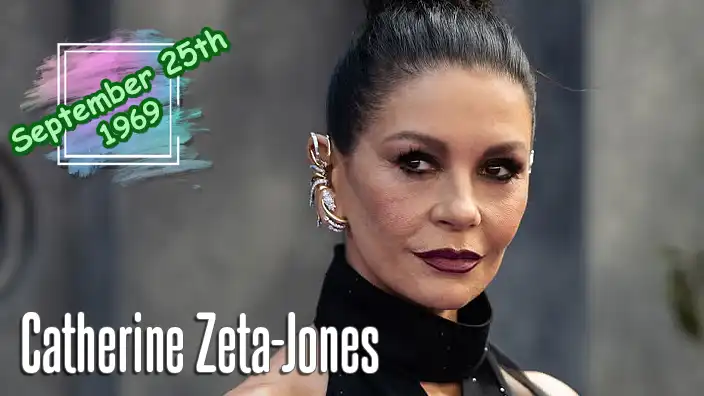
September 25, 1969, in Swansea, Wales

Catherine Zeta Jones was born on September 25, 1969, in Swansea, Wales, and grew up in the nearby seaside community of Mumbles. She was the daughter of Patricia, a seamstress, and David "Dai" Jones, who owned a sweet factory. Her distinctive middle name came from her paternal grandmother, Zeta Jones, and helped distinguish the aspiring performer from the many other Catherine Joneses she encountered. Considering the name would eventually appear in enormous letters above movie theater entrances around the world, grandmother Zeta made a rather useful contribution to the branding department.
Zeta-Jones began dancing when she was a small child and demonstrated an appetite for performing that quickly moved beyond the usual childhood recital. She participated in local theatrical productions and appeared in musicals while still young, including Annie and Bugsy Malone. Her ambitions were sufficiently serious that she eventually left traditional schooling behind and pursued professional theater, moving toward London's West End while most teenagers were still contemplating considerably less glamorous employment.
One of the important early breaks came with the musical 42nd Street. Zeta-Jones had been working as an understudy when circumstances provided an opportunity worthy of a backstage musical in its own right. Both the leading actress and another understudy became unavailable, allowing Zeta-Jones to step into the central role of Peggy Sawyer. She impressed sufficiently to remain in the role, providing an unusually appropriate beginning for someone appearing in a musical about a young performer unexpectedly getting her chance at stardom.
Her stage experience gave Zeta-Jones skills that would prove particularly valuable years later. She could act, sing and dance, although movie audiences initially became much more familiar with the first of those abilities. Before Hollywood came calling, British television made her famous at home.
In 1991, Zeta-Jones was cast as Mariette Larkin in The Darling Buds of May, an adaptation of H. E. Bates's novels starring David Jason and Pam Ferris. Set in rural England during the 1950s, the series followed the cheerfully unconventional Larkin family and became enormously popular with British audiences. Zeta-Jones's performance as the eldest Larkin daughter transformed her into one of Britain's most recognizable television personalities almost overnight.
That sudden fame was not entirely comfortable. British newspapers became intensely interested in Zeta-Jones, and the attention threatened to overshadow her work. She found herself widely recognized but increasingly associated with her appearance rather than her abilities as a performer. Determined to build a broader career, she eventually turned toward the United States, where she was ironically able to enjoy something British fame could no longer provide: relative anonymity.
Her early international screen work included Christopher Columbus: The Discovery, Splitting Heirs, Blue Juice and The Phantom. None immediately transformed her into a major Hollywood star, but they gave her experience and visibility while she pursued the role that finally would.
That role was Elena Montero in the 1998 adventure The Mask of Zorro. Directed by Martin Campbell, the film starred Antonio Banderas as Alejandro Murrieta, who is trained by Anthony Hopkins's aging Don Diego de la Vega to become the new Zorro. Zeta-Jones played Elena, Diego's daughter, combining romance, comedy, action and swordplay in a performance that introduced her to a worldwide audience.
Her casting was particularly effective because Elena was not merely decorative scenery waiting for the masked hero to arrive. Zeta-Jones gave the character considerable spirit and matched Banderas in their playful confrontations. Their sword-fighting sequence became one of the movie's most memorable scenes, while the film's success established Zeta-Jones firmly in Hollywood.
She followed Zorro with the 1999 thriller Entrapment, starring opposite Sean Connery. Zeta-Jones played insurance investigator Virginia "Gin" Baker, who becomes involved with Connery's veteran art thief Robert MacDougal. The movie featured elaborate heists, considerable mistrust and an unforgettable sequence involving Zeta-Jones navigating a field of laser beams. It was precisely the sort of scene that encouraged an entire generation to believe museums protected paintings with elaborate red-light obstacle courses.
The same year brought the horror film The Haunting, before Zeta-Jones took on a dramatically different role in Steven Soderbergh's Traffic in 2000. The sprawling drama examined the illegal drug trade from several interconnected perspectives. Zeta-Jones played Helena Ayala, a pregnant wife who discovers that her wealthy husband has been deeply involved in drug trafficking.
The performance allowed her to move considerably beyond the glamorous adventure roles that had helped establish her Hollywood career. Helena initially appears sheltered from her husband's criminal world but becomes increasingly formidable as circumstances force her to protect herself and her family. Zeta-Jones received a Golden Globe nomination, while the ensemble won the Screen Actors Guild Award for Outstanding Performance by a Cast in a Motion Picture.
Then came the role that allowed her theatrical background and movie career finally to collide.
Rob Marshall's 2002 film adaptation of the Broadway musical Chicago cast Zeta-Jones as Velma Kelly, a nightclub performer jailed for murdering her husband and sister after discovering them together. Renée Zellweger played Roxie Hart, another accused murderer who becomes Velma's rival for publicity, while Richard Gere appeared as attorney Billy Flynn.
For Zeta-Jones, Chicago offered the opportunity to use the singing and dancing skills she had developed long before Hollywood knew her name. Velma required swagger, comic timing, dramatic ability and demanding musical performances, and Zeta-Jones attacked the role with considerable enthusiasm. Her rendition of "All That Jazz" opens the film and immediately establishes Velma as someone who considers sharing the spotlight an unfortunate administrative error.
Zeta-Jones performed her own singing and dancing in the film, including while pregnant during production. Her musical-theater experience was suddenly no longer an interesting detail from the early portion of her biography; it was central to one of the most acclaimed performances of her career.
The awards followed. Zeta-Jones won the Academy Award for Best Supporting Actress for Chicago, along with the BAFTA Award for Supporting Actress and a Screen Actors Guild Award. The film itself won the Academy Award for Best Picture and became one of the most successful movie musicals of its era.
Winning an Oscar placed Zeta-Jones firmly among Hollywood's leading actresses, and she followed it with a succession of prominent films. In the Coen brothers' Intolerable Cruelty, she starred opposite George Clooney as Marilyn Rexroth, a woman with considerable experience in profitable marriages and even more profitable divorces. She then appeared with Tom Hanks in Steven Spielberg's The Terminal and joined the elaborate ensemble of Ocean's Twelve.
In 2005, she returned to Elena for The Legend of Zorro, once again starring opposite Antonio Banderas. She later played a professional chef in the romantic comedy No Reservations, appeared in Death Defying Acts and continued selecting projects across several genres rather than settling permanently into action films, romantic comedies or dramas.
Zeta-Jones had married actor Michael Douglas in November 2000, creating one of Hollywood's more recognizable marriages. There is a particularly convenient piece of family trivia attached to the couple: both were born on September 25, although 25 years apart. Apparently remembering a spouse's birthday becomes considerably easier when forgetting it would simultaneously require forgetting your own.
The couple have two children, Dylan and Carys. Zeta-Jones increasingly balanced work with family life, reducing her screen workload during portions of her career rather than maintaining the relentless pace that had accompanied her rise to international fame.
Her theatrical roots eventually called her back to the stage. In 2009, Zeta-Jones made her Broadway debut as Desirée Armfeldt in a revival of Stephen Sondheim's A Little Night Music, appearing opposite the formidable Angela Lansbury. Returning to musical theater after years as an international movie star might have been intimidating, but Zeta-Jones had begun her career on precisely that sort of stage.
The return proved triumphant. In 2010, she won the Tony Award for Best Actress in a Musical for A Little Night Music. The achievement gave her major honors in both film and theater and confirmed that the dancing teenager from Wales had not simply used musical theater as a route toward something bigger. She remained capable of commanding a Broadway stage after years away from it.
That same year, Zeta-Jones was appointed Commander of the Order of the British Empire, or CBE, in the Queen's Birthday Honours for her services to the film industry and charity. For someone who had started performing professionally in Britain before becoming a Hollywood star, the recognition represented a significant honor from home.
Her later screen work included Rock of Ages, Playing for Keeps, Broken City, Side Effects and Red 2. In Steven Soderbergh's psychological thriller Side Effects, she played psychiatrist Dr. Victoria Siebert, while Red 2 placed her alongside Bruce Willis, Helen Mirren, John Malkovich and Anthony Hopkins in a considerably louder environment involving retired spies who appeared to have interpreted retirement rather loosely.
Zeta-Jones also returned increasingly to television. In the anthology series Feud: Bette and Joan, she portrayed actress Olivia de Havilland, joining a production centered on the famously difficult relationship between Bette Davis and Joan Crawford. She later appeared in Prodigal Son as Dr. Vivian Capshaw.
Then came another character seemingly designed for someone capable of turning elegance into a mild threat.
Zeta-Jones joined Netflix's Wednesday as Morticia Addams, mother of Wednesday Addams and wife of Gomez. With Jenna Ortega playing Wednesday and Luis Guzmán portraying Gomez, Zeta-Jones inherited a character with a long history in cartoons, television and film. Morticia requires a peculiar combination of maternal affection, gothic glamour and the reassuring manner of someone who might have carnivorous plants somewhere in the house.
The role proved a natural fit. Zeta-Jones's Morticia is poised and affectionate while remaining unmistakably part of the Addams family, where compliments involving darkness, misery and possible bodily harm are generally signs that everybody is getting along splendidly. Her participation in Wednesday introduced her to another generation of viewers decades after The Darling Buds of May had first made her a television star in Britain.
The continuing success of Wednesday also demonstrated the durability of Zeta-Jones's career. She has moved repeatedly between stage, film and television rather than belonging entirely to one medium. A performer first known for musical theater became a British television celebrity; the television celebrity became an international movie star; the movie star returned to Broadway and won a Tony; and decades into her career she found another widely recognized television role.
That versatility is particularly striking because Zeta-Jones spent part of her early career fighting against being regarded primarily as a beautiful woman. Hollywood certainly made considerable use of her glamour, particularly during her rise in films such as The Mask of Zorro and Entrapment, but performances in Traffic and Chicago demonstrated a much broader range.
Her career has also benefited from skills acquired before movie stardom arrived. Chicago did not require an actress to pretend she could handle a musical number while editors performed emergency surgery around her. Zeta-Jones already knew how to sing and dance because she had spent years doing exactly that onstage. Her Oscar-winning performance therefore represented less of a surprising transformation than the rediscovery by movie audiences of abilities she had possessed all along.
From Swansea stages to British television, Hollywood adventures, an Oscar-winning musical, Broadway and the wonderfully macabre Addams household, Catherine Zeta-Jones has created a career considerably broader than the glamorous image that first accompanied her international fame. She has been a sword-wielding heroine, art thief, drug trafficker's wife, murderous vaudeville performer, chef, spy, psychiatrist and Morticia Addams.
And after all of that, she can still walk into a room looking as though everyone else has somehow failed to dress properly.