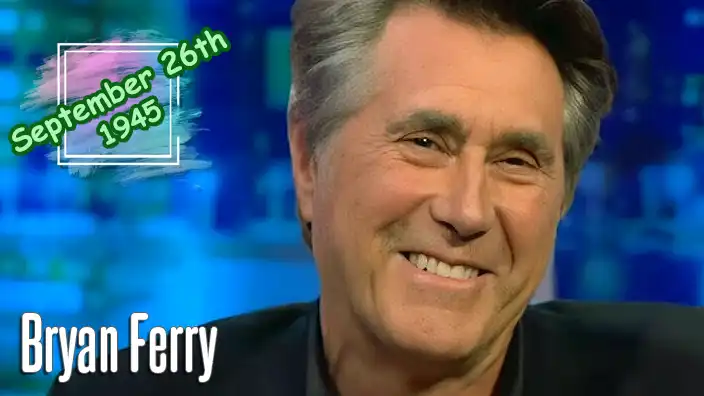
September 26, 1945, in Washington, England

Born on September 26, 1945, in Washington, County Durham, England, Bryan Ferry grew up in a working-class family in northeastern England. His father, Frederick Ferry, worked as a farm laborer and also tended pit ponies associated with the local coal mines. Ferry's eventual image as one of rock music's most stylish performers therefore came from decidedly unglamorous beginnings. Long before the tailored suits, album covers and sophisticated stage persona, there was a boy growing up amid the industrial landscape of postwar County Durham with an increasing fascination for music and art.
Ferry studied fine art at Newcastle University, where one of his teachers was the influential British pop artist Richard Hamilton. That education became enormously important to Ferry's later approach to music. He did not simply think about songs; he was interested in presentation, imagery, fashion, typography and the way a record could exist as a complete artistic package. The striking covers that later accompanied Roxy Music albums were not merely decoration pasted onto the music after everybody had finished recording. Visual style was woven into the identity of the band from the beginning.
After university, Ferry moved to London, where he worked as an art teacher while continuing to pursue music. He had previously performed with bands including the Banshees and the Gas Board, the latter also featuring future Roxy Music bassist Graham Simpson. By the beginning of the 1970s, Ferry began assembling the musicians who would become Roxy Music. The early lineup eventually included Andy Mackay, Brian Eno, Phil Manzanera, Paul Thompson and Simpson, although the band's personnel would change considerably over the years. What emerged was something very different from the straightforward rock groups surrounding them.
Roxy Music combined rock and roll, glam rock, experimental electronics, pop, fashion and deliberately constructed visual imagery. Ferry served as lead singer, principal songwriter and the elegantly theatrical figure at the center of it all. His voice was immediately distinctive: controlled, dramatic and sometimes deliberately mannered, capable of turning a conventional romantic lyric into something that sounded considerably more complicated. Nobody listening to Bryan Ferry ever had much difficulty wondering whether they had accidentally put on a Rod Stewart record.
The band's self-titled debut album, Roxy Music, arrived in 1972 and immediately established its unusual identity. Songs such as "Re-Make/Re-Model" mixed rock instrumentation with electronic experimentation and influences drawn from earlier popular music. The album was followed quickly by For Your Pleasure in 1973, the final Roxy Music studio album featuring Brian Eno. Although Ferry and Eno represented very different creative personalities within the band, their brief period together helped establish Roxy Music as one of the most adventurous British groups of the early 1970s.
Even while Roxy Music was becoming successful, Ferry began a parallel solo career. His first solo album, These Foolish Things, appeared in 1973 and consisted largely of interpretations of songs written or previously recorded by other artists. Ferry tackled material associated with performers ranging from Bob Dylan to the Rolling Stones, demonstrating a fascination with reshaping familiar songs through his own vocal and musical style. His version of Dylan's "A Hard Rain's a-Gonna Fall" became a UK hit and showed that Ferry could take a well-known song and make it sound as though it had wandered into an unusually stylish cocktail party.
Ferry continued alternating between Roxy Music and solo recordings throughout the decade. His solo albums included Another Time, Another Place, Let's Stick Together and In Your Mind. The title track of Let's Stick Together, Ferry's interpretation of the Wilbert Harrison song, became one of his best-known solo recordings. Its accompanying image—Ferry impeccably dressed while model Jerry Hall appeared alongside him—further reinforced the sophisticated visual identity surrounding his work. Hall also appeared on the cover of Roxy Music's 1975 album Siren, one of the band's most celebrated releases.
Roxy Music accumulated an impressive catalog during the 1970s, including albums such as Stranded, Country Life and Siren. Songs including "Street Life," "All I Want Is You" and "Love Is the Drug" expanded the band's audience, with "Love Is the Drug" becoming particularly successful internationally. The group could move between experimental art rock and remarkably accessible pop without completely abandoning either side of its personality. Ferry's songs frequently dealt with romance, desire, glamour and disappointment, although romance in the Roxy Music universe seldom sounded as straightforward as buying flowers and remembering an anniversary.
The band temporarily separated in 1976, allowing Ferry to concentrate more heavily on his solo career, but Roxy Music reunited before the end of the decade. The returning group produced Manifesto in 1979, followed by Flesh + Blood in 1980. Their sound had become smoother and more polished, moving away from some of the deliberate eccentricity of the early records toward an elegant form of sophisticated pop. Songs such as "Dance Away" and "Over You" became successful singles and introduced the band to listeners who had missed the feather boas and synthesizer experiments of its earlier incarnation.
That evolution reached its commercial and stylistic peak with Avalon in 1982. The album included the title track and "More Than This," songs that remain among Roxy Music's most familiar recordings. Avalon presented a lush, atmospheric sound far removed from the restless experimentation of the band's debut a decade earlier, yet Ferry's voice and romantic preoccupations provided continuity. The album became enormously successful and ultimately served as Roxy Music's final studio album. The band broke up following its supporting tour, although reunions would occur many years later.
Ferry returned to his solo career and achieved another major success with Boys and Girls in 1985. The album reached number one in the United Kingdom and included "Slave to Love," which became one of his signature solo songs. Its elegant production fitted perfectly with the Ferry persona that had developed over the preceding decade. By this point, the rougher glam-rock edges had largely disappeared, replaced by carefully constructed arrangements and a vocal delivery that sounded as though the microphone itself ought to be wearing evening clothes.
His subsequent solo work included albums such as Bête Noire, Taxi, Mamouna, Frantic, Dylanesque, Olympia and Avonmore. Ferry continued interpreting other songwriters as well as producing his own material, returning repeatedly to Bob Dylan's work in particular. Dylanesque, released in 2007, was devoted almost entirely to Dylan compositions. The connection was hardly new—Ferry had been reworking Dylan since his first solo album more than three decades earlier—but the project demonstrated the durability of that influence.
Roxy Music also returned periodically. Ferry, Andy Mackay, Phil Manzanera and Paul Thompson reunited for live performances during the 2000s, giving audiences another opportunity to hear the band's catalog performed by much of its classic lineup. In 2019, Roxy Music was inducted into the Rock & Roll Hall of Fame, recognition of a group whose influence extended well beyond its chart successes. Artists associated with new wave, synth-pop, art rock and alternative music drew inspiration from Roxy Music's combination of sound, image and deliberate sophistication.
In 2022, Roxy Music reunited again for a tour marking the 50th anniversary of the band's debut album. Half a century after their first record, Ferry, Mackay, Manzanera and Thompson returned to the stage to revisit music that had once seemed almost aggressively futuristic. Time had caught up with some of the technology, perhaps, but the songs and visual imagination continued to demonstrate why the group had been so influential.
Ferry was appointed Commander of the Order of the British Empire, or CBE, in 2011 for services to music. It was formal recognition for an artist whose career had crossed several generations of British popular music. As both a solo performer and the central figure in Roxy Music, he helped demonstrate that rock could borrow freely from fashion, fine art, classic popular songwriting, electronic experimentation and old Hollywood glamour without surrendering its identity.
The lasting fascination of Bryan Ferry lies partly in those contrasts. He came from an industrial, working-class corner of northeastern England but developed one of popular music's most cultivated personas. He studied fine art before helping create a band whose album covers became nearly as recognizable as its songs. He emerged during the flamboyant glam-rock era but survived long after most of its platform boots had been sensibly returned to the attic. And through everything—from the experimental early Roxy Music recordings to the polished romanticism of Avalon and "Slave to Love"—there has always been that unmistakable voice.
Bryan Ferry did not merely front Roxy Music; he helped construct an entire aesthetic around it. The records sounded different, the sleeves looked different and the singer certainly looked different. More than five decades later, the combination remains remarkably distinctive. Plenty of rock stars have attempted sophistication. Ferry somehow made it look as though sophistication had joined his band.