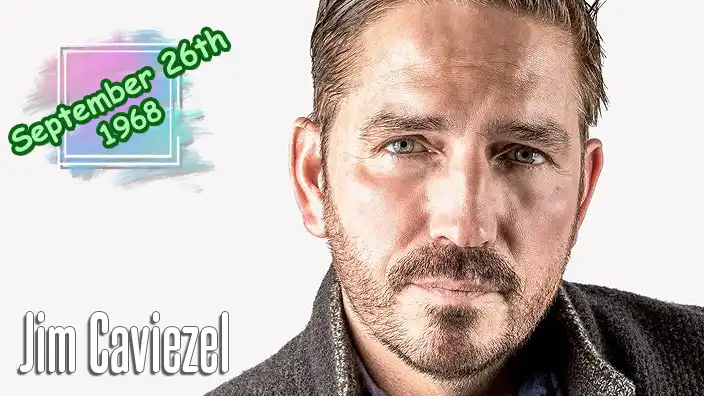
September 26, 1968, in Mount Vernon, Washington
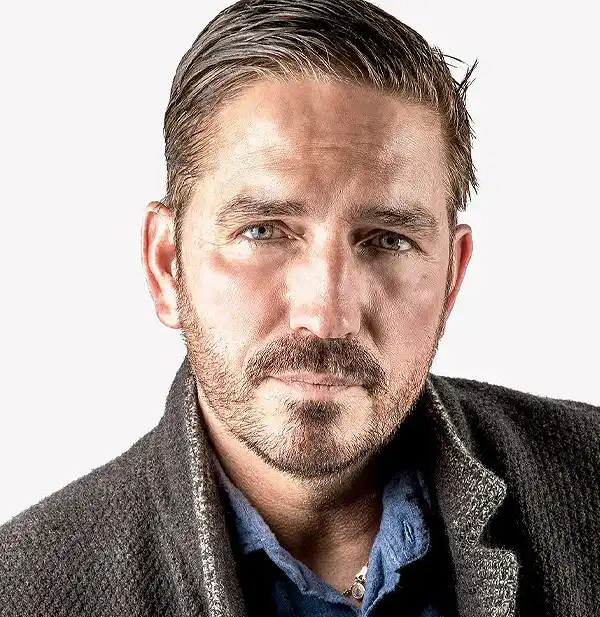
Born James Patrick Caviezel on September 26, 1968, in Mount Vernon, Washington, he grew up in a Catholic family in Washington state. His mother, Margaret, had been a stage actress before becoming a homemaker, while his father, James Caviezel Sr., worked as a chiropractor. Basketball occupied much of Caviezel's attention when he was young, and for a time he hoped the sport might provide his future. He played basketball while attending Bellevue College, but a foot injury disrupted those ambitions and helped redirect his attention toward acting. Hollywood gained an actor; professional basketball lost a player whose future career would require considerably more sword fighting.
Caviezel began pursuing acting professionally during the early 1990s. Like many actors before becoming recognizable names, he started with relatively small parts. One of his earliest film appearances came in Gus Van Sant's My Own Private Idaho in 1991. Television work followed, including appearances in programs such as The Wonder Years and Murder, She Wrote. He continued building his résumé through supporting movie roles rather than arriving overnight as a leading man, gradually earning increasingly substantial parts as the decade progressed.
His film credits during the 1990s included Diggstown, Wyatt Earp, The Rock and G.I. Jane. The latter, directed by Ridley Scott and starring Demi Moore, placed Caviezel within a major Hollywood production, but his breakthrough came soon afterward in a very different war film. Director Terrence Malick cast him as Private Witt in The Thin Red Line, the acclaimed 1998 adaptation of James Jones's novel about American soldiers fighting during the Guadalcanal campaign of World War II.
The Thin Red Line featured a remarkable ensemble cast that included Sean Penn, Nick Nolte, Elias Koteas, Woody Harrelson, John Cusack and several other prominent actors. Caviezel's Private Witt nevertheless became one of the emotional centers of the film. Malick's approach to warfare was contemplative as well as violent, examining mortality, nature, fear and humanity rather than treating combat simply as spectacle. Caviezel's quiet performance suited that approach, and the film significantly raised his profile within the industry. After years of supporting work, he had demonstrated that he could carry a substantial dramatic role alongside some of Hollywood's most established performers.
More prominent films followed. Caviezel appeared with Dennis Quaid in the 2000 science-fiction drama Frequency, playing John Sullivan, a New York City police officer who discovers that unusual atmospheric conditions allow him to communicate by radio with his father decades in the past. The premise combined science fiction, crime and family drama, with Caviezel's character attempting to use his extraordinary connection to change history and prevent tragedy. It became one of his best-known early leading roles and remains a favorite among viewers who discovered that an old radio set could apparently cause substantially more trouble than static.
In 2001, Caviezel starred with Jennifer Lopez in the romantic drama Angel Eyes. A year later came one of the roles most strongly associated with his career before The Passion of the Christ: Edmond Dantès in The Count of Monte Cristo. Based on Alexandre Dumas's classic novel, the 2002 film followed Dantès from wrongful imprisonment through escape, reinvention and elaborate revenge. Guy Pearce played Fernand Mondego, while Richard Harris appeared as Abbé Faria, the fellow prisoner who educates Dantès and helps set his transformation in motion.
Caviezel's performance in The Count of Monte Cristo required him to portray dramatic changes in the same character. Dantès begins as an earnest young sailor, becomes a devastated prisoner and ultimately emerges as the wealthy and calculating Count of Monte Cristo. The movie condensed and altered elements of Dumas's enormous novel, but its combination of adventure, romance and revenge found a lasting audience. For Caviezel, it demonstrated his ability to lead a large-scale period production involving sword fights, imprisonment, betrayal and hidden treasure—considerably more eventful than the average employment contract.
The defining role of Caviezel's film career arrived when Mel Gibson cast him as Jesus Christ in The Passion of the Christ. Released in 2004, the film focused primarily on the final hours before the Crucifixion and was performed largely in Aramaic and Latin. Caviezel undertook physically demanding filming for the production, which depicted the scourging and crucifixion with graphic intensity. His performance relied heavily upon physical expression because much of the dialogue was delivered in languages unfamiliar to most of the film's audience.
The Passion of the Christ became both enormously commercially successful and intensely debated. Supporters praised its uncompromising depiction of Christ's suffering and its religious message, while critics disputed its extreme violence and raised concerns about aspects of its portrayal of responsibility for Jesus's death. Whatever one's interpretation of the film, its cultural impact was substantial. It became one of the highest-grossing R-rated films in American box-office history and brought Caviezel worldwide recognition far beyond the audiences familiar with his previous work.
Caviezel has frequently discussed his Catholic faith in connection with his decision to accept the role. Playing Jesus became closely associated with his public identity, sometimes overshadowing the diverse film work he had completed before it. Yet he continued appearing in a variety of productions afterward, including Unknown, Déjà Vu, Outlander, The Stoning of Soraya M. and Escape Plan. The roles ranged from science fiction and action to serious drama, continuing the pattern of characters facing unusually unpleasant circumstances with remarkably little opportunity for a quiet lunch.
His next major career-defining role came on television. In 2011, Caviezel was cast as John Reese in the CBS series Person of Interest, created by Jonathan Nolan and produced by J.J. Abrams' Bad Robot Productions. Reese is a former CIA operative recruited by mysterious billionaire computer expert Harold Finch, played by Michael Emerson. Finch has developed access to information generated by a powerful artificial-intelligence surveillance system known simply as the Machine, which identifies people connected to impending violent crimes.
The clever twist was that the Machine supplied only a person's Social Security number. It did not explain whether that individual would become the victim or perpetrator of the predicted crime. Finch and Reese therefore had to investigate each number and intervene before disaster occurred. Reese supplied the muscle, tactical expertise and extraordinarily calm threats, while Finch provided technological knowledge and a tendency to know considerably more than he initially explained. It was not exactly conventional private investigation, but conventional private investigators generally do not have access to an all-seeing artificial intelligence.
Person of Interest began largely as a procedural drama, with the team tackling a new case each week, but gradually developed an increasingly complex mythology involving mass surveillance, artificial intelligence, government secrecy and the consequences of allowing powerful computer systems to make decisions about human lives. Those themes became remarkably prescient as public concern about digital surveillance and artificial intelligence increased during and after the show's run.
Caviezel's John Reese was deliberately restrained. The character's dry humor, low voice and seemingly unflappable demeanor contrasted effectively with sudden bursts of action. Reese might enter a room surrounded by armed criminals looking mildly inconvenienced, shortly before everyone else discovered they had made a significant scheduling error. His partnership with Emerson's Finch formed the emotional foundation of the series, eventually expanding to include characters played by Taraji P. Henson, Amy Acker, Sarah Shahi and Kevin Chapman.
The series ran for five seasons from 2011 to 2016 and produced more than 100 episodes. During that period, Person of Interest evolved from a network crime drama into an ambitious science-fiction story examining whether artificial intelligence could develop morality, loyalty or even something resembling consciousness. Caviezel remained at the center of the story throughout its run, making John Reese arguably his most sustained and widely recognized television role.
Caviezel later appeared in films including the biblical drama Paul, Apostle of Christ, playing Luke opposite James Faulkner's Paul. In 2023, he starred as Tim Ballard in Sound of Freedom, a dramatization centered on efforts to combat child trafficking. The movie became an unexpected commercial success, although both the film and Ballard became subjects of substantial public controversy. Caviezel's involvement also attracted attention because of political and conspiratorial remarks he has made publicly. Those controversies form part of his public profile but are separate from the dramatic performances for which he initially became widely known.
Across his career, Caviezel has repeatedly gravitated toward serious characters confronting questions of morality, sacrifice, loyalty and faith. Private Witt in The Thin Red Line, Edmond Dantès in The Count of Monte Cristo, Jesus in The Passion of the Christ and John Reese in Person of Interest are dramatically different figures, yet each spends much of his story confronting suffering, responsibility or the consequences of difficult choices.
For many viewers, Caviezel will forever be associated with one of two images: carrying the cross in The Passion of the Christ or walking calmly through New York as John Reese while Harold Finch explains that the Machine has produced another number. Between those two performances lies an unusually varied career encompassing war films, historical adventures, science fiction, thrillers and television. If nothing else, Jim Caviezel's résumé demonstrates that when a script contains danger, imprisonment, international conspiracies, artificial intelligence or the imminent collapse of civilization, someone in casting apparently knows his telephone number.