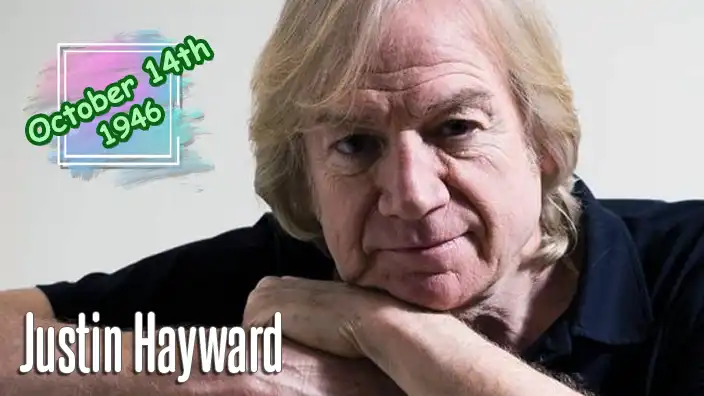
October 14, 1946, in Swindon, England
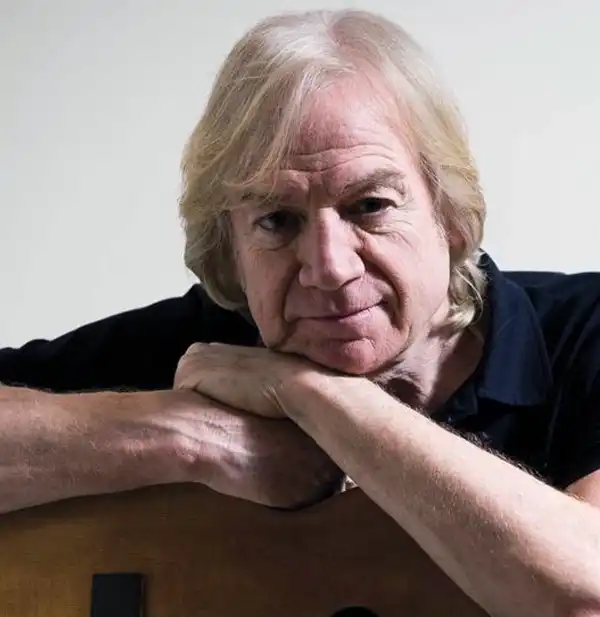
Born David Justin Hayward on October 14, 1946, in Swindon, Wiltshire, England, Justin Hayward is an English singer, songwriter, guitarist, and composer best known as the distinctive lead vocalist and principal songwriter of the legendary British rock band the Moody Blues. His soaring vocals, melodic guitar playing, and emotionally expressive compositions helped transform the group into one of the influential acts associated with psychedelic and progressive rock. Through songs such as "Nights in White Satin," "Tuesday Afternoon," "Question," "The Story in Your Eyes," "Your Wildest Dreams," and "I Know You're Out There Somewhere," Hayward created a musical legacy that continues to resonate with listeners who appreciate thoughtful lyrics, memorable melodies, and arrangements that frequently reach well beyond the traditional boundaries of rock music.
Hayward's fascination with music began during his childhood in Swindon, an industrial and railway town in southwest England. One of his earliest musical influences came from his grandfather, who left him a collection of 78-rpm records when Justin was a small child. The recordings introduced him to a wide variety of musical sounds and encouraged an interest that would eventually become his life's work. He taught himself to play the ukulele before progressing to guitar, developing an appreciation for melody and the expressive possibilities of stringed instruments. By his early teens, he was performing with local groups and becoming increasingly serious about a professional musical career. At an age when most youngsters were still wondering what they wanted to do for a living, Hayward was already discovering that a guitar could provide a remarkably effective answer.
The British music scene of the early 1960s offered tremendous opportunities for young performers. Rock and roll, skiffle, rhythm and blues, and the emerging beat movement were transforming popular entertainment, while bands such as the Beatles and the Rolling Stones demonstrated that British musicians could achieve international success. Hayward immersed himself in this changing environment, developing his guitar playing and songwriting abilities while gaining practical experience through local performances. His early musical interests were broad, and he became particularly attracted to songs that combined strong melodies with emotional storytelling. These qualities would later become defining characteristics of his work with the Moody Blues.
After leaving school, Hayward answered an advertisement in the British music newspaper Melody Maker seeking a guitarist for established rock and roll performer Marty Wilde. He successfully auditioned and joined Wilde's backing group, gaining valuable experience performing professionally and working alongside experienced musicians. Wilde encouraged Hayward to develop his songwriting abilities, advice that proved particularly important as the young guitarist began considering a career built around his own compositions. Hayward also recorded early solo material, although these releases attracted limited commercial attention. Nevertheless, his growing confidence and professional contacts helped prepare him for an opportunity that would change the direction of British rock music.
That opportunity arrived in 1966 when Hayward joined the Moody Blues, replacing original guitarist and vocalist Denny Laine. The group had already achieved success with the rhythm-and-blues-influenced hit "Go Now!" but was undergoing significant changes in personnel and musical direction. Bassist and vocalist John Lodge also joined during this period, completing the lineup that would become most closely associated with the band's classic recordings. Alongside Hayward and Lodge were keyboardist Mike Pinder, flautist and vocalist Ray Thomas, and drummer Graeme Edge. Together, the five musicians began developing a sound that combined rock instrumentation with classical influences, poetic lyrics, elaborate vocal harmonies, and increasingly ambitious studio production.
Hayward quickly established himself as a central creative force within the reconfigured Moody Blues. His early composition "Fly Me High," released as a single in 1967, demonstrated the band's movement away from its original rhythm-and-blues style toward a more melodic and experimental approach. The group was exploring new recording techniques and musical arrangements at a time when popular music was becoming increasingly adventurous. Rather than relying exclusively on conventional guitars, bass, and drums, the Moody Blues incorporated instruments such as the Mellotron, flute, and orchestral arrangements to create an atmospheric sound that distinguished them from many contemporary rock groups.
The band's artistic breakthrough came with the 1967 album Days of Future Passed, a pioneering recording that combined rock songs with orchestral passages performed by the London Festival Orchestra under conductor Peter Knight. Originally developed in connection with Decca Records' efforts to demonstrate new stereo recording technology, the project evolved into an ambitious musical exploration of an ordinary day, from morning through night. The album's combination of classical instrumentation, progressive arrangements, and reflective lyrics helped establish a new direction for rock music. It also introduced two of Hayward's most enduring compositions, "Tuesday Afternoon" and "Nights in White Satin."
"Nights in White Satin" became the song most closely associated with Justin Hayward and the Moody Blues. Written during his early period with the band, the composition explored romantic longing, uncertainty, and emotional vulnerability through a haunting melody and powerful vocal performance. Its dramatic arrangement, incorporating the Mellotron and orchestral passages, gave the recording an unusual emotional intensity. Although its initial commercial performance varied between countries, the song gradually became an international classic. When reissued in 1972, it reached number two on the American Billboard Hot 100, introducing the Moody Blues to an even wider audience. Few rock songs have managed to sound quite so magnificently heartbroken for so many decades.
The success of Days of Future Passed helped establish the Moody Blues as pioneers of a developing progressive rock movement. Their music demonstrated that rock albums could be organized around broader themes rather than functioning simply as collections of unrelated singles. Hayward's compositions contributed significantly to this approach, frequently exploring love, memory, spirituality, personal uncertainty, and the passage of time. His distinctive singing voice provided an emotional center for the band's increasingly elaborate arrangements, while his guitar playing combined melodic precision with occasional bursts of energetic rock instrumentation.
The Moody Blues followed their breakthrough with a series of ambitious albums that strengthened their reputation. In Search of the Lost Chord, released in 1968, explored themes of discovery, consciousness, and human experience while incorporating an unusually broad range of instruments. Hayward contributed songs including "Voices in the Sky" and "The Actor," both demonstrating his ability to combine introspective lyrics with memorable melodies. The album reflected the experimental atmosphere of the late 1960s, when musicians were increasingly interested in Eastern philosophy, alternative instrumentation, and the possibilities of studio recording. The Moody Blues approached these ideas with considerable enthusiasm, occasionally producing enough musical atmosphere to make listeners wonder whether their record players had developed philosophical opinions.
Their next album, On the Threshold of a Dream, appeared in 1969 and continued the group's exploration of conceptual songwriting and progressive arrangements. Hayward contributed compositions including "Lovely to See You" and "Never Comes the Day," the latter becoming another recognizable entry in the band's catalog. The album reached number one on the United Kingdom Albums Chart, demonstrating that the Moody Blues' increasingly sophisticated approach could achieve substantial commercial success. Their ability to combine artistic experimentation with accessible melodies helped distinguish them from some progressive rock contemporaries whose compositions occasionally required listeners to consult a map, a calendar, and possibly a scientific calculator.
Later in 1969, the Moody Blues released To Our Children's Children's Children, an album inspired partly by the Apollo 11 Moon landing and humanity's expanding understanding of space exploration. Hayward's contributions included "Watching and Waiting" and "Gypsy (Of a Strange and Distant Time)," songs that reflected the album's themes of distance, discovery, and humanity's place in the universe. The recording featured dense arrangements and extensive studio experimentation, further developing the band's reputation for ambitious album production. Its connection with space exploration was particularly appropriate for a group whose music frequently seemed designed to accompany journeys far beyond ordinary earthly concerns.
In 1970, the Moody Blues released A Question of Balance, an album that featured a somewhat more direct musical approach while retaining the group's characteristic philosophical themes. Hayward's composition "Question" became one of the band's most successful singles, reaching number two on the British singles chart. The song combined urgent acoustic guitar rhythms with dramatic changes in tempo and emotional intensity, addressing uncertainty, conflict, and the search for meaningful answers. Its distinctive introduction became a familiar part of the Moody Blues' concert repertoire, and the recording remains one of Hayward's most recognizable achievements as a songwriter.
The following year brought Every Good Boy Deserves Favour, another successful album featuring Hayward's composition "The Story in Your Eyes." The song combined energetic electric guitar with lyrics examining personal relationships and the uncertainty of the world around them. It demonstrated Hayward's ability to write compelling rock music without abandoning the emotional depth associated with his slower compositions. The album reached number one in Britain and became another major success in the United States, confirming the Moody Blues' position among the internationally recognized rock groups of the period.
The band's 1972 album Seventh Sojourn continued its commercial success and included Hayward's reflective composition "New Horizons." Written during a difficult personal period following the death of his father and the birth of his daughter, the song explored grief, renewal, and the possibilities of moving forward. Its emotional sincerity became an important part of its appeal, illustrating Hayward's ability to transform personal experiences into music with broader meaning. The album also included John Lodge's "I'm Just a Singer (In a Rock and Roll Band)," which became another major hit for the group. By this stage, the Moody Blues had established a substantial international following and were performing increasingly demanding concert schedules.
After years of recording and touring, the band entered an extended period of reduced activity during the middle of the 1970s. The demanding pace of producing elaborate albums and performing internationally had taken its toll, and the musicians began exploring individual projects. For Hayward, the break offered an opportunity to pursue musical ideas outside the group's established format. He collaborated with John Lodge on the 1975 album Blue Jays, a recording that preserved many of the melodic and orchestral qualities associated with the Moody Blues while allowing the two musicians greater creative independence. The album became a commercial success in Britain and demonstrated the strength of their songwriting partnership.
The Hayward and Lodge collaboration also produced the single "Blue Guitar," released in 1975 and recorded with members of the British band 10cc. The song became a British hit and further established Hayward's reputation beyond the Moody Blues. Its melodic guitar work and polished production reflected his continuing interest in combining accessible pop arrangements with emotionally expressive songwriting. Although the two musicians had developed successful individual careers, their work together retained the distinctive musical chemistry that had contributed to the Moody Blues' earlier achievements.
Hayward released his first solo studio album, Songwriter, in 1977. The recording allowed him to explore a more personal musical direction, combining acoustic and electric arrangements with the melodic songwriting for which he had become known. Songs such as "Country Girl" and "One Lonely Room" reflected his interest in storytelling and emotional expression without the broader conceptual framework associated with many Moody Blues albums. The album marked an important stage in his development as an independent performer, demonstrating that his musical identity extended beyond his role within the group.
One of Hayward's most memorable solo successes arrived in 1978 when he performed "Forever Autumn" for Jeff Wayne's musical adaptation of H. G. Wells' science-fiction novel The War of the Worlds. The ambitious concept album combined narration, orchestral music, rock performances, and dramatic storytelling, with Richard Burton providing the voice of the Journalist. Hayward's emotional performance of "Forever Autumn" became one of the recording's most recognizable moments, reaching number five on the United Kingdom Singles Chart. The song's themes of separation, longing, and loss suited his distinctive vocal style, and it became an enduring favorite among listeners. Even during an imaginary Martian invasion, Hayward somehow managed to make heartbreak sound like the most pressing emergency.
Hayward's association with The War of the Worlds continued long after the original recording. He later participated in Jeff Wayne's elaborate live stage productions, performing before audiences across Britain and elsewhere. These performances combined music, narration, theatrical effects, and large-scale visual presentations, bringing the science-fiction story to life in a spectacular concert setting. Hayward's contribution remained closely associated with the production, demonstrating the lasting appeal of a recording that had successfully combined literary storytelling with popular music.
Meanwhile, the Moody Blues reunited for the 1978 album Octave, marking their return to studio recording after several years apart. The album included Hayward's compositions "Driftwood" and "The Day We Meet Again," reflecting his continuing interest in melodic rock and emotional themes. The recording also marked the end of an era, as keyboardist Mike Pinder subsequently departed from the group's active lineup. Former Yes keyboardist Patrick Moraz joined the band, helping shape the more synthesizer-oriented sound that would characterize much of its work during the following decade.
The Moody Blues achieved another major commercial success with Long Distance Voyager, released in 1981. The album reached number one on the Billboard 200 in the United States and introduced the group to listeners who may have been unfamiliar with its earlier progressive rock recordings. Hayward's composition "The Voice" became a major American rock radio hit, combining atmospheric keyboards with a strong melodic chorus and his familiar vocal delivery. The album demonstrated that the Moody Blues could adapt to changing musical tastes without abandoning the qualities that had established their reputation.
During the 1980s, Hayward continued balancing his work with the Moody Blues and his solo recording career. His solo albums included Night Flight, released in 1980, and Moving Mountains, released in 1985. These recordings explored different production styles and musical arrangements while retaining his characteristic emphasis on melody and lyrical expression. Although his solo releases did not consistently achieve the commercial success of the Moody Blues' biggest albums, they provided opportunities for creative experimentation and helped establish an independent catalog appreciated by longtime fans.
The Moody Blues experienced another resurgence in popularity with the 1986 album The Other Side of Life. Its leading single, Hayward's "Your Wildest Dreams," became a major international hit and reached number nine on the Billboard Hot 100. The song's nostalgic lyrics explored memories of a past romance and the lingering question of what might have happened to someone once deeply loved. Its accompanying music video, featuring a story of youthful romance and later reflection, received extensive MTV exposure and introduced the band to another generation of listeners. The video won Billboard's Video of the Year award, demonstrating that the Moody Blues could thrive in an entertainment environment very different from the one in which they had originally achieved fame.
Hayward returned to similar themes with "I Know You're Out There Somewhere," released on the Moody Blues' 1988 album Sur la Mer. The song served as a thematic continuation of "Your Wildest Dreams," exploring the possibility of reconnecting with someone from the past. Its polished production and memorable chorus helped it become another successful single, while the accompanying music video continued the romantic narrative established by its predecessor. Together, the two songs demonstrated Hayward's remarkable ability to turn nostalgia into compelling popular music. Anyone who had ever wondered what became of a former sweetheart suddenly had approximately eight minutes of musical encouragement to reconsider the matter.
Throughout the following decade, Hayward remained active with the Moody Blues while pursuing additional solo projects. The group's albums included Keys of the Kingdom in 1991 and Strange Times in 1999, both featuring his contributions as a singer, guitarist, and songwriter. His solo work included Classic Blue, a 1989 collaboration with Mike Batt and the Royal Philharmonic Orchestra, and The View from the Hill, released in 1996. These recordings demonstrated his continuing interest in orchestral music, acoustic arrangements, and songs built around emotional storytelling.
The Moody Blues' final studio album, December, appeared in 2003 and featured a collection of seasonal songs and original compositions. Although the group continued performing live for many years afterward, its studio recording activity became increasingly limited. The band's concerts remained popular with audiences who appreciated both its classic progressive rock material and later commercial hits. Hayward's distinctive voice and guitar playing continued to occupy a central position in these performances, connecting songs recorded across several decades into a recognizable musical identity.
In 2013, Hayward released Spirits of the Western Sky, his first solo studio album of newly recorded material in many years. The collection explored acoustic folk influences, atmospheric arrangements, and the reflective songwriting that had characterized much of his career. Songs such as "In Your Blue Eyes" and "One Day, Someday" demonstrated his continuing ability to create expressive melodies while drawing on a broad range of musical traditions. The album was followed by live recordings and concert performances that allowed audiences to experience both his solo compositions and familiar Moody Blues classics in more intimate settings.
Hayward also continued to reach audiences through television, documentary appearances, and recorded concerts. His IMDb credits include appearances in music videos, concert productions, and documentaries, along with soundtrack credits associated with films such as A Bronx Tale, Casino, Stealth, and Pirate Radio. He also appeared as himself in an episode of the animated television series The Simpsons in 1999. These credits demonstrate the continuing presence of his music in popular culture, where songs originally recorded decades earlier remain effective tools for establishing atmosphere, emotion, and nostalgia.
Recognition for Hayward's musical achievements has included several major industry honors. As a member of the Moody Blues, he was inducted into the Rock & Roll Hall of Fame in 2018, alongside fellow members Graeme Edge, John Lodge, Mike Pinder, Ray Thomas, and original vocalist Denny Laine. The induction acknowledged the band's contributions to progressive rock, orchestral arrangements, and the development of ambitious album-oriented music. Hayward has also received songwriting honors, including Ivor Novello Awards and recognition from the American Society of Composers, Authors and Publishers.
In 2022, Hayward was appointed an Officer of the Order of the British Empire, or OBE, for services to the music industry. The honor recognized his lengthy career as a performer and songwriter, as well as his influence on British popular music. For a musician who began his professional journey by answering an advertisement in Melody Maker, receiving an official royal honor represented a particularly distinguished milestone. One suspects that the young guitarist from Swindon would have been rather pleased to discover where that newspaper advertisement eventually led.
Hayward's personal life has generally remained more private than his professional career. He married Ann Marie Guirron on December 19, 1970, and the couple have a daughter, Doremi. Throughout his career, he has balanced the demands of international touring and recording with family life, maintaining a degree of personal privacy despite his public recognition. His music has frequently explored relationships, separation, memory, and emotional commitment, subjects that have helped establish a strong connection between his songwriting and listeners' personal experiences.
The Moody Blues' later history was marked by the deaths of several important members, including Ray Thomas in 2018, Graeme Edge in 2021, Mike Pinder in 2024, Denny Laine in 2023, and John Lodge in 2025. Their contributions remain central to the band's recorded legacy, particularly the remarkable period during which its classic lineup developed a distinctive combination of rock, classical music, and philosophical songwriting. Hayward's continued performances have helped preserve that musical heritage while allowing him to explore his own artistic interests.
As a solo performer, Hayward has continued presenting concerts featuring his best-known compositions alongside selections from his independent recordings. His performances frequently emphasize the melodic and lyrical qualities of the songs, sometimes using more intimate arrangements than the elaborate studio productions associated with the Moody Blues. His 2026 concert schedule included performances in Britain under the title The Story in Your Eyes Tour, reflecting the continuing demand for music that has remained familiar across generations. His ability to perform songs written many decades earlier without losing their emotional impact is an important part of his enduring appeal.
Justin Hayward's contribution to popular music extends beyond his impressive catalog of songs. His work with the Moody Blues helped demonstrate that rock music could incorporate classical instrumentation, philosophical themes, and extended musical structures while remaining accessible to mainstream audiences. His songwriting combined poetic imagery with direct emotional expression, creating recordings that appealed to listeners interested in both musical experimentation and memorable melodies. The group's influence can be heard in the development of progressive rock and in later artists who explored the relationship between orchestral arrangements and popular music.
His distinctive vocal style has also been an important part of that influence. Rather than relying primarily on aggressive rock delivery, Hayward developed a clear, expressive singing voice capable of conveying vulnerability, longing, optimism, and dramatic intensity. Combined with his melodic guitar playing, this approach helped give the Moody Blues a recognizable sound that remained consistent even as the band's arrangements evolved from Mellotron-driven progressive rock to polished 1980s productions. His songs often invite listeners to reflect on their own experiences, which helps explain why they continue to hold meaning long after their original release.
From his childhood in Swindon to international concert stages and the Rock & Roll Hall of Fame, Justin Hayward has followed a musical journey shaped by creativity, persistence, and an enduring appreciation for melody. His career encompasses the psychedelic experimentation of the 1960s, the ambitious progressive rock albums of the 1970s, the commercial resurgence of the Moody Blues during the 1980s, and decades of solo recording and live performance. Through each stage, his songwriting has remained closely associated with the emotional experiences that connect audiences across generations.
For millions of listeners, Justin Hayward will always be the voice behind "Nights in White Satin," the songwriter who captured romantic uncertainty in "Question," and the musician who turned memories of lost love into "Your Wildest Dreams." His music has accompanied weddings, heartbreaks, long journeys, quiet evenings, and countless moments of personal reflection. And while musical fashions have changed dramatically since he first picked up a guitar, his compositions continue to demonstrate that a memorable melody and a few carefully chosen words can outlast almost any passing trend. After all, fashions come and go, but apparently nobody has yet found a convincing reason to retire those nights in white satin.