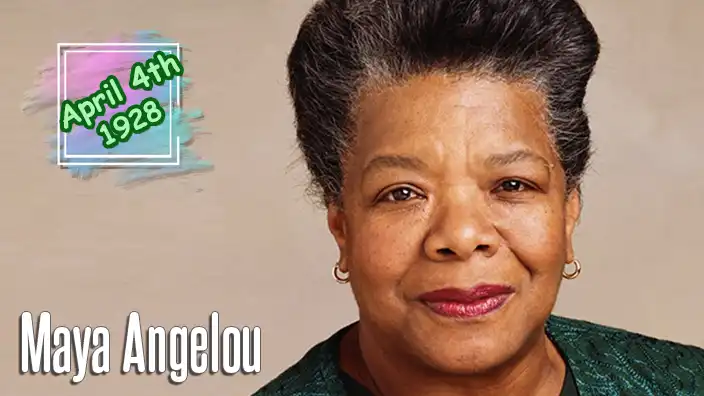
April 4, 1928, in St. Louis, Missouri
 May 28, 2014, in Winston-Salem, North Carolina
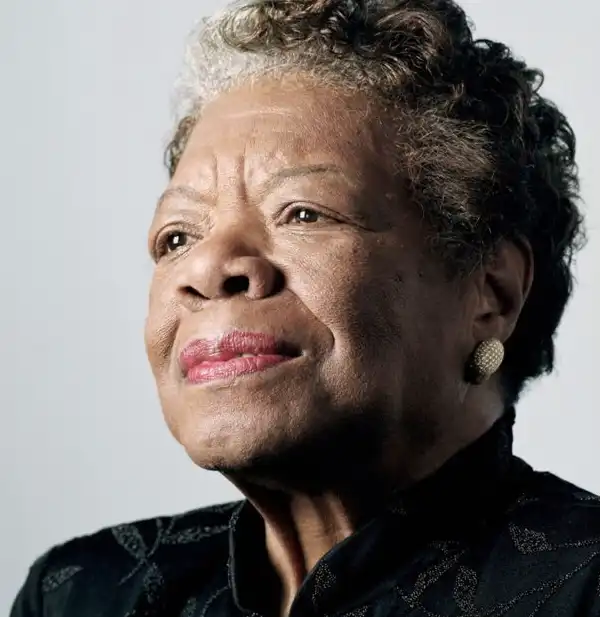
Maya Angelou was one of the most influential literary voices of the twentieth century—an author, poet, civil rights activist, performer, and storyteller whose words reached across generations. She had the rare ability to combine honesty, grace, humor, and deep wisdom into writing that felt both deeply personal and universally meaningful.
Born Marguerite Annie Johnson on April 4, 1928, in St. Louis, she spent much of her childhood in Stamps, Arkansas with her grandmother. Life in the American South during the era of segregation was not easy, and Angelou later drew heavily on those experiences in her writing. Her childhood was marked by hardship, trauma, and periods of silence—but those same experiences would eventually shape the powerful voice that made her famous.
Angelou adopted the name “Maya,” a nickname given by her brother, and “Angelou,” adapted from the surname of her first husband. Before she became widely known as a writer, she lived what can only be described as several lives’ worth of experiences. She worked as a streetcar conductor in San Francisco—one of the first Black women to hold that job in the city. She was also a singer, dancer, and stage performer, touring Europe in the 1950s with a production of Porgy and Bess. Later she released a music album titled Miss Calypso in 1957, showcasing her talent as a performer.
Angelou’s path eventually led her into journalism and activism. During the early 1960s she lived in Cairo and later Accra, where she worked as a writer and editor. While in Africa she became involved with a community of African American expatriates who were exploring cultural and political connections with the continent.
Upon returning to the United States, Angelou became active in the civil rights movement. She worked with prominent leaders including Martin Luther King Jr. and Malcolm X. These relationships further shaped her commitment to equality, dignity, and justice—themes that would later appear throughout her writing.
Angelou’s literary breakthrough came in 1969 with the publication of her groundbreaking autobiography, I Know Why the Caged Bird Sings. The book explored her childhood experiences with honesty that was both painful and inspiring. At the time, autobiographies by Black women were rarely published by major presses, and Angelou’s work helped open doors for many writers who followed.
The book became an international success and remains widely read today. It is often taught in schools and universities because of its powerful exploration of identity, resilience, and the struggle to find one’s voice.
Angelou went on to write several more autobiographical volumes, including Gather Together in My Name, Singin' and Swingin' and Gettin' Merry Like Christmas, and The Heart of a Woman. Each continued the story of her life while offering insight into American culture, race, and personal growth.
In addition to autobiographies, Angelou became one of the most celebrated poets in America. Her poems combined musical rhythm with powerful themes of identity, hope, and dignity. Perhaps her most widely recognized poem is Still I Rise, which has become a symbol of resilience and empowerment around the world.
Angelou reached one of the most visible moments of her career in 1993 when she recited the poem On the Pulse of Morning at the presidential inauguration of Bill Clinton. Millions of Americans watched as she delivered the poem, becoming only the second poet in U.S. history to perform at a presidential inauguration.
Throughout her life Angelou received numerous honors, including the Presidential Medal of Freedom, which was awarded to her in 2011 by Barack Obama. She also taught for many years at Wake Forest University in Winston-Salem, North Carolina, where she served as a professor of American studies.
Angelou was not just a writer—she was also an actress, director, educator, and lecturer. She appeared in films and television, wrote screenplays, and directed the 1998 film Down in the Delta. Her voice, both literally and through her writing, carried authority, compassion, and a touch of wit.
Even with all her achievements, Angelou often emphasized the importance of kindness and understanding. One of her most famous quotes reminds us that people may forget what you said or did, but they will never forget how you made them feel.
Maya Angelou passed away on May 28, 2014, but her influence continues to echo through literature, education, and culture. Her works are still read around the world, her poems still quoted, and her message of resilience still inspires readers of every generation.
Her life demonstrates that even the most difficult beginnings can lead to extraordinary accomplishments. Through courage, creativity, and determination, Maya Angelou transformed personal experiences into words that helped millions of people better understand themselves and one another.