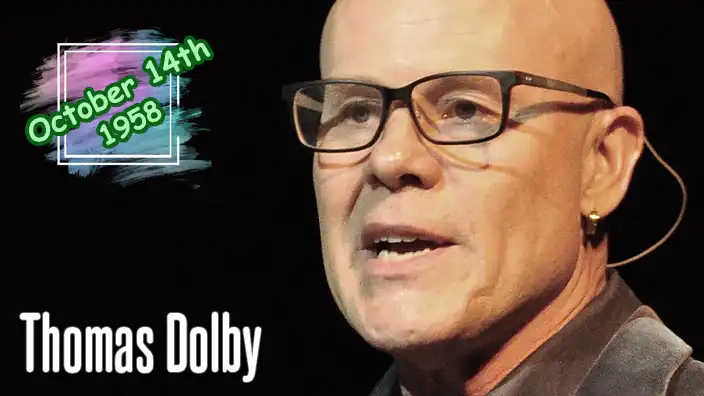
October 14, 1958, in London, England
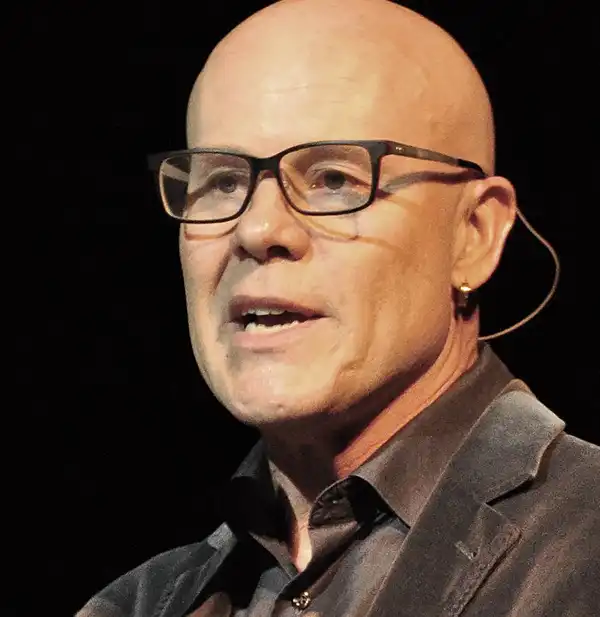
Born Thomas Morgan Robertson on October 14, 1958, in London, England, Thomas Dolby became one of the distinctive creative voices of the 1980s new wave and synth-pop movements. Best known for his international hit "She Blinded Me with Science," Dolby built a career extending far beyond popular music. His work as a songwriter, record producer, film composer, technology entrepreneur, and university professor has connected the worlds of entertainment, engineering, and education in ways few musicians could have anticipated when electronic keyboards first began invading recording studios.
Dolby's fascination with music and technology began during a childhood spent partly outside Britain. His father, Martin Robertson, was an internationally respected archaeologist and classical scholar, and the family's travels exposed young Thomas to different cultures and musical traditions. He developed interests in folk music, jazz, and electronic sound, eventually becoming particularly fascinated by synthesizers. Unlike conventional instruments, these electronic devices offered the possibility of creating entirely new sounds rather than simply reproducing familiar ones. For Dolby, this was irresistible. Why settle for sounding like a piano when a collection of oscillators could make noises resembling an orchestra, a spaceship, or an exceptionally nervous household appliance?
During the late 1970s, Dolby became involved in London's developing electronic music scene, experimenting with synthesizers and working with other musicians. His early professional experiences included performing with Bruce Woolley and the Camera Club and contributing to recordings by artists such as Lene Lovich. He wrote Lovich's song "New Toy," demonstrating his ability to combine memorable melodies with unusual electronic arrangements. These early collaborations helped establish his reputation as a resourceful musician who understood both traditional songwriting and the rapidly developing technology of modern recording studios.
By the beginning of the 1980s, Dolby was becoming a sought-after session musician and producer. He contributed synthesizer performances to recordings by established artists, including Foreigner's album 4 and Def Leppard's Pyromania. His electronic arrangements helped expand the musical possibilities available to rock performers who were beginning to experiment with synthesizers. Rather than replacing guitars and drums, Dolby demonstrated how electronic sounds could complement conventional instruments and create a richer musical atmosphere. His growing reputation eventually brought him into contact with an extraordinary range of performers, including Joni Mitchell, George Clinton, Stevie Wonder, Herbie Hancock, and David Bowie.
Dolby's debut studio album, The Golden Age of Wireless, arrived in 1982 and introduced listeners to his distinctive mixture of synthesizer-driven pop, atmospheric compositions, and imaginative storytelling. Songs such as "Europa and the Pirate Twins," "Airwaves," "Radio Silence," and "Windpower" revealed an artist interested in far more than catchy electronic dance rhythms. His lyrics frequently explored technology, memory, communication, and human relationships, while his arrangements combined futuristic sounds with traditional musical influences. The album's title reflected an affectionate fascination with the history of broadcasting and the possibilities of electronic communication, subjects that would continue to influence his work for decades.
Dolby's international breakthrough came with "She Blinded Me with Science," released in 1982 and popularized internationally during 1983. The song combined an infectious electronic rhythm, playful lyrics, and the unmistakable shouted exclamations of British television scientist Magnus Pyke. Its accompanying music video presented Dolby as an eccentric scientific character surrounded by laboratory equipment, unusual inventions, and considerable comic confusion. The video became a favorite on MTV, helping the single reach number five on the Billboard Hot 100 in the United States. It also demonstrated how visual storytelling could transform a distinctive song into an international cultural phenomenon. Apparently, the formula for success required synthesizers, a memorable chorus, and a scientist willing to shout enthusiastically at the appropriate moments.
The success of "She Blinded Me with Science" established Dolby as an important figure in the emerging relationship between popular music and music videos. MTV was transforming the recording industry, and Dolby understood that musicians could use the new medium to develop characters, tell stories, and create elaborate visual identities. His imaginative videos were often humorous, theatrical, and technically ambitious, reflecting his interest in filmmaking as well as music. Although the song became his most recognizable commercial success, it represented only one aspect of his creative abilities. Dolby's broader catalog contained sophisticated compositions that explored jazz, funk, ambient music, and experimental electronic arrangements.
In 1984, Dolby released his second studio album, The Flat Earth, which demonstrated a more expansive and musically adventurous approach. The album incorporated elements of jazz, funk, world music, and atmospheric electronic production, showing that his interests extended well beyond conventional synth-pop. Its best-known single, "Hyperactive!," became another international hit and reached number seventeen on the United Kingdom Singles Chart. The song featured energetic rhythms, rapid vocal delivery, and a playful examination of excessive enthusiasm and restless behavior. Its accompanying music video continued Dolby's fascination with exaggerated characters and unusual visual effects, proving that he had not entirely abandoned the laboratory after his previous success.
Dolby's abilities as a record producer also became increasingly important during the middle of the decade. In 1985, he produced Steve McQueen for the British band Prefab Sprout, released in the United States under the title Two Wheels Good. The album became an important recording in the band's career, combining sophisticated songwriting with Dolby's polished production techniques. He also worked on Joni Mitchell's Dog Eat Dog and George Clinton's Some of My Best Jokes Are Friends. These projects demonstrated his versatility, as he moved between sophisticated pop, politically conscious songwriting, and adventurous funk without insisting that every recording sound like a science experiment conducted during a thunderstorm.
Another memorable chapter in Dolby's career involved his participation in major international musical events. He performed as part of David Bowie's band at the historic Live Aid concert in 1985, joining an extraordinary gathering of musicians raising money for famine relief in Africa. In 1990, he also participated in Roger Waters' large-scale performance of The Wall in Berlin, staged shortly after the fall of the Berlin Wall. These appearances placed Dolby alongside internationally recognized performers and demonstrated his continuing reputation as a versatile keyboardist capable of contributing to demanding live productions.
Dolby expanded his work into film music during the 1980s, composing and contributing to soundtracks that combined electronic experimentation with cinematic storytelling. His credits included the 1986 science-fiction comedy Howard the Duck and Ken Russell's 1986 horror film Gothic. Although Howard the Duck received a famously difficult critical reception, its soundtrack offered Dolby another opportunity to experiment with dramatic musical arrangements. His association with film and television continued through soundtrack contributions, music videos, and occasional acting appearances. IMDb also records his appearance in the 1990 musical horror comedy Rockula, in which he played Stanley, along with soundtrack credits associated with Romy and Michele's High School Reunion and Mission: Impossible III.
Dolby's third studio album, Aliens Ate My Buick, appeared in 1988 and continued his exploration of electronic pop, funk, and humorous songwriting. The album included songs such as "Airhead" and "Hot Sauce," reflecting a playful approach to contemporary music and popular culture. Although it did not reproduce the enormous commercial success of his earlier singles, the recording demonstrated his willingness to experiment rather than simply repeat a successful formula. Dolby had little interest in becoming permanently trapped inside the sound of 1983, even if that particular sound continued to receive enthusiastic attention from audiences who remembered the early days of MTV.
His fourth studio album, Astronauts & Heretics, followed in 1992 and featured collaborations with musicians including Eddie Van Halen, Jerry Garcia, and Ofra Haza. The album incorporated a broad range of influences, combining electronic arrangements with guitar performances, international musical traditions, and more reflective songwriting. Its songs included "I Love You Goodbye" and "Close but No Cigar." By this stage, Dolby was increasingly interested in the relationship between music and digital technology, and his career was preparing to take another unexpected turn. Most musicians would have been content to purchase new recording equipment. Dolby was becoming interested in inventing the software that made such equipment possible.
During the 1990s, Dolby moved increasingly into the technology industry, founding a software company originally known as Headspace, which later became Beatnik. The business developed interactive audio technology for computers, websites, games, and mobile devices. Dolby recognized that digital music would become an increasingly important part of everyday life as personal computers and mobile communications developed. His company worked on software capable of producing sophisticated audio while operating within the technical limitations of early digital devices. This was particularly important at a time when computers had limited processing power and mobile telephones were considerably less capable than today's smartphones.
One of Dolby's most significant technological contributions involved the development of polyphonic ringtone technology. Earlier mobile phones generally produced simple electronic tones, but Beatnik's software helped enable devices to reproduce multiple musical notes simultaneously, creating more elaborate melodies and arrangements. The technology was licensed to mobile phone manufacturers and eventually appeared in an enormous number of devices worldwide. It was an extraordinary achievement for a musician who had begun his career experimenting with synthesizers. Having helped define the sound of the 1980s, Dolby was now helping shape the sounds heard whenever somebody received a telephone call. Unfortunately, he could not prevent people from answering those calls in the middle of restaurants.
Dolby's technological interests also extended to interactive entertainment, computer games, and virtual reality. His work included music and sound design associated with video games such as The Dark Eye, Obsidian, and Double Switch. He explored ways of making music responsive to the actions of players rather than restricting it to a fixed recording. This approach anticipated many developments in modern interactive entertainment, where soundtracks change according to a player's location, decisions, and activities. His experiments demonstrated that music could become an active part of a digital environment rather than simply something playing in the background.
From 2001 to 2012, Dolby served as music director for the influential TED Conferences, helping incorporate live music and creative performances into events devoted to technology, entertainment, design, and new ideas. The position was particularly appropriate for someone whose career had consistently crossed the boundaries between artistic creativity and scientific innovation. His work with TED brought him into contact with researchers, inventors, entrepreneurs, and performers exploring developments in numerous fields. For Dolby, it was an environment in which discussions about music, computers, and the future of technology could comfortably occupy the same conversation.
After an extended period concentrating on technology and other projects, Dolby returned to studio recording with A Map of the Floating City in 2011. His first full-length studio album in nearly two decades featured contributions from artists including Mark Knopfler, Regina Spektor, and Imogen Heap. The recording explored themes of travel, memory, identity, and changing societies, combining electronic arrangements with acoustic instrumentation and atmospheric storytelling. Dolby also developed an accompanying online interactive game called The Floating City, allowing fans to participate in a fictional world connected to the album. It was a creative approach to releasing music, transforming the traditional album promotion campaign into something resembling an elaborate digital adventure.
Dolby's interest in visual storytelling continued with his 2013 documentary project The Invisible Lighthouse. The film explored the closure of a historic lighthouse visible from his home on the Suffolk coast of England, combining personal reflection, local history, and environmental imagery. Dolby directed the project and created its musical accompaniment, bringing together his abilities as a composer, filmmaker, and storyteller. The documentary also formed the basis of a multimedia live performance, demonstrating his continuing enthusiasm for combining recorded images, music, and technology into new artistic experiences.
In 2014, Dolby joined the faculty of Johns Hopkins University, bringing his experience in electronic music, production, and digital innovation into higher education. At the university's Peabody Institute, he became involved in developing the Music for New Media program, which began enrolling students in 2018. The program emphasizes composition and sound design for contemporary media, including film, video games, virtual reality, and interactive entertainment. His academic role allows students to learn from someone who has experienced several major transformations in the music industry firsthand. It is not every day that a professor can explain synthesizer programming, record production, digital audio technology, and MTV history while also appearing in the music videos being discussed.
Dolby has also shared his experiences through writing. His 2016 memoir, The Speed of Sound: Breaking the Barriers Between Music and Technology, recounts his journey through the recording industry, Silicon Valley, and the rapidly changing world of digital entertainment. The book explores the creative and technical challenges involved in developing new musical possibilities, as well as the difficulties of operating in industries where technology can become obsolete almost as quickly as it appears. His account provides insight into a career built around curiosity, experimentation, and a willingness to pursue unfamiliar opportunities.
Recognition for Dolby's contributions has extended beyond record sales and chart positions. He has received multiple Grammy Award nominations and honors acknowledging his influence on electronic music and technological innovation. In 2012, he received the Moog Innovation Award, recognizing his creative approach to electronic music and his connection to the pioneering spirit of synthesizer developer Robert Moog. In 2018, he received a Roland Lifetime Achievement Award, another acknowledgment of his contributions to electronic musical instruments and their creative possibilities.
Away from his professional achievements, Dolby has maintained a family life alongside his demanding musical and technological pursuits. He married American actress Kathleen Beller on July 2, 1988, and the couple have three children. Beller is known for her work in film and television, including appearances in The Betsy and Dynasty. Dolby has also spoken about his enjoyment of windsurfing and his attachment to coastal environments, interests reflected in aspects of his music and filmmaking. His life has involved considerable international travel, but his creative work frequently returns to themes of place, memory, and the relationship between people and their surroundings.
Thomas Dolby's career illustrates how musical creativity can extend far beyond the recording studio. His early work helped popularize electronic music during a period when synthesizers were transforming the sound of popular entertainment. His collaborations introduced innovative arrangements to established performers, while his film compositions and interactive projects expanded the possibilities of recorded sound. His later achievements in digital audio technology helped bring more sophisticated music to computers and mobile devices, and his teaching has provided a new generation of composers with access to his experience.
For many listeners, Thomas Dolby will always be associated with the unforgettable electronic rhythms of "She Blinded Me with Science." Yet that familiar song represents only the beginning of a much larger story involving music, invention, entrepreneurship, filmmaking, and education. From the synthesizer-filled studios of London to Silicon Valley and the classrooms of Johns Hopkins University, Dolby has repeatedly demonstrated that curiosity can be as valuable as commercial success. And if the history of popular music teaches us anything, it is that a man who once made millions of people dance to a song about science probably deserves to have his laboratory equipment left exactly where he wants it.