September 30, 1971, in Los Angeles, California
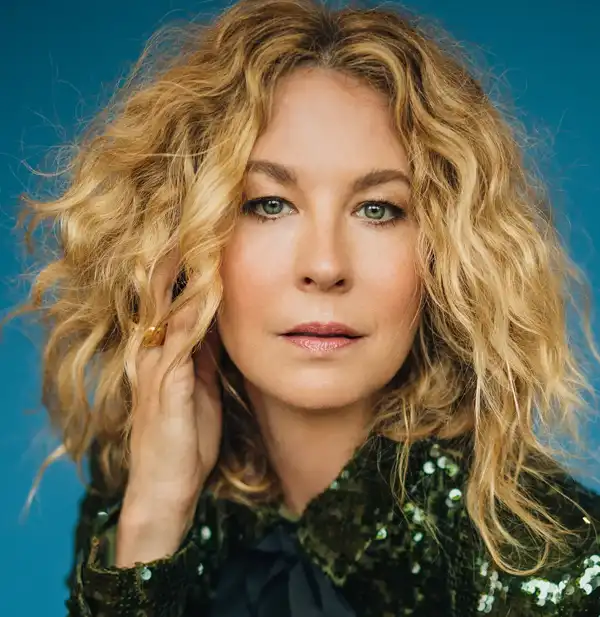
Jenna Elfman became one of television's most recognizable comedy stars as the irrepressibly cheerful Dharma Finkelstein Montgomery on Dharma & Greg, but acting was not the career she originally set out to pursue. Born Jennifer Mary Butala on September 30, 1971, in Los Angeles, California, she began studying classical ballet as a child and spent years training as a dancer. Injuries eventually interfered with her ballet ambitions, but dance remained her route into professional entertainment. Before sitcom audiences knew her as Dharma, Elfman was working professionally as a dancer, appearing in music videos and even performing during the 1991 Academy Awards broadcast in a production choreographed by Debbie Allen.
Her early dancing résumé was considerably more rock-and-roll than her classical ballet training might suggest. Elfman appeared in music videos connected with performers including Depeche Mode and Anthrax, and her dance career gave her experience performing in front of cameras long before she became a television regular. She gradually moved toward acting, studying the craft and beginning with commercials and television appearances. Guest roles followed on established programs including Roseanne, NYPD Blue and Murder One, allowing Elfman to demonstrate that the energetic personality she brought to dance could translate rather effectively into comedy and drama.
An important early opportunity arrived with the 1996 ABC sitcom Townies, in which Elfman appeared alongside Molly Ringwald and Lauren Graham. The series did not last long, but sometimes television failure has a peculiar way of being useful. Elfman's performance attracted attention, and she subsequently landed the role that transformed her career. In 1997, ABC introduced Dharma & Greg, created by Dottie Dartland and Chuck Lorre, with Elfman starring opposite Thomas Gibson. The premise was gloriously simple: Dharma, a spontaneous, unconventional woman raised by hippie parents, meets Greg, a straight-laced attorney from an affluent conservative family. They fall in love and marry on their first date. Sensible? Absolutely not. Excellent material for a weekly sitcom? Very much so.
Elfman's Dharma was the engine driving much of the comedy. The character was optimistic, impulsive and almost constitutionally incapable of behaving according to the expectations of polite society. Gibson's Greg provided the comparatively restrained counterweight, while the wildly different parents on both sides of the marriage ensured that peace and quiet rarely survived for an entire episode. Rather than simply playing Dharma as scatterbrained, Elfman gave her considerable warmth and confidence. Dharma generally knew exactly who she was; it was everyone else who had trouble keeping up. That distinction helped prevent the character from becoming merely a collection of eccentricities.
Dharma & Greg premiered in September 1997 and ran for five seasons and 119 episodes. The series made Elfman a major television star and brought substantial awards recognition. She received three consecutive Golden Globe nominations for her performance, winning the Golden Globe for Best Performance by an Actress in a Television Series – Musical or Comedy in 1999. She also received three Primetime Emmy Award nominations for Outstanding Lead Actress in a Comedy Series and won two TV Guide Awards. For an actress who had only recently made the transition from professional dancer to television performer, it was an extraordinarily rapid arrival at the top tier of American sitcom comedy.
Elfman's film career was developing at roughly the same time. She appeared in the dark comedy Grosse Pointe Blank and followed it with roles in films including Krippendorf's Tribe, Dr. Dolittle and Ron Howard's EDtv. In 2000 she starred as Anna Reilly in Keeping the Faith, opposite Ben Stiller and Edward Norton. The romantic comedy gave Elfman a substantial big-screen role outside the broad eccentricity associated with Dharma, placing her at the center of a story involving two longtime friends—one a rabbi and the other a Catholic priest—who both develop feelings for the same woman. If that sounds like the opening line of a joke involving a rabbi and a priest, the filmmakers were clearly aware of the possibilities.
Other film work included Town & Country, Looney Tunes: Back in Action, Big Stone Gap and Friends with Benefits, in which she appeared alongside Justin Timberlake and Mila Kunis. Elfman also supplied the voice of Dorothy in the animated Clifford's Really Big Movie. Her film career never eclipsed the enormous visibility she achieved through Dharma & Greg, but it demonstrated a willingness to move between romantic comedy, ensemble pictures, family entertainment and supporting character roles rather than spending the remainder of her career attempting to recreate Dharma under different names.
Television, however, remained Elfman's natural territory. After Dharma & Greg, she returned to series television with Courting Alex, playing attorney Alex Rose, and later starred in Accidentally on Purpose as Billie, a film critic whose unexpected pregnancy considerably complicates her carefully organized life. She subsequently appeared in 1600 Penn, the family comedy Growing Up Fisher with J.K. Simmons, and Imaginary Mary, in which her character's childhood imaginary friend unexpectedly returned to interfere with adult life. She also made appearances in series including Two and a Half Men, My Name Is Earl, Royal Pains, The Mindy Project, Shameless and Damages.
A particularly significant change of direction came when Elfman joined AMC's Fear the Walking Dead. Beginning with the show's fourth season, she played June, initially introduced under another name as a mysterious survivor with medical skills. The part was far removed from the buoyant sitcom characters with which she had long been associated. June existed in a world of violence, loss, uncertainty and the persistent inconvenience of corpses refusing to remain properly dead. Elfman has spoken about wanting an opportunity to explore deeper human stories, and Fear the Walking Dead allowed her to spend several seasons doing exactly that.
Her background in dance has never entirely disappeared from her professional life. As a classically trained dancer, Elfman has served as a guest judge on So You Think You Can Dance and has been involved with efforts supporting dance education. The physical awareness developed through years of dance training also helps explain some of the distinctive energy of her comedy performances. Dharma was a character who rarely seemed merely to enter a room when bouncing, gliding, charging or otherwise arriving with considerably more enthusiasm was available.
Away from the screen, Elfman has been married to actor Bodhi Elfman since 1995, and the couple have two sons. The Elfman surname also connects her to a well-known entertainment family: Bodhi is the nephew of composer Danny Elfman. Jenna and Bodhi have worked together as well, including creating the conversational podcast Kicking and Screaming, centered on marriage, relationships and the everyday absurdities that accumulate when two people spend enough years together to have ample evidence against one another.
Jenna Elfman's career is unusual because the role that made her famous arrived relatively early, yet it did not become the end of the story. Dharma & Greg remains the performance most closely associated with her, and understandably so: Dharma was tailor-made for Elfman's combination of comic timing, physicality and exuberance. Yet the decades that followed included romantic comedies, ensemble films, short-lived sitcoms, guest performances, voice acting and a lengthy excursion into zombie-infested drama. That is considerably more range than might have been predicted when Dharma Finkelstein met Greg Montgomery and decided that dating was an unnecessary administrative step.
For television audiences who remember the late 1990s, Elfman will probably always carry a little of Dharma with her. The character belonged to an era when network sitcoms could still command enormous audiences and a successful series became part of the weekly routine in millions of homes. Elfman's Golden Globe-winning performance gave Dharma & Greg its infectious energy, but her later work demonstrated something equally important: there was considerably more to Jenna Elfman than one wonderfully eccentric woman with hippie parents, a conservative husband and absolutely no intention of doing anything the conventional way.