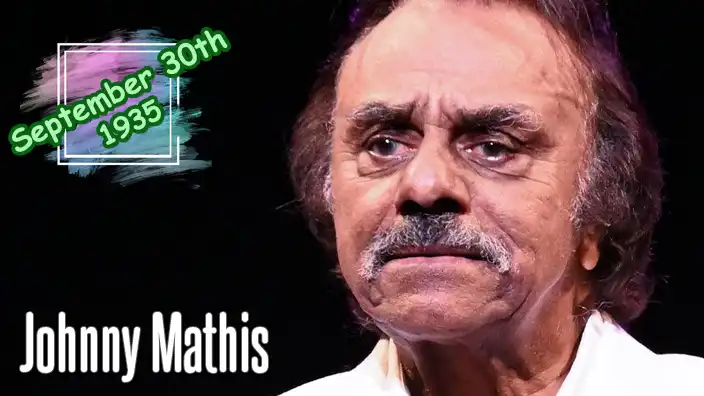
September 30, 1935, in Gilmer, Texas

Johnny Mathis possesses one of the most distinctive voices in American popular music, a warm and immediately recognizable sound that carried songs such as “Chances Are,” “Misty,” “Wonderful! Wonderful!” and “It’s Not for Me to Say” into popular culture. Emerging during the 1950s, Mathis built a recording career that survived enormous changes in musical fashion, from traditional pop and jazz through rock and roll, soul, disco and the modern pop era. Rather than repeatedly reinventing himself to chase whatever happened to be fashionable, he concentrated on the thing he did exceptionally well: interpreting a good melody with elegance, control and enough romance to make a perfectly ordinary living room seem as though someone ought to be bringing in champagne.
John Royce Mathis was born on September 30, 1935, in Gilmer, Texas, and grew up in San Francisco, California, as one of seven children. His father, Clem Mathis, recognized his son's musical ability early and encouraged it. According to Mathis's official biography, his father bought an old upright piano for the family and taught Johnny songs and routines. Mathis later studied voice seriously with teacher Connie Cox, who helped him develop the technique behind the seemingly effortless singing style that would eventually become his trademark.
Music was not his only exceptional ability. As a student at George Washington High School in San Francisco and later San Francisco State College, Mathis became an outstanding athlete. He competed in track and field, particularly the high jump, and was accomplished enough to attract attention well beyond ordinary collegiate competition. His athletic talent placed him in the remarkable position of having to choose between pursuing elite-level competition and an opportunity to begin a professional recording career. Music won. Considering what followed, Columbia Records probably remains quite comfortable with the outcome.
Mathis's route into the recording industry began when Helen Noga, co-owner of San Francisco's Black Hawk nightclub, heard him performing at a jam session and became his manager. She helped bring him to the attention of Columbia Records executive George Avakian, an influential producer and jazz specialist. Mathis signed with Columbia, and his first album, Johnny Mathis: A New Sound in Popular Song, was released in 1956. The recording leaned strongly toward jazz and featured accomplished musicians, revealing that the singer who would become famous for romantic ballads began with serious jazz credentials.
Commercial success arrived quickly once Mathis was directed toward lushly arranged popular songs. In 1957, “Wonderful! Wonderful!” became one of his early hits, followed by “It’s Not for Me to Say.” Then came “Chances Are,” the recording that became one of his signature performances and reached No. 1 on the Billboard pop chart. Its opening notes are enough for generations of listeners to recognize both the song and the singer almost immediately. Mathis's controlled phrasing and gentle vibrato turned the recording into a defining example of the romantic pop ballad.
Another major recording from this period was “The Twelfth of Never,” which became permanently associated with Mathis even though its chart history was unusual. His version appeared as the B-side of “Chances Are” and developed into one of his best-known songs. He also recorded “Misty,” the Erroll Garner jazz standard with lyrics by Johnny Burke, giving the song one of its most famous vocal interpretations. Mathis had found an ideal territory between jazz sophistication and accessible popular music, allowing him to perform standards without sounding old-fashioned and romantic songs without drowning them in sentimentality.
In 1958, Columbia released Johnny's Greatest Hits, a collection that became enormously important in the history of the record business. The album remained on the Billboard album chart for an extraordinary 490 consecutive weeks, a record it held for many years. More importantly, it helped establish the commercial model of assembling an artist's successful singles into a dedicated greatest-hits album. What later became a routine record-company practice was still comparatively novel when Mathis's collection demonstrated just how enthusiastically listeners would buy their favorite songs together in one package.
Mathis became particularly associated with the album format at a time when many popular performers depended primarily upon hit singles. His albums were designed for sustained listening, often combining standards, Broadway songs, contemporary compositions and carefully arranged romantic material. Records such as Heavenly, Open Fire, Two Guitars, Faithfully and Rapture helped establish him as an artist whose audience wanted considerably more than whichever song happened to be playing on the radio.
Christmas music became another major part of the Mathis catalog. His 1958 album Merry Christmas became an enduring seasonal favorite, featuring his interpretations of traditional standards including “Winter Wonderland,” “Sleigh Ride,” “The Christmas Song” and “White Christmas.” Mathis returned repeatedly to holiday music throughout his career, recording several Christmas albums. For many households, his voice became as much a part of December as decorated trees, wrapping paper and the annual discovery that somebody forgot where the spare Christmas lights were stored.
Although Mathis became strongly identified with the sophisticated romantic pop of the 1950s and early 1960s, his recording career continued through musical revolutions that swept away many of his contemporaries. The arrival of the Beatles, the rise of soul, hard rock, singer-songwriters and disco could easily have confined him to nostalgia. Instead, Mathis maintained a devoted audience while continuing to record new material and perform live. His ability to interpret songs rather than depend upon one particular musical fashion gave him unusual longevity.
He demonstrated that adaptability dramatically in 1978 when he recorded “Too Much, Too Little, Too Late” with Deniece Williams. The duet reached No. 1 on the Billboard Hot 100, giving Mathis another chart-topping pop hit more than two decades after “Chances Are.” The record also performed strongly on R&B and adult contemporary charts and introduced Mathis to listeners who had not necessarily grown up with his earlier recordings. He and Williams subsequently recorded additional material together, including an album of duets.
Mathis has collaborated with an impressive range of performers during his career. His recordings have included duets with artists such as Barbra Streisand, Dionne Warwick, Natalie Cole, Gladys Knight, Patti Austin and Jane Olivor. These collaborations highlighted one of his great strengths: Mathis could retain his unmistakable vocal identity while adjusting comfortably to another singer's style. He rarely approached a duet as a contest to see who could occupy the most musical territory. Instead, the voices were allowed to complement one another—a civilized arrangement that occasionally seems revolutionary in popular music.
Recognition from the recording industry has accumulated alongside his enormous catalog. Mathis received the Grammy Lifetime Achievement Award, and several of his landmark recordings have been inducted into the Grammy Hall of Fame, including “Chances Are,” “Misty” and “It's Not for Me to Say.” He has also been honored with a star on the Hollywood Walk of Fame. His recording output numbers in the dozens of albums, while worldwide record sales have been measured in the hundreds of millions.
His connection with Columbia Records is itself remarkable. Apart from a period recording for Mercury Records during the 1960s, Mathis spent the overwhelming majority of his career associated with Columbia, the label that signed him when Dwight D. Eisenhower was president and Elvis Presley was still a relatively new national phenomenon. Few major recording artists have maintained such a lengthy relationship with one label, particularly across an industry that changed from vinyl records to eight-tracks, cassettes, compact discs, downloads and streaming.
Mathis's vocal longevity has been equally impressive. His singing style depended upon precision rather than brute force, with careful breath control, distinctive vibrato and phrasing influenced by both jazz and traditional popular singing. While his records became shorthand for romance, the technique underneath them was considerable. Songs that sound relaxed in his hands are not necessarily easy to sing; making difficult things appear uncomplicated is usually the clue that somebody knows exactly what he is doing.
The description “romantic singer” therefore captures only part of Johnny Mathis. He emerged from jazz, possessed genuine athletic ability, helped establish the greatest-hits album as a commercial phenomenon, survived repeated transformations of the recording industry and returned to the top of the pop charts more than twenty years after his first major successes. Through it all, his voice remained instantly identifiable.
For generations of listeners, however, statistics and industry milestones are secondary to the records themselves. Put on “Chances Are,” “Misty,” “Wonderful! Wonderful!” or “The Twelfth of Never,” and the reason for Mathis's extraordinary longevity becomes obvious. Musical fashions change with remarkable enthusiasm, but a beautiful melody sung exceptionally well has a stubborn habit of refusing to become obsolete. Johnny Mathis built an extraordinary career around that simple principle—and made romance sound very easy while he was doing it.