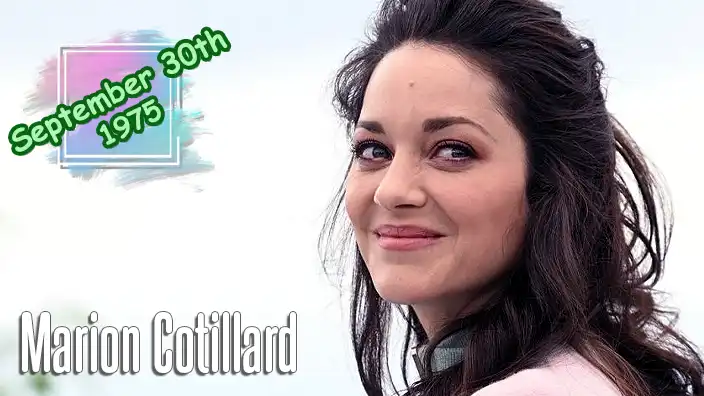
September 30, 1975, in Paris, France
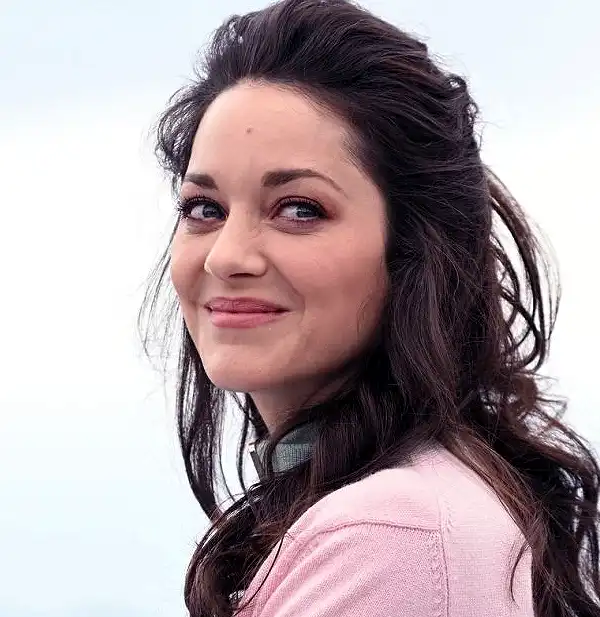
Marion Cotillard became an international star through a career that has moved effortlessly between French cinema and major Hollywood productions, bringing her distinctive intensity to everything from intimate dramas to enormous blockbusters. Her extraordinary portrayal of legendary French singer Édith Piaf in La Vie en Rose brought her an Academy Award, while films including Inception, The Dark Knight Rises, Rust and Bone, Nine, Midnight in Paris and Two Days, One Night established her as one of France's most internationally successful contemporary performers.
Born on September 30, 1975, in Paris, France, Cotillard grew up surrounded by the performing arts. Her father, Jean-Claude Cotillard, was an actor, teacher and theater director, while her mother, Niseema Theillaud, was an actress and drama teacher. With theater woven into family life, performing was hardly an exotic career choice. Cotillard began acting while young and studied drama at the Conservatoire d'Art Dramatique in Orléans before pursuing professional work in theater, television and film.
French audiences began noticing Cotillard during the 1990s, but a major breakthrough arrived with Luc Besson's 1998 action comedy Taxi. Cotillard played Lilly Bertineau, the girlfriend of speed-loving taxi driver Daniel Morales, played by Samy Naceri. The movie became a major French box-office success and developed into a franchise. Cotillard returned for Taxi 2 and Taxi 3, and the original film earned her a César Award nomination for Most Promising Actress. The films were considerably louder and faster than much of her later work, but they provided a highly visible platform for a young actress whose career was beginning to accelerate almost as enthusiastically as the cars.
Cotillard increasingly pursued more varied roles, appearing in French productions including Pretty Things, for which she received another César nomination. International audiences gained a better look at her in Tim Burton's 2003 fantasy Big Fish. She played Joséphine, the French wife of Billy Crudup's character Will Bloom, in a story filled with giants, witches, circus performers and the deliberately exaggerated memories of Albert Finney's Edward Bloom. The supporting role introduced Cotillard to a substantial English-speaking audience and demonstrated that her career could travel comfortably beyond France.
Her reputation within French cinema grew dramatically with Jean-Pierre Jeunet's A Very Long Engagement in 2004. Cotillard played Tina Lombardi, a woman searching for answers after the disappearance of her lover during World War I. The role was dark, intense and far removed from the lighter material of Taxi. Her performance earned her the César Award for Best Supporting Actress, confirming her status as one of France's increasingly important dramatic performers.
Then came Édith Piaf.
Cotillard portrayed the legendary French singer in Olivier Dahan's 2007 biographical film La Vie en Rose, released in France as La Môme. Piaf's turbulent life presented an enormous challenge. Cotillard had to portray the singer across several decades, from a young woman beginning her career to a physically diminished performer nearing the end of her life. Makeup and prosthetics contributed heavily to the transformation, but Cotillard supplied the posture, movements, expressions and emotional intensity that made Piaf seem to inhabit the screen.
The performance brought extraordinary international acclaim. Cotillard won the Academy Award for Best Actress, becoming the first performer to win the award for a French-language performance since Simone Signoret won for Room at the Top decades earlier. She also won the BAFTA Award, César Award and Golden Globe for her performance. Her Oscar victory was particularly significant because Hollywood's major acting categories have historically favored English-language performances. Cotillard had crossed the language barrier without needing Piaf to suddenly develop an American accent for everyone's convenience.
The success of La Vie en Rose transformed Cotillard into an international leading actress. Hollywood quickly came calling, although she continued making films in France and Europe rather than abandoning the industry that had established her. She appeared alongside Johnny Depp and Christian Bale in Michael Mann's Public Enemies, playing Billie Frechette, companion of notorious bank robber John Dillinger. She then joined Daniel Day-Lewis, Penélope Cruz, Nicole Kidman and an enormous ensemble cast in Rob Marshall's musical Nine. Cotillard's performance as Luisa Contini earned her another Golden Globe nomination.
In 2010, Cotillard joined Leonardo DiCaprio in Christopher Nolan's Inception, one of the most ambitious science-fiction films of its era. She played Mal Cobb, the deceased wife of DiCaprio's Dom Cobb, who continues appearing within the dream worlds he enters. Mal is simultaneously a memory, a manifestation of guilt and an increasingly dangerous presence inside Cobb's subconscious. Cotillard gave the character an unsettling combination of tenderness and menace, making Mal far more than the standard deceased spouse conveniently supplied to explain a hero's emotional problems.
Inception became a major international success and firmly established Cotillard within blockbuster filmmaking. She reunited with Nolan for The Dark Knight Rises in 2012, playing Miranda Tate, a businesswoman who becomes involved with Bruce Wayne before revealing a rather more complicated identity. The film placed Cotillard alongside Christian Bale, Anne Hathaway, Tom Hardy, Gary Oldman and Michael Caine in the conclusion to Nolan's Batman trilogy. Between infiltrating dreams and becoming involved in Gotham City's problems, Cotillard had managed to enter two of the largest film franchises of the period without surrendering her reputation as a serious dramatic actress.
Indeed, some of her strongest performances continued to come from smaller European productions. In Jacques Audiard's Rust and Bone, Cotillard played Stéphanie, a killer-whale trainer who loses both legs following an accident. Rather than reducing the character to her disability, the film follows her complicated physical and emotional recovery and her relationship with Matthias Schoenaerts' troubled Ali. Cotillard's performance received widespread acclaim and another Golden Globe nomination.
She earned a second Academy Award nomination for Best Actress for the Belgian drama Two Days, One Night, directed by Jean-Pierre and Luc Dardenne. Cotillard played Sandra, a factory worker who learns that her colleagues have been offered bonuses in exchange for accepting her dismissal. She spends a weekend visiting them individually, attempting to persuade enough coworkers to surrender their bonuses so she can keep her job. The film was deliberately stripped of glamour and spectacle, relying heavily upon Cotillard's ability to portray exhaustion, depression, desperation and dignity without theatrical excess.
Cotillard has continued moving between French and English-language productions. Her credits include Woody Allen's Midnight in Paris, in which she played Adriana, an alluring woman encountered in the film's romanticized version of 1920s Paris; James Gray's The Immigrant opposite Joaquin Phoenix; Macbeth with Michael Fassbender; Robert Zemeckis's wartime thriller Allied with Brad Pitt; and Assassin's Creed, again opposite Fassbender. She also provided the voice of Tutu in the French-language version of the animated film The Little Prince.
Music has remained another important part of Cotillard's creative life. She sings, plays several instruments and has collaborated with musicians and recording projects outside her film work. Her musical ability proved particularly useful for Nine, where she performed her own musical numbers. Despite becoming permanently associated with Édith Piaf through La Vie en Rose, Cotillard did not simply imitate Piaf's famous recordings; much of the film relied upon original Piaf recordings, while Cotillard concentrated upon physically and emotionally embodying the singer.
Cotillard has also become well known for environmental advocacy. She has worked with Greenpeace and participated in campaigns concerning climate change, deforestation, ocean protection and other environmental issues. Her involvement has included documentary work, public appearances and field visits rather than simply appearing for the occasional photograph beside a conveniently positioned tree. Environmental concerns have remained a consistent part of her public activities alongside her acting career.
Her personal life has generally remained considerably less theatrical than many of the characters she portrays. Cotillard has had a long relationship with French actor and director Guillaume Canet, with whom she has two children. The pair have also collaborated professionally on several films. Cotillard has frequently worked within French cinema even while enjoying the sort of international recognition that could easily have led to a permanent relocation into Hollywood blockbusters.
That balance is an important part of her career. Cotillard can appear in a film costing hundreds of millions of dollars and then return to a small European drama built largely around conversation and human behavior. She has played historical figures, romantic leads, emotionally damaged women, villains, singers and characters caught inside elaborate science-fiction worlds. Her performances often share an emotional intensity, but the women themselves rarely resemble one another.
The defining performance remains La Vie en Rose, and understandably so. Playing Édith Piaf would have been intimidating for any French actress. Piaf is not simply a famous singer in France; her voice and turbulent biography occupy an enormous place in the country's cultural history. Cotillard managed not merely to survive the comparison but to create a performance recognized around the world. The Academy Award that followed turned an already successful French actress into an international star.
Yet Marion Cotillard's career did not peak with that golden statuette. Instead, the Oscar opened another door while she kept the previous ones firmly unlocked. She moved into Christopher Nolan blockbusters, continued making demanding French-language films, earned another Academy Award nomination and maintained interests extending well beyond acting. It is an unusually international career built without abandoning the language, filmmakers or cinematic traditions from which she emerged.
For many moviegoers she will always first be remembered as Édith Piaf, hunched beneath heavy makeup and apparently transformed into another human being. Others discovered her haunting Leonardo DiCaprio through the dream corridors of Inception. Either way, Marion Cotillard has demonstrated that subtitles, national borders and enormously complicated dream architecture are relatively minor obstacles when the performance is good enough.