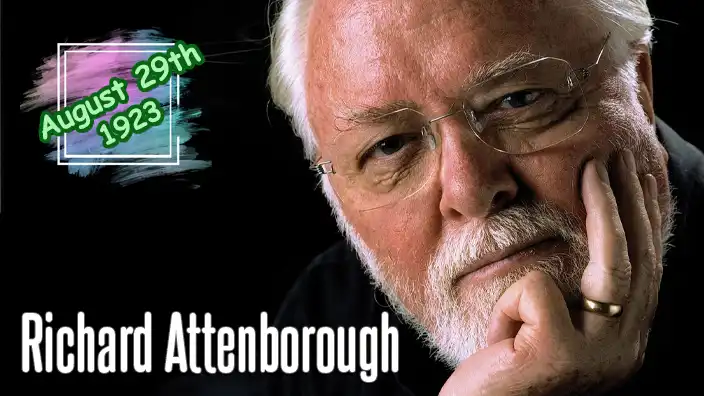
August 29, 1923, in Cambridge, England
 August 24, 2014, in Northwood, England
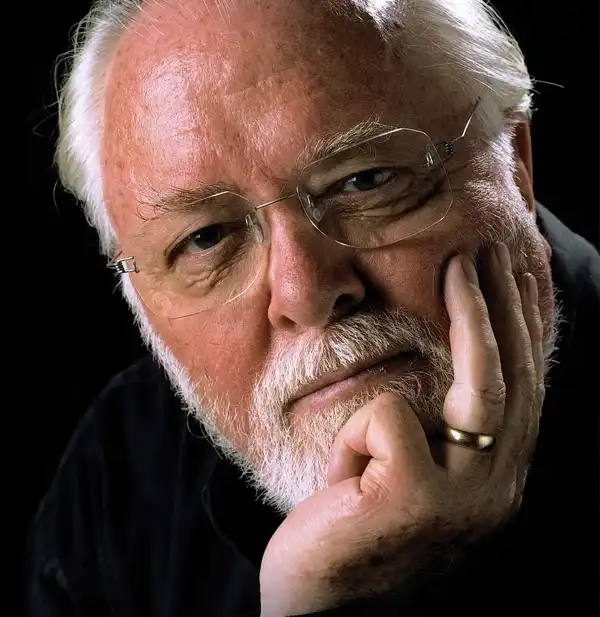
Richard Samuel Attenborough was a British actor, director, producer and lifelong champion of the arts whose extraordinary career stretched across more than six decades. Born on August 29, 1923, in Cambridge, England, he became one of Britain's most recognizable film personalities, first through acting and later as the Academy Award-winning director of Gandhi. To another generation, however, he will forever be John Hammond, the enthusiastic billionaire who built Jurassic Park and somehow failed to anticipate that enormous prehistoric carnivores might object to remaining behind fences.
Attenborough grew up in Leicester, where his father, Frederick Attenborough, became principal of University College, Leicester. The Attenborough household was intellectually energetic and socially conscious. During the Second World War, his parents took in two Jewish refugee girls who had escaped Nazi Germany, and the girls subsequently became members of the family.
Richard was the eldest of three brothers. His younger brother David Attenborough would eventually become one of the world's most celebrated broadcasters and natural historians, while their youngest brother, John, pursued a career in the motor industry. Between Richard's movies and David's wildlife documentaries, the Attenborough family managed to occupy an impressive amount of British television and cinema for several generations.
Richard developed an interest in acting early and studied at the Royal Academy of Dramatic Art in London. His film career began while he was still a young man, including an appearance in Noël Coward and David Lean's wartime film In Which We Serve in 1942.
The Second World War soon interrupted his developing career. Attenborough joined the Royal Air Force and eventually served with the RAF Film Production Unit. His work included flying on operational missions over Europe to obtain footage, giving him genuine wartime experience that went considerably beyond pretending to look worried while standing beside a cardboard aircraft on a studio set.
After the war, Attenborough resumed acting and quickly established himself as one of Britain's most capable young character actors. His breakthrough performance came as Pinkie Brown in the 1947 film Brighton Rock, adapted from Graham Greene's novel.
Pinkie was a vicious young gangster, and Attenborough's chilling performance was far removed from the warm, grandfatherly figure later familiar to Jurassic Park audiences. His portrayal became one of the defining performances of early postwar British cinema and demonstrated his willingness to play deeply unpleasant characters.
His career expanded rapidly throughout the 1950s. Attenborough appeared in films including The Guinea Pig, Morning Departure, The Magic Box, The Ship That Died of Shame and Private's Progress. He developed a reputation as an exceptionally versatile performer, moving between comedy, crime, war films and drama.
One of his most memorable roles arrived in 1963 with The Great Escape. The film assembled an extraordinary international cast including Steve McQueen, James Garner, Charles Bronson, Donald Pleasence, James Coburn and David McCallum. Attenborough played Squadron Leader Roger Bartlett, known as “Big X,” the British officer responsible for organizing the enormous escape attempt from a German prisoner-of-war camp.
Bartlett is calm, determined and relentlessly focused on escaping despite knowing the consequences if the prisoners are caught. Attenborough's performance provided much of the dramatic backbone of the film while Steve McQueen handled the motorcycle department.
Attenborough continued appearing in major international productions. He played Regimental Sergeant Major Lauderdale in Guns at Batasi, a performance that earned him the BAFTA Award for Best British Actor. He later appeared in The Flight of the Phoenix, The Sand Pebbles and Doctor Dolittle.
His work in The Sand Pebbles, starring Steve McQueen, earned Attenborough a Golden Globe Award for Best Supporting Actor. He won another Golden Globe the following year for Doctor Dolittle. By the late 1960s, he was firmly established as an internationally successful actor.
But acting was no longer enough.
Attenborough had become increasingly interested in producing and directing. Alongside fellow actor Bryan Forbes, he formed Beaver Films, and his work behind the camera gradually became as important as his acting career.
His directorial debut came with Oh! What a Lovely War in 1969. Based on the stage musical, the film used songs, satire and striking imagery to examine the First World War. It was an ambitious choice for a first-time director and immediately demonstrated that Attenborough wasn't particularly interested in starting small.
He followed it with Young Winston in 1972, chronicling the early life of Winston Churchill. The film received three Academy Award nominations and established Attenborough as a director capable of handling large-scale historical productions.
His subsequent films included A Bridge Too Far in 1977, an enormous war epic depicting Operation Market Garden during the Second World War. The cast included Sean Connery, Michael Caine, Gene Hackman, Anthony Hopkins, James Caan, Robert Redford, Laurence Olivier and several other performers who collectively could have populated an awards ceremony without inviting anybody else.
Yet one project had occupied Attenborough's thoughts for years.
He wanted to make a film about Mahatma Gandhi.
Attenborough spent roughly two decades attempting to bring Gandhi's life to the screen. Financing was difficult, the scale of the proposed production was enormous and various obstacles repeatedly delayed the project. He persisted.
Eventually, Gandhi was released in 1982, starring Ben Kingsley in the title role.
The film became the defining achievement of Attenborough's career as a director. It portrayed Gandhi's life from his experiences confronting racial discrimination in South Africa through his leadership of India's independence movement and his assassination in 1948.
The production was enormous. One of its most famous sequences, depicting Gandhi's funeral, involved hundreds of thousands of participants and became legendary for its scale.
At the 55th Academy Awards, Gandhi received eleven nominations and won eight Oscars. Among them were Best Picture, Best Actor for Ben Kingsley and Best Director for Richard Attenborough.
After decades spent trying to make the film, Attenborough had become an Academy Award-winning director.
He continued directing ambitious projects rather than retreating somewhere comfortable to polish his Oscars. His 1985 film A Chorus Line adapted the enormously successful Broadway musical for cinema. In 1987 he directed Cry Freedom, telling the story of South African anti-apartheid activist Steve Biko and journalist Donald Woods. The film starred Denzel Washington as Biko and Kevin Kline as Woods.
Attenborough followed with Shadowlands in 1993, starring Anthony Hopkins as writer C. S. Lewis and Debra Winger as Joy Gresham. The deeply personal drama about love, faith and loss received considerable critical acclaim.
He also directed Chaplin in 1992, with Robert Downey Jr. portraying Charlie Chaplin. Although the film received a mixed reception upon release, Downey's performance was widely praised and earned him an Academy Award nomination for Best Actor.
By this stage Attenborough had spent years concentrating primarily on directing and producing. His acting career had effectively been dormant since the late 1970s.
Then Steven Spielberg called.
Attenborough returned to acting after more than a decade away from the screen to play John Hammond in Spielberg's 1993 blockbuster Jurassic Park, based on Michael Crichton's novel.
Hammond is the creator of a revolutionary theme park populated by genetically recreated dinosaurs. He is charming, enthusiastic and utterly convinced that his creation will astonish the world.
It does.
Unfortunately, the dinosaurs also astonish the insurance industry.
Attenborough gave Hammond an infectious warmth that made the character much more sympathetic than the colder businessman portrayed in Crichton's original novel. His repeated insistence that he had “spared no expense” became particularly amusing considering that the park's security ultimately depended rather heavily upon one disgruntled computer programmer.
The film became a worldwide phenomenon and introduced Attenborough to millions of viewers who had never seen Brighton Rock, The Great Escape or even Gandhi. Suddenly one of Britain's most distinguished filmmakers was also the grandfatherly gentleman responsible for unleashing velociraptors upon unsuspecting tourists.
He returned as Hammond in The Lost World: Jurassic Park in 1997, although by then the character had acquired a rather more cautious attitude toward dinosaur-based tourism.
Attenborough's return to acting also included one of his warmest later performances. He played Kris Kringle in the 1994 remake of Miracle on 34th Street. His naturally genial screen presence made him an excellent choice for a man claiming to be Santa Claus, although audiences familiar with Brighton Rock knew perfectly well that this Santa had once played one of British cinema's nastiest gangsters.
He subsequently appeared in Kenneth Branagh's Hamlet and the historical drama Elizabeth, among other productions.
Away from filmmaking, Attenborough devoted enormous energy to British cultural and charitable institutions. He served for many years as president of the Royal Academy of Dramatic Art, the institution where he had trained as a young actor. He also became closely associated with Chelsea Football Club and served the club in several capacities over many decades.
He was knighted in 1976 and became Baron Attenborough of Richmond upon Thames in 1993, entering the House of Lords. Despite the titles, awards and international fame, he was widely known throughout the British entertainment industry by the affectionate nickname “Dickie.”
His personal life was marked by tremendous success but also profound tragedy. Attenborough married actress Sheila Sim in 1945, and their marriage lasted for nearly seven decades. They had three children.
In December 2004, their daughter Jane Holland, granddaughter Lucy and Jane's mother-in-law, Jane Martin, were killed in the Indian Ocean tsunami while holidaying in Thailand. Attenborough later spoke about the devastating impact of the tragedy upon his family.
His health declined during his later years. After suffering a stroke in 2008, he increasingly withdrew from public life. Richard Attenborough died on August 24, 2014, only five days before what would have been his 91st birthday. He was 90 years old.
The scale of Attenborough's career is difficult to squeeze neatly into one category. He was a celebrated actor before becoming a director, a successful producer before winning Oscars and an international movie star decades before Jurassic Park introduced him to an entirely new generation.
As an actor, he could be terrifying in Brighton Rock, determined in The Great Escape, authoritarian in Guns at Batasi and wonderfully warm in Miracle on 34th Street. As a director, he repeatedly tackled enormous historical subjects requiring years of preparation and casts large enough to require their own postal codes.
And then there was Gandhi.
Attenborough's determination to make that film, despite years of setbacks, became characteristic of the persistence that defined much of his career. Its eight Academy Awards confirmed that the project others had repeatedly considered too difficult was worth pursuing.
His legacy also reaches beyond his own films. His support for actors, filmmakers, cultural institutions and charitable causes made him an influential figure throughout British public life.
Yet popular culture has a delightful habit of deciding for itself how people will be remembered.
For some, Richard Attenborough will always be Pinkie Brown.
For others, he will forever be the director who finally brought Gandhi to the screen.
And for millions who first encountered him standing beside the gates of a remarkable island theme park, he will always be John Hammond—the smiling man in the white suit and straw hat who welcomed everyone to Jurassic Park.
Considering what happened immediately afterward, perhaps the rest of us should have read the liability waiver more carefully.