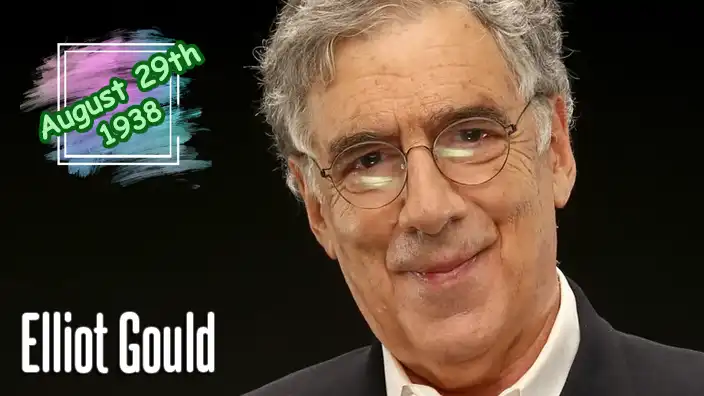
August 29, 1938, in Brooklyn, New York
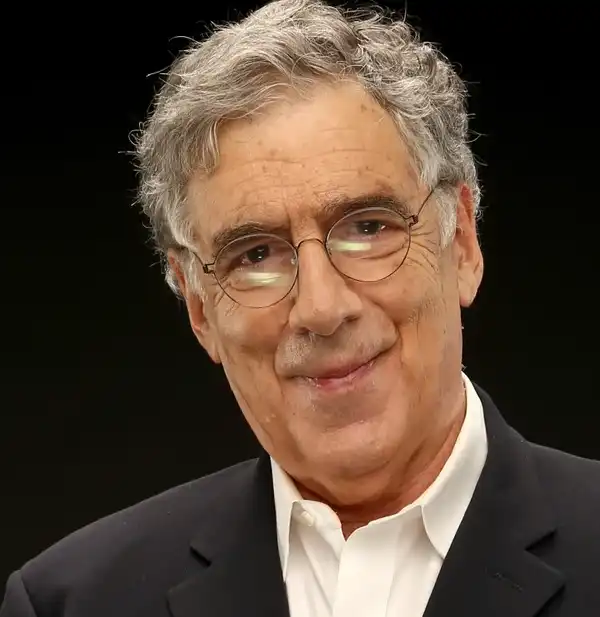
Elliot Gould is an American actor whose career has stretched across film, television, theater and several generations of popular culture. Born on August 29, 1938, in Brooklyn, New York, Gould became one of the defining faces of American cinema during the late 1960s and 1970s, earning an Academy Award nomination for Bob & Carol & Ted & Alice and starring in Robert Altman’s MASH*. Decades later, entirely new audiences came to know him as Jack Geller on Friends and as Reuben Tishkoff in the Ocean’s films.
Gould was born Elliot Goldstein to a Jewish family in Brooklyn. His mother worked in the artificial-flower business, while his father was involved in textiles. He became interested in performing while still young and attended the Professional Children’s School in Manhattan, an institution that allowed young performers to continue their education while pursuing careers in entertainment.
His early career developed in the theater. Gould appeared in Broadway productions and touring shows during the 1950s and 1960s, gradually establishing himself as a versatile performer capable of comedy and drama. One of the most important productions of his early career was the musical I Can Get It for You Wholesale, which opened on Broadway in 1962.
The production also starred Barbra Streisand, then at the beginning of her extraordinary career. Gould and Streisand married in 1963 and had a son, Jason Gould. Their marriage ended in divorce in 1971, but for several years they were one of the most prominent young couples in American entertainment.
Gould’s film career began expanding rapidly during the late 1960s. His major breakthrough came with Bob & Carol & Ted & Alice, released in 1969 and directed by Paul Mazursky. The satirical comedy examined changing attitudes toward marriage, sexuality and relationships during a period when American social conventions appeared to be undergoing renegotiation on an almost weekly basis.
Gould played Ted Henderson opposite Dyan Cannon, with Robert Culp and Natalie Wood playing their friends Bob and Carol. The film was funny, provocative and very much a product of its era, but Gould’s performance stood out because of his unusual ability to appear both intelligent and slightly overwhelmed by everything happening around him.
His work earned him an Academy Award nomination for Best Supporting Actor.
The success of Bob & Carol & Ted & Alice placed Gould at the center of what would become known as New Hollywood, the period when younger filmmakers and actors began moving American cinema away from older studio conventions toward more experimental, cynical and character-driven stories.
Then came MASH*.
Released in 1970 and directed by Robert Altman, the film was set during the Korean War but arrived while the Vietnam War was dominating American political and cultural life. Gould played Captain John McIntyre, better known as Trapper John, alongside Donald Sutherland as Hawkeye Pierce.
The two surgeons are highly skilled, deeply irreverent and almost pathologically resistant to military discipline. They operate on wounded soldiers under horrific circumstances and respond to the surrounding absurdity with jokes, pranks, alcohol and a general determination not to behave as though war makes any more sense simply because everyone is wearing uniforms.
Altman’s loose, overlapping style gave the film an unconventional rhythm, and Gould’s performance fit it perfectly. He delivered jokes without seeming to pause for them, contributing to the sense that the characters were simply living inside a chaotic environment rather than waiting for the screenplay to hand them punch lines.
MASH* became a huge commercial and critical success and later inspired the enormously popular television series. Although Gould did not play Trapper John on television, his performance helped establish the character for audiences and remained one of the defining roles of his career.
His collaboration with Robert Altman continued with The Long Goodbye in 1973, an unconventional adaptation of Raymond Chandler’s detective novel. Gould played private investigator Philip Marlowe, a role previously associated with performers including Humphrey Bogart.
Rather than imitate the traditional hard-boiled detective, Gould played Marlowe as a rumpled, sardonic outsider wandering through 1970s Los Angeles while apparently operating according to a moral code several decades out of date. The result confused some audiences at the time but was later reassessed as one of Altman’s most important films and one of Gould’s finest performances.
The character worked because Gould never tried to turn Marlowe into a conventional hero. He appeared tired, amused and mildly irritated by the modern world, yet beneath the sarcasm remained a stubborn loyalty to his own principles. It was a performance that became more highly regarded with time, which is usually a healthier fate than the reverse.
Gould also starred in Altman’s California Split in 1974 opposite George Segal. The film followed two gamblers whose friendship develops around casinos, cards, racetracks and the increasingly dangerous excitement of betting. Gould’s relaxed and improvisational style again fit naturally into Altman’s filmmaking.
During the 1970s he appeared in a wide variety of productions, including Little Murders, A Bridge Too Far, Capricorn One, The Silent Partner and The Lady Vanishes. He moved between comedy, drama, thrillers and ensemble films, maintaining a screen persona that was difficult to categorize neatly.
That unpredictability was part of his appeal. Gould was never a conventional leading man in the old Hollywood sense. He did not project polished authority or heroic certainty. Instead, he often looked as though he had wandered into the situation five minutes earlier and was still deciding whether any of it deserved to be taken seriously.
His career slowed somewhat during the 1980s, but Gould continued working steadily in film and television. Like many actors who became strongly identified with the New Hollywood era, he adapted to an industry that was changing rapidly around him.
Then, in the 1990s, another generation discovered Elliot Gould.
He began appearing on the hit television sitcom Friends as Jack Geller, father of Ross and Monica Geller. The role was recurring rather than regular, but Gould made a strong impression whenever Jack appeared.
Jack Geller was affectionate, enthusiastic and frequently capable of saying precisely the wrong thing at precisely the wrong time. Together with Christina Pickles as Judy Geller, Gould helped create one of television’s more entertaining sets of sitcom parents.
Jack often seemed unaware of just how awkward his comments could be, which made them considerably funnier. Gould played him with warmth rather than cruelty, allowing the character’s occasional insensitivity to feel like the product of a man whose internal editing system had retired years earlier.
His appearances on Friends introduced Gould to millions of younger viewers who had never seen MASH* or The Long Goodbye. For them, he was simply Ross and Monica’s father, occasionally entering a scene, delivering something inappropriate and leaving everyone else to deal with the consequences.
Another major later-career role arrived with Steven Soderbergh’s Ocean’s Eleven in 2001.
Gould played Reuben Tishkoff, a wealthy casino owner who helps finance Danny Ocean’s plan to rob three Las Vegas casinos simultaneously. The enormous ensemble included George Clooney, Brad Pitt, Matt Damon, Julia Roberts, Andy Garcia, Don Cheadle and Carl Reiner.
Reuben is eccentric, experienced and extremely knowledgeable about the casino business. Gould played him with flamboyant confidence, colorful clothing and the unmistakable attitude of a man who has already seen every bad idea Las Vegas can produce and is therefore perfectly qualified to fund one more.
He returned for Ocean’s Twelve in 2004, Ocean’s Thirteen in 2007 and later appeared in Ocean’s Eight in 2018, becoming one of the recurring links connecting the different installments of the franchise.
Gould continued working steadily across television and film during the following decades. His credits included appearances in series such as Ray Donovan, Grace and Frankie and other productions, demonstrating the longevity of a career that had begun before many of his later co-stars were born.
His appeal has always depended partly on his distinctive personality. Gould developed a screen presence that could be funny without obvious joke delivery, serious without becoming solemn and intelligent without appearing eager to prove it.
That quality made him particularly suited to the cultural mood of the late 1960s and 1970s. American movies during that period increasingly questioned authority, conventional morality and traditional ideas of heroism. Gould looked entirely at home in that environment because his characters rarely seemed convinced that authority knew what it was doing in the first place.
His career also illustrates how an actor can become associated with entirely different eras of entertainment. One audience remembers the nervous sexual politics of Bob & Carol & Ted & Alice. Another remembers Trapper John and Hawkeye creating chaos in MASH*. Film enthusiasts celebrate his Philip Marlowe in The Long Goodbye.
Then there are the people who hear the name Elliot Gould and immediately think, “Ross and Monica’s dad.”
All of them are correct.
Gould’s Academy Award nomination confirmed his standing early in his film career, but his longevity may be an even more impressive achievement. He survived the transition from Broadway to New Hollywood, from major studio films to television and eventually to the streaming era without becoming merely a nostalgic reminder of his earlier success.
He continued finding characters worth playing.
That is perhaps the defining feature of Elliot Gould’s career. He never required every role to make him the center of attention. Sometimes he was the star, sometimes an important supporting character and sometimes the wonderfully strange man who arrived long enough to make everyone else in the room uncomfortable.
More than half a century after MASH*, audiences continue discovering his work.
And somewhere, Jack Geller is probably still telling Monica an embarrassing story she specifically asked him never to repeat.