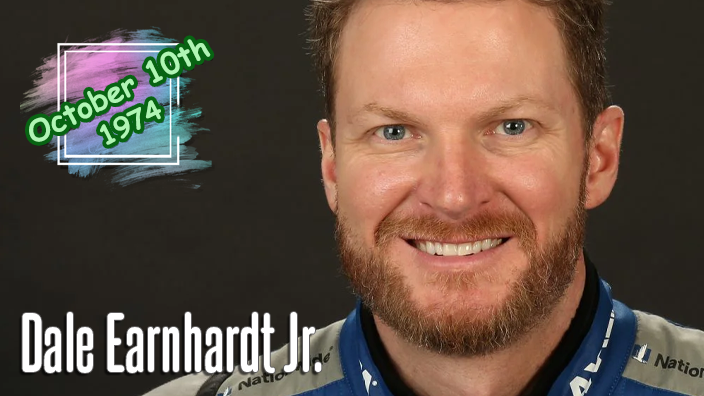
October 10, 1974, in Concord, North Carolina
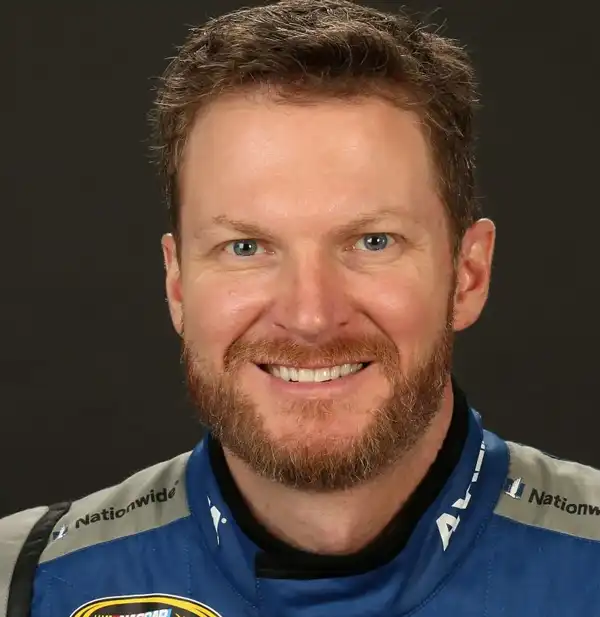
Ralph Dale Earnhardt Jr., born October 10, 1974, in Concord, North Carolina, is an American former full-time professional stock car racing driver, NASCAR team owner, television analyst, author, and media personality. Known affectionately as Junior, Little E, and Junebug, he belongs to one of the most recognizable families in American motorsports. His father, Dale Earnhardt Sr., was a seven-time NASCAR Cup Series champion whose aggressive driving earned him the nickname "The Intimidator." His grandfather, Ralph Earnhardt, was also an accomplished stock car racer. With that family history, young Dale was probably more familiar with the smell of motor oil than most children were with the smell of freshly sharpened pencils. Nevertheless, he would eventually establish an identity far beyond his famous surname, becoming one of NASCAR's most popular drivers and an influential figure in the sport's development.
Growing up in North Carolina, Earnhardt Jr. experienced both the advantages and expectations of belonging to a racing dynasty. His father was already a major figure in stock car racing, but Junior's path into the sport was not simply a matter of receiving the keys to a championship-winning Chevrolet. He studied automotive technology at Mitchell Community College and worked as a mechanic at his father's Chevrolet dealership, developing practical knowledge of the machinery that would eventually carry him around America's most famous racetracks. He began racing in the street stock division at Concord Speedway, driving modest equipment and learning the fundamentals of competition. According to accounts of his early career, he and his half-brother Kerry sold a go-kart to help finance the purchase of an inexpensive race car. It was hardly a glamorous beginning, but it provided the sort of education that cannot be acquired by watching races from a comfortable grandstand.
Earnhardt Jr. gradually progressed through the lower levels of stock car racing, competing in Late Model events before advancing into NASCAR's Busch Series, now known as the O'Reilly Auto Parts Series. His breakthrough came in 1998 when he won the series championship while driving for Dale Earnhardt Inc., the racing organization established by his father. He repeated the achievement in 1999, collecting 13 victories across those two championship seasons. The accomplishments made him the first third-generation NASCAR champion, following his father and grandfather into the record books. They also demonstrated that his success was based on more than an impressive family name. Winning one championship might invite suggestions of good fortune; winning consecutive titles makes those suggestions considerably harder to defend.
His transition into NASCAR's premier Cup Series began with selected appearances in 1999 before he competed full-time in 2000. Earnhardt Jr. quickly established himself as a serious contender, earning his first Cup Series victory at Texas Motor Speedway in just his 12th career start. Another victory followed at Richmond, and he became the first rookie to win NASCAR's prestigious All-Star Race. Driving the famous No. 8 Chevrolet, he combined an aggressive racing style with a relaxed, approachable personality that appealed to longtime NASCAR supporters and newcomers alike. His performances attracted enormous attention, particularly among younger fans who saw in Junior a driver who respected the sport's traditions without behaving as though every interview required a formal speech and a freshly pressed suit.
The 2001 NASCAR season brought unimaginable tragedy when Dale Earnhardt Sr. was killed in a crash on the final lap of the Daytona 500. His death shocked the motorsports community and placed his son under an extraordinary emotional spotlight. Earnhardt Jr. suddenly found himself grieving his father while millions of fans looked to him as a connection to one of racing's greatest personalities. Just five months later, he returned to Daytona International Speedway and won the Pepsi 400, producing one of the most emotional victories in NASCAR history. The celebration, which included his teammate Michael Waltrip, became an enduring image of the sport's ability to unite competitors and spectators during difficult times. Although the victory could never diminish the family's loss, it provided a moment of celebration for a racing community still struggling to come to terms with the tragedy.
Earnhardt Jr. developed a particular reputation for his skill at Daytona International Speedway and Talladega Superspeedway, two tracks where high-speed drafting and precise positioning are essential. He demonstrated an exceptional ability to understand the movement of competing cars, using the aerodynamic effects of closely packed racing to advance through the field. His accomplishments included four consecutive Cup Series victories at Talladega between 2001 and 2003, an extraordinary achievement at a circuit notorious for unpredictable finishes. At speeds approaching 200 miles per hour, with competitors often separated by inches, success demanded concentration, courage, and a willingness to trust both machinery and fellow drivers. It was a remarkable environment in which to build a reputation, particularly considering that most motorists become nervous when another vehicle follows them too closely through a supermarket parking lot.
One of Earnhardt Jr.'s defining career moments arrived in 2004 when he won the Daytona 500, NASCAR's most celebrated race. The victory came six years after his father had finally captured the same prize following years of frustrating attempts. For Junior, winning at Daytona carried personal significance as well as professional prestige, reinforcing the family's extraordinary connection to the Florida speedway. He added a second Daytona 500 victory in 2014, becoming one of a select group of drivers to win the event multiple times. Across his Cup Series career, he recorded 26 victories, including ten at Daytona and Talladega combined. Although a Cup Series championship ultimately eluded him, his achievements established him as one of the outstanding superspeedway competitors of his generation.
A major turning point came when Earnhardt Jr. announced his departure from Dale Earnhardt Inc. in 2007. The decision attracted considerable attention because of his family's association with the organization, but he believed a change was necessary for his professional future. He joined Hendrick Motorsports in 2008, driving the No. 88 Chevrolet alongside some of NASCAR's leading competitors. His early years with the team included difficult stretches and disappointing results, demonstrating that even celebrated drivers cannot simply order victories like replacement tires. However, his fortunes improved as he developed stronger relationships with his crew and benefited from changes in the team's technical organization. His resurgence included victories at Michigan International Speedway, Pocono Raceway, and Daytona, while his 2014 season produced four Cup Series wins.
Throughout his racing career, Earnhardt Jr. maintained an extraordinary connection with NASCAR supporters. He received the sport's Most Popular Driver Award for 15 consecutive years, from 2003 through 2017, an achievement reflecting his appeal beyond race results. Fans appreciated his willingness to speak openly, acknowledge mistakes, and discuss the frustrations that accompanied professional competition. Unlike drivers who cultivated an intimidating public image, Junior frequently appeared more comfortable presenting himself as an ordinary fellow who happened to drive extraordinarily fast automobiles. His popularity also benefited NASCAR commercially, attracting viewers, sponsors, and merchandise sales during a period when the sport was expanding its national audience. His familiar racing numbers, particularly 8 and 88, became recognizable symbols among stock car racing enthusiasts.
Despite his achievements, Earnhardt Jr.'s career was not without physical challenges. Repeated concussions and their lingering symptoms forced him to reconsider the risks associated with racing. He missed significant portions of the 2016 season while undergoing medical evaluation and recovery, later speaking publicly about his experiences with head injuries. His willingness to discuss the issue helped encourage greater awareness of concussion management in motorsports, where competitors had historically been reluctant to acknowledge injuries that might keep them out of their cars. In 2017, he announced that he would retire from full-time Cup Series competition at the conclusion of the season. The decision allowed him to prioritize his long-term health and family while remaining involved in the sport he loved. For a man accustomed to traveling at breathtaking speeds, choosing when to slow down may have been among his most important decisions.
Retirement from full-time Cup racing did not mean Earnhardt Jr. abandoned competition altogether. He continued making occasional appearances in NASCAR's secondary national series and participating in selected Late Model races, maintaining a connection with the grassroots racing culture that had shaped his early career. These appearances were generally undertaken for enjoyment rather than as part of a full-time championship campaign. His continued enthusiasm for smaller racing venues also reflected his appreciation for the mechanics, drivers, and local supporters who sustain stock car racing beyond its nationally televised events. While some retired athletes disappear into private life, Earnhardt Jr. has remained particularly visible, proving that hanging up a full-time racing helmet does not necessarily require leaving it permanently on the shelf.
His involvement in motorsports extends well beyond driving through JR Motorsports, the racing organization he developed into a successful NASCAR team. Working closely with his sister, Kelley Earnhardt Miller, and other experienced racing professionals, he helped establish an organization known for developing talented drivers and competing for championships. JR Motorsports has earned multiple NASCAR secondary-series championships, including titles associated with Chase Elliott, William Byron, Tyler Reddick, and Justin Allgaier. The organization has provided opportunities for emerging competitors while strengthening Earnhardt Jr.'s reputation as a businessman and team owner. Managing a racing team requires skills quite different from those needed behind the wheel, including sponsorship negotiations, personnel management, technical planning, and the occasional difficult conversation about why a perfectly good race car has returned to the garage looking like a collection of spare parts.
Earnhardt Jr. also developed a successful broadcasting career, joining NBC Sports as a NASCAR analyst following his retirement from full-time competition. His knowledge of racing strategy, driver behavior, and the technical demands of competition made him a valuable commentator. Rather than relying exclusively on technical terminology, he developed a conversational approach that helped viewers understand what was happening on the track and why particular decisions mattered. His broadcasting work subsequently expanded through partnerships with other television networks, including Amazon Prime Video and TNT Sports. The transition from competitor to commentator allowed him to remain involved in major racing events while offering insights informed by decades of personal experience. There is, after all, a considerable difference between describing a driver taking a corner at tremendous speed and remembering exactly what that corner feels like from inside the car.
Beyond television, Earnhardt Jr. established himself as an influential voice in motorsports media through The Dale Jr. Download, a popular podcast featuring interviews, personal stories, and discussions about NASCAR history and contemporary racing. The program has welcomed numerous drivers, team owners, mechanics, and other personalities, often exploring subjects that traditional race broadcasts have limited time to address. His Dirty Mo Media company expanded this work into a broader collection of podcasts and original productions. Earnhardt Jr.'s enthusiasm for preserving racing history has become a particularly important feature of his media career, helping introduce younger audiences to personalities and events that shaped NASCAR long before modern television coverage and social media transformed the sport.
His interest in racing history also inspired Lost Speedways, a documentary television series exploring abandoned and forgotten racetracks across the United States. As host and executive producer, Earnhardt Jr. investigated the stories behind once-popular venues that had fallen into disuse, examining their significance to local communities and American motorsports. The series combined historical research, interviews, and exploration, offering viewers an opportunity to discover a side of racing that seldom appears during major championship broadcasts. His screen credits also include appearances in productions such as Cars, Talladega Nights: The Ballad of Ricky Bobby, and Herbie: Fully Loaded, along with documentary projects including Unrivaled: Earnhardt vs. Gordon. His IMDb credits encompass acting, producing, and appearances as himself, demonstrating that his professional life has traveled well beyond the confines of a racing cockpit.
Earnhardt Jr. has also become a published author, using his experiences to explore the personal and professional challenges of motorsports. His books include Driver #8, written with Jade Gurss, and Racing to the Finish: My Story, which examines his racing career and experiences with concussions. The latter provided readers with a candid account of the difficulties associated with head injuries and his decision to retire from full-time competition. He subsequently entered children's publishing with the Buster series, featuring stories intended to introduce younger readers to racing, perseverance, and teamwork. Writing for children represents a rather different challenge from negotiating traffic at Talladega, although both activities can involve considerable noise, unexpected developments, and the occasional loss of control.
Away from his professional commitments, Earnhardt Jr. has built a family life with his wife, Amy Reimann, whom he married on December 31, 2016. The couple have two daughters, Isla and Nicole, and live in North Carolina. His sister Kelley has remained an important figure in his business endeavors, particularly through her leadership role at JR Motorsports. Earnhardt Jr. has frequently expressed his appreciation for family relationships and the importance of balancing professional ambitions with personal responsibilities. His public personality combines an enthusiasm for racing with interests in automotive restoration, historical preservation, and collecting memorabilia. These pursuits reflect a man who appreciates both the technological development of modern racing and the mechanical ingenuity of earlier generations.
His contributions to NASCAR received formal recognition with his selection for the NASCAR Hall of Fame's Class of 2021, whose induction ceremony was held in January 2022. The honor acknowledged his achievements as a driver, his popularity among fans, and his broader influence on motorsports. He was also named among NASCAR's 75 Greatest Drivers in 2023, reinforcing his place in the sport's history. Although his father remains associated with seven Cup Series championships and an intimidating competitive reputation, Junior's legacy has developed along a different path. His combination of racing success, media influence, business leadership, and historical preservation has made him one of the sport's most recognizable ambassadors.
Dale Earnhardt Jr.'s career illustrates that success in motorsports cannot always be measured exclusively by championship trophies. His 26 Cup Series victories, two Daytona 500 triumphs, consecutive Busch Series championships, and extraordinary popularity would be enough to secure a distinguished place in NASCAR history. Yet his continuing work as a team owner, broadcaster, author, and advocate for racing heritage has expanded that influence well beyond his driving years. He inherited one of the most famous names in American racing, but he earned his own reputation through determination, personality, and an enduring enthusiasm for the sport. And while he no longer spends every Sunday trying to reach the checkered flag before everybody else, Dale Earnhardt Jr. has discovered that there are plenty of ways to remain in the fast lane without actually having to drive in it.