October 10, 1946, in Redditch, England
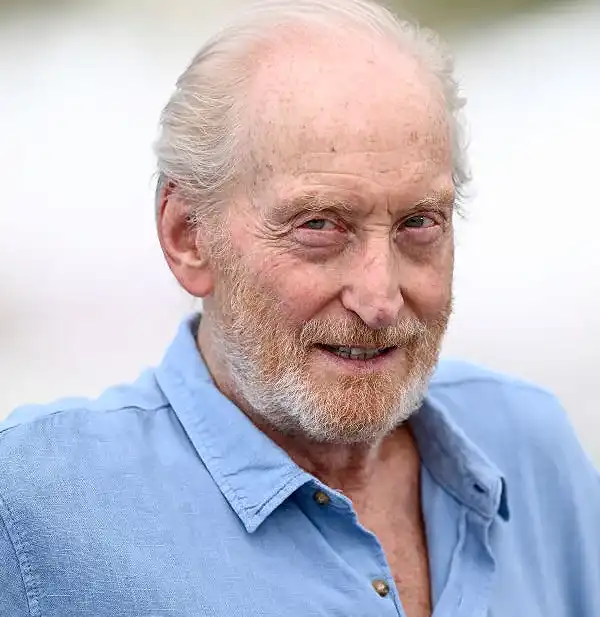
Walter Charles Dance, born October 10, 1946, in Redditch, Worcestershire, England, is a distinguished English actor, screenwriter, and film director whose remarkable career has encompassed classical theater, historical drama, Hollywood blockbusters, and internationally successful television productions. Widely recognized for his portrayal of the formidable Tywin Lannister in HBO's Game of Thrones, Dance has developed a reputation for playing powerful, intelligent, and occasionally thoroughly unpleasant characters. His distinctive voice, imposing height, precise delivery, and commanding screen presence have made him a natural choice for aristocrats, military officers, political leaders, and villains who prefer calculated intimidation to unnecessary shouting. Nevertheless, his extensive body of work demonstrates a versatility that reaches far beyond the stern authority figures for which he is most frequently celebrated.
Dance's childhood was marked by personal challenges that contrasted sharply with the privileged backgrounds of many characters he would eventually portray. His father, Walter Dance, was an electrical engineer who died when Charles was four, leaving his mother, Eleanor, to raise her family under difficult financial circumstances. The family subsequently settled in Plymouth, Devon, where Dance developed an interest in art and design. His mother worked hard to support the household, and the experience of growing up without substantial financial advantages helped shape his outlook. Although he would later become particularly convincing as wealthy aristocrats accustomed to issuing orders, his own beginnings were considerably more modest. There were no ancestral castles, obedient servants, or family fortunes waiting to be inherited, although the future actor would eventually portray enough aristocrats to furnish several impressive country estates.
Initially, Dance did not intend to become an actor. He studied graphic design and photography at Plymouth College of Art and later at Leicester College of Art, preparing for a career in the visual arts. His artistic education developed an appreciation for composition, presentation, and visual storytelling, skills that would prove useful when he eventually moved into directing. During this period, however, he became increasingly interested in theatrical performance and began participating in amateur productions. His enthusiasm for acting gradually overtook his original professional ambitions, prompting him to pursue opportunities in repertory theater. It was a significant change of direction, particularly for someone who had already invested considerable time in formal artistic training. Fortunately, audiences would eventually benefit from his decision to exchange drawing boards for scripts, although the graphic design profession undoubtedly lost a man capable of making even a typeface look intimidating.
Dance began his professional acting career in the early 1970s, gaining experience through regional theater productions and developing the discipline required for classical performance. He joined the prestigious Royal Shakespeare Company in 1975, becoming part of one of Britain's most respected theatrical institutions. Working with the company allowed him to perform in productions of Shakespeare's plays, including Hamlet, Richard III, As You Like It, and Henry V. Classical theater demanded precise diction, physical control, emotional range, and an understanding of complex language, all qualities that would later distinguish his film and television performances. His theatrical training also helped develop the extraordinary vocal authority that became one of his trademarks. While some performers require dramatic music and elaborate lighting to command attention, Dance learned how to achieve much the same effect simply by speaking.
His early television appearances included a role in the BBC mystery series Father Brown in 1974, followed by other British productions that gradually expanded his professional experience. He made his feature film debut in the James Bond adventure For Your Eyes Only, starring Roger Moore as the famous British secret agent. Dance played Claus, a henchman working for the film's principal antagonist. Although the part was relatively small, appearing in a major international production represented an important step in his developing screen career. The Bond franchise was already famous for its elaborate action sequences, exotic locations, and memorable villains, providing a suitable introduction for an actor who would eventually become exceptionally accomplished at portraying dangerous men. His character's unfortunate encounter with a speargun also demonstrated that employment in a Bond villain's organization rarely includes a generous retirement package.
Dance's major television breakthrough arrived in 1984 when he portrayed Guy Perron in The Jewel in the Crown, an acclaimed British miniseries adapted from Paul Scott's Raj Quartet novels. Set during the final years of British colonial rule in India, the production explored political tensions, cultural divisions, personal relationships, and the collapse of an imperial system. Dance's performance as Perron, a thoughtful British military officer observing the changing political landscape, attracted widespread critical attention and introduced him to a much larger audience. The series became a major international success, earning recognition for its writing, performances, and historical atmosphere. For Dance, it represented the transition from a respected stage performer to a prominent television actor capable of carrying substantial dramatic responsibilities.
Following the success of The Jewel in the Crown, Dance appeared in several significant films during the 1980s, demonstrating his ability to portray both romantic leading men and morally complicated personalities. In Plenty, he appeared alongside Meryl Streep in a drama exploring the emotional consequences of wartime experiences and postwar disillusionment. He subsequently portrayed the sinister Sardo Numspa in The Golden Child, starring Eddie Murphy. The film combined supernatural fantasy, martial arts, and comedy, with Dance providing a suitably menacing antagonist opposite Murphy's energetic comic performance. His character's sinister elegance helped establish a screen persona that Hollywood would repeatedly revisit. Dance demonstrated that a villain need not shout, snarl, or destroy the furniture to appear dangerous; a measured voice and an expression of profound disappointment could be considerably more unsettling.
His work during the same period included White Mischief, a historical drama based on a notorious murder investigation among wealthy British expatriates in colonial Kenya. Dance portrayed Josslyn Hay, Earl of Erroll, a charismatic aristocrat whose complicated romantic relationships contribute to the film's central mystery. The production provided another opportunity to explore the darker side of privilege, presenting characters whose wealth and social standing did little to improve their judgment. He also appeared in Good Morning, Babylon and Pascali's Island, continuing to establish himself as an actor particularly effective in historical settings. His refined appearance and precise manner of speaking made him a natural fit for period dramas, although his characters were frequently the sort of gentlemen whose invitations to dinner might be best declined.
Despite his growing success in film and television, Dance continued returning to the stage. His theatrical performances included the demanding title role in Shakespeare's Coriolanus, a tragedy centered on a proud Roman military leader whose uncompromising personality contributes to his downfall. The character's combination of authority, ambition, and emotional rigidity suited Dance's developing strengths as a performer. He also portrayed C. S. Lewis in a stage revival of Shadowlands, earning recognition for his sensitive depiction of the writer's relationship with Joy Davidman and his struggle with grief. The performance demonstrated a more vulnerable dimension of Dance's acting, reminding audiences that his considerable talent extended beyond cold aristocrats and calculating villains. Indeed, the ability to portray emotional tenderness convincingly made his more intimidating characters all the more effective.
During the 1990s, Dance continued appearing in major international productions, including Alien 3, directed by David Fincher. He portrayed Dr. Jonathan Clemens, a prison physician who develops a relationship with Ellen Ripley, played by Sigourney Weaver. Unlike many of his more authoritarian characters, Clemens displayed compassion, intelligence, and personal vulnerability, providing an important emotional presence within the film's bleak science-fiction setting. His performance offered a welcome contrast to the hostility and suspicion surrounding Ripley as she confronted another deadly extraterrestrial creature. Unfortunately, the Alien franchise has never been particularly generous toward sympathetic supporting characters, and professional medical qualifications offer surprisingly little protection against an aggressive extraterrestrial organism.
Dance returned to more familiar villainous territory in Last Action Hero, starring Arnold Schwarzenegger. He played Benedict, a ruthless professional assassin who becomes aware that he exists within a fictional action movie. The film's unusual premise allowed Dance to combine genuine menace with self-aware comedy, particularly as Benedict discovered that the rules governing violence in the real world differed considerably from those of Hollywood action films. His performance became one of the production's most memorable elements, demonstrating his ability to deliver humor without abandoning the character's threatening personality. Benedict's calm, calculated approach to villainy contrasted effectively with the film's exaggerated action sequences, proving that a sophisticated criminal could remain thoroughly unpleasant even while participating in a story designed to parody the conventions of his own profession.
His later film credits included Michael Collins, Hilary and Jackie, and Gosford Park, directed by Robert Altman. In Gosford Park, Dance portrayed Lord Raymond Stockbridge, one of several wealthy guests attending a country-house gathering that becomes the setting for a murder investigation. The film examined British class divisions, social conventions, and the complicated relationships between aristocratic employers and their servants. Its distinguished ensemble cast included Maggie Smith, Helen Mirren, Michael Gambon, Kristin Scott Thomas, and many other celebrated performers. Dance's natural command of period dialogue and aristocratic mannerisms made him an ideal participant in the production, where social standing was carefully maintained even as murder threatened to interrupt the weekend's entertainment.
In 2004, Dance expanded his creative career by writing and directing Ladies in Lavender, a sensitive drama starring Judi Dench and Maggie Smith as two elderly sisters living in a coastal Cornish village during the 1930s. Their peaceful existence changes when they discover a young Polish violinist washed ashore following a shipwreck. The film explores affection, loneliness, jealousy, and the unexpected emotional consequences of welcoming a stranger into an established household. Dance also served as an executive producer, taking responsibility for several aspects of the production beyond the performances themselves. His directorial debut demonstrated an appreciation for restrained storytelling and nuanced characterization, offering a marked contrast to the intimidating personalities he frequently portrayed on screen. It also confirmed that a man capable of playing some of cinema's most disagreeable individuals could create a film filled with warmth and compassion.
Dance received further critical recognition for his portrayal of Mr. Tulkinghorn in the BBC's 2005 adaptation of Charles Dickens's Bleak House. Tulkinghorn is a secretive, calculating lawyer whose knowledge of other people's private affairs gives him considerable power over their lives. Dance captured the character's cold professionalism and quiet menace with remarkable precision, creating a figure who rarely needed to raise his voice to make others uncomfortable. His performance earned a Primetime Emmy Award nomination, adding international recognition to his already distinguished career. The role also reinforced his reputation as an exceptionally effective interpreter of literary villains, particularly those whose outward respectability conceals questionable motives. Tulkinghorn's ability to make legal paperwork seem threatening was particularly impressive, considering that most people already regard legal paperwork as sufficiently frightening without additional assistance.
His television work during this period also included Fingersmith, The Phantom of the Opera, Foyle's War, and Terry Pratchett's Going Postal, in which he portrayed Lord Havelock Vetinari, the calculating ruler of the fictional city of Ankh-Morpork. Vetinari is a master political strategist who maintains order through intelligence, manipulation, and a remarkably sophisticated understanding of human weakness. The character proved an excellent match for Dance's controlled performance style, allowing him to combine dry humor with an unsettling sense of authority. His portrayal was particularly appreciated by admirers of Terry Pratchett's Discworld novels, who recognized the importance of presenting Vetinari as both intellectually formidable and quietly amusing. It was another role in which Dance demonstrated that the most dangerous person in the room is not necessarily the one carrying the largest weapon.
The defining television role of Dance's international career arrived in 2011 when he joined HBO's Game of Thrones as Tywin Lannister, the ruthless patriarch of one of the wealthiest and most politically influential families in the fictional continent of Westeros. Based on George R. R. Martin's A Song of Ice and Fire novels, the series combined medieval-inspired political intrigue, warfare, family rivalries, and supernatural fantasy. Tywin served as the head of House Lannister, a man whose determination to preserve his family's power frequently outweighed considerations of affection, morality, or personal happiness. Dance's performance transformed the character into one of the series' most formidable figures, establishing him as a calculating strategist capable of dominating a conversation without drawing a sword.
Tywin Lannister's relationships with his children provided some of the series' most compelling dramatic conflicts. His treatment of Tyrion, portrayed by Peter Dinklage, revealed deep prejudice and resentment, while his expectations of Jaime and Cersei demonstrated an obsession with family reputation and political advantage. Dance portrayed these relationships with extraordinary restraint, allowing small changes in expression and vocal emphasis to communicate contempt, disappointment, or barely concealed anger. His scenes with Dinklage became particularly memorable, as the two actors explored the emotional damage inflicted by a father who valued dynastic ambition above genuine parental affection. Tywin might have been a brilliant political strategist, but his parenting methods would have caused considerable concern at the average school conference.
One of the most striking aspects of Dance's portrayal was his ability to make Tywin appear dangerous even when surrounded by armed soldiers and powerful political rivals. The character's authority came not from physical violence alone but from his understanding of power, loyalty, fear, and the consequences of disobedience. Dance's theatrical background proved invaluable in scenes dominated by dialogue, particularly when Tywin delivered carefully measured warnings or exposed the weaknesses of his opponents. His interactions with Arya Stark, portrayed by Maisie Williams, offered a different perspective on the character, revealing moments of curiosity and unexpected warmth beneath his formidable exterior. These scenes added complexity to a man who might otherwise have appeared simply cruel, demonstrating Dance's ability to suggest hidden emotional dimensions without undermining Tywin's intimidating reputation.
Tywin's storyline reached its dramatic conclusion during the fourth season, when years of manipulation and family conflict culminated in a confrontation with Tyrion. The character's death became one of the series' most memorable moments, partly because of the extraordinary contrast between his lifelong obsession with dignity and the undignified circumstances of his final appearance. For a man who had devoted himself to preserving the honor and reputation of House Lannister, the ending was spectacularly inconvenient. Dance's performance remained so influential that Tywin continued to be regarded as one of the defining characters of Game of Thrones long after his departure from the central storyline. His portrayal demonstrated how a skilled actor could turn a fictional nobleman into a figure whose presence shaped an entire political landscape.
The worldwide success of Game of Thrones introduced Dance to a new generation of viewers, many of whom subsequently discovered his extensive earlier work. Although he had already enjoyed decades of professional success, the enormous popularity of the series transformed him into an internationally recognizable television personality. His distinctive appearance and commanding delivery became familiar through interviews, promotional appearances, and popular culture references. The character of Tywin Lannister also reinforced the enduring appeal of carefully written antagonists whose motivations are understandable even when their actions are morally indefensible. Dance's contribution was essential to that complexity, providing the character with intelligence, conviction, and a sense of personal history that made him far more interesting than a conventional villain.
Following Game of Thrones, Dance continued appearing in major productions, including The Imitation Game, starring Benedict Cumberbatch as mathematician and codebreaker Alan Turing. Dance portrayed Commander Alastair Denniston, a senior military officer overseeing aspects of Britain's wartime codebreaking operations at Bletchley Park. The film dramatized the efforts to decipher encrypted German communications during the Second World War, highlighting the extraordinary intellectual achievements of Turing and his colleagues. Dance's character provided institutional resistance to Turing's unconventional methods, creating tension between military authority and scientific innovation. Although the film took dramatic liberties with some historical relationships, Dance's performance effectively represented the rigid administrative attitudes that could complicate ambitious wartime projects.
His film appearances also included Dracula Untold, in which he portrayed the Master Vampire, an ancient supernatural being whose powers become central to the story. The role returned him to the territory of sinister fantasy, although this particular character required considerably more elaborate makeup and supernatural menace than the average aristocratic villain. He also appeared in Godzilla: King of the Monsters, portraying Colonel Alan Jonah, a former British Army officer associated with an organization seeking to exploit enormous prehistoric creatures. Once again, Dance found himself involved in a situation where ordinary human authority was unlikely to prove sufficient. Ordering a room full of soldiers to remain silent is one thing; attempting to manage a radioactive monster capable of destroying cities is quite another.
Another major television achievement came when Dance portrayed Lord Louis Mountbatten in the third and fourth seasons of Netflix's The Crown. Mountbatten was a prominent British naval officer, statesman, and member of the extended royal family whose influence extended through several decades of British history. Dance's portrayal captured the character's military bearing, aristocratic confidence, and complicated relationships with members of the royal household, particularly Prince Charles. His performance earned a Primetime Emmy Award nomination, further demonstrating his ability to bring historical personalities to life. The role also presented an interesting contrast with Tywin Lannister: both men were influential patriarchal figures with strong opinions about family responsibility, although Mountbatten operated within the British monarchy rather than a fictional kingdom where political disagreements frequently ended with somebody losing their head.
Dance's later work included Mank, directed by David Fincher, in which he portrayed newspaper magnate William Randolph Hearst. The film explored the Hollywood environment surrounding screenwriter Herman J. Mankiewicz and the creation of Citizen Kane. Dance's portrayal of Hearst emphasized the enormous influence wielded by a wealthy media proprietor whose relationships with Hollywood personalities were shaped by power, ambition, and personal loyalty. The production's black-and-white cinematography and period setting allowed Dance to inhabit another historically significant figure, continuing his long association with characters whose authority extends far beyond their immediate surroundings.
His extensive filmography has also included The King's Man, the political satire Rumours, and numerous independent and international productions. These projects illustrate his continued willingness to explore different genres rather than limiting himself to prestigious historical dramas. In Rumours, he joined an ensemble portraying political leaders attending a fictional international summit that descends into increasingly bizarre circumstances. The film combined political satire, absurdist comedy, and horror, providing another opportunity for Dance to employ his distinguished appearance in a setting where dignity becomes progressively harder to maintain. His participation in such unconventional productions reflects an actor who remains interested in creative challenges and is evidently not afraid to appear ridiculous when the material requires it.
Beyond his professional achievements, Dance has experienced the ordinary complexities of family relationships and personal change. He married sculptor Joanna Haythorn in 1970, and the couple had two children, Oliver and Rebecca, before their marriage ended in divorce in 2004. He later welcomed a daughter, Rose, with artist Eleanor Boorman. Although his personal relationships have occasionally attracted media attention, Dance has generally maintained a degree of privacy surrounding his family life. His public interviews often reveal a dry sense of humor and a willingness to discuss the realities of acting without excessive self-importance. This relaxed personality contrasts amusingly with the stern and intimidating characters he frequently portrays, suggesting that audiences should not automatically assume every actor who plays a ruthless aristocrat behaves like one when ordering breakfast.
Dance's contributions to British drama received formal recognition in 2006 when he was appointed an Officer of the Order of the British Empire, commonly abbreviated OBE, for services to drama. The honor acknowledged his achievements across theater, film, and television, recognizing a career that had already established him among Britain's most respected performers. His professional accomplishments also include nominations for major television awards and recognition for ensemble performances in acclaimed productions. Nevertheless, his enduring reputation rests primarily on the quality and consistency of his work rather than the number of trophies displayed on a shelf. Few actors have maintained such a recognizable screen presence across so many decades while continuing to move comfortably between classical theater, literary adaptations, Hollywood action films, and contemporary television.
One of the most distinctive features of Dance's acting is his remarkable economy of expression. Where other performers might rely on exaggerated gestures or raised voices, he frequently communicates complex emotions through controlled movements, subtle changes in tone, and carefully timed pauses. His classical training provides the foundation for this approach, allowing him to deliver complicated dialogue with clarity and conviction. His deep, resonant voice has become particularly recognizable, lending authority to characters even before their intentions become clear. This combination of physical presence and vocal precision has made him exceptionally effective at portraying individuals accustomed to power, although it has occasionally encouraged audiences to overlook his considerable talent for tenderness, vulnerability, and comedy.
Charles Dance's career represents an extraordinary journey from modest beginnings in Worcestershire to international recognition as one of Britain's most distinguished screen performers. His work with the Royal Shakespeare Company established a strong theatrical foundation, while productions such as The Jewel in the Crown, The Golden Child, Bleak House, Game of Thrones, The Imitation Game, and The Crown demonstrated his remarkable versatility. As an actor, writer, and director, he has contributed to an impressive range of stories, creating memorable characters whose intelligence, authority, and emotional complexity continue to captivate audiences. Although Tywin Lannister may remain his most widely recognized role, Charles Dance's professional legacy extends far beyond the walls of King's Landing. And if there is one lesson audiences have learned from watching him, it is that a perfectly tailored suit, impeccable manners, and a magnificent speaking voice are no guarantee that the gentleman addressing you has honorable intentions.