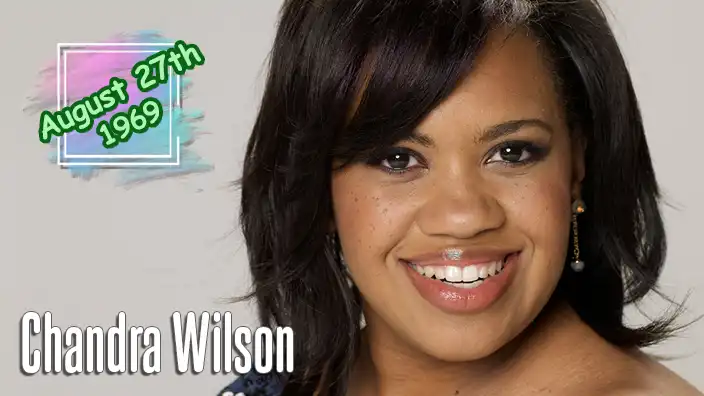
August 27, 1969, in Houston, Texas

Chandra Danette Wilson was born on August 27, 1969, in Houston, Texas, and was raised by her mother, Wilma Bradshaw Allen. Her interest in performing appeared extraordinarily early. Rather than waiting for childhood to get properly underway, Wilson began participating in dance, acting and performance activities when she was only a few years old. Her mother kept her involved in structured activities throughout childhood, helping develop the discipline that would later become important during a career requiring years of auditions, stage performances and television work before widespread fame finally arrived.
Wilson began performing with Houston's Theatre Under the Stars at the age of five and attended the organization's Humphreys School of Musical Theatre. She subsequently attended Houston's High School for the Performing and Visual Arts, an institution that has produced numerous successful performers. By the time she reached adulthood, acting was not a vague possibility or a glamorous fantasy. It was already something she had spent years learning as a craft.
After high school, Wilson moved to New York and attended the Tisch School of the Arts at New York University, earning a Bachelor of Fine Arts degree in drama in 1991. Her formal training included work at the Lee Strasberg Theatre & Film Institute, giving her a substantial theatrical foundation before she entered the professional acting world.
That professional world did not immediately greet her with fame, enormous salaries and a private dressing room.
Wilson built her early career primarily on the stage, appearing in New York theater and Broadway productions while also seeking film and television roles. She appeared in productions including The Good Times Are Killing Me, for which she received a Theatre World Award, and later accumulated Broadway credits in shows including On the Town, Avenue Q and Caroline, or Change.
Her theatrical background would remain an important part of her career even after television made her famous. Stage acting requires consistency, projection, timing and the ability to maintain a performance without somebody yelling "cut" and allowing everyone another attempt. Those skills translated particularly well to Miranda Bailey, a character who could silence an entire hospital corridor with a look suggesting that everybody present had just disappointed her personally.
Television work arrived gradually. Wilson appeared in guest roles on programs including The Cosby Show, Law & Order and The Sopranos, as well as other television productions. She also had film appearances, including a small role in the 1993 drama Philadelphia, starring Tom Hanks and Denzel Washington.
But acting jobs remained inconsistent, and Wilson faced the financial reality familiar to many professional performers: talent does not necessarily arrive with a regular paycheck.
For years, she maintained employment outside acting. Most famously, Wilson worked at Deutsche Bank in New York, where she held a job processing documents and continued working even while pursuing her theatrical and television career. She reportedly remained there for years, maintaining the sensible philosophy that rent generally prefers cash to promising reviews.
Then, in 2005, everything changed.
Wilson was cast as Dr. Miranda Bailey in a new ABC medical drama called Grey's Anatomy, created by Shonda Rhimes. The series centered initially on Meredith Grey, played by Ellen Pompeo, and a group of surgical interns beginning their careers at Seattle Grace Hospital.
Bailey was their resident supervisor.
And Bailey was terrifying.
During the show's early episodes, the interns referred to her as "The Nazi" because of her demanding personality, uncompromising standards and complete lack of interest in excuses. She was considerably shorter than many of the doctors she supervised, but the difference in height became irrelevant approximately three seconds after Bailey began speaking.
Wilson immediately made the character memorable.
Miranda Bailey could be stern, sarcastic and intimidating, but Wilson never allowed her to become a simple television caricature of the difficult boss. Bailey genuinely cared about medicine, her patients and the young doctors she trained. Her harshness frequently came from the knowledge that mistakes in a hospital could kill people, making excellence something more important than professional pride.
As Grey's Anatomy developed, audiences discovered increasingly complicated layers beneath Bailey's formidable exterior. She became a mentor, surgeon, wife, mother and eventually one of the hospital's senior leaders. The series explored her marriage, divorce, motherhood, relationships, professional ambitions, health concerns and struggles with obsessive-compulsive disorder.
Wilson's ability to move easily between comedy and drama became one of the character's greatest strengths. Bailey could produce one of an episode's funniest lines and, minutes later, carry one of its most emotionally demanding scenes. Her facial expressions alone frequently communicated exactly what she thought about the behavior of her colleagues, usually saving her the inconvenience of explaining that they were being idiots.
The role brought Wilson widespread critical recognition.
She received four consecutive Primetime Emmy Award nominations for Outstanding Supporting Actress in a Drama Series for her work on Grey's Anatomy from 2006 through 2009. In 2009, she also received an Emmy nomination for Outstanding Lead Actress in a Miniseries or Movie for portraying Yvonne in the television film Accidental Friendship.
Five Emmy nominations within a relatively short period confirmed what Grey's Anatomy viewers had already discovered: Wilson had become one of television's most dependable dramatic performers.
Her work also earned recognition from the Screen Actors Guild. Wilson won the Screen Actors Guild Award for Outstanding Performance by a Female Actor in a Drama Series in 2007, while the Grey's Anatomy ensemble won the SAG Award for Outstanding Performance by an Ensemble in a Drama Series.
Wilson has also received numerous NAACP Image Awards and nominations for portraying Bailey, reflecting both the longevity of the performance and the importance of the character within American television. Miranda Bailey became one of the most prominent Black female physicians in television history, portrayed not as a supporting stereotype but as an ambitious, authoritative and fully developed medical professional.
As the seasons accumulated, Bailey's career advanced alongside the series itself. She progressed from surgical resident to attending surgeon and eventually became Chief of Surgery at Grey Sloan Memorial Hospital. For longtime viewers who remembered the tiny resident terrorizing terrified interns during the first season, Bailey becoming chief seemed less like a promotion than the hospital finally correcting an administrative oversight.
Wilson's importance to Grey's Anatomy also expanded behind the camera.
She began directing episodes of the series, making her directorial debut with the 2009 episode "Give Peace a Chance." Over subsequent years she directed numerous additional episodes, demonstrating an understanding of the show's complicated mixture of medical drama, comedy, romance and emotional catastrophe.
Wilson also directed episodes of other television programs connected with the Grey's Anatomy universe, including Scandal and The Fosters, expanding her career beyond acting. Directing a show in which she also performs added another responsibility to an already demanding production schedule, but it provided Wilson with an opportunity to influence storytelling from both sides of the camera.
Her longevity on Grey's Anatomy is remarkable by virtually any television standard.
The series premiered in March 2005. Many television programs celebrate reaching five seasons. Ten seasons represents a major achievement. Grey's Anatomy sailed past both milestones while routinely killing characters, relocating characters, marrying characters, divorcing characters, bringing in new surgeons and subjecting Seattle to an astonishing collection of disasters.
Through it all, Miranda Bailey remained.
Wilson became one of only a handful of original cast members to continue with the series through its extraordinary run. Along with James Pickens Jr., who plays Dr. Richard Webber, she provided continuity between the earliest days of Seattle Grace Hospital and the generations of doctors who followed.
That longevity has allowed Bailey to undergo something relatively rare in television: genuine development across decades.
Audiences first met her as a resident supervising interns. They subsequently watched her become an attending surgeon, mentor younger doctors, raise a family, confront personal difficulties, experience professional setbacks and take on leadership responsibilities. Rather than remaining frozen in the personality that made her popular during the first season, Bailey aged, changed and accumulated the experiences of an actual career.
Wilson has also returned to the stage periodically despite the enormous demands of television production. Her theater experience remained an important part of her professional identity, and she appeared in the Broadway revival of Chicago as Matron "Mama" Morton during a hiatus from Grey's Anatomy. The role allowed audiences accustomed to seeing her in surgical scrubs to remember that Wilson could also sing—and that commanding a room apparently works equally well in a hospital and a Broadway musical.
Her personal life has generally remained considerably more private than her television career. Wilson has three children and has spoken publicly about balancing motherhood with the demands of acting. One particularly important aspect of her family's experience also influenced her advocacy work.
Wilson's daughter experienced a mysterious illness involving repeated episodes of severe nausea and vomiting before eventually being diagnosed with cyclic vomiting syndrome. Wilson subsequently became involved in raising awareness of the condition and even directed a Grey's Anatomy episode incorporating a storyline inspired partly by her family's experience.
It demonstrated an unusual intersection between Wilson's private life and professional work: a difficult medical experience that could be transformed into television capable of informing millions of viewers about a poorly understood condition.
The enormous success of Grey's Anatomy has sometimes made it easy to forget how uncertain any new television series is when filming begins. Nobody in 2005 could reasonably have expected that the program would continue for more than two decades, become one of the longest-running prime-time medical dramas in American television history and launch a broader fictional universe.
For Wilson, that unexpected longevity created something even more unusual. Miranda Bailey became a role with enough time to develop an entire adult professional life onscreen.
She has trained interns who became residents, watched residents become attending physicians, witnessed colleagues leave or die and repeatedly watched the hospital change names and leadership. At various moments, Bailey has effectively represented the institutional memory of the series.
Yet Wilson has kept the character recognizable throughout.
The Bailey of later seasons is more experienced and vulnerable than the fearsome resident introduced in 2005, but the underlying characteristics remain: intelligence, discipline, compassion, ambition and an extremely low tolerance for foolishness.
That consistency explains much of Chandra Wilson's success.
She did not become famous overnight. She trained from childhood, studied drama seriously, worked in theater, accepted small television roles and maintained a regular job while waiting for acting to become financially dependable. When Grey's Anatomy finally provided the role that transformed her career, she arrived with decades of preparation behind her.
The result was Miranda Bailey—a character who could easily have been merely the intimidating senior doctor standing between the show's attractive young interns and their romantic adventures. Wilson instead made her indispensable.
More than twenty years after audiences first encountered Bailey marching through Seattle Grace Hospital, Chandra Wilson remains closely associated with one of television's most successful dramas. Multiple Emmy nominations, Screen Actors Guild recognition, directing credits, Broadway performances and decades of professional acting surround the role for which she is best known.
And somewhere in the fictional corridors of Grey Sloan Memorial Hospital, another generation of young doctors is presumably doing something spectacularly ill-advised.
Fortunately, Dr. Bailey is still around.