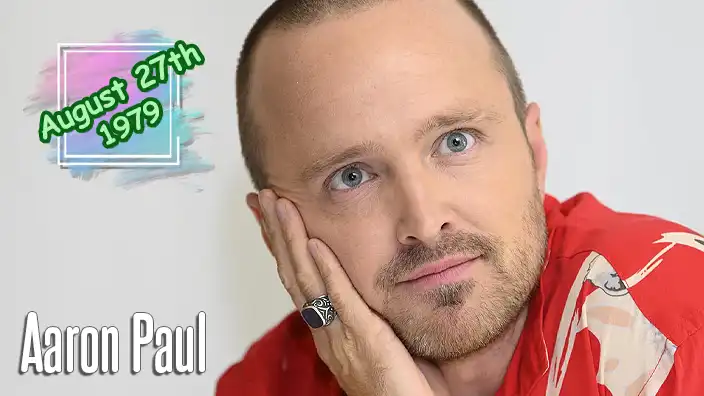
August 27, 1979, in Emmett, Idaho
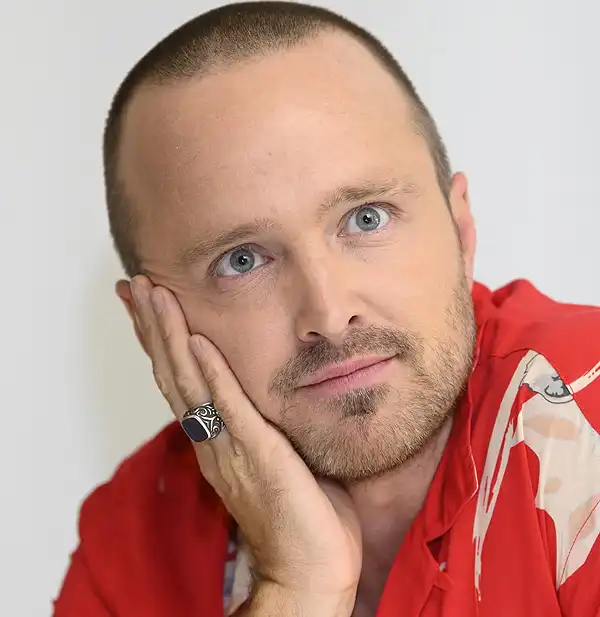
Aaron Paul was born Aaron Paul Sturtevant on August 27, 1979, in Emmett, Idaho, the youngest of four children born to Darla and Robert Sturtevant. His father was a Baptist minister, giving Paul's childhood a background rather far removed from the meth laboratories, drug cartels and morally compromised chemistry teachers that would eventually make him famous. Growing up in a small Idaho community, Paul became interested in performing at an early age and participated in church plays before discovering that acting might offer considerably greater possibilities than simply entertaining the congregation.
Paul attended Centennial High School in Boise, Idaho, and was determined to pursue acting professionally. He graduated early, in 1997, and soon headed for Los Angeles with his mother and a relatively modest amount of money saved for the journey. Like thousands of aspiring actors before him, he arrived with ambition considerably larger than his résumé. Unlike most of them, however, he would eventually become one of the most recognizable television actors of his generation.
His first years in Los Angeles followed the familiar young-actor pattern of auditions, small jobs and persistent uncertainty. Paul competed in an International Modeling and Talent Association competition, where he performed well enough to attract representation. He also worked as an usher at Universal Studios while pursuing acting opportunities, proving that even future Emmy winners sometimes begin their Hollywood careers by helping tourists find their seats.
Paul appeared in television commercials and music videos before gradually accumulating small television roles. Among his early appearances were parts in programs including Beverly Hills, 90210, Melrose Place, 3rd Rock from the Sun, The X-Files, NYPD Blue, ER, CSI: Crime Scene Investigation, Veronica Mars, Criminal Minds and Bones. None made him a household name, but collectively they provided valuable experience and demonstrated the persistence required to survive in an industry where hearing "no" is practically part of the morning routine.
He also appeared in films, including Whatever It Takes in 2000, K-PAX in 2001 and National Lampoon's Van Wilder in 2002. His roles remained relatively small, and for much of the early 2000s Paul was one of those actors audiences might recognize without necessarily knowing his name. That began to change when he secured the recurring role of Scott Quittman on HBO's Big Love, appearing as the boyfriend and eventual husband of Sarah Henrickson, played by Amanda Seyfried.
Then came the audition that changed everything.
In 2008, Paul was cast as Jesse Pinkman in AMC's Breaking Bad, opposite Bryan Cranston as Walter White. Created by Vince Gilligan, the series followed White, a high-school chemistry teacher diagnosed with cancer who begins manufacturing methamphetamine in an attempt to provide financially for his family. Jesse, a former student of Walter's with experience in the drug trade, becomes his reluctant business partner.
On paper, Jesse Pinkman could easily have become little more than comic relief—the reckless young drug dealer constantly getting himself and Walter into trouble. Paul's performance quickly revealed considerably greater possibilities. Beneath Jesse's slang, bravado and frequently spectacular inability to make sensible decisions was a vulnerable young man increasingly horrified by the consequences of the criminal world into which he had wandered.
Remarkably, Jesse was not originally intended to survive throughout the series. Vince Gilligan initially planned to kill the character during the first season. Paul's performance, however, helped convince Gilligan that eliminating Jesse would be a serious mistake. A television character scheduled for an early exit had effectively acted his way out of his own execution.
That turned out rather well for everybody concerned.
Over five seasons, the relationship between Walter White and Jesse Pinkman became the emotional center of Breaking Bad. At various times they functioned as teacher and student, business partners, surrogate father and son, adversaries and unwilling allies. Their relationship became increasingly toxic as Walter manipulated Jesse, while Jesse struggled with addiction, guilt, trauma and the deaths of people around him.
Paul's greatest strength in the role was his ability to make Jesse sympathetic without pretending the character was innocent. Jesse participated in terrible crimes and made disastrous choices, yet Paul allowed audiences to see the frightened, damaged person beneath them. As Walter White gradually became colder and more calculating, Jesse increasingly emerged as the character retaining a functioning conscience.
The performance earned Paul widespread critical acclaim and an impressive collection of awards. He won the Primetime Emmy Award for Outstanding Supporting Actor in a Drama Series three times, in 2010, 2012 and 2014. At the time of his third victory, he became the first actor to win that particular award three times since the category had been separated into drama and comedy divisions.
Paul's chemistry with Bryan Cranston became one of the defining features of the series. Cranston's controlled transformation of Walter White contrasted beautifully with Paul's more openly emotional Jesse. Their arguments could be frightening, heartbreaking and occasionally extremely funny, often within the same scene. Together, they created one of television's most celebrated and dysfunctional partnerships.
Breaking Bad concluded in 2013 after five seasons, with Jesse escaping captivity and driving away toward an uncertain future. The finale provided some hope for the character but deliberately left his fate unresolved. Audiences knew Jesse had survived. What happened next remained another matter entirely.
After Breaking Bad, Paul moved aggressively into film and television rather than attempting to reproduce Jesse Pinkman under another name. In 2014, he starred as street racer Tobey Marshall in the action film Need for Speed, based on the popular video-game franchise. The film gave Paul the opportunity to lead a major studio production while spending a great deal of time around extremely fast automobiles, which is not the worst possible way to recover from five seasons trapped in Albuquerque methamphetamine laboratories.
He appeared in Ridley Scott's biblical epic Exodus: Gods and Kings and later took roles in films including Eye in the Sky, Central Intelligence and Triple 9. These projects demonstrated his willingness to move among action films, thrillers, dramas and comedy rather than allowing the success of one enormously famous television character to dictate the rest of his career.
One of Paul's most notable post-Breaking Bad roles came with Hulu's drama series The Path, which premiered in 2016. He played Eddie Lane, a husband and father involved in a fictional spiritual movement called Meyerism who begins questioning his faith. The role gave Paul another psychologically complicated character, but one considerably removed from Jesse Pinkman's criminal world.
Paul also discovered that he possessed a voice particularly well suited to animated existential despair.
Beginning in 2014, he voiced Todd Chavez in Netflix's animated series BoJack Horseman. Todd initially appeared to be BoJack's cheerful, unemployed houseguest, but the character developed considerably as the series progressed. Paul also served as an executive producer on the acclaimed show. Todd's bizarre adventures and relentlessly optimistic personality provided Paul with a comic role far removed from Jesse, although BoJack Horseman itself was perfectly capable of becoming emotionally devastating without assistance from anyone in Albuquerque.
The Breaking Bad universe eventually called him back.
In 2019, Netflix released El Camino: A Breaking Bad Movie, written and directed by Vince Gilligan. The film began immediately after the events of the television finale and followed Jesse as he attempted to escape law enforcement, deal with the psychological consequences of captivity and build a new life.
This time, Jesse was unquestionably the central character.
Paul carried the film almost entirely on his shoulders, returning to a role he had last played regularly six years earlier. El Camino provided the character with a more complete conclusion, following Jesse's efforts to obtain enough money to disappear and begin again. The film ultimately sent him toward a new life in Alaska, offering a measure of peace after years in which peace had been in extremely short supply.
Paul later reprised Jesse again in the final season of Better Call Saul, appearing alongside Bryan Cranston. Their return connected the prequel series directly with the events of Breaking Bad and gave longtime viewers another opportunity to see Walter White and Jesse Pinkman together. Considering the history of those two characters, "opportunity" may be a safer description than "pleasure."
Paul continued taking substantial television roles outside the Breaking Bad universe. He joined HBO's Westworld in its third season as Caleb Nichols, a construction worker and military veteran who becomes involved with Dolores Abernathy, played by Evan Rachel Wood. The elaborate science-fiction drama provided another major change of scenery, replacing New Mexico deserts and meth labs with artificial intelligence, futuristic technology and the occasional question about whether anybody on screen was actually human.
He has also continued working in film, including appearances in Dual and Charlie Brooker's Black Mirror. His career after Breaking Bad has demonstrated both the advantage and difficulty of creating an iconic character. Jesse Pinkman will probably always be the role most closely associated with Aaron Paul, but Paul has consistently sought projects that allow him to move beyond it rather than simply repeating what made him famous.
Away from acting, Paul married filmmaker and director Lauren Parsekian in 2013. The couple met at the Coachella music festival and later became engaged in Paris. They have two children, daughter Story Annabelle and son Ryden Caspian. Bryan Cranston is Ryden's godfather, meaning the Walter White and Jesse Pinkman connection has survived into real life in a considerably healthier form.
Paul has also been involved in charitable causes, including support for the Kind Campaign, an anti-bullying nonprofit co-founded by Parsekian. His public persona has generally been considerably warmer and more cheerful than many of the damaged characters he has played, which is reassuring because nobody particularly wants to discover that Jesse Pinkman was actually the calm one.
The success of Breaking Bad permanently altered Aaron Paul's career, but it also changed television history. The series became one of the defining dramas of the so-called golden age of television, and Jesse Pinkman became essential to its emotional power. Paul's performance allowed viewers to watch a reckless young criminal gradually become painfully aware of the human cost of the world around him.
There is also something particularly satisfying about the way Paul earned the role's importance. Jesse was not originally designed to become one of television's great dramatic characters. He was supposed to disappear early. Instead, Paul's performance persuaded the creator to rewrite the plan, kept Jesse alive for the entire series and eventually produced three Emmy Awards, a feature-length sequel and appearances in Better Call Saul.
Aaron Paul's journey from a minister's son in small-town Idaho to internationally recognized Emmy winner was hardly an overnight success. It involved years of commercials, guest appearances, auditions and minor roles before Jesse Pinkman arrived. When the opportunity finally came, Paul took a character who could have vanished after a handful of episodes and made audiences care deeply about what happened to him.
For an actor whose most famous character spent years making terrible decisions, Aaron Paul certainly made the most of one very good audition.