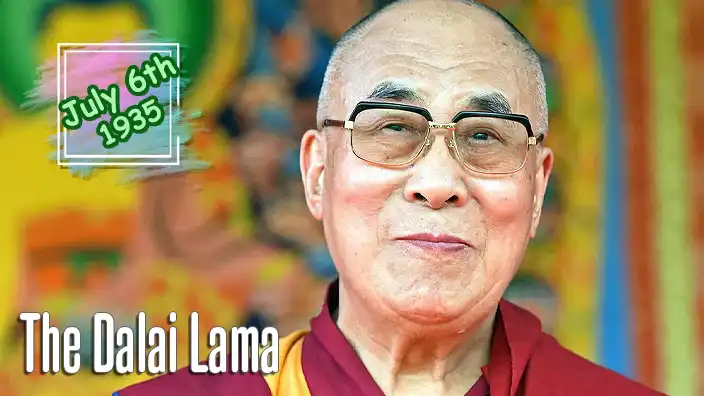
July 6, 1935, in Taktser, Tibet
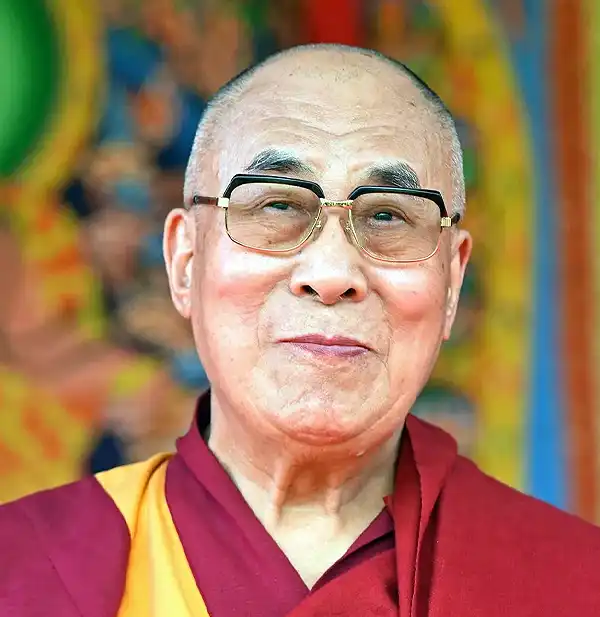
Tenzin Gyatso, the 14th Dalai Lama, was born Lhamo Dhondup in Taktser, a small village in northeastern Tibet. Born into a farming family, he was recognized at the age of two as the reincarnation of the 13th Dalai Lama, Thubten Gyatso. He was later formally enthroned and given the spiritual responsibilities associated with one of Tibetan Buddhism’s most important roles.
As the Dalai Lama, he became both a spiritual figure and, for many years, the temporal leader of the Tibetan people. His early life was shaped by religious education, political upheaval, and the growing conflict between Tibet and China. In 1959, following a failed uprising in Tibet, he fled to India, where he established himself in Dharamshala. That community became the center of the Tibetan government-in-exile and remains closely associated with his life and work.
Over the decades, the Dalai Lama became known internationally for his teachings on compassion, nonviolence, interfaith understanding, and human responsibility. His message has often been simple but demanding: peace begins not merely with treaties and speeches, but with the discipline of the human heart. He has spoken frequently about kindness, education, environmental care, religious harmony, and the need for people to recognize their shared humanity.
In 1989, the Dalai Lama was awarded the Nobel Peace Prize for his nonviolent struggle for the liberation of Tibet. The Nobel Committee also recognized his efforts to seek a peaceful solution based on tolerance and mutual respect. His award brought renewed global attention to Tibet and strengthened his role as an international advocate for peaceful resistance.
Unlike many political figures, the Dalai Lama has repeatedly emphasized that hatred cannot create lasting peace. His approach has been rooted in Buddhist teaching, but his appeal has reached far beyond Buddhism. He has met with religious leaders, scientists, educators, political leaders, and ordinary people around the world, often encouraging dialogue rather than division.
He is also known for his interest in science, particularly the relationship between Buddhist thought and modern research into the mind, consciousness, and human behavior. His conversations with scientists have helped encourage broader discussion about meditation, emotional well-being, and the study of compassion as a serious human concern rather than merely a pleasant slogan.
In 2011, the Dalai Lama formally stepped away from his political role, transferring secular authority to elected Tibetan leadership. This decision marked an important shift in Tibetan governance and reflected his long-stated belief that democratic institutions should guide the Tibetan people’s political future.
Even in advanced age, the Dalai Lama has remained a powerful spiritual presence. His public schedule has become more limited, but his influence continues through teachings, books, recorded talks, public statements, and the devotion of millions of followers around the world. In 2025, as he approached his 90th birthday, he reaffirmed that the institution of the Dalai Lama would continue and stated that the process of recognizing a future successor should remain under the authority of the Gaden Phodrang Trust.
The question of succession remains sensitive because it involves both religious tradition and political pressure. The Dalai Lama has made clear that the future of the institution should be guided by Tibetan Buddhist tradition and the wishes of Tibetan people, not by outside political control. That issue will likely remain one of the most important questions surrounding Tibet in the years ahead.
As the Dalai Lama celebrates his 91st birthday, his life remains closely associated with exile, faith, patience, and moral courage. He has endured the loss of his homeland, carried the hopes of displaced people, and continued to speak about compassion in a world that often seems determined to test the idea. His legacy is not merely that he preached peace, but that he did so consistently, even when peace was difficult.