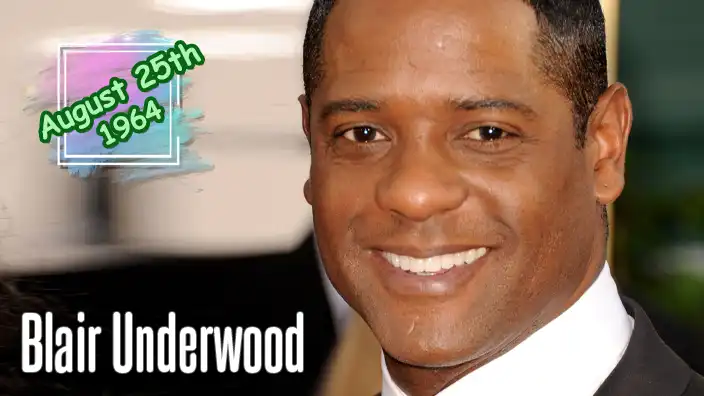
August 25, 1964, in Tacoma, Washington
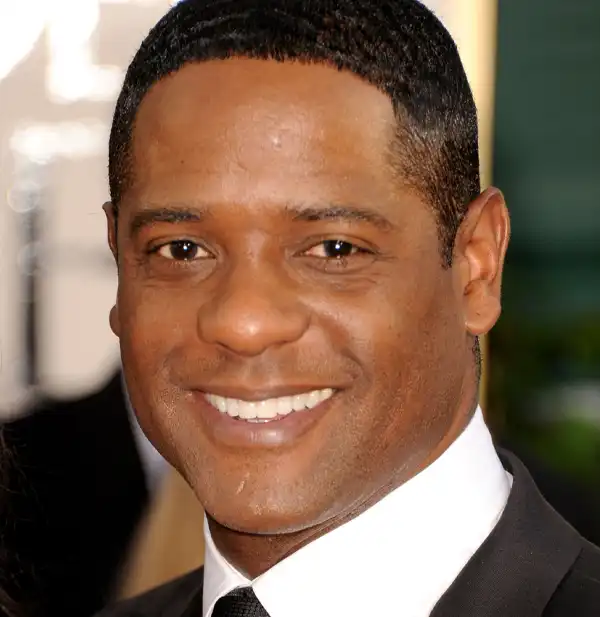
Blair Underwood was born August 25, 1964, in Tacoma, Washington. His childhood was considerably more mobile than that of the average future Hollywood actor because his father, Frank Underwood Sr., was a colonel in the United States Army. The family lived at military bases and communities in the United States and Germany, exposing young Blair to different places and cultures long before acting would require him to inhabit different lives for a living. His mother, Marilyn Ann Scales, worked as an interior decorator.
Underwood graduated from Petersburg High School in Virginia and studied at Carnegie Mellon University's prestigious School of Drama in Pittsburgh. The training provided a serious theatrical foundation for a career that would eventually encompass television, movies and Broadway. He headed into professional acting during the 1980s, when television was about to provide him with a role that changed everything.
One of Underwood's earliest screen appearances came in the 1985 musical film Krush Groove, based loosely upon the early days of Def Jam Recordings. Television work followed, including appearances on Knight Rider and other series, before he landed the role that introduced him to millions of viewers: attorney Jonathan Rollins on NBC's L.A. Law.
Underwood joined L.A. Law in 1987 during the acclaimed legal drama's second season. Jonathan Rollins was a young Harvard-educated attorney entering the prestigious Los Angeles firm of McKenzie, Brackman, Chaney and Kuzak. The role placed Underwood in an ensemble that included Harry Hamlin, Corbin Bernsen, Jimmy Smits, Susan Dey and Jill Eikenberry.
The significance of the character extended beyond another handsome young lawyer joining a successful television drama. Rollins was one of the relatively few prominent Black attorneys regularly portrayed on prime-time American television at the time, and the series gave the character substantial stories involving race, professional ambition, relationships and the legal system. Underwood remained with L.A. Law through 1994, establishing himself as one of the show's most recognizable performers and earning a Golden Globe nomination during his run.
It would have been very easy for Underwood to spend the rest of his career playing Jonathan Rollins under different names. Hollywood does enjoy discovering that an actor does something well and then asking him to do precisely that until retirement. Underwood instead began accumulating roles that steadily widened his range.
During and after L.A. Law, his film work included Set It Off, the 1996 crime drama starring Jada Pinkett Smith, Queen Latifah, Vivica A. Fox and Kimberly Elise. Underwood played Keith Weston, a banker whose relationship with Pinkett Smith's character, Stony, provided an emotional counterpoint to the increasingly desperate circumstances surrounding the film's four central women. The movie developed an enduring following and became one of the notable films of the 1990s featuring a predominantly Black cast.
Underwood also appeared in Steven Spielberg's Amistad in 1997. The historical drama told the story surrounding enslaved Africans who seized control of the Spanish slave ship La Amistad in 1839 and the subsequent American legal battle over their freedom. Underwood portrayed the abolitionist Theodore Joadson, a fictional composite character created for the film, appearing alongside Morgan Freeman, Anthony Hopkins, Djimon Hounsou and Matthew McConaughey.
Television remained a particularly productive home. Underwood starred as Dr. Ben Turner on the CBS medical drama City of Angels, one of American network television's relatively rare medical dramas at the time to feature a predominantly Black cast. He later played school principal Steven Harper in The New Adventures of Old Christine, demonstrating that the intense dramatic actor from L.A. Law was also perfectly capable of handling a sitcom opposite Julia Louis-Dreyfus.
Then there was Sex and the City.
Underwood appeared during the final season as Dr. Robert Leeds, a successful sports medicine doctor who became romantically involved with Miranda Hobbes, played by Cynthia Nixon. Robert was charming, accomplished and handsome, which in the peculiar romantic mathematics of Sex and the City naturally meant that trouble was approaching. Miranda ultimately reunited with Steve Brady, leaving Robert to discover that being a successful doctor apparently offered no immunity from Manhattan relationship complications.
Underwood's television résumé continued growing with roles in Dirty Sexy Money, In Treatment, The Event, Ironside, Agents of S.H.I.E.L.D., Quantico and Dear White People. His ability to move between network dramas, cable productions, streaming series, comedy and genre television became one of the defining characteristics of his career.
His work on HBO's In Treatment was particularly acclaimed. Underwood played Alex Prince, a Navy fighter pilot receiving psychotherapy after a traumatic military mission. The performance earned him a Golden Globe nomination and demonstrated the emotional complexity he could bring to a character whose confidence gradually revealed considerably deeper turmoil.
In Quantico, Underwood joined the ABC thriller as Owen Hall, a CIA officer and instructor, appearing opposite Priyanka Chopra. Marvel audiences subsequently knew him as Dr. Andrew Garner in Agents of S.H.I.E.L.D.—a character whose professional life as a psychologist became considerably more complicated after he transformed into the powerful Inhuman known as Lash. It was another demonstration of Underwood's unusual range: courtroom attorney, therapist, CIA officer and superpowered monster all fit comfortably onto the same résumé.
His film career has been similarly varied. In addition to Set It Off and Amistad, his credits include Deep Impact, Rules of Engagement, Full Frontal, Madea's Family Reunion and Bad Hair. He has also worked extensively as a voice actor, including animated productions and audiobooks, where his distinctive voice has proved nearly as useful as his screen presence.
The stage has always remained important to Underwood as well. He made his Broadway debut in the 2012 revival of Tennessee Williams' A Streetcar Named Desire, taking on the demanding role of Stanley Kowalski. The production featured a predominantly Black cast, with Nicole Ari Parker playing Blanche DuBois. Stanley is about as far removed from polished attorney Jonathan Rollins as a man can travel without requiring a passport, giving Underwood another opportunity to resist comfortable typecasting.
He returned to Broadway in 2020 in A Soldier's Play, Charles Fuller's Pulitzer Prize-winning drama set at a segregated Louisiana Army base during World War II. Underwood played Captain Richard Davenport, the military lawyer investigating the murder of a Black sergeant. The Roundabout Theatre Company production also starred David Alan Grier and became an acclaimed Broadway success, winning the Tony Award for Best Revival of a Play.
Underwood received a Tony Award nomination for Best Performance by an Actor in a Leading Role in a Play for his portrayal of Davenport. For an actor who had already spent decades succeeding in television and film, the nomination was further evidence that his career was never going to be confined comfortably to one medium.
Recognition has followed Underwood throughout his career. In addition to his Golden Globe and Tony nominations, he has received multiple NAACP Image Awards and nominations for his work. The NAACP has repeatedly recognized performances from across his career, reflecting his longstanding position as one of the prominent Black leading actors in American television.
Underwood has also devoted considerable attention to charitable and humanitarian work. Causes involving muscular dystrophy have been particularly important to him because of the disease's effect on his family. He has supported the Muscular Dystrophy Association and has been involved with numerous other charitable organizations and initiatives over the years.
He has also worked behind the camera. Underwood has directing and producing credits and co-authored the Tennyson Hardwick mystery novels with writers Tananarive Due and Steven Barnes. The books feature an actor and former gigolo who becomes involved in criminal investigations—a premise suggesting that merely solving murders wasn't considered enough trouble for one fictional character.
One of the more remarkable things about Underwood's career is how consistently he has worked without becoming trapped by the role that first made him famous. Jonathan Rollins could easily have defined him forever. Instead, L.A. Law became the beginning of a résumé containing romantic comedy, historical drama, science fiction, superhero television, psychological drama, Broadway classics and even the occasional Tyler Perry family gathering.
He has also remained closely associated with the increasing diversity of American television. When Underwood joined L.A. Law in the 1980s, seeing a young Black attorney as a major character in a highly rated network drama carried particular significance. Decades later, his body of work spans an era in which television has changed considerably in who gets to occupy the courtroom, hospital, executive office, intelligence agency and center of the story.
Blair Underwood has accomplished that without relying on a single persona. He can project authority without shouting, charm without becoming lightweight and seriousness without making every character feel identical. More than four decades after his earliest screen appearances, he remains one of those actors whose arrival in a production immediately gives the proceedings a little additional weight.
And should Hollywood ever produce a drama about a lawyer who becomes a doctor, joins the CIA, develops superpowers and then appears on Broadway in the evening, they already know whom to call.