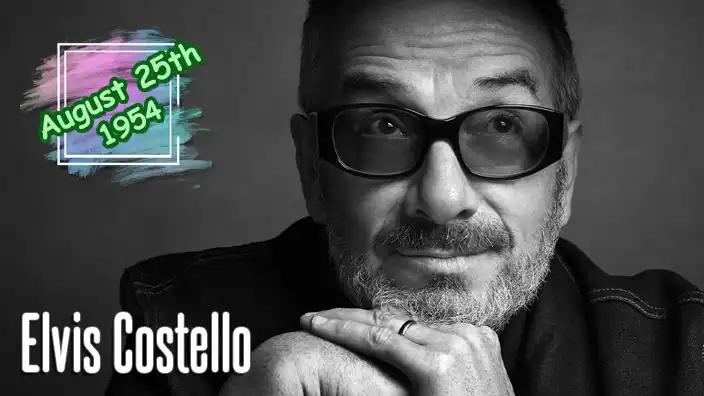
August 25, 1954, in London, England

Elvis Costello was born Declan Patrick MacManus on August 25, 1954, in London, England. Music was hardly foreign territory in the MacManus household. His father, Ross MacManus, was a professional singer who performed with the Joe Loss Orchestra, giving young Declan an unusually close view of the working musician's life. Costello later moved with his mother to the Liverpool area, where he formed a folk duo called Rusty and began developing the songwriting instincts that would eventually make him one of Britain's most respected popular composers.
Music did not immediately pay the bills. Before becoming famous, Costello worked at a number of ordinary jobs, including one as a computer operator. During the first half of the 1970s he continued writing and performing while Britain's pub-rock scene provided an increasingly useful home for musicians who favored direct, energetic performances over the more elaborate rock productions fashionable at the time. His persistence eventually brought him to Stiff Records, the independent British label that signed him in 1976. Around this period, Declan MacManus became Elvis Costello—a stage name sufficiently audacious to guarantee that people would at least remember it.
His debut album, My Aim Is True, arrived in 1977 and immediately established Costello as a distinctive new songwriting voice. Produced by Nick Lowe and recorded with members of the American band Clover, the album included “Alison,” “(The Angels Wanna Wear My) Red Shoes” and “Less Than Zero.” Costello's songs could be melodic and romantic one moment and sharply sarcastic the next, often packing considerably more language into three minutes than seemed strictly necessary. His appearance—short hair, large glasses and an intentionally unfashionable suit—also separated him from the conventional rock-star image.
Costello soon assembled the Attractions, featuring keyboard player Steve Nieve, bassist Bruce Thomas and drummer Pete Thomas. The band provided a harder, faster sound for This Year's Model in 1978, an album containing “Pump It Up” and “Radio Radio.” Costello was frequently grouped with Britain's punk and New Wave movements, and he certainly shared their energy and impatience, but his songwriting drew from a much broader musical education. Pop, soul, rhythm and blues and traditional songcraft were already lurking beneath the sharp edges.
His reputation for unpredictability was reinforced during a notorious 1977 appearance on Saturday Night Live. Costello had been expected to perform “Less Than Zero,” but after beginning the song he abruptly stopped the band and launched instead into “Radio Radio.” The unscheduled substitution reportedly angered the show's producers and became one of the most famous rebellious moments in the program's musical history. It also suited Costello's emerging image perfectly: skinny tie, enormous spectacles and absolutely no apparent interest in behaving himself.
The albums came quickly. Armed Forces appeared in 1979 and included “Accidents Will Happen” and “Oliver's Army,” the latter becoming Costello's biggest UK singles-chart success. Get Happy!! followed in 1980, drawing heavily upon American soul and R&B influences. Rather than settling comfortably into the New Wave category that had helped make him famous, Costello was already demonstrating that musical classification was going to be somebody else's problem.
He made that point particularly clearly with Almost Blue in 1981. Instead of another New Wave record, Costello traveled to Nashville and recorded an album of country songs associated with performers including George Jones and Gram Parsons. The record included “Good Year for the Roses,” which became a UK Top 10 hit. The album reportedly carried a warning that its country-and-western content might cause a strong reaction among narrow-minded listeners—an excellent summary of Costello's approach to genre throughout his career.
Costello continued stretching musically during the 1980s. Imperial Bedroom in 1982 showcased increasingly sophisticated arrangements, while Punch the Clock produced “Everyday I Write the Book,” his first single to reach the American Top 40. By the end of the decade, Spike delivered another of his best-known songs, “Veronica,” co-written with Paul McCartney. Costello and McCartney developed a productive songwriting partnership that also produced material recorded separately by both men.
Collaboration eventually became one of the defining characteristics of Costello's career. He has worked with musicians from remarkably different traditions, including Paul McCartney, Allen Toussaint, The Roots, the Brodsky Quartet and jazz pianist Marian McPartland. He has recorded country music, composed classical works and written songs for films. Johnny Cash, George Jones, Linda Ronstadt, Chet Baker and numerous other performers have recorded songs associated with his catalog.
One particularly important partnership was with legendary composer Burt Bacharach. Their collaboration produced the 1998 album Painted from Memory, pairing Costello's voice and lyrics with Bacharach's sophisticated melodic and orchestral style. “I Still Have That Other Girl” earned them the Grammy Award for Best Pop Collaboration with Vocals. More than two decades later, Costello won another Grammy when his album Look Now received Best Traditional Pop Vocal Album honors. His Grammy record includes nominations spanning rock, alternative music, pop, folk and spoken word, which is about as Elvis Costello as an awards list could possibly get.
Costello and the Attractions were inducted into the Rock & Roll Hall of Fame in 2003, with Elton John performing the induction. The Hall recognized not merely the band's importance during the New Wave era but Costello's extraordinary willingness to move between styles without surrendering his identity as a songwriter. In 2016, he was also inducted into the Songwriters Hall of Fame.
His songwriting also reached Hollywood. Costello and T Bone Burnett co-wrote “The Scarlet Tide” for the 2003 film Cold Mountain. The song earned an Academy Award nomination for Best Original Song, adding Oscar nominee to a résumé already becoming difficult to summarize without running out of commas.
Television and movies have provided another outlet for Costello's dry humor and recognizable appearance. He has appeared as himself or in character in productions including The Simpsons, Frasier, 3rd Rock from the Sun, Austin Powers: The Spy Who Shagged Me and Talladega Nights: The Ballad of Ricky Bobby. He even substituted as host of Late Show with David Letterman in 2003. Later, he hosted Spectacle: Elvis Costello with..., an interview and performance program that allowed him to have lengthy musical conversations with other prominent performers.
Costello added author to his collection of occupations with the publication of his memoir, Unfaithful Music & Disappearing Ink, in 2015. Appropriately, the audiobook subsequently received a Grammy nomination. Even when writing a book, apparently, he found a way of getting it into the recording studio.
His personal life has also connected him closely with music. In 2003, Costello married Canadian jazz singer and pianist Diana Krall. The couple have twin sons. Rather than retiring into nostalgia, Costello has continued recording, performing and experimenting well into the twenty-first century, including work with his longtime collaborators in the Imposters. His 2022 album The Boy Named If received a Grammy nomination for Best Rock Album.
The remarkable thing about Elvis Costello's career is not simply its longevity. Plenty of musicians survive for decades by faithfully repeating the music that originally made them successful. Costello has spent much of his career doing almost the opposite. The young New Wave songwriter responsible for “Pump It Up” could record a country album, collaborate with Burt Bacharach, work with a classical string quartet, write with Paul McCartney and make an album with The Roots without any of those choices seeming entirely out of character.
Through all those musical detours, the songs have remained the center of his reputation. “Alison,” “Watching the Detectives,” “Pump It Up,” “Oliver's Army,” “Everyday I Write the Book” and “Veronica” represent only part of a catalog that has been interpreted by performers from widely different musical traditions.
Elvis Costello arrived during the punk era looking rather like an irritated accountant who had accidentally been handed an electric guitar. Nearly half a century later, that bespectacled young songwriter has become a Rock & Roll Hall of Famer, Songwriters Hall of Fame inductee and Grammy winner whose career refuses to fit comfortably into any single category.
Which is probably exactly how he likes it.