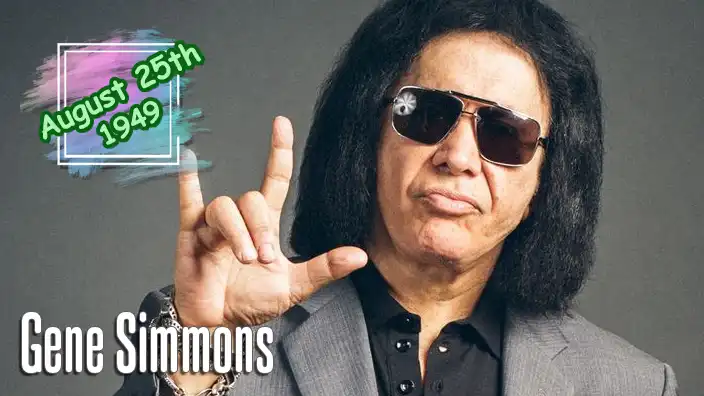
August 25, 1949, in Haifa, Israel
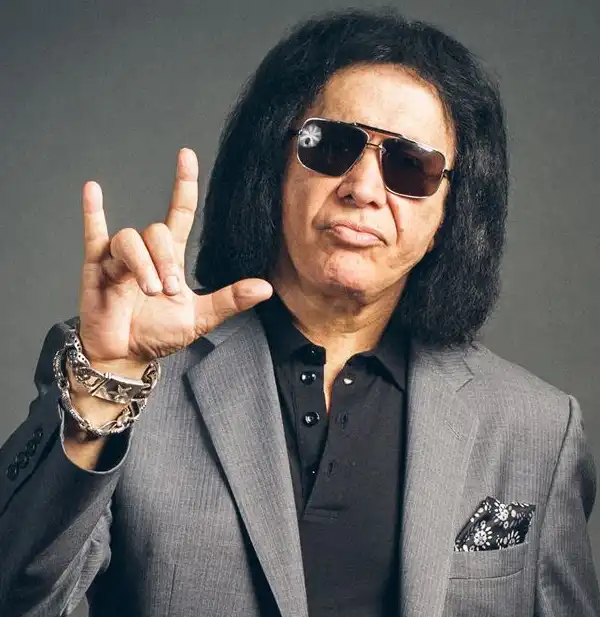
Gene Simmons was born Chaim Witz on August 25, 1949, in Haifa, Israel. His mother, Flóra Klein, was a Hungarian Jewish survivor of the Holocaust, and Simmons has spoken frequently about her influence on his determination and work ethic. He spent his earliest years in Israel before immigrating to the United States with his mother when he was eight. Settling in New York City, he eventually adopted the name Eugene Klein and later became professionally known as Gene Simmons. Long before the makeup, pyrotechnics and enormous boots, he was a young immigrant learning English partly through American popular culture.
Comic books, science fiction and movies fascinated Simmons, but music eventually provided the bigger obsession. The Beatles were particularly influential. Like countless young musicians of his generation, Simmons saw the band's enormous cultural impact and realized that playing music might offer a rather more exciting future than conventional employment. Unlike most of those young musicians, he actually managed to turn that idea into a career lasting more than half a century.
There was, however, a wonderfully unlikely stop along the way. Before becoming the blood-spitting Demon of KISS, Simmons briefly worked as a sixth-grade teacher in Spanish Harlem. The Recording Academy has noted that his unconventional classroom methods reportedly included using Spider-Man comics as teaching material. One imagines parent-teacher night would have become considerably more interesting had everyone known what Mr. Simmons was eventually going to wear to work.
Simmons spent the late 1960s and early 1970s playing in several bands before joining forces with guitarist and singer Paul Stanley. The two performed together in Wicked Lester, but they became dissatisfied with the group's direction. Rather than continue with a project they didn't believe could achieve their ambitions, Simmons and Stanley began building something new. Drummer Peter Criss and guitarist Ace Frehley eventually joined them, and in 1973 KISS was born in New York City. The original lineup of Simmons, Stanley, Criss and Frehley would become one of the most recognizable groups in rock history.
From the beginning, KISS understood that being heard was only half the job. They intended to be seen.
Each member developed an individual stage character. Stanley became the Starchild, Frehley the Spaceman and Criss the Catman. Simmons transformed himself into the Demon, complete with black-and-white makeup, armor-like costumes, towering platform boots and a stage presence apparently designed to convince the audience that something had escaped from a medieval dungeon and learned bass guitar. The Rock & Roll Hall of Fame credits KISS with establishing a remarkably high standard for theatrical rock performances, combining catchy rock music with personas and spectacular presentation.
KISS released its self-titled debut album in 1974, followed quickly by Hotter Than Hell and Dressed to Kill. The early records did not immediately turn the band into superstars, despite an exhausting touring schedule and increasingly elaborate concerts. The breakthrough came with the live album Alive! in 1975. Its energetic version of “Rock and Roll All Nite” helped transform KISS from a struggling theatrical rock band into a major attraction. The song, written by Simmons and Stanley, became the band's signature anthem.
The successful albums then arrived rapidly. Destroyer appeared in 1976, followed by Rock and Roll Over and Love Gun. Songs including “Detroit Rock City,” “Shout It Out Loud,” “Beth,” “Calling Dr. Love,” “Christine Sixteen,” “Love Gun” and “I Was Made for Lovin' You” became staples of the KISS catalog. Simmons provided lead vocals on numerous songs, including “Calling Dr. Love,” “God of Thunder” and “I Love It Loud,” while his bass playing provided a muscular foundation beneath the band's enormous stage production.
And enormous really is the appropriate word.
KISS concerts became famous for fire, explosions, smoke, elevated platforms, flying performers, burning guitars and enough pyrotechnics to make the local fire marshal reconsider his career choices. Simmons developed some of the band's most famous visual moments. During performances he would spit theatrical blood, breathe fire and sometimes rise high above the stage. The Recording Academy's account of a KISS concert describes Simmons breathing fire during “Firehouse,” spitting blood during his bass solo and performing high above the stage lighting rig.
Behind the Demon makeup, however, Simmons was paying close attention to something besides music: business.
KISS became one of rock's great merchandising operations. The band's logo and painted faces appeared on an extraordinary assortment of products, ranging from T-shirts, posters and action figures to comic books and considerably stranger merchandise. Simmons enthusiastically embraced the commercial possibilities of the KISS identity rather than pretending rock musicians were somehow above making money.
That approach occasionally reached magnificent levels of absurdity. Simmons was involved with the infamous KISS Kasket, a KISS-branded coffin that could also be used as a cooler before eventually being required for its more traditional purpose. When Simmons released his massive archival project The Vault, the Recording Academy reported that the collection contained more than 150 songs and came in a safe weighing roughly 38 pounds. One premium option cost $50,000 and included Simmons personally delivering it to the purchaser. Subtlety has rarely troubled the man.
The KISS phenomenon expanded beyond records and concerts during the band's first period of enormous fame. They appeared in comic books and starred in the gloriously peculiar 1978 television movie Kiss Meets the Phantom of the Park. Meanwhile, all four members simultaneously released solo albums in 1978. Simmons' album demonstrated some of his broader musical interests and featured a surprisingly diverse group of guests.
KISS itself underwent numerous lineup changes during the following decades. Criss and Frehley departed, and musicians including Eric Carr, Vinnie Vincent, Bruce Kulick, Eric Singer and Tommy Thayer became part of the band's history. Simmons and Stanley remained the constants, steering KISS through changing musical fashions, the removal of the famous makeup in 1983, its restoration for the original lineup reunion in the 1990s and eventually the band's massive farewell touring era.
The 1983 decision to appear publicly without makeup was particularly dramatic because the identities beneath the KISS faces had once been carefully guarded. For the next decade the band performed without its trademark face paint, enjoying renewed success during the MTV era before the original lineup reunited in makeup in 1996. That reunion was introduced at the Grammy Awards by Tupac Shakur—one of those wonderfully strange moments that could only happen in popular music.
Simmons also pursued acting. His film credits include the 1984 science-fiction thriller Runaway, in which he played the villain opposite Tom Selleck, and the 1986 action film Never Too Young to Die. Over the years he accumulated numerous film and television appearances, frequently playing exaggerated versions of himself or characters that benefited from his naturally intimidating screen presence.
Television eventually introduced another side of Simmons to audiences. Gene Simmons Family Jewels, which premiered in 2006, followed his domestic life with longtime partner Shannon Tweed and their children, Nick and Sophie. Simmons and Tweed had been together for decades before marrying in 2011. The reality series provided a rather different picture from the fire-breathing Demon: family life, business meetings and ordinary domestic disagreements involving a man who happened to have spent his professional life wearing seven-inch boots.
KISS received one of rock music's highest institutional honors in 2014 when the original four members—Simmons, Stanley, Frehley and Criss—were inducted into the Rock & Roll Hall of Fame. Tom Morello of Rage Against the Machine inducted the group. The Hall recognized the band's combination of hard rock, pop craftsmanship and theatrical spectacle, as well as its enormous influence on generations of performers who discovered that putting on a rock concert did not necessarily mean merely standing beside an amplifier.
Simmons has also received Grammy recognition as a member of KISS. The band's “Psycho Circus” was nominated for Best Hard Rock Performance at the 41st Annual Grammy Awards. Despite the band's extraordinary commercial success and longevity, Grammy trophies have not been the primary measure of KISS's influence; their impact is more readily visible in decades of arena rock, theatrical metal and performers who followed their example by treating the concert stage as a place where virtually anything could happen.
Outside KISS, Simmons has remained a prolific entrepreneur, author, speaker and relentless promoter. He has published books, pursued business ventures, worked in television and continued making public appearances. In December 2025, he even appeared before a U.S. Senate Judiciary subcommittee during a hearing concerning compensation for recording artists when their music is played on traditional AM/FM radio. More than 50 years after forming KISS, Simmons was still advocating for the business interests of musicians.
KISS concluded its End of the Road World Tour in December 2023 at Madison Square Garden in New York, bringing the touring career of the band back to the city where it had begun half a century earlier. For Simmons, it closed an extraordinary circle: the immigrant boy who arrived in New York speaking limited English had become one of the most recognizable figures in rock music.
Gene Simmons will always be inseparable from the Demon. The makeup, tongue, fake blood, fire breathing and armor became some of rock's most enduring imagery. Yet concentrating entirely on the spectacle misses the shrewder accomplishment underneath it. Simmons and his bandmates understood very early that KISS was more than four musicians playing songs. It was an experience, an identity and eventually an international brand.
Plenty of bass players have dreamed of becoming rock stars.
Gene Simmons became a rock star, a monster, a businessman, a teacher-turned-fire-breather and the co-founder of a band whose logo ended up on practically everything except, presumably, the kitchen sink.
And if nobody ever manufactured a KISS kitchen sink, Simmons may still have time.