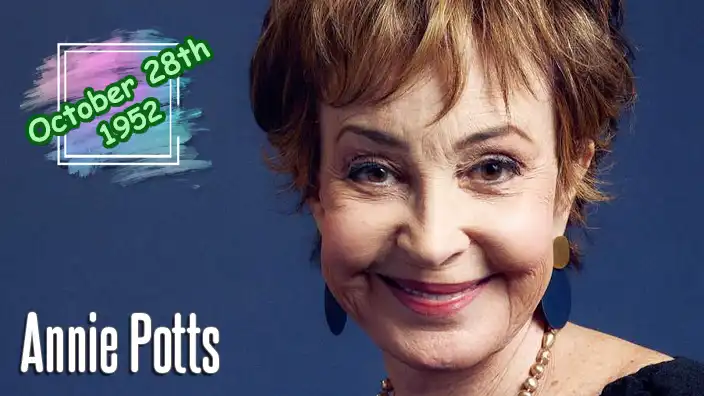
October 28, 1952, in Nashville, Tennessee

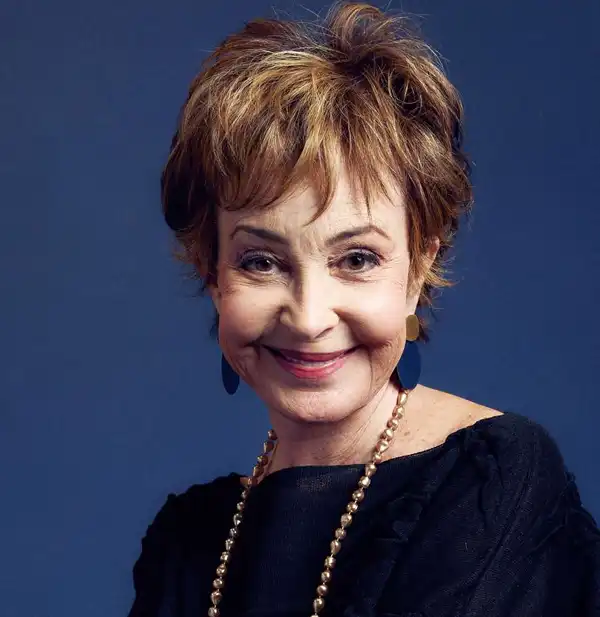
Annie Potts, born Anne Hampton Potts on October 28, 1952, in Nashville, Tennessee, has built a remarkable career as one of America's most versatile and recognizable actresses. Known for her distinctive voice, expressive personality, impeccable comic timing, and ability to bring warmth to even the most sarcastic characters, Potts has entertained audiences across film, television, theater, and animation. Her performances have ranged from eccentric Southern women and sharp-witted receptionists to loving grandmothers and adventurous animated characters. While many performers spend their careers hoping to create one memorable character, Potts has managed to establish several, demonstrating a talent for remaining relevant through changing generations of entertainment.
Although born in Nashville, Annie Potts grew up in Franklin, Kentucky, where she developed an early interest in acting and the performing arts. She was the youngest of three daughters born to Powell Grisette Potts and Dorothy Harris Potts. Her childhood in the American South provided an important foundation for the Southern charm and natural conversational style that would later become recognizable features of her performances. However, Potts was never content simply to rely on regional personality or a pleasant accent. She developed a serious interest in theatrical performance and eventually attended Stephens College in Columbia, Missouri, where she earned a Bachelor of Fine Arts degree in theater. The college's emphasis on performing arts helped prepare her for a professional career that would eventually take her from regional productions to major Hollywood films and nationally successful television series.
Potts' early adulthood included a frightening experience that might have ended her ambitions before her acting career had properly begun. In the early 1970s, she and her first husband, Steven Hartley, were involved in a serious automobile accident that left her with multiple injuries, including fractures affecting her legs. Her recovery required considerable determination and rehabilitation, but she eventually resumed her pursuit of acting. The experience became part of her personal history, illustrating the resilience that would help sustain her through the inevitable uncertainties of an entertainment career. Hollywood is notoriously difficult to enter even under ideal circumstances, and recovering from serious physical injuries before establishing a professional reputation hardly made the challenge any easier.
Annie Potts made her feature film debut in the 1978 comedy Corvette Summer, starring opposite Mark Hamill, who was already internationally famous for portraying Luke Skywalker in Star Wars. In the film, Potts played Vanessa, a spirited young woman who becomes involved in an adventure surrounding a stolen customized Chevrolet Corvette. Her lively performance attracted immediate attention and earned her a Golden Globe nomination for New Star of the Year in a Motion Picture – Actress. The film introduced audiences to the engaging screen personality that would become her trademark, combining confidence, humor, and an ability to make unconventional characters seem believable. For an actress beginning her movie career alongside a performer associated with one of cinema's biggest science-fiction franchises, Potts demonstrated that she had no intention of being overshadowed by someone who had already saved the galaxy.
During the late 1970s and early 1980s, Potts continued establishing herself through film and television appearances. She starred in the short-lived television comedy Goodtime Girls in 1980 and appeared in the romantic comedy Heartaches (1981), for which she received a Genie Award for Best Performance by a Foreign Actress. These early projects helped demonstrate her versatility and ability to handle both comedy and emotionally demanding material. Although she had not yet achieved widespread household recognition, casting directors and filmmakers increasingly recognized her talent for portraying intelligent, independent women whose personalities were often more memorable than the situations surrounding them.
Her major breakthrough arrived in 1984 with Ivan Reitman's supernatural comedy Ghostbusters, one of the most successful and influential comedies of the decade. Potts portrayed Janine Melnitz, the sharp-tongued receptionist employed by a group of eccentric scientists who establish a paranormal investigation and extermination business in New York City. Working alongside Bill Murray, Dan Aykroyd, Harold Ramis, Ernie Hudson, and Sigourney Weaver, Potts created a character whose dry humor and unimpressed attitude provided a perfect counterbalance to the increasingly ridiculous events unfolding around her. Janine's distinctive New York accent, oversized glasses, and matter-of-fact responses to supernatural emergencies quickly made her a fan favorite. While the Ghostbusters were busy confronting ghosts, demons, and the occasional enormous marshmallow creature, Janine remained the person most likely to remind them that somebody still needed to answer the telephone.
The enormous popularity of Ghostbusters established Potts as a recognizable figure in American popular culture. The film became a major box-office success and developed an enduring following through television broadcasts, home video, merchandise, and subsequent franchise productions. Potts' portrayal of Janine demonstrated the effectiveness of supporting characters who contribute personality and humor without dominating the central storyline. She returned for Ghostbusters II in 1989, once again portraying the receptionist who had somehow remained employed despite the unusual occupational hazards associated with the business. Her continued association with the franchise eventually extended into later productions, including Ghostbusters (2016), in which she made a cameo appearance as a hotel desk clerk, Ghostbusters: Afterlife (2021), and Ghostbusters: Frozen Empire (2024), where she returned as Janine Melnitz.
Potts also appeared in the critically acclaimed 1986 romantic drama Pretty in Pink, directed by Howard Deutch and written by John Hughes. She portrayed Iona, the eccentric and supportive record-store manager who becomes an important friend and confidante to Andie Walsh, played by Molly Ringwald. Iona's colorful wardrobe, unconventional personality, and willingness to offer advice made her one of the film's most memorable supporting characters. Potts brought humor and emotional warmth to the role, portraying a woman who understood the challenges of adolescence while maintaining an entertaining disregard for conventional expectations. The film became an enduring favorite among audiences who appreciated its exploration of teenage relationships, social divisions, and the complicated business of growing up. Potts' performance also demonstrated that a supporting character could become unforgettable simply by offering excellent advice while wearing an extraordinary collection of clothes.
In 1986, Annie Potts began one of the most important chapters of her television career when she joined the CBS sitcom Designing Women. Created by Linda Bloodworth-Thomason, the series followed four women working at an interior design business in Atlanta, Georgia. Potts portrayed Mary Jo Shively, a divorced mother and designer whose practical intelligence, emotional vulnerability, and increasingly confident personality made her an essential member of the ensemble. She starred alongside Dixie Carter as Julia Sugarbaker, Delta Burke as Suzanne Sugarbaker, and Jean Smart as Charlene Frazier Stillfield. The show's combination of Southern humor, strong female friendships, social commentary, and sharp dialogue helped distinguish it from other television comedies of the period.
Designing Women ran from 1986 to 1993, becoming one of the most recognizable American sitcoms of its era. Potts appeared throughout the show's seven-season run, portraying Mary Jo as a woman navigating motherhood, divorce, professional responsibilities, and romantic relationships while gradually developing greater confidence in her own abilities. The series frequently addressed social issues, including sexism, discrimination, relationships, and women's independence, often incorporating serious subjects into otherwise humorous storylines. Potts' ability to shift naturally between comedy and drama made her particularly effective in these episodes. Although Julia Sugarbaker often delivered the show's most theatrical speeches, Mary Jo provided an equally important perspective through her practical observations, emotional honesty, and occasional willingness to tell everyone else that they were behaving like complete fools.
The popularity of Designing Women helped establish Potts as a major television personality, but she continued exploring other opportunities throughout the 1990s. She starred in the CBS sitcom Love & War from 1993 to 1995, portraying Dana Palladino, a strong-willed restaurant owner whose relationship with a sportswriter provided the foundation for the show's romantic comedy. Her performance earned a Primetime Emmy Award nomination for Outstanding Lead Actress in a Comedy Series in 1994. Although the series did not achieve the longevity of Designing Women, it demonstrated Potts' ability to carry a television comedy as a central performer rather than relying exclusively on an ensemble cast.
Another significant television role arrived in 1998 when Potts began starring in Any Day Now, a Lifetime drama series exploring the lifelong friendship between two women who grew up in Birmingham, Alabama, during the civil rights era. Potts portrayed Mary Elizabeth "M.E." Sims, while Lorraine Toussaint played her childhood friend Rene Jackson. The series examined race relations, family relationships, personal identity, and the lasting effects of segregation through stories alternating between the women's childhood experiences and their adult lives. Potts delivered a nuanced performance that combined humor, emotional vulnerability, and an honest examination of difficult social issues. The series ran until 2002 and earned recognition for its willingness to address complicated historical and contemporary subjects through the perspectives of two women whose friendship endured despite significant differences in their experiences.
While her live-action performances brought Potts widespread recognition, her voice acting introduced her to an entirely new generation of audiences. In 1995, she voiced Bo Peep in Pixar's groundbreaking animated feature Toy Story, portraying the porcelain shepherdess who serves as a romantic interest for Woody, voiced by Tom Hanks. Her warm, playful performance helped establish Bo Peep as a memorable member of the film's ensemble of living toys. Toy Story became a landmark in animation history as the first feature-length film created entirely with computer-generated imagery, launching one of Disney and Pixar's most successful franchises. Potts returned as Bo Peep in Toy Story 2 (1999), continuing the character's affectionate relationship with Woody and demonstrating that even a porcelain shepherdess could possess considerably more romantic confidence than the average cowboy.
After an extended absence from the franchise, Bo Peep returned as a central character in Toy Story 4 (2019), with Potts once again providing her voice. This time, the character had undergone a substantial transformation, becoming an independent and adventurous lost toy who preferred exploring the wider world to remaining on a child's bedroom shelf. Potts embraced the updated interpretation, bringing greater confidence, humor, and determination to a character who had originally played a relatively small supporting role. The film became another major success for Pixar and introduced Bo Peep to younger audiences as a resourceful figure capable of leading her own adventures. The transformation also offered a rather encouraging message about personal reinvention: even after spending years as a decorative lamp accessory, it is apparently possible to embark on an exciting new career.
Potts continued appearing in television productions throughout the 2000s and 2010s, maintaining a steady presence in an industry where long-term success can be difficult to sustain. She portrayed Sophie Devereaux in the NBC drama Law & Order: Special Victims Unit and appeared in series including Joan of Arcadia, Ugly Betty, Two and a Half Men, Grey's Anatomy, and The Fosters. She also played Gigi Stopper in the ABC drama GCB (2012), a comedy-drama centered on the complicated social lives of women in an affluent Dallas community. These appearances allowed Potts to explore different characters and television formats, demonstrating her adaptability as the entertainment industry evolved from traditional network programming toward an increasingly diverse range of productions.
In addition to her screen work, Potts maintained a connection to theater, the discipline that originally inspired her acting ambitions. She appeared in stage productions and made her Broadway debut in the 2014 revival of Pippin, playing Berthe, the title character's spirited grandmother. The production gave her an opportunity to combine acting, music, and physical comedy in a theatrical setting, showcasing talents that television audiences had not always seen. Her performance reflected the energy and enthusiasm that had characterized her career from its earliest stages. Broadway also presented a particularly appropriate challenge for an actress who had spent decades playing memorable women with strong opinions, since Berthe is hardly a grandmother inclined to sit quietly in a rocking chair and discuss the weather.
One of Annie Potts' most beloved later television roles began in 2017 when she joined the CBS comedy Young Sheldon, a prequel to the enormously successful sitcom The Big Bang Theory. Potts portrayed Constance "Connie" Tucker, affectionately known as Meemaw, the maternal grandmother of young Sheldon Cooper, played by Iain Armitage. Set in East Texas during the late 1980s and early 1990s, the series explored Sheldon's childhood as an exceptionally intelligent boy growing up in a family that frequently struggled to understand his unusual personality and extraordinary academic abilities. Meemaw quickly became one of the show's most popular characters, combining affection for her grandchildren with a rebellious streak, sharp humor, and a willingness to challenge conventional expectations.
Potts' portrayal of Meemaw gave Young Sheldon an important source of warmth and comic energy. Unlike some members of Sheldon's family, Connie generally accepted her grandson's unusual interests and intellectual abilities without demanding that he behave like an ordinary child. However, her affection rarely prevented her from delivering a sarcastic observation or reminding Sheldon that intelligence did not automatically make him right about everything. Her relationships with daughter Mary Cooper, played by Zoe Perry, and grandchildren Sheldon, Missy, and Georgie provided opportunities for both humor and emotionally meaningful storytelling. Connie's romantic relationships, gambling interests, business ventures, and occasional questionable decisions also gave the character an independent identity beyond her responsibilities as a grandmother. She was, in short, the sort of grandmother who might bake cookies for the children and then head out for an evening that required a lawyer.
The character of Meemaw had previously been portrayed by June Squibb in an episode of The Big Bang Theory, but Potts developed her own interpretation for the prequel series. Her version of Connie became a central part of the Cooper family dynamic, offering a contrast to Mary's religious convictions and Sheldon's rigid attachment to logic and scientific reasoning. Potts brought emotional depth to the character, particularly during storylines involving family difficulties, romantic disappointments, and the challenges of raising children and grandchildren in a changing world. Her performance helped make Meemaw much more than a conventional sitcom grandmother, creating a character whose flaws, independence, and affection made her feel believable and thoroughly human.
Young Sheldon concluded in 2024 after seven seasons, bringing an emotional conclusion to the Cooper family's story. Potts remained a central cast member throughout the series, contributing to its popularity and its successful combination of family comedy and more serious dramatic themes. The show's final season explored significant changes within the Cooper family, including the death of Sheldon's father, George Cooper Sr., portrayed by Lance Barber. Potts' performance during these emotional episodes demonstrated her ability to move seamlessly between humor and grief, reminding audiences that the best television comedies often succeed because viewers genuinely care about the people behind the jokes. Her portrayal of Meemaw became one of the defining performances of her later career, introducing her talents to viewers who might never have seen Designing Women or the original Ghostbusters.
The success of Young Sheldon also highlighted the remarkable longevity of Potts' career. Few performers manage to become closely associated with successful productions across several different decades, particularly when those projects appeal to substantially different audiences. Potts achieved that distinction through Ghostbusters in the 1980s, Designing Women during the late 1980s and early 1990s, Toy Story beginning in the 1990s, and Young Sheldon in the twenty-first century. Each role required a different combination of humor, emotional expression, and character development, yet all benefited from her recognizable ability to deliver dialogue with natural timing and personality. Her career demonstrates that lasting success in entertainment often depends less on chasing celebrity trends than on consistently delivering memorable performances.
Outside her professional achievements, Annie Potts has experienced a busy family life. She has been married to television director and producer James Hayman since 1990, and she is the mother of three sons. Her earlier marriages were to Steven Hartley and Greg Antonacci. Despite maintaining a successful entertainment career, Potts has spoken about the importance of family relationships and balancing professional commitments with her responsibilities as a mother. Her experiences raising children and navigating family life have also informed her performances as maternal figures, particularly in Young Sheldon, where Connie's affection for her family is often expressed through teasing, practical assistance, and occasionally rather questionable advice.
Potts has also supported charitable causes and community organizations, including efforts connected to children's welfare, education, and the arts. Her professional background and theatrical training have contributed to her appreciation for arts education and opportunities that encourage young performers to develop their abilities. Throughout her career, she has participated in public appearances, interviews, and events celebrating the productions that made her famous, maintaining a warm relationship with audiences who have followed her work for decades. Her continuing popularity at fan conventions and entertainment events reflects the lasting cultural impact of characters such as Janine Melnitz and Bo Peep.
One of the most distinctive qualities of Annie Potts' acting is her ability to portray women who possess strong personalities without becoming caricatures. Her characters frequently display independence, intelligence, and a willingness to challenge authority, but they also reveal vulnerability, affection, and emotional complexity. Janine Melnitz could deliver a sarcastic remark while keeping a supernatural extermination business organized, Mary Jo Shively could navigate difficult family circumstances while maintaining her sense of humor, and Meemaw could love her grandchildren fiercely while occasionally behaving like the most irresponsible adult in East Texas. Potts approaches these characters with a combination of realism and comedy that makes their personalities entertaining without sacrificing their humanity.
Her contributions to animation are equally significant. As the voice of Bo Peep, Potts helped bring personality and emotional warmth to one of the most influential animated franchises in cinema history. Voice acting requires performers to communicate emotion, humor, and character development without relying on facial expressions or physical gestures visible to the audience. Potts' distinctive vocal qualities and precise delivery made her particularly well suited to this challenge. Her return to the character in Toy Story 4 demonstrated the continuing value of experienced performers in animated storytelling, where familiar voices can help connect different generations of viewers.
Annie Potts has also benefited from an unusual professional advantage: her ability to remain memorable even when surrounded by large ensemble casts. In Ghostbusters, she shared the screen with several established comedy stars, yet Janine became one of the franchise's most recognizable supporting characters. In Designing Women, she held her own alongside performers known for powerful personalities and elaborate comic speeches. In Young Sheldon, she brought balance to a family ensemble centered on an exceptionally unusual child. This talent for making supporting characters essential to a production has been a consistent feature of her success, demonstrating that an actress does not always need the largest role to make the strongest impression.
From her early breakthrough in Corvette Summer to her enduring popularity as Meemaw in Young Sheldon, Annie Potts has established herself as a performer whose appeal crosses generations. Her work in film, television, theater, and animation reflects an impressive combination of versatility, dedication, and natural comic ability. She has portrayed memorable characters in some of America's most recognizable entertainment franchises while maintaining the warmth and authenticity that first attracted audiences to her performances. Whether answering the Ghostbusters' telephone, offering advice in a record store, navigating the complicated friendships of Designing Women, or keeping young Sheldon Cooper from becoming entirely impossible, Potts has consistently demonstrated that intelligence and humor make an exceptionally entertaining combination.
Annie Potts' remarkable career illustrates the lasting importance of character actors who bring individuality and emotional depth to every production. Her performances have helped shape beloved films and television programs, while her distinctive personality has ensured that audiences remember her characters long after the final credits. Hollywood may continually search for its next major star, but performers with Potts' versatility and enduring appeal are considerably harder to replace. After decades of entertaining audiences, she remains a familiar and welcome presence on screen, proving that a well-delivered sarcastic remark, a generous heart, and impeccable timing can be just as effective as any Hollywood special effect.