September 29, 1942, in Blackburn, England
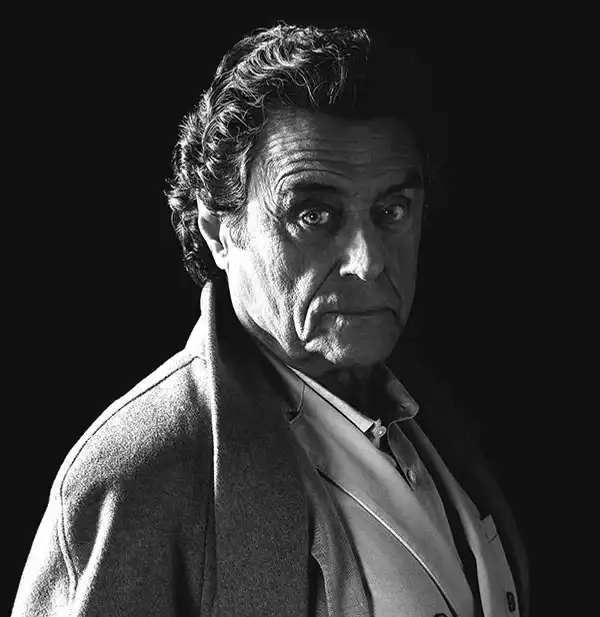
Ian David McShane was born on September 29, 1942, in Blackburn, Lancashire, England, and grew up around Manchester. His father, Harry McShane, was a professional footballer whose career included spells with Blackburn Rovers, Bolton Wanderers and Manchester United before he later became a football scout. Young Ian briefly considered football himself, but acting ultimately proved the stronger attraction. According to IMDb, a broken leg helped steer him toward performing when he became involved in a school production of Cyrano de Bergerac, an accident that proved unusually productive for British television and considerably less so for whatever football team had expected him to turn up.
McShane gained early experience with the National Youth Theatre before studying at the Royal Academy of Dramatic Art. His contemporaries at RADA included John Hurt, who became a lifelong friend, and Anthony Hopkins. McShane did not wait around for graduation before beginning his screen career. He left RADA shortly before completing his studies after being cast in The Wild and the Willing, released in 1962. It was the beginning of a professional career that would eventually encompass well over a hundred acting credits across film and television, along with work as a producer, director and voice performer.
During the 1960s, McShane established himself as a handsome young leading man in British film and television. His credits accumulated steadily rather than through one sudden breakthrough, allowing him to move among contemporary dramas, historical productions and television series. Films including The Battle of Britain and If It's Tuesday, This Must Be Belgium contributed to a career that increasingly demonstrated his usefulness as both a leading man and character actor. Television offered even more opportunities, and McShane gradually developed the screen presence that would eventually make morally questionable characters something of a specialty.
One particularly important performance came in the 1978 television miniseries Disraeli, in which McShane portrayed Benjamin Disraeli, the flamboyant novelist, politician and future British prime minister. The role allowed him to move beyond the romantic-leading-man image associated with some of his earlier work and demonstrated that he could carry a substantial historical drama. By this stage, McShane was moving naturally into the character roles that would ultimately produce some of his most memorable performances. IMDb notes that his career had progressed from romantic leads into increasingly substantial character parts by the late 1970s.
For British television audiences, however, one character would come to define McShane for years: Lovejoy. Based on the novels by Jonathan Gash, Lovejoy first appeared on British television in 1986 before returning for an extended run between 1991 and 1994. McShane played the title character, an East Anglian antiques dealer blessed with an extraordinary ability to recognize genuine antiques and an equally impressive willingness to operate somewhere in the broad geographical region between respectable commerce and cheerful skulduggery.
Lovejoy was a "divvie," someone possessing an instinctive ability to recognize valuable and authentic objects. He was charming, clever, perpetually short of money and usually involved in a scheme that might technically have been legal if viewed from sufficient distance. McShane's charisma made the character enormously appealing. Lovejoy could manipulate buyers, sellers, rivals and friends while maintaining the air of a man who considered the entire antiques business one enormous game and couldn't understand why everyone else took the rules so seriously.
The series became a major British television success. IMDb records that its later run attracted audiences as large as 18 million viewers, making McShane one of British television's most recognizable performers. His involvement went considerably beyond playing the title character: he also produced the series and directed several episodes. For years afterward, Lovejoy remained so strongly associated with McShane that IMDb even lists "Lovejoy" among his nicknames.
McShane continued working extensively after Lovejoy, but the role that transformed his international reputation arrived in 2004. HBO's Deadwood, created by David Milch, dramatized the notoriously lawless South Dakota settlement during the 1870s. At the center of much of its intrigue stood Al Swearengen, proprietor of the Gem Saloon, brothel keeper, political operator, criminal and a man whose vocabulary could have caused structural damage to the average Victorian drawing room.
McShane's Swearengen was far more complicated than a conventional Western villain. He could be vicious, manipulative and murderous, yet also intelligent, pragmatic, darkly funny and occasionally capable of actions suggesting that somewhere beneath several geological layers of profanity and self-interest there remained a human being. McShane delivered Milch's elaborate dialogue with extraordinary control, turning long speeches into performances that could move from comedy to menace almost without warning.
Deadwood ran for three seasons and 36 episodes from 2004 through 2006. McShane's performance brought him the 2005 Golden Globe Award for Best Performance by an Actor in a Television Series – Drama, along with Emmy and Screen Actors Guild nominations. He also received the Television Critics Association Award for Individual Achievement in Drama for the show's first season. The role transformed him from a performer familiar particularly to British audiences into an internationally recognized character actor.
More than a decade after the original series ended, McShane returned to the character in Deadwood: The Movie in 2019. The film reunited much of the surviving cast and provided an opportunity to revisit characters whose stories had ended abruptly when the television series was canceled. McShane has described his original years playing Swearengen as among the most creatively satisfying of his career, making his return to Deadwood considerably more than an exercise in nostalgia.
His post-Deadwood career became remarkably busy. McShane appeared as Blackbeard in Pirates of the Caribbean: On Stranger Tides, bringing his established talent for dangerous charm to one of piracy's most famous names. He appeared as King Brahmwell in Jack the Giant Slayer, played King Silas Benjamin in the ambitious television drama Kings, portrayed the scheming Bishop Waleran Bigod in The Pillars of the Earth, and appeared in projects including Ray Donovan, American Horror Story and Game of Thrones. His performance in The Pillars of the Earth earned another Golden Globe nomination.
McShane's unmistakable voice also created a substantial parallel career in animation. He voiced the villainous snow leopard Tai Lung in Kung Fu Panda, Captain Hook in Shrek the Third and Mr. Bobinsky in Coraline. He later returned as Tai Lung in Kung Fu Panda 4. Long before those animated roles, producer Trevor Horn had recruited McShane to provide narration for Grace Jones's 1985 album Slave to the Rhythm. According to McShane's IMDb biography, Horn's reasoning was wonderfully straightforward: Orson Welles was unavailable on account of being dead, and he needed a voice. McShane evidently qualified.
Another career-defining role arrived in 2014 with John Wick. McShane played Winston Scott, the urbane manager of New York's Continental Hotel, an establishment catering exclusively to the criminal underworld and operating according to strict rules. Winston could offer a drink, deliver a warning or order someone's execution with approximately the same level of courteous professionalism. In a franchise populated by assassins capable of dispatching rooms full of opponents, McShane demonstrated that sitting quietly in a beautifully tailored suit could be equally intimidating.
Winston became increasingly important as the John Wick mythology expanded. McShane returned for John Wick: Chapter 2, John Wick: Chapter 3 – Parabellum and John Wick: Chapter 4, appearing alongside Keanu Reeves throughout the enormously successful action franchise. He reprised Winston again in Ballerina, the franchise spinoff starring Ana de Armas. Across the films, Winston developed from an intriguing supporting character into one of the principal guardians and interpreters of the elaborate rules governing Wick's underworld.
Television provided McShane with another memorably devious character in American Gods, adapted from Neil Gaiman's novel. McShane played Mr. Wednesday, a charismatic con man who recruits Shadow Moon, played by Ricky Whittle, into a mysterious journey across America. Wednesday eventually reveals himself as Odin, the Norse god attempting to rally the Old Gods against a new generation of deities representing modern obsessions such as technology and media.
McShane also served as an executive producer on American Gods, giving him a significant role behind the scenes as well as in front of the camera. Mr. Wednesday was almost perfectly suited to his established screen persona: charming, eloquent, funny, manipulative, dangerous and never entirely trustworthy. If Al Swearengen had somehow acquired divine powers and a better suit, there might have been a family resemblance.
Even after decades of constant work, McShane has continued taking leading roles rather than simply appearing for distinguished cameos. In the 2024 film American Star, which he also executive produced, he played Wilson, an aging assassin sent to the island of Fuerteventura for an assignment. When circumstances delay the planned killing, Wilson becomes increasingly absorbed by the island and the people he encounters. The restrained role gave McShane another opportunity to explore the sort of dangerous man he has played many times while stripping away much of the flamboyance associated with characters such as Swearengen and Wednesday.
His later screen work has continued to demonstrate an impressive refusal to settle into retirement mode. He appeared in the 2025 John Wick spinoff Ballerina and in the British crime comedy Deep Cover, adding still more entries to a screen career that began when black-and-white television was commonplace and has continued into the era of streaming franchises and digital effects. IMDb lists his professional screen career as dating back to 1962 and credits him not merely as an actor but also as a producer and director.
One reason for McShane's remarkable longevity may be his willingness to embrace character roles rather than struggle against them. The handsome young leading man gradually became a rogue, villain, king, gangster, pirate and criminal mastermind, and the older he became, the more interesting the parts seemed to get. His calm, rasping voice became one of his recognizable trademarks, as did his ability to suggest that a character was thinking several unpleasant moves ahead while everyone else was still learning the rules.
McShane also possesses an unusually broad range within that familiar territory. Lovejoy is dishonest but lovable. Swearengen is brutal yet capable of surprising humanity. Winston is courteous but potentially lethal. Mr. Wednesday can make outrageous deception seem like friendly conversation. Even Tai Lung, an animated snow leopard, receives from McShane enough wounded pride and menace to become something more interesting than a conventional children's-film villain.
That talent for finding complexity inside dubious characters has made Ian McShane one of Britain's most distinctive screen performers. He has worked continuously through changing fashions in film and television, moving from British dramas and historical productions to enormously popular television series and international movie franchises without losing the qualities that made him recognizable in the first place.
For some viewers, Ian McShane will forever be Lovejoy, strolling through East Anglia looking for an undervalued antique and an overvalued customer. For others he will always be Al Swearengen, ruling the Gem Saloon with whiskey, intelligence and an astonishing command of profanity. Another generation knows him as Winston, calmly explaining the rules of the Continental while John Wick prepares to break several of them. That is quite a collection of rogues for one career—and McShane has somehow made every one of them seem like a man you might enjoy having a drink with, provided you remembered where the nearest exit was.